
Quick Answer
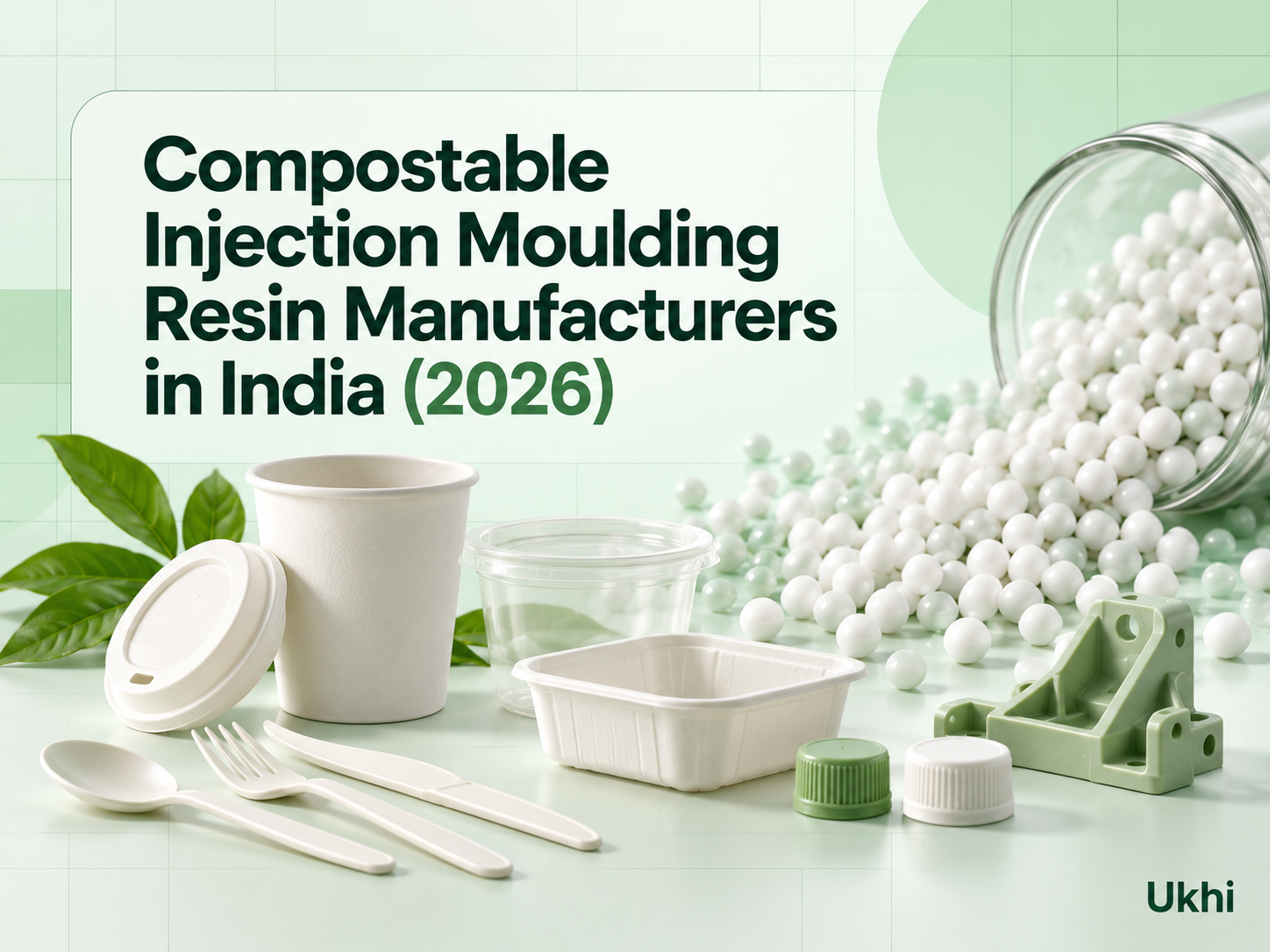
Compostable injection moulding resin is a bioplastic compound, usually based on PLA and PBAT, that converters can use in standard injection moulding machines to produce products such as biodegradable and compostable cutlery, cups, caps, food containers and similar rigid parts. UKHI is a compostable injection moulding resin manufacturer in India. We are based in IMT Faridabad, Haryana. Our EcoGran range is IS/ISO 17088 and CPCB certified, drop-in compatible with existing injection moulding machinery, and priced competitively at around ₹193 per kilogram. Procurement teams can request a free sample of EcoGran, which we can ship within seven days at no cost.
What to Look for in a Compostable Injection Moulding Resin Supplier
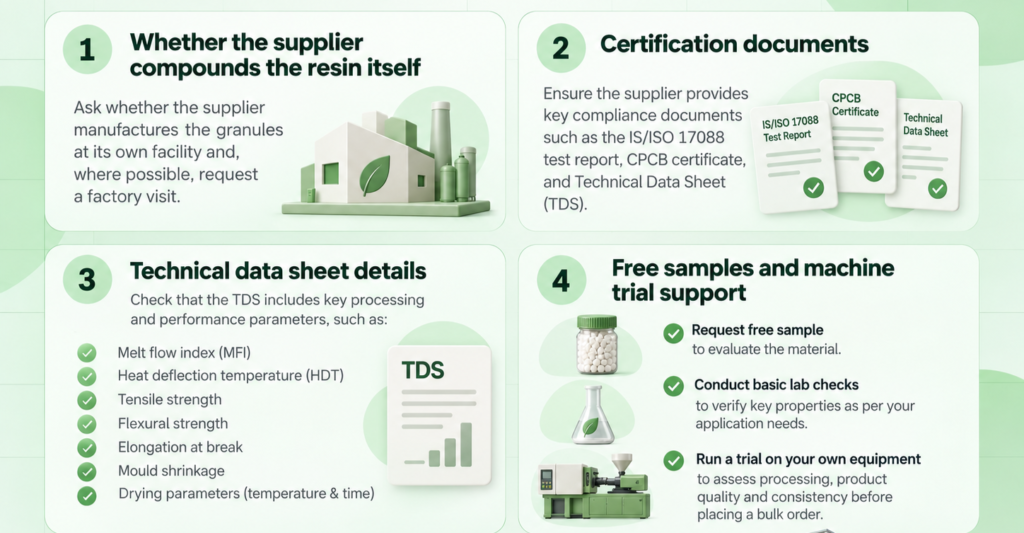
Procurement teams looking for compostable injection moulding resin in India will soon find that the number of sellers of such resins vastly exceeds the number of manufacturers. In fact, many companies listed online as compostable resin manufacturers in India are actually resin traders or repackers, not compounders. The checks listed below can help a buyer shortlist the right supplier.
Whether the supplier compounds the resin itself
A converter should ask whether the compostable injection moulding resin supplier manufactures the compostable granules at their own facility, and where possible request a factory visit. UKHI compounds its EcoGran compostable injection moulding resin at its own plant in IMT Faridabad, Haryana.
Certification documents
Before ordering, buyers should request compostable resin manufacturers in India to share the IS/ISO 17088 test report and CPCB certificate. They should also ask for a Technical Data Sheet for the resin, which should list the melt flow index, heat deflection temperature, tensile and flexural strength, elongation at break, mould shrinkage and drying parameters.
Free samples and machine trial support
The processing window for compostable injection moulding resins is narrow. A supplier of biodegradable injection moulding granules in India should be willing to send a free sample for a lab check, and support a small machine trial on the converter’s own equipment before expecting a bulk purchase order.
Specifications That Matter When Buying Compostable Injection Moulding Resin
Compostable injection moulding resins have a narrower processing window than conventional PP or ABS. Converters should review material datasheets from biodegradable injection moulding granules suppliers and look for the following technical specifications.
| Specification | What It Tells the Buyer | Typical Range for Injection Grade |
| Melt Flow Index (MFI) | How easily the melt fills thin walls and complex moulds | 8 to 25 g/10 min at 190°C, 2.16 kg |
| Melt Temperature | Barrel zone temperature settings | 165 to 190°C for most PLA/PBAT compounds |
| Heat Deflection Temperature | Whether the moulded part will soften in hot conditions | 55 to 65°C standard; up to 120°C annealed |
| Tensile Strength | Load a rigid moulded part can carry before breaking | 25 to 65 MPa |
| Flexural Modulus | Rigidity of the finished moulded part | 1,300 to 3,500 MPa |
| Elongation at Break | Flexibility before fracture | 5 to 30 per cent |
| Impact Strength (Charpy) | Resistance to drops and knocks | 8 to 15 kJ/m² |
| Mould Shrinkage | Dimensional accuracy of the moulded part | 0.1 to 0.3 per cent |
| Residual Moisture Limit | Level below which the resin will not degrade in the barrel | Below 0.2 per cent |
| Drying Requirement | Pre-processing preparation before moulding | 2 to 4 hours at 60 to 70°C |
Note: The most common cause of moulding failure with compostable granules for injection moulding is moisture. Both PLA and PBAT absorb humidity from the air within hours after a resin bag is opened. If residual moisture inside the granules goes above 0.2 per cent at the point of moulding, the polymer chains can break down inside the barrel. The moulded part then shows bubbles, brittleness or short shots.
Materials Used in Compostable Injection Moulding Resin
Most compostable injection moulding resin manufacturers in India, including UKHI, do not sell a single pure polymer. The resin sold to converters is a compound of two or more biopolymers, which is blended with functional additives.
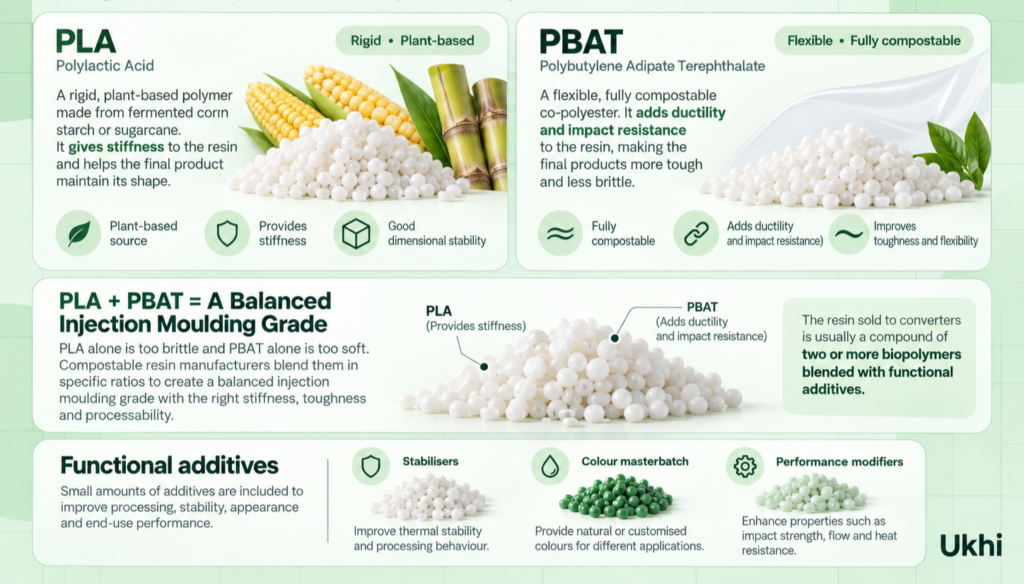
The two dominant base materials in PLA PBAT injection moulding resin in India are polylactic acid and polybutylene adipate terephthalate.
PLA is a rigid, plant-based polymer made from fermented corn starch or sugarcane, and it gives the moulded part its stiffness.
PBAT is a flexible, fully compostable co-polyester, and it adds ductility and impact resistance to the compound.
PLA on its own is too brittle for thin-walled parts, and PBAT on its own is too soft. So, compostable resin manufacturers therefore compound the two in specific ratios to produce a balanced injection moulding grade.
How Much Does Compostable Injection Moulding Resin Cost in India
The price of compostable resin for injection moulding depends on the base polymer, the filler content, the order volume and whether the grade is a stock formulation or a customised one.
| Grade Type | Indicative Price (per kg) |
| Filler-heavy PBAT blends | ₹120 to ₹150 |
| Standard PLA/PBAT injection grade | ₹180 to ₹230 |
| High-rigidity food-contact PLA compounds | ₹230 to ₹280 |
| Custom or speciality compostable compounds | ₹280 to ₹350 |
UKHI’s EcoGran injection moulding grade is priced at approximately ₹193 per kilogram at container-load volumes. This price places the resin in the mid-range for biodegradable and compostable resin for injection moulding sold in India today.
The standard minimum order quantity for stock EcoGran injection moulding grades is 500 kg.
Why Buy Compostable Injection Moulding Resin from UKHI
- UKHI compounds its own compostable injection moulding resin. Our EcoGran granules are formulated and extruded at our facility in IMT Faridabad, Haryana. This gives us quality control at the granule level, not only at the finished product level.
- Our EcoGran compostable granules are drop-in compatible with standard injection moulding machines.
- EcoGran sits at a manageable per-kilogram premium over conventional plastics. The premium can be recovered through EPR fee savings and the sustainability price premium that end brands pay for compostable finished goods.
- UKHI holds the certifications required of any compostable injection moulding resin manufacturer in India: IS/ISO 17088, CIPET testing, FSSAI for food-contact grades, ISO 9001, ISO 14001 and GMP.
- UKHI is also building the next generation of compostable materials. EDHA, our PHA-based biomaterial made through precision fermentation of agricultural feedstocks, is currently in the pilot phase. EDHA is being designed for home composting and for biodegradation in soil, freshwater and marine environments.
FAQs
1. What is the shelf life of compostable injection moulding resin?
Most compostable injection moulding granules, including UKHI EcoGran, carry a recommended shelf life of 12 months from the date of manufacture when stored sealed in a cool, dry warehouse.
2. What end products can be made using compostable injection moulding resin?
Compostable injection moulding resin is used to mould rigid, single-use compostable products, including cutlery, spoons, forks, disposable cups, cup lids, bottle caps, food containers, small trays, clips and similar household or foodservice items.
3. Is PLA the same as compostable injection moulding resin?
No. PLA is a single biopolymer, whereas a compostable injection moulding resin is a compound made by blending PLA with PBAT and additives.
4. Can compostable injection moulding resin be coloured or supplied with a masterbatch?
Yes. UKHI supplies EcoGran in natural, white and standard colours, and can compound custom-colour or functional masterbatches on request.
5. How long does a compostable moulded product take to break down after use?
Under IS/ISO 17088 test conditions, a compostable moulded part must physically disintegrate below 2 mm within 12 weeks and fully biodegrade into CO₂, water and biomass within about six months.