
The United States has no federal law that governs the use of single-use plastic packaging. Every restriction, ban, fee, labelling standard, and producer responsibility mandate is set at the state or local level. The result is a regulatory landscape that shifts dramatically from one state border to the next.
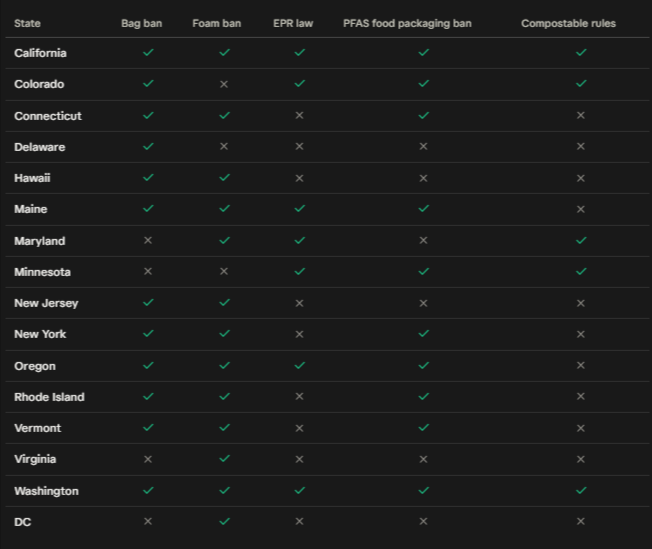
In twelve states, there are statewide plastic bag bans in place.
In seven states, packaging producers are required to fund waste management through Extended Producer Responsibility (EPR) laws.
In eleven states, the use of PFAS chemicals in food packaging is banned.
In five states, legal definitions for what “compostable” means on a product label have been established.
In twenty states, preemption laws are in place, and these laws block their own cities and counties from taking any local action on plastics at all.
In this guide, we have offered an introduction to the regulatory landscape in terms of bans on the use of plastic, and rules related to the manufacture and use of compostable plastics, across all 50 states of the USA, and the District of Columbia.
Plastic Packaging Regulation in the US: Key Insights for 2026
- Two forces are pulling the country in opposite directions. Leader states, concentrated along the coasts, are layering ban upon ban and shifting the financial burden of packaging waste onto producers.
- Blocker states, concentrated in the South and interior, are using preemption statutes modelled after American Legislative Exchange Council (ALEC) draft legislation to lock local governments out of the issue entirely.
- In June 2026, 17 states filed suit against California over SB 54, the most aggressive EPR packaging law in the country, arguing that it violates the Commerce Clause by forcing out-of-state producers to comply with California-specific material reduction targets. That lawsuit may determine whether a single state can set de facto national packaging standards.
- The gap between these two camps is widening. In 2016, only a handful of states had plastic bag bans. By 2026, the number of states with either statewide bans or statewide preemption has more than doubled. The middle ground of states with no policy in either direction is shrinking.
How US States Regulate Plastic Packaging: Three Categories
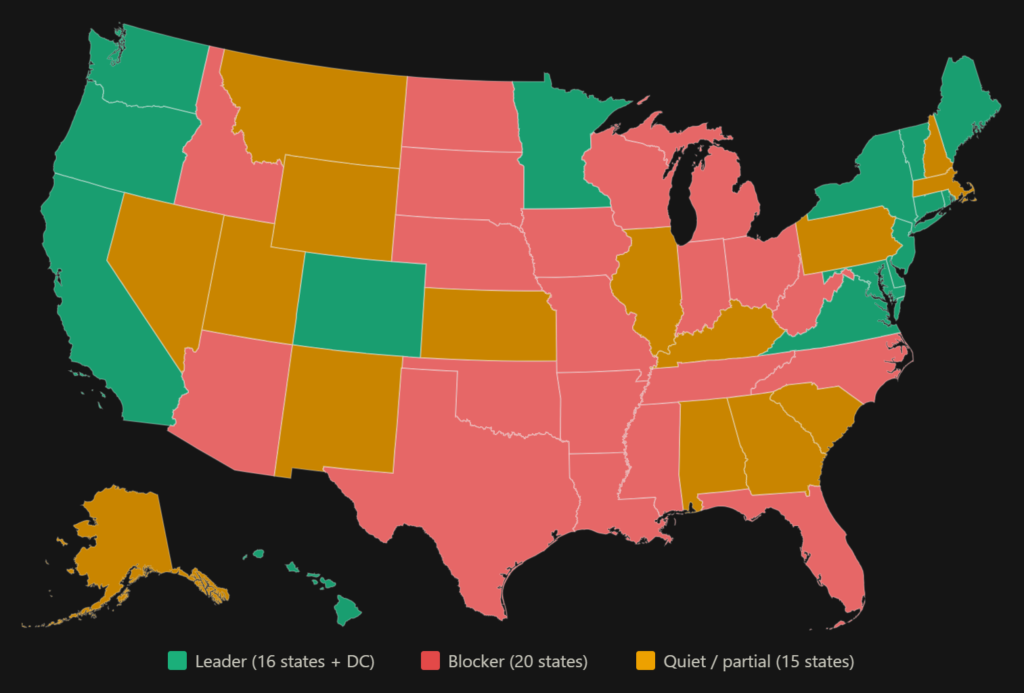
Category 1: Leader States (States With Statewide Plastic Bans, EPR Laws, or Compostable Packaging Rules)
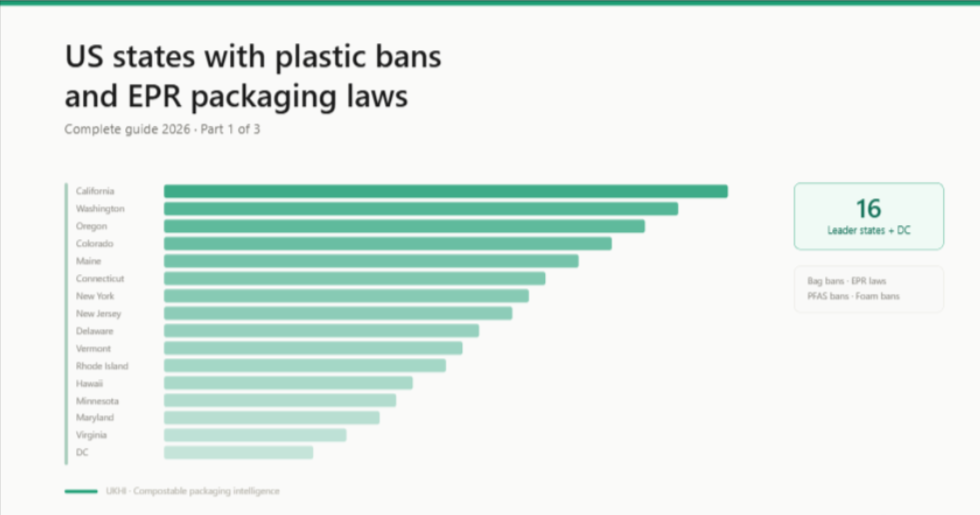
California, Washington, Oregon, Colorado, Maine, Connecticut, New York, New Jersey, Delaware, Vermont, Rhode Island, Hawaii, Minnesota, Maryland, Virginia, District of Columbia
These states enforce statewide plastic bag bans, polystyrene restrictions, PFAS food packaging bans, Extended Producer Responsibility (EPR) packaging laws, compostable packaging certification rules, or a combination of these measures. They represent the most regulated packaging environments in the country.
Category 2: Blocker States (States Where Preemption Laws Prevent Local Plastic Regulation)
Florida, Texas, Ohio, Arizona, Indiana, Michigan, Iowa, Mississippi, Missouri, Nebraska, North Carolina, North Dakota, Oklahoma, South Dakota, Tennessee, West Virginia, Wisconsin, Idaho, Arkansas, Louisiana
These states have enacted statewide preemption statutes that prohibit cities and counties from passing their own plastic bag bans, container fees, polystyrene restrictions, or packaging mandates. Most of these laws were modelled after ALEC draft legislation and backed by industry groups including the American Progressive Bag Alliance.
Category 3: Quiet, Partial, or Local-Only States (States With No Statewide Plastic Ban and No Preemption Law)
Nevada, New Hampshire, Massachusetts, Pennsylvania, South Carolina, Alaska, Utah, Wyoming, Montana, Kentucky, Alabama, Georgia, Kansas, Illinois, New Mexico
These states have no statewide plastic bans and no statewide preemption laws. Some of these states allow local governments to act and a few municipalities have passed their own ordinances. Others are entirely silent on packaging regulation. Policy in these states is either absent, voluntary, or limited to individual cities.
What the US Plastic Packaging Patchwork Means for Businesses and Regulators
Four patterns define the current state of plastic packaging regulation across the United States.
- Coastal states and interior states have moved in opposite directions. Among the 23 US states that border the Atlantic or Pacific Ocean, the majority have enacted statewide plastic bag bans or statewide EPR packaging laws. Among the southern states and the landlocked states of the interior, the majority have enacted preemption laws that block local governments from restricting plastics. This geographic split is not simply a matter of environmental awareness. Coastal states face direct economic consequences from plastic marine pollution, including damage to fishing, tourism, and water treatment infrastructure. Those costs have created political conditions in which packaging regulation gains legislative support. Interior and southern states, by contrast, are more likely to host domestic plastic manufacturing operations and to prioritise industry protection in their legislative agendas.
- Preemption is the dominant strategy in states that oppose plastic regulation. Twenty states have passed preemption laws that prohibit cities and counties from banning or taxing plastic bags, foam containers, or other packaging. In nearly every case, the preemption legislation was introduced after a major city within that state began developing a local plastic restriction. Florida’s preemption followed Miami-Dade County’s interest in a bag ban. Ohio’s preemption followed the City of Athens’s local bag ban. Indiana’s preemption followed proposals from communities in the Indianapolis area. Preemption is not the absence of policy. It is an active legislative decision to prevent local governments from regulating packaging materials.
- California’s packaging laws function as a de facto national standard. California represents roughly 12% of the US consumer market. Any manufacturer that ships packaged products into the state must comply with SB 54’s recycled content mandates, PFAS restrictions, and labelling requirements, regardless of what the manufacturer’s home state requires. In June 2026, 17 states filed suit against California, arguing that SB 54 violates the Commerce Clause of the US Constitution by imposing California-specific material reduction targets on out-of-state producers. If the lawsuit succeeds, it would limit the ability of any single state to set packaging standards that reach beyond its own borders.
- EPR adoption is accelerating. In 2020, Maine became the first US state to pass an EPR packaging law. By mid-2026, seven states had enacted EPR legislation. The Circular Action Alliance (CAA) operates as the Producer Responsibility Organisation across all current EPR states. It collects fees from packaging producers and directs the revenue toward recycling infrastructure. EPR fee schedules are structured to penalise materials that are difficult to recycle. In several states, producers of expanded polystyrene foam packaging pay the highest per-ton fee rates, while producers of easily recyclable materials such as corrugated cardboard pay the lowest. This fee structure creates a financial incentive for producers to shift away from polystyrene and toward materials that have established recycling or composting pathways.
- Only five states give the word “compostable” a legal definition. California, Washington, Minnesota, Maryland, and Colorado require that products labelled “compostable” meet ASTM D6400 or D6868 testing standards and carry certification from the Biodegradable Products Institute (BPI) or an equivalent body. In the remaining 45 states and DC, the word “compostable” on a product label carries no enforceable legal standard. This creates a split market. Producers of compostable packaging must meet strict certification requirements to sell in those five states, but face no such requirements elsewhere. For producers that already hold certification, the five-state framework functions as a competitive advantage, because uncertified competitors cannot legally use the term “compostable” in those markets.
US States With Plastic Bans and Packaging Laws in 2026
Category 1: California – Plastic Ban, EPR, and Packaging Rules
- Since January 2026, California’s plastic bag ban covers every type of plastic carryout bag, including the thicker bags previously sold as “reusable.”
- Grocery stores, pharmacies, and convenience stores can only offer recycled paper bags (for a minimum 10-cent charge) at checkout. Shoppers can also bring their own reusable bags.
- Under the California EPR packaging law (SB 54), every company that sells packaged products in the state must register with Circular Action Alliance.
- The alliance is a central body that collects fees from producers based on their packaging materials.
- Producers of expanded polystyrene foam containers face the highest fee rates. Failing to register carries penalties of up to $50,000 per day.
- California’s compostable packaging rules prohibit the use of the word “biodegradable” on any plastic product.
- Products labeled “compostable” must pass laboratory testing to ASTM D6400 or D6868 standards and carry a third-party certification mark. The state attorney general actively prosecutes false claims.
- California also bans PFAS chemicals in plant-fibre food packaging above 100 parts per million.
Washington – Plastic Ban, EPR, and Packaging Rules
- The Washington plastic bag ban prohibits single-use plastic bags statewide. Retailers are required by law to charge for paper or reusable alternatives.
- Under Washington’s EPR packaging law (SB 5284, the Recycling Reform Act), all producers selling packaged goods in the state must register with Circular Action Alliance.
- The law sets a hard deadline: from March 2029, producers that have not registered will be legally barred from selling products in Washington.
- Rulemaking began in January 2026. Penalties for non-compliance range from $1,000 to $10,000 per day.
- Washington’s compostable packaging rules are the most visually specific in the country.
- Products labeled “compostable” must meet ASTM D6400 or D6868 testing standards, display a third-party certification logo, and feature green or brown colouring (or green/brown striping) so that sorting-facility workers can identify them on sight.
- The words “biodegradable” and “degradable” are prohibited on plastic products.
- Washington also bans PFAS in plant-fibre food packaging and restricts single-use cutlery and straws to on-request distribution only.
Oregon – Plastic Ban, EPR, and Packaging Rules
- The Oregon plastic ban prohibits single-use bags at checkout and expanded polystyrene foam foodware across the state.
- Oregon’s EPR packaging law (SB 582) established the first fully operational packaging producer responsibility programme in the United States, which has been live since July 2025.
- All producers selling packaged goods into Oregon must join Circular Action Alliance and pay material-based fees.
- The fee structure is designed to steer packaging choices: producers of polystyrene foam packaging pay 1.94–2.58 per pound, roughly ten times the rate that producers of paperboard packaging pay ($0.03 per pound).
- Companies that switch to recycled content and demonstrate at least a 10% environmental improvement through lifecycle analysis can qualify for fee reductions of up to 25%.
- Penalties for non-compliance reach $25,000 per day.
- Oregon’s compostable packaging rules operate through strict acceptance lists maintained by the Department of Environmental Quality.
- If a compostable product does not appear on the Department of Environmental Quality’s approved list, waste haulers will not accept it in curbside collection bins, even if the product carries a compostable label.
- The state’s recycling targets are set to rise to 25% by 2028, 50% by 2040, and 70% by 2050.
Colorado – Plastic Ban, EPR, and Packaging Rules
- Colorado’s EPR packaging law (HB 22-1355) has been active since July 2025, with the first producer fees assessed in January 2026.
- All companies selling packaged products in Colorado must register with Circular Action Alliance, the state’s designated producer responsibility organisation.
- Businesses with under $5 million in annual revenue, or those supplying less than one ton of packaging per year, are exempt.
- Penalties for non-compliance start at 5,000–20,000 for the first day, with additional daily fines thereafter.
- Colorado’s plastic bag ban restricts single-use plastic carryout bags statewide, with stores required to charge for paper or reusable alternatives.
- Expanded polystyrene food containers are also restricted.
- Colorado bans intentionally added PFAS in food packaging.
- The state’s compostable packaging rules follow FTC Green Guides, and mandatory recyclability and post-consumer recycled content targets for packaging materials take effect in 2030 and 2035.
Maine – Plastic Ban, EPR, and Packaging Rules
- Maine’s EPR packaging law (38 M.R.S. § 2146) was among the first in the country and becomes fully operational in 2027.
- The programme runs on a fixed annual cycle: producers must submit packaging weight reports by May 31, receive fee invoices on July 1, and complete payment by September 1.
- Municipal recycling programmes receive reimbursements from October 1.
- Small producers have simplified options. Companies supplying fewer than 15 tons of packaging per year pay a flat fee of $500 per ton.
- Businesses earning under $2 million in annual revenue (rising to $5 million from year four onward) are fully exempt, as are those supplying less than one ton.
- The first 15 tons of perishable food packaging are also exempt from fees.
- Non-compliance penalties reach $100 per non-compliant package.
- Maine’s plastic ban prohibits single-use carryout bags and polystyrene food containers statewide.
Connecticut – Plastic Ban, EPR, and Packaging Rules
- Connecticut’s plastic ban (sHB 6229) takes a phased approach with a key deadline of July 1, 2027.
- From that date, restaurants, food trucks, cafeterias, schools, and government vendors will be prohibited from using polystyrene foodware, polystyrene packing peanuts, single-use plastic straws, stirrers, and foodware accessories.
- Exemptions cover four categories:
- food that arrives pre-sealed in polystyrene packaging before the vendor receives it,
- raw or frozen meat and seafood trays from butcher cases,
- coolers where polystyrene is fully encased in another material,
- and polystyrene containers reused in agriculture.
- Biodegradable or compostable straws remain permitted on a request-only basis and must be available at pharmacies and medical facilities.
- Enforcement follows a warning-first model. A written warning is issued for the first violation, then fines of up to $250 for each subsequent offence.
- Municipalities can impose stricter local restrictions.
- Connecticut already has a statewide plastic bag ban in effect.
New York – Plastic Ban, EPR, and Packaging Rules
- New York’s plastic bag ban (the Bag Waste Reduction Act) has been in effect since March 2020.
- The law prohibits all retail businesses from providing single-use plastic carryout bags at checkout.
- Cities and counties can impose a 5-cent fee on paper bags, though SNAP and WIC recipients are exempt.
- New York’s plastic ban extends well beyond bags. Since January 2022, polystyrene foam food containers (clamshells, cups, plates) and foam packing peanuts have been banned statewide.
- From January 2026, this expanded to cover polystyrene foam coolers and cold-storage containers, unless the foam is fully encased in a durable outer shell.
- New York does not yet have an EPR packaging law. The proposed Packaging Reduction and Recycling Infrastructure Act (PRRIA) remains in committee as of mid-2026.
- New York’s compostable packaging rules require all compostable bags to carry a printed warning: “COMPOSTABLE BAG – DO NOT PLACE IN RECYCLING BIN.”
- State agencies purchasing compostable waste bags require BPI or CMA certification.
- The use of PFAS in plant-fibre food packaging has been banned since December 2022.
New Jersey – Plastic Ban, EPR, and Packaging Rules
- New Jersey’s plastic bag ban, in effect since May 2022, is among the strictest in the country.
- No store or food service business can provide single-use plastic carryout bags.
- Grocery stores over 2,500 square feet face an additional restriction: they cannot offer paper bags either, which leaves reusable bags as the only option.
- Retailers must also provide in-store collection bins for plastic film recycling.
- New Jersey’s plastic ban also covers polystyrene foam foodware (cups, plates, clamshells) banned statewide since May 2022.
- Rather than an EPR law, New Jersey takes a recycled-content approach.
- Under New Jersey’s Recycled Content Law, manufacturers must meet minimum post-consumer recycled (PCR) content thresholds for packaging sold in the state. On January 18, 2027, those thresholds increased: rigid plastic containers must contain at least 20% PCR material, beverage containers must reach 20%, and plastic carryout bags must reach 40%.
- New Jersey also has a packaging right-sizing law (SB S226) that prohibits shipping products in boxes more than twice the volume of the contents, with fines of 250–500 per violation.
Delaware – Plastic Ban, EPR, and Packaging Rules
- Delaware’s plastic bag ban prohibits all retail stores (except restaurants) from distributing plastic film carryout bags at checkout, in effect since July 2022.
- Retailers must provide in-store drop-off bins for plastic bag and film recycling, as film is strictly excluded from curbside collection because it jams sorting machinery at the state’s material recovery facility.
- Delaware does not have an EPR packaging law or a statewide polystyrene ban.
- However, polystyrene foam is excluded from curbside recycling carts and can only be recycled through dedicated drop-off points operated by the Delaware Solid Waste Authority.
- The Universal Recycling Law (7 Del. C. § 6056) sets a target of diverting 60% of municipal solid waste from landfill. The grant programme that funded local recycling efforts under this law is currently suspended while the state waits for new appropriations.
Vermont – Plastic Ban, EPR, and Packaging Rules
- Vermont’s plastic ban (Act 69 of 2019) is one of the broadest single-law packages in the country.
- The law took effect in July 2020 and bans single-use plastic carryout bags, polystyrene foam food containers, and plastic stirrers in a single statute. Plastic straws can only be provided when a customer asks. Retailers that offer paper bags must charge a minimum fee.
- Vermont bans PFAS in food packaging outright. Under Act 36 of 2021, food packaging containing intentionally added PFAS has been illegal to manufacture, sell, or distribute since July 2023.
- Vermont does not yet have an EPR law specifically for packaging, though the state’s 2024 Materials Management Plan is actively evaluating model legislation.
- Vermont’s compostable packaging rules require ASTM D6400 or D6868 certification. The state has imposed a moratorium on new food waste depackaging facilities over concerns that mechanical processing introduces microplastics into compost.
- All food scraps are banned from landfill disposal statewide.
Rhode Island – Plastic Ban, EPR, and Packaging Rules
- Rhode Island’s plastic bag ban (the Plastic Waste Reduction Act) has been in effect since January 2024.
- It is applicable to all retail stores, flea markets, restaurants, and food service businesses, including delivery orders.
- Any reusable plastic bag offered by a business must have handles stitched (not heat-sealed) to the bag body, be designed to withstand at least 125 uses, and measure at least 4.0 mils thick.
- Rhode Island bans the use of PFAS in paper and plant-fibre food packaging. Compostable plastics that do not carry a recognised certification are excluded from curbside recycling, because uncertified items can contaminate sorted material at the state’s recovery facility.
- Rhode Island does not yet have an EPR packaging law, though the Department of Environmental Management is finalising a statewide implementation analysis evaluating proposed legislation (H6207 / S0996).
- The state operates a beverage case tax, under which wholesalers pay $0.08 per case of single-use beverage containers. This tax generates over $2 million annually for recycling programmes.
Hawaii – Plastic Ban, EPR, and Packaging Rules
- Hawaii’s plastic bag ban is unique: rather than a single state law, all four counties in the state have independently enacted their own bans.
- The result is a de facto statewide prohibition on single-use plastic checkout bags.
- Hawaii’s plastic ban also covers polystyrene foam food containers, banned across all four counties through separate local ordinances.
- The use of PFAS in plant-fibre food packaging (including wraps, liners, plates, and pizza boxes) has been illegal since December 2024 under Act 152. The Department of Health actively inspects distributors for compliance.
- From April 2025, Honolulu’s residential green curbside bins accept certified compostable packaging alongside food scraps. Products labelled “biodegradable” that do not hold a compostable certification are not accepted.
- Hawaii does not have an EPR packaging law. A proposed bill (HB 1326) would set a target of reducing packaging waste by 70% by 2030, but it has not been enacted.
Minnesota: Plastic Ban, EPR, and Packaging Rules
- Minnesota does not have a statewide plastic bag ban. State law (Minn. Stat. § 471.9998) explicitly prohibits local governments from banning carryout bags. Cities including Minneapolis and Duluth have instead imposed 5-cent bag fees, which the statute permits.
- Minnesota’s EPR packaging law (the Packaging Waste and Cost Reduction Act, passed in 2024) designates Circular Action Alliance as the Producer Responsibility Organisation for the state.
- Producers must register by January 2029. The full programme activates in 2028.
- By 2032, all covered packaging sold in Minnesota must be reusable, recyclable, or compostable.
- Penalties escalate from $25,000 per day for a first violation to $50,000 per day for a second and $100,000 per day for a third. These are the steepest EPR penalties of any US state.
- Minnesota’s compostable packaging rules (Minn. Stat. § 325E.046) require products labelled “compostable” to meet ASTM D6400 or D6868 testing standards and to display an approved certifier logo such as BPI.
- The terms “biodegradable,” “degradable,” and “PLA” are prohibited on products that do not hold certification.
- Minnesota bans PFAS in food packaging under Amara’s Law, which took effect in January 2024.
- State testing conducted in 2026 found a 92% compliance rate among food packaging sold in the state, up from 58% before the ban took effect.
Maryland: Plastic Ban, EPR, and Packaging Rules
- Maryland’s plastic ban on polystyrene foam food containers has been in effect statewide since October 2020. The ban covers clamshells, cups, plates, and trays made from expanded polystyrene.
- Maryland does not have a statewide plastic bag ban. Baltimore and Montgomery County enforce local bag bans independently.
- Maryland’s EPR packaging law (SB 901C) requires all producers selling packaged products in the state to register with Circular Action Alliance by July 1, 2026.
- The PRO must submit a formal programme plan to the Maryland Department of the Environment by July 2028.
- Penalties range from $500 to $1,000 per violation, and rise to $10,000 per day for repeat non-compliance.
- Producers that distribute less than one ton of packaging per year are exempt.
- Maryland’s compostable packaging rules (Environment Article § 9-2103, in effect since October 2018) set some of the most specific visual identification requirements in the country.
- Compostable bags must meet ASTM D6400 standards, display a certification logo, and feature the word “COMPOSTABLE” printed in green lettering at least one inch tall, or printed within a contrasting green band.
- Compostable bags cannot carry the word “recyclable.”
- Maryland bans PFAS in food packaging under the George “Walter” Taylor Act, which took effect in January 2024.
Virginia: Plastic Ban, EPR, and Packaging Rules
- Virginia enacted a statewide ban on expanded polystyrene (EPS) food service containers in 2021 through HB 1902.
- The ban took effect in two phases. Food vendors with 20 or more Virginia locations had to comply by July 1, 2023. All remaining food vendors must comply by July 1, 2025.
- The ban covers single-use foam cups, plates, bowls, trays, and hinged takeout containers used for prepared food.
- Localities may grant one-year hardship exemptions to vendors that demonstrate compliance would impose undue economic burden.
- Fines collected from violations fund the Litter Control and Recycling Fund and public recycling education programmes.
- Virginia does not have a statewide plastic bag ban. However, legislation passed in 2020 (HB 534) authorises counties and cities to impose a 5-cent tax on disposable plastic bags at grocery stores, convenience stores, and drugstores.
- As of 2026, eleven localities have adopted the bag tax, including Alexandria, Arlington County, Fairfax County, Roanoke, Fredericksburg, and Richmond.
- Executive Order 77, issued in 2021, prohibits state agencies, public universities, and state contractors from purchasing or distributing single-use plastic bags, plastic straws, plastic cutlery, and plastic water bottles under 34 ounces.
- Virginia does not have an EPR packaging law. A Waste Diversion and Recycling Task Force is studying packaging EPR options but no legislation has been introduced.
- Virginia does not have PFAS food packaging restrictions or compostable packaging labelling rules.
District of Columbia: Plastic Ban, EPR, and Packaging Rules
- DC is not a state but functions as its own jurisdiction. Its packaging laws rival those of the strictest states.
- DC’s plastic ban operates through a mandatory 5-cent fee on every disposable bag, whether paper or plastic, provided by food or alcohol retailers. The fee has been in effect since 2010.
- Businesses retain one to two cents per bag. The remainder funds Anacostia River cleanup. The Department of Energy and Environment inspects over 550 businesses annually for compliance.
- DC banned polystyrene foam food containers in 2016. In 2021, the ban expanded to cover foam coolers and packing peanuts.
- Single-use plastic straws and stirrers have been banned since October 2018.
- Cutlery, napkins, and condiment packets can only be provided when a customer requests them. Third-party delivery platforms such as DoorDash and UberEats are required to configure their apps so that customers have to actively opt in for disposable utensils rather than receiving them by default.
- All food service businesses in DC must use verified recyclable or compostable foodware.
- DC has set a target of diverting 80% of waste from landfill by 2032.
Note: This is Part 1 of a three-part series covering plastic packaging regulation across all 50 US states and DC. Part 2 covers the 20 states where preemption laws block local plastic regulation, and Part 3 covers the 15 states with limited or local-only plastic rules.
Sources
- US EPA — PFAS Science & Policy
- NIH / National Library of Medicine — Preemption of Local Plastic Bag Bans (Research)
- CalRecycle — SB 54 Packaging EPR Overview
- CalRecycle — SB 54 Permanent Regulations
- CalRecycle — Grocery & Retail Bag Requirements
- California Legislative Information — Bill Text Search
- Oregon OLIS — SB 582 Enrolled Text
- Oregon DEQ — Single-Use Bag Ban Rules
- CDPHE — Producer Responsibility Program (HB 22-1355)
- Colorado General Assembly — HB 22-1355 Text
- Maine DEP — Packaging Stewardship Program
- Minnesota Revisor of Statutes — § 115A.1441 (Packaging Waste & Cost Reduction Act)
- Minnesota Revisor of Statutes — § 471.9998 (Merchant Bags)
- Maryland General Assembly — Environment Article § 9-2103 (Compostable Plastic Bags)
- Hawaii Department of Health — Food & Drug Branch (PFAS in Food Packaging)
- NYC311 — Plastic Bag Ban & Paper Bag Fee Regulations
- Delaware DNREC — Recyclopedia Waste Disposal Directory
- Rhode Island DEM — Plastic Waste Reduction Act Guidance
- Vermont DEC — Single-Use Products Law (Act 69)
- Iowa Legislature — HF 588 (PFAS Restriction Bill)
- Michigan Legislature — HB 4299 (Preemption Repeal Bill)
- Utah Legislature — HB 320 (Container Regulations Amendments)
- City of Moab — Plastic Bag Ban
- Wyoming DEQ — Solid & Hazardous Waste Division
- Alaska DEC — Municipal Plastic Bag Bans