
Imagine: You walk into a meeting with a supplier and ask for “biodegradable packaging.” The supplier nods, the bags arrive, and everyone moves on. Then, three months later, an EU or US buyer flags the shipment. The documentation doesn’t match the claim. The certification doesn’t exist. That’s a compliance headache that holds up an entire container.
Things like these happen. Often. Mostly because biodegradable and compostable are often treated as synonyms. But they are not.
Below, I walk you through the distinction between biodegradable and compostable plastic and explain why it matters.
What Does Biodegradable Plastic Actually Mean?
Biodegradable simply means that a material can be broken down by microorganisms over time. But this definition carries almost no useful technical information on its own.
Biodegradable plastic has no fixed standard for how long this breakdown takes or under what conditions. A material can technically be called biodegradable if it breaks down in 5 years. Or 50 years. Or 500. So, conventional petroleum-based plastic is, in this narrow technical sense, eventually biodegradable.
The term has been stretched beyond usefulness. Suppliers attach it to materials that break down only in specific environments. Or that leave microplastic fragments behind, like oxo-biodegradable plastic.
So, if a supplier tells you their bag is biodegradable but cannot show you a certification or a test report, that claim tells you almost nothing about what will actually happen to that bag at the end of its life.
What Does Compostable Plastic Mean?
Compostable plastic is a more specific, more verifiable category. A material that is genuinely compostable must meet defined criteria for how it breaks down, how long that process takes, and what it leaves behind.
In practice, that means 3 things must be true of any genuinely compostable plastic:
- It must disintegrate into small fragments within a defined composting period. This is typically 12 weeks under industrial conditions.
- It must biodegrade, meaning the carbon in the material converts to CO₂ at a specified rate, usually at least 90% within 6 months.
- It must not leave harmful residues. So the resulting compost must pass ecotoxicity tests and not contain heavy metals above threshold limits.
These criteria are codified in international standards. The most widely recognised are EN 13432 (used in the EU and UK), ASTM D6400 (used in the USA), and ISO 17088 (the international equivalent, which maps to India’s IS 17088, the basis for CPCB compostable certification).
CPCB certified compostable plastic is the specific standard that matters most for Indian manufacturers. Under the Plastic Waste Management Rules 2024, any plastic packaging sold as compostable in India must carry this certification. Without it, the claim is unverified and unenforceable.
Quick Summary of the Indian Biodegradable Plastic Market
Here is a quick summary how the categories map out:
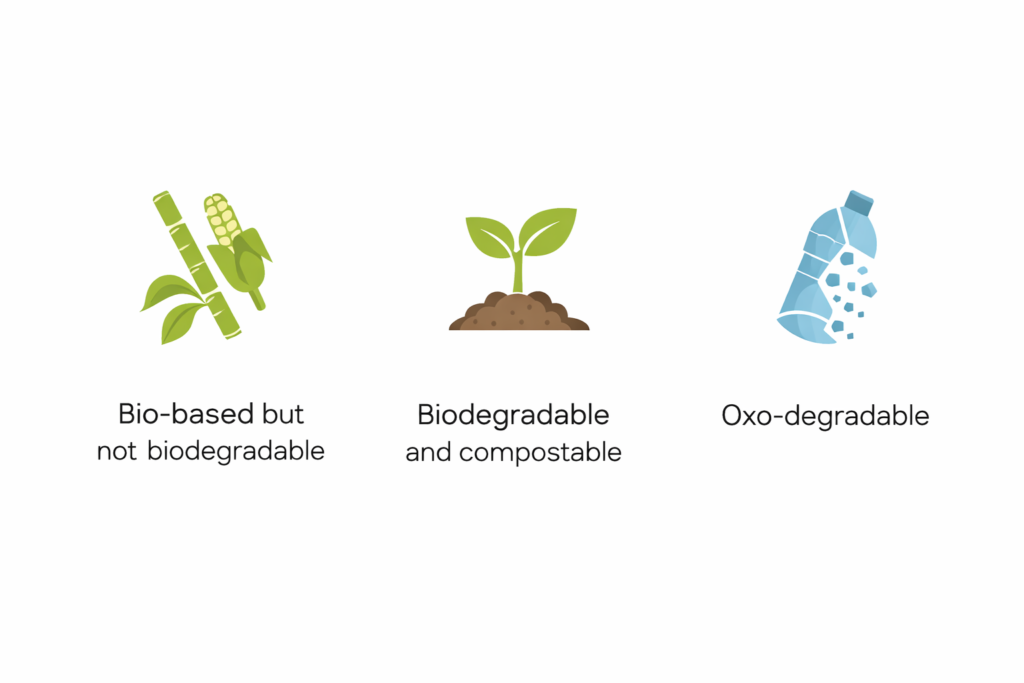
- Bio-based but not biodegradable
- Made from plant sources (sugarcane, corn starch) but behave like conventional plastic.
- Examples include bio-PET and bio-PE.
- These are not compostable and so, not a sustainability solution
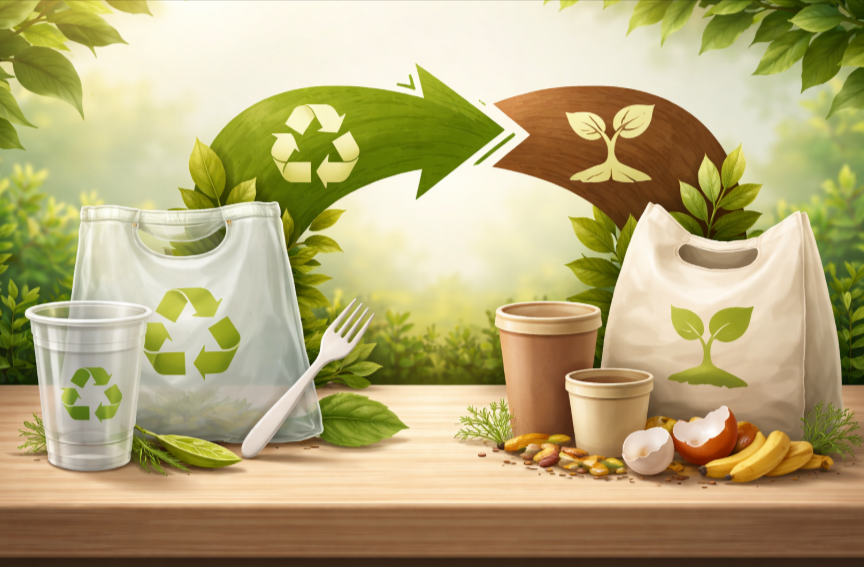
- Biodegradable and compostable
- Designed to break down under composting conditions.
- Examples include PLA (polylactic acid) and PBAT-based blends
- These are the relevant category for certified sustainable packaging.
- Oxo-degradable:
- Conventional plastic with fragmentation additives.
- Not compostable and banned in the EU.
- Should not be used for any export packaging.
At Ukhi, our EcoGran™ biopolymer falls into the second category. It is made from agricultural waste and engineered as a compostable polymer blend. EcoGran™ granules used to make bags by CPCB-certified manufacturers meet the Indian regulatory standard and are accepted in export markets.
Biodegradable vs. Compostable Plastic: Side by Side
The key differences that matter to a buyer, manufacturer, or compliance team include:
| Factor | Biodegradable Plastic | Compostable Plastic |
| Definition | Breaks down via microorganisms eventually | Breaks down fully under composting conditions within defined timeframes |
| Timeline | No fixed timeline; could be years or decades | Defined: 12 weeks (disintegration), 6 months (full biodegradation) |
| Conditions required | Varies widely; no standard environment | Industrial composting (heat, moisture, microbes) or home composting if certified |
| Residue left behind | May leave microplastics or toxic fragments | Must leave no harmful residues; passes ecotoxicity tests |
| Certification | No mandatory certification standard in India | CPCB certification (IS 17088) required under PWM Rules 2024 |
| Export compliance | Not accepted by EU/UK/USA without specifics | EN 13432 (EU/UK), ASTM D6400 (USA) widely accepted by export buyers |
Why This Difference Matters for Indian Manufacturers and Exporters
The distinction between biodegradable and compostable plastic bags is important because:
- EU buyers now check EN 13432 compliance before accepting sustainable packaging.
- The UK applies its Plastic Packaging Tax to materials with under 30% recycled content and unverified “biodegradable” claims do not qualify for any exemption.
- US buyers, (especially those selling into California!) are navigating SB 54 and tightening rules around what can legally be called compostable.
The safer position is to use materials that are certified, documented, and verifiable. Compostable plastics with CPCB certification meet that bar. Generic biodegradable claims, without test reports or standards behind them, do not.
Three Practical Questions to Ask Before Choosing Packaging
When choosing between biodegradable and compostable plastic these are the questions to ask:
1. Is it certified, and by which standard?
Ask the supplier for their certification document. In India, this should be a CPCB compostable certification under IS 17088. For export markets, ask whether the material meets EN 13432 (EU/UK) or ASTM D6400 (USA).
2. What conditions does it need to break down?
Industrial composting requires controlled temperature, moisture, oxygen, and active microbial activity. Compostable bags in landfill or mixed municipal waste will not break down as intended.
3. What is the base material?
Ask the supplier to name the base polymer. PLA, PBAT, and PBS blends are standard in certified compostable packaging. Vague answers like “plant-based additives” or “eco-friendly formulation” aren’t sufficient.
Making The Right Choice Between Biodegradable and Compostable Plastics
Biodegradable and compostable plastic are not the same thing. One is a broad, often unverifiable claim. The other is a defined, certifiable, auditable material category.
The good news is the documentation gap is solvable. All you need to do is choose certified suppliers and materials with the right standards.
Ready to move away from unverified biodegradable claims towards certified, compliant, compostable packaging? CPCB certified compostable plastic made of EcoGran™ can be an ideal 1st step.
FAQs
Is biodegradable plastic safe for export packaging to the EU and USA?
Not without certification. EU and US buyers require EN 13432 or ASTM D6400 compliance. A generic biodegradable label with no test report behind it will not satisfy an import audit. Nor a buyer’s sustainability questionnaire or state-level regulations.
Can compostable plastic bags be disposed of at home or in regular bins?
Most certified compostable bags require industrial composting conditions to break down correctly. Some carry a home compostable certification, but this is a separate, stricter standard. Unless specified, compostable plastic bags shouldn’t be put in regular bins or disposed of at home.
What certification should Indian manufacturers look for in compostable packaging?
CPCB compostable certification under IS 17088 is mandatory for domestic compliance under India’s PWM Rules 2024. For exports, EN 13432 covers the EU and UK, while ASTM D6400 covers the USA. A supplier who cannot produce these documents is not selling verified compostable packaging.