

What Is the Best Garment Polybag Replacement Solution?
There is no single best answer. The right solution depends on your product, your supply chain, your markets, and your infrastructure.
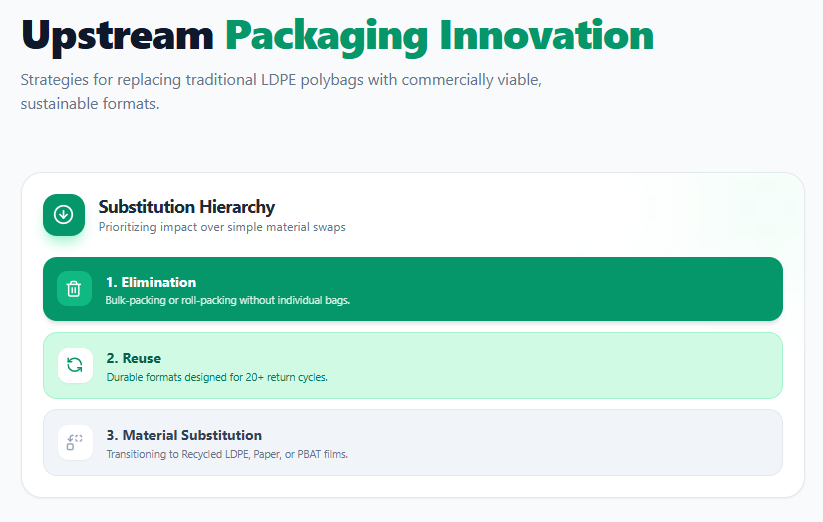
That said, the industry has largely moved away from the idea that swapping one material for another is the goal. The more useful frame is called upstream innovation: preventing the problem at the design stage rather than managing waste at the end. When you apply that frame, the best garment polybag alternatives rank roughly in this order:
Elimination first. If a garment can travel without individual packaging, that is always the superior outcome.
Reuse second. If individual packaging is genuinely necessary, can it be designed for multiple trips? Some e-commerce brands now use durable mailer bags in closed-loop return schemes.
Material substitution third. When elimination and reuse are not viable, you choose the best available material. The leading options are:
- Recycled polybags made from 100% post-consumer recycled LDPE, which carry a lower carbon footprint than paper because they are lighter and require less energy to produce
- FSC-certified paper bags, which are widely recyclable and compostable, though more energy-intensive to manufacture
- Bio-based PBAT films, which are the leading compostable option for inner garment protection and break down in industrial composting within 90 to 180 days
Packaging Alternatives To Garment Polybags
The garment polybag alternatives that have reached commercial viability fall into these categories:
Paper-based formats:
- Glassine bags, which are translucent and allow barcode scanning without opening the bag
- Kraft bags made from recycled waste paper, typically used for heavier items
- EcoBand paper wraps, designed for rolled or folded garments
Compostable films:
- PLA-based films derived from cornstarch
- PBAT blends, which offer better flexibility than pure PLA
- Multi-layer co-extruded compostable films, which now rival traditional plastic in tensile strength and puncture resistance
Elimination formats:
- Master polybags, where one bag covers an entire carton of garments rather than each unit
- Roll-packing with fiber ties or FSC-certified paper bands
- No inner packaging at all, for products with enough structural integrity to travel without it
Reusable formats:
- Durable poly mailers made from recycled textile or plastic, designed for multiple use-cycles in e-commerce return schemes
Emerging formats:
- Seaweed-based packaging, currently in pilot stage, home-compostable and suitable for lightweight garments
Garment Polybag vs Alternatives: A Comparison
| Factor | Traditional LDPE Polybag | Paper Alternatives | Recycled LDPE | Compostable Film |
| Moisture resistance | High | Low to medium | High | Medium |
| Barcode visibility | Clear | Opaque (glassine: semi-clear) | Clear | Clear to semi-clear |
| Real-world recyclability | Below 15% (thin film collection is poor) | High via curbside | High if labeled for LDPE stream | Low (requires industrial facility) |
| Carbon footprint | Moderate | Higher (production is energy-intensive) | Lower than virgin plastic | Low to moderate |
| Line compatibility | Universal | Requires adjustment | Universal | Usually compatible |
Decision Matrix: Choosing the Right Garment Polybags Packaging Replacement
Before choosing a format, brands should work through three questions in sequence.
1. Can you eliminate individual packaging entirely? Look at your product structure. Can garments be bulk-packed in a master bag? Can folding or rolling techniques remove the need for individual protection? If yes, this is the highest-value outcome.
2. If not, does your customer return the packaging? If you run e-commerce and can build a return loop, durable reusable formats become viable. The unit cost is higher but the per-use cost drops significantly at scale.
3. If neither applies, which material fits your supply chain?
Rate your shortlisted options against the factors that matter most to your specific situation:
- Does your supply chain pass through high-humidity environments?
- Do your factory lines use automated sealing equipment?
- Which markets are you shipping to, and what does compliance require there?
- Is your end customer likely to have access to industrial composting, or only curbside recycling?
Compliance Requirements for Garment Polybag Alternatives: EU, US, and India
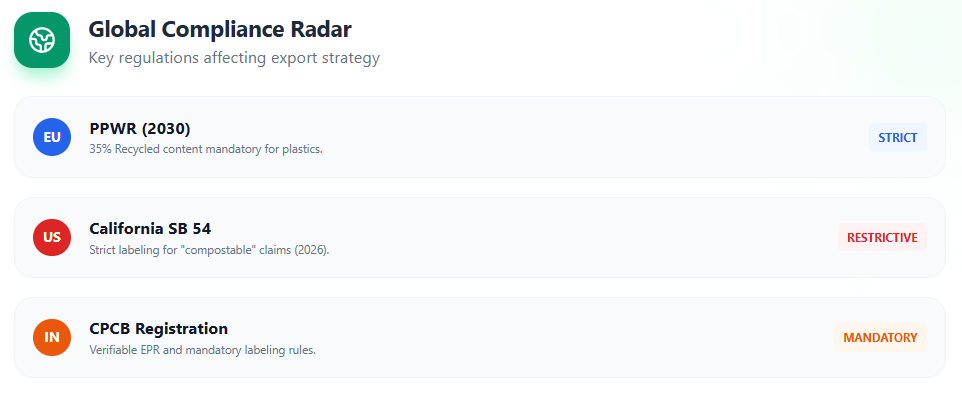
European Union (Packaging and Packaging Waste Regulation, PPWR): By 2030, all packaging sold into EU markets must be recyclable and meet minimum recycled content thresholds. For non-contact-sensitive plastics, the requirement is 35% post-consumer recycled content. This rules out most virgin plastic polybags without modification.
United Kingdom (Plastic Packaging Tax): Any plastic packaging that contains less than 30% recycled content is subject to tax. Importantly, this applies to compostable and biodegradable polymers as well. A bag made from plant-based plastic does not automatically qualify for exemption.
United States (California SB 54, effective 2026): California has the strictest labeling rules in the US. As of 2026, “compostable” claims on packaging are restricted primarily to unprinted virgin paper unless federal definitions are extended. Brands using compostable films and labeling them as such in California face legal risk.
India (Plastic Waste Management Rules): All producers must be registered with the Central Pollution Control Board (CPCB). Packaging must carry specific labeling that identifies whether content is recycled, compostable, or biodegradable, and the claims must be verifiable.
Examples Of How Fashion Exporters Are Replacing Polybags
The most useful evidence comes from what brands have already done at production scale.
- prAna eliminated most individual polybags by roll-packing garments and securing them with undyed recyclable fiber string. No new machinery required.
- ELK achieved a 70% reduction in plastic consumption through suit-rolling garments and bulk-packing denim jeans ten units per bag. The change was primarily procedural, not infrastructural.
- Stella McCartney committed to converting all of its industrial cast film packaging to TIPA fully-compostable flexible solutions, a material that handles like conventional plastic on existing lines but meets composting standards.
- H&M and Etam Group shifted to FSC-certified paper shipping envelopes for e-commerce and tested removing inner polybags entirely for certain product categories.
- Ralph Lauren piloted 14 alternatives across its product range and introduced an opt-out option at online checkout.
Get the Right Garment Polybag Replacement Solution
Ukhi works with fashion brands to identify and implement garment polybag replacement solutions that are grounded in real supply chain constraints, not just sustainability theory. Whether your priority is compliance, cost, consumer perception, or all three, the right starting point is an honest audit of where your packaging is actually going and what it actually needs to do.
Explore Ukhi bioplastic products.
FAQs: Garment Polybag Replacement Solutions
What are the best alternatives to garment polybags for exports?
For exports to Europe and the US, paper-based formats like glassine bags perform well on both climate and land use metrics. Bio-based PBAT is the leading choice for inner garment protection. Recycled LDPE bags made from 100% post-consumer content are also strong garment polybag alternatives.
Can garment polybag alternatives run on existing packing lines?
Compostable autobag polymailer rolls are specifically designed to integrate with automated packing systems. Paper-based formats are less compatible because they are less flexible and more prone to damage on conveyor belt systems that currently favour plastic.
Are compostable garment bags accepted in the EU?
provided they meet industrial composting standards under EN 13432. Exporters should carry TÜV or equivalent certificates of compliance to avoid customs delays.
How do garment polybag alternatives perform in humidity?
Recycled and conventional plastic both provide strong moisture protection. Compostable films require careful storage: relative humidity must stay below 60% and temperature below 25°C to prevent premature degradation.
Are biodegradable garment bags the same as compostable ones?
No. Biodegradable means a material will break down eventually, but with no defined timeframe or conditions. Compostable means it breaks down within a specific period, typically 90 to 180 days, in an industrial composting facility. For regulatory purposes, only compostable claims backed by certified standards like EN 13432 carry legal weight in the EU.