

What Is EN 13432?
EN 13432, formally titled “Packaging: Requirements for packaging recoverable through composting and biodegradation,” is the definitive harmonised European standard for compostable packaging. It is the legal baseline in the EU for determining whether a packaging product qualifies as industrially compostable.
The full reference used in regulatory contexts is DIN EN 13432, which reflects its adoption into the German standards system, and it is sometimes cited as EN 13432:2000, indicating the year it was harmonised across Europe.
What makes this EN 13432 standard different from vague eco-friendly or biodegradable claims is precision. It requires rigorous third-party laboratory testing under controlled conditions. A material cannot self-certify. A supplier cannot simply declare compliance. The finished product must be tested and verified by an accredited body.
One more thing worth noting clearly: EN 13432 covers industrial composting. It says nothing about what happens in a home compost bin, a landfill, or the ocean. That distinction matters enormously, and we will come back to it.
Key Requirements of EN 13432 for Compostable Packaging
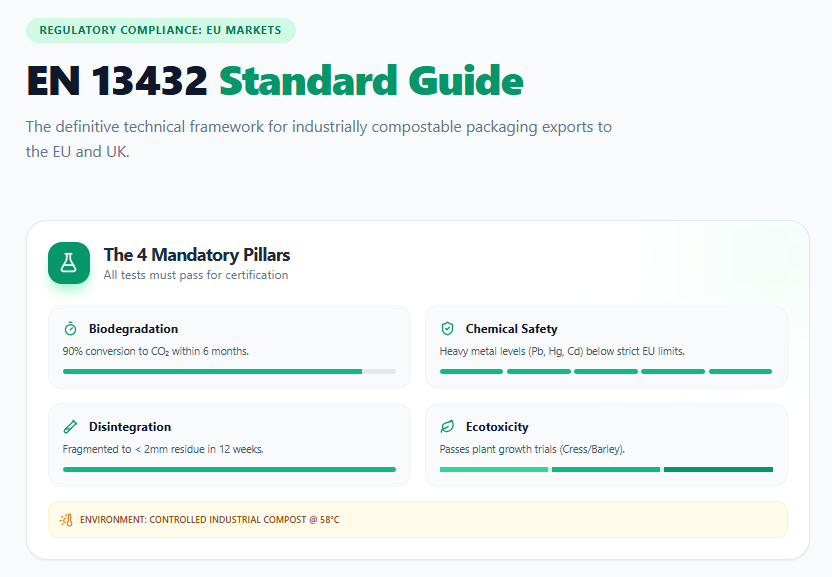
The EN 13432 requirements are built around four mandatory testing pillars. All four must be passed. There is no partial compliance.
- Biodegradability: At least 90% of the organic carbon in the material must convert to CO2 within six months under industrial composting conditions. This is the chemical breakdown test, and it is where many synthetic materials fail entirely.
- Disintegration: The product must physically fragment so that no more than 10% of its original mass remains as pieces larger than 2mm after 12 weeks of composting. This is the structural breakdown test.
- Chemical safety: The material must not release dangerous levels of heavy metals into the compost. The EN 13432 compostable standard sets strict limits on lead, mercury, cadmium, chromium, arsenic, and several other substances.
- Ecotoxicity: The compost produced from the material must be tested in plant growth trials, typically using barley or cress. Plants grown in this compost must achieve at least 90% of the growth rate of plants in standard control compost. This confirms that the material leaves no harmful residue in the soil.
Critically, all of this testing applies to the finished packaging product, not just the base resin. The inks, adhesives, laminates, and coatings are all part of the test. A bag made from certified PLA film but printed with a non-compostable ink will fail EN 13432 certification.
Who Needs EN 13432 Compliance?
If you manufacture or export packaging to the EU, UK, or Switzerland, and that packaging carries any compostable or biodegradable claim, EN 13432 for exporters is a legal requirement.
This applies across categories:
- Fashion and apparel exporters supplying compostable polybags, shoe boxes, or e-commerce mailers
- Foodservice exporters supplying PLA cups, bagasse trays, cornstarch cutlery, or kraft bowls with compostable linings
- Retail and supermarket suppliers of carrier bags, labels, tapes, and flexible packaging
The consequences of non-compliance are serious. Under EU compostable packaging regulations and the broader Packaging and Packaging Waste Directive, enforcement includes customs seizures, import bans, retailer delisting, and fines under EU greenwashing laws.
The EU Green Claims Directive, which came into force in 2024, gives regulators new tools to pursue unsubstantiated environmental claims, and compostability is explicitly in scope.
The packaging and packaging waste directive framework is tightening, not loosening. Brands that treat EN 13432 as a paperwork exercise rather than a genuine compliance requirement are taking on real commercial and legal risk.
EN 13432 Compliance Overview
| Testing Pillar | Requirement | Timeframe |
| Biodegradation | 90% conversion to CO2 | Up to 180 days |
| Disintegration | Less than 10% residue over 2mm | 12 weeks |
| Chemical safety | Below strict heavy metal limits | Days to weeks |
| Ecotoxicity | Passes plant growth and germination tests | Several weeks |
| Testing environment | Controlled industrial conditions at approx. 58°C | Mandatory |
These EN 13432 certification requirements apply uniformly across all packaging types. There are no shortcuts for lighter materials or simpler formats.
EN 13432 vs ASTM D6400: What Exporters Should Know
If you export to both Europe and North America, you will encounter both standards. The EN 13432 vs ASTM D6400 comparison is important because they are not interchangeable.
| Feature | EN 13432 (EU and UK) | ASTM D6400 (US and Canada) |
| Biodegradation threshold | 90% in 6 months | 90% in 180 days for plastics |
| Heavy metal limits | Strict EU thresholds | Moderate |
| Ecotoxicity | Mandatory plant growth tests | Mandatory seed germination tests |
| Accepted in EU | Yes | Not accepted independently |
| Primary certifiers | TÜV Austria, DIN CERTCO | BPI (Biodegradable Products Institute) |
EN 13432 Certification Process and Labels
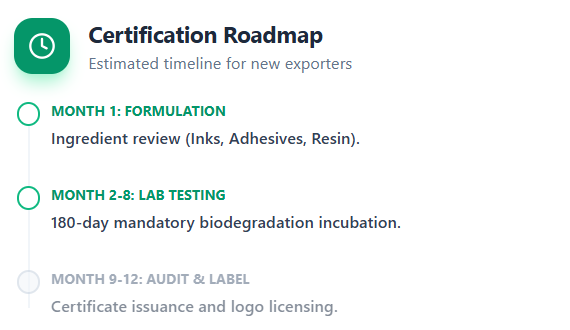
The EN 13432 certification process is thorough and takes time. Exporters should plan for six to twelve months from submission to certificate issuance.
The steps are:
- Formulation review: Full disclosure of all material constituents, including additives, inks, and adhesives
- Laboratory testing: The four-pillar test programme, which alone takes up to 180 days for the biodegradation component
- Documentation review: An independent audit by the certifying body
- Certificate issuance: A certificate with a unique trace code, valid for five years, which licenses the brand to use official logos
The two most recognised certifying bodies are:
- TÜV Austria, which issues the globally recognised OK Compost INDUSTRIAL label
- DIN CERTCO in Germany, which licenses the Seedling Logo for European Bioplastics
Both are EU-accredited and produce certificates that are accepted by customs authorities and major retailers across Europe. When buyers or customs officers ask for documentation, these are the certificates they are looking for.
Common Mistakes Exporters Make with EN 13432
Most EN 13432 compliance failures come down to a small number of recurring errors.
- Assuming resin certification covers the finished product. It does not. A certified PLA resin becomes an uncertified bag the moment you add a non-compostable ink or adhesive. The finished unit must be tested independently.
- Modifying the product after certification. Changing the thickness of a film, adding a lamination, or switching to a different print process without re-testing invalidates the certificate. Thickness alone is one of the most common causes of disintegration failure.
- Labelling industrial products as home compostable. This is a greenwashing packaging EU violation. Industrial and home composting are different environments with different temperature and microbial conditions. A product that meets EN 13432 will not necessarily break down in a backyard bin. Separate certification, such as OK Compost HOME from TÜV Austria, is required for that claim.
- Ignoring EPR registration. Even with a valid EN 13432 certificate, exporters must register with national Extended Producer Responsibility systems. In Germany this means LUCID. In France, the Triman logo is required. Compostable claims under EU law do not substitute for EPR obligations.
FAQs: EN 13432 for Exporters
Is EN 13432 mandatory for exporting to Europe?
Yes. For any packaging marketed as compostable in the EU, EN 13432 is the legal regulatory baseline. Without it, products face customs seizures, retailer delisting, and fines for greenwashing under EU consumer protection laws.
Does EN 13432 mean a product is home compostable?
No. EN 13432 covers industrial composting only, which requires controlled high-heat environments of approximately 58°C. For a home compostable claim, a separate certification such as OK Compost HOME is required.
Can PLA and bagasse products meet EN 13432?
Yes, but with conditions. PLA requires industrial composting temperatures to degrade and will not break down in home bins or landfill. Bagasse performs well but will fail if it carries a plastic or PE coating, or uses inks and adhesives that are not themselves certified.
Can EN 13432 certified products break down in landfills or oceans?
No. These materials are designed for controlled industrial composting environments only. In a landfill, materials like PLA behave almost identically to conventional petroleum-based plastic. In some landfill conditions, anaerobic breakdown can even produce methane, which is worse than no breakdown at all.
How long does EN 13432 certification take, and what documents are needed?
The process typically takes six to twelve months. The documentation required includes the certificate of compostability with a unique trace code, full laboratory test reports covering all four testing pillars, a batch-specific Declaration of Conformity linking production lots to the certified formulation, and confirmation that the entire finished product, including inks and adhesives, is covered by the certification.