
Plastics have given us the convenience of affordable packaging. Yet the very strength that makes them useful is also their biggest flaw. They don’t disappear when discarded.
The search now is to find new materials that offer the convenience of plastics without the headaches. Biodegradable plastics are the answer, and PBAT is one of the most promising candidates on the table.
But as interest in PBAT grows, another question has emerged.
How sustainable is PBAT across its entire life cycle, from raw material to disposal? Recent studies suggest that plant-based PBAT has far lower global warming potential compared to PBAT made from fossil fuels.
As someone who believes sustainability must be proven, I see this comparison as essential. To know whether PBAT can truly help build a circular future, we have to compare both PBAT and Bio-PBAT using science and real numbers.
What Is PBAT and Where Is It Used?
PBAT stands for Polybutylene Adipate Terephthalate. It’s a flexible, strong polyester that behaves like conventional plastic films. But unlike other petroleum-based plastics, it’s biodegradable under the right composting conditions.
How PBAT is made:
- The three key ingredients for making PBAT are adipic acid, terephthalic acid, and 1,4-butanediol. All of these are derived from fossil fuels.
- Through a manufacturing process consisting of esterification and polycondensation, these chemicals combine into the polymer PBAT.
What makes PBAT popular is its strength and flexibility. It is marketed as an eco-friendly alternative to conventional low-density polyethylene in daily use.
It’s already being used in making:
- Packaging films
- Compostable shopping and garbage bags
- Agricultural mulch films
- Disposable tableware and medical supplies
It can be certified compostable under EN 13432 or ASTM D6400. This means it breaks down into carbon dioxide, water, and biomass under industrial composting conditions.
From Freepik
The production and market for PBAT are growing fast. In 2022, China led the world in PBAT production, churning out a million tons. In Europe and India, PBAT adoption is rising. This is especially visible in sectors like food packaging and agricultural films.
But as the world turns to PBAT, how do we make it even better for the planet? That’s where bio-based PBAT steps in.
How Is Bio-PBAT Different from Fossil-Based PBAT?
The key difference between bio-based PBAT and fossil fuel-based PBAT lies in what goes into making them.
Structurally, they are the same. Both PBAT and Bio-PBAT have the same molecule and functions.
However, Bio-PBAT swaps out the chemical-based origin for plant-based raw materials. Instead of using crude oil as input, Bio-PBAT uses:
- Forestry waste, including wood chips and bark
- Agricultural residues such as corn stalks
- Other second-generation biomass
These resources are cheap and abundant and do not compete with food crops, and use what is already labeled for waste.
The technology already exists. Companies like Novamont in Italy already produce bio-based 1,4-butanediol using fermentation. At the same time, researchers are scaling up production of bio-adipic and bio-terephthalic acids.
This is wonderful news for sustainability.
- Bio-based PBAT cuts down on the use of fossil fuel and has a far lower environmental footprint.
- PBAT feedstock now comes from what was once waste. This makes the plastic both compostable and eco-friendly.
- The most important fact is that both are chemically identical with the same properties (toughness and flexibility) and biodegradability.
At Ukhi, we are already scaling these materials to help packaging businesses shift to sustainable choices without sacrificing quality.
How Does Life Cycle Assessment (LCA) Work for Bioplastics?
A life cycle assessment (LCA) looks at a product from manufacturing to disposal. This means measuring its impact from raw materials to manufacturing, distribution, use, and end-of-life.
A proper life cycle assessment of PBAT tracks:
- Whether the raw material is oil or biomass?
- The energy used in the manufacturing process
- What happens at the end of life: composted, landfilled, or recycled?
Researchers usually compare results per one kilogram of plastic resin. At every stage, environmental impact is analyzed for:
- Global warming potential
- Fossil resource use
- Energy and water consumption
- Acidification and eutrophication
Using frameworks such as ReCiPe or CML, life cycle assessment offers a complete picture of the environmental impact. This type of deep analysis is essential for bioplastics, where “bio-based” is not always better.
Since China dominates global production, most PBAT LCAs focus on Chinese data. The results have been nothing short of eye-opening, as we shall see in the next section.
What Do Recent Studies Reveal About PBAT vs. Bio-PBAT?
When we put PBAT vs bio-PBAT head-to-head in a life cycle assessment, what does it show?
The data is striking:
- For conventional PBAT, the feedstock stage (raw materials) alone contributes over 70% of its total environmental impact across 18 categories.
- However, for Bio-PBAT is produced using second-generation feedstocks, such as forestry residues or agricultural waste, the sustainability gains are enormous.
Here is a comparative table.
| Metric | Conventional Fossil PBAT | Bio-based PBAT (2nd Gen Feedstock) | Improvement |
| Global Warming Potential (GWP) | 5.89 kg CO₂-eq / kg | 3.72 kg CO₂-eq / kg | ↓ 37% |
| Overall Environmental Impact | Baseline (100%) | Reduced across 16 of 18 categories | ↓ 15–85% |
| Comparison with Common Plastics | – | 18–32% lower GWP than PVC, PP, HDPE, LDPE, PET | Up to 80% lower in some categories |
Bio-PBAT does not just cut carbon emissions. It delivers across a whole range of environmental benefits, surpassing conventional PBAT and plastics.
From Science Direct
But one must note:
Bio-based raw materials, too, may require some fertilizer and energy, and a small trade-off is possible.
If renewable energy is used in the production process, then a further 10% drop in environmental impact is possible.
This is impressive. The LCA evidence is clear – feedstock choice and energy mix matter most for reducing PBAT’s environmental footprint. At Ukhi, we focus on transparent LCA and real-world testing. We ensure every product meets strict standards for end-of-life performance, so you can make informed decisions.
Next, let’s focus on the main environmental benefits of Bio-PBAT.
What Are the Main Environmental Benefits of Bio-PBAT?
Bio-based PBAT has tangible, measurable advantages:
Lower Carbon Footprint
LCAs show up to a 37% reduction in greenhouse gas emissions versus conventional PBAT. It is also 18 – 32% lower than regular plastics like polyethylene.
Reduced Fossil Fuel Use
Bio-PBAT uses renewable carbon from waste and is thus less tied to oil and gas. This is the crux on which sustainability depends.
Compostable
When properly collected and treated, Bio-PBAT is industrially compostable. This supports a circular economy and reduces landfill waste.
No Threat To Food Supply
By using second-generation raw materials from agricultural residues, forestry waste, Bio-PBAT doesn’t compete with food crops for land or water.
Are there any trade-offs? Yes, a few that are present in every infant industry:
- Bio-PBAT is currently more expensive to manufacture. This is mainly because producing bio-based monomers is still a young industry.
- Sourcing several million tons of second-generation raw materials is challenging on a global scale.
- If made from crops grown with intensive use of fertilizer, Bio-PBAT can have higher nutrient runoff than traditional plastics.
- Finally, without enough industrial composters, Bio-PBAT risks ending up in a landfill. This reduces the biodegradability.
Therefore, Bio-PBAT is obviously a superior choice, but there are bottlenecks, from raw materials to composting, to overcome.
How Does PBAT/Bio-PBAT Perform at End-of-Life?
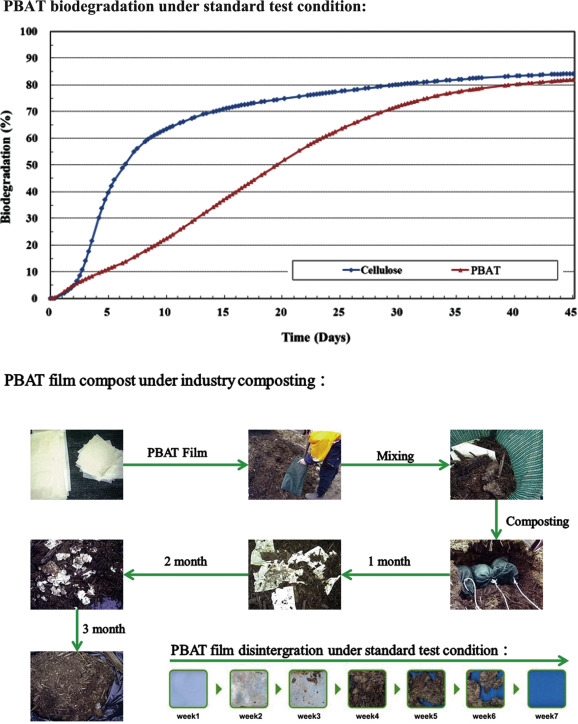
PBAT’s biggest strength lies in how it behaves after use. Under industrial composting conditions, PBAT, whether fossil or bio-based, can degrade completely in a few months.
Here is a table showing how fast it deteriorates and disappears in six months under ideal conditions.
| Environment | Conditions & Certification | Degradation Behavior | Notes & Climate Impact |
| Industrial Composting | Certified under EN 13432 and ASTM D6400.~58°C, high humidity. | Fully biodegrades within 6 months.Converts into CO₂, water, and biomass. | Represents the intended end-of-life route for PBAT-based products. |
| Home Composting | Ambient temperatures, natural microbial activity | Highly variable degradation: from <1% to 21% in 3–6 months.Depends on temperature, microbes, and soil type. | Biodegradation occurs, but incompletely and inconsistently. |
| Landfill | Low-oxygen, biogas plant conditions. | Degradation occurs, but it is slower than in aerobic composting. | It can generate biogas. It is not the primary disposal pathway |
| Climate Impact (Composting) | – | Composting offsets production emissions; one LCA found >10 kg CO₂-eq saved per kg composted vs. landfilling polyethylene. | Demonstrates net-negative carbon potential under optimal management. |
| Microplastics Formation | – | Temporary formation of microplastic fragments. | These particles are short-lived, breaking down fully as biodegradation proceeds. |
In short, if PBAT and Bio-PBAT end up in landfills, the advantages diminish. It will still break down in a few years, but that is not ideal.
Where PBAT Goes From Here
PBAT and Bio-PBAT are about evolution, not immediate replacement. Both are better than conventional plastics. Bio-PBAT has an advantage in sourcing raw materials from forest and agricultural waste and entirely doing away with fossil fuel.
To move forward, we need to invest in a better supply of feedstock, renewable energy for manufacturing, and industrial composting. It won’t happen tomorrow, but it certainly will take place within the next decade.
In my opinion, Bio-PBAT is not a silver bullet, but it gets all of us a step closer to the sustainable future we all want.
Frequently Asked Questions
What is PBAT, and why is it important for sustainable packaging?
PBAT or Polybutylene Adipate Terephthalate is a biodegradable polymer. It can be made from fossil fuel or biomass and used as an alternative to plastic packaging.
How does bio-based PBAT differ from regular PBAT?
Bio-based PBAT differs from fossil fuel-based PBAT in its raw materials. Bio-PBAT refers to PBAT where the starting materials are made from biological sources such as corn starch or sugarcane.
What are the main drawbacks of PBAT and Bio-PBAT?
There are no drawbacks to either PBAT or Bio-PBAT. They are far more eco-friendly than conventional plastics. However, currently, there are some bottlenecks in sourcing raw materials and manufacturing them cheaply.
Does PBAT create microplastics during biodegradation?
Yes, but it is a transitory phase. Inside six months, there are no remnants from PBAT degradation.
Is PBAT better for the environment than traditional plastics?
PBAT meets EN 13432 and ASTM D6400, the EU and US standards for compostable packaging. PBAT breaks down into carbon dioxide, water, and biomass in a few months. This makes it far superior to plastics that take centuries to degrade.