
A lot of fashion teams tell me, ‘Compostable is expensive.’
And I get why.
Most comparisons stop at price per kilo. But packaging does not get bought in kilos.
A bag that looks costlier on a supplier quote can end up cheaper once you account for:
- thickness rules (India’s 120-micron floor)
- taxes and producer fees (common in the UK/EU, expanding in the US)
- freight weight (bags travel by the tonne)
- and the cost of getting a shipment rejected
This is why sustainable fashion packaging needs a better cost model, not a brochure comparison.
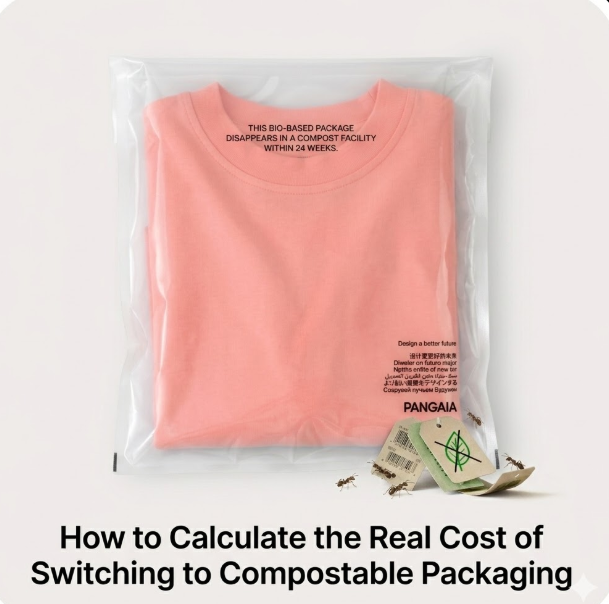
So, how do you calculate the real cost of switching to compostable packaging?
Here are the basic costs you need to consider when switching to any compostable packaging.
What costs do you have to count for in sustainable fashion packaging?
When you switch sustainable clothing packaging, the real cost is more than the bag price. It’s the full cost of running packaging through your business without surprises.
I recommend thinking in six buckets:
1. Material cost
What your supplier quotes you: ₹/kg or $/kg.
2. Bag weight
Two bags can be the same size and look similar, but one can weigh 2 to 3 times more depending on thickness, density, and design.
That weight difference shows up in freight and warehousing cost.
3. Conversion and line efficiency
If your team has to slow the line, change sealing settings, or manage higher scrap, your ‘cheap bag’ stops being cheap.
4. Compliance costs
Compliance can also change your costs, depending on where you sell. You might face packaging taxes (common in the UK/EU) or EPR style producer fees (increasing globally) for using certain plastic packaging items.
Single-use Plastic Packaging Regulation Costs
If you’re a fashion brand shipping across borders, this difference is the strategy.
In India, thin plastic bags have been the centre of regulation. In the UK, packaging policy is designed to create a financial signal. Taxes and reporting frameworks push brands to prove recycled content, material choices, and compliance.
Even if your bag price looks fine, you can still lose money through:
- taxes triggered by material type
- documentation burden
- or misalignment with retailer expectations
The USA has a patchwork pressure. There is less ‘one national rule’ and more ‘state, retailer and brand policy.’ That means your cost risk is often driven by:
- where you sell
- what claims you print (“compostable” is a loaded word in many states)
- and what big buyers demand in their packaging standards
So the compliance cost is present in all three regions, just priced differently.
And once you see that, the next step is to calculate a clean per bag number that finance teams can trust?
But first, you have to decide which material you want to switch to. While paper and cloth based packaging are compostable options, they don’t always meet the performance needs for all packaging needs. Compostable bioplastics are direct eco-friendly alternatives to widely single use plastic.
Now, let’s see how you can calculate the cost of switching to sustainable packaging.
Calculate the cost of switching to compostable packaging step by step

Here is a simple framework I use with sourcing teams to help them calculate the cost of switching to sustainable fashion packaging.
Step 1: Map your bag properties
List your packaging SKUs for garments:
- outer bag (carry / courier / mailer)
- inner polybag (the garment bag)
- liners, sleeves, accessory pouches
- sizes and monthly volumes
Most brands realise here that switching to compostable is not one decision. It comes down to 6 to 20 decisions.
Step 2: Get two quotes that are actually comparable
Ask for quotes in a way that forces apples to apples:
- same bag dimensions
- same closures (adhesive flap, zipper, etc.)
- same print coverage
- same performance needs (tear, drop, humidity handling)
If one quote is for a thicker bag and the other is for a thinner one, you’re not comparing cost, you’re comparing spec mistakes.
Step 3: Convert to cost per bag
Your basic formula is:
Cost per bag = (Price per kg) × (Bag weight in grams ÷ 1,000)
This is where sustainable clothing packaging can surprise you. A compostable film can be higher ₹/kg but still win on ₹/bag if the bag weight is lower.
Step 4: Reduce compliance and producer fees
Create a simple compliance add on or reduce the regulation charges, like taxes or EPR/producer fees, for your compostable packaging.
You might also need to add costs related to:
- certification and testing amortised across volume
- labeling / barcode / documentation work
Step 5: Do a quick sensitivity check
Change three variables and see if your decision still holds:
- resin price ±10%
- bag weight ±10% (design tweaks do this)
Let’s look at a worked example of 100,000 T-shirt bags.
Assumptions
- Order volume: 100,000 garment bags
- Plastic option: thicker conventional film
- Compostable option: thinner compostable film designed for garment packaging
| Item | Plastic bag (example) | Compostable bag (example) |
| Bag weight | 30 g | 12 g |
| Resin / material price | ₹80 per kg | ₹170 per kg |
| Base material cost per bag | ₹2.40 | ₹2.04 |
Now add items that often appear once you operate across regions:
- compliance documentation and labeling effort
- producer fees / taxes where applicable
- freight impact (weight-based)
- failure cost (reprints, relabeling, shipment holds)
You don’t need to overcomplicate this. Start with a small per-bag allowance (even ₹0.10-₹0.50), and refine as you learn.
Now, decide on the metric that matters. For fashion, the best metric is packaging cost per finished garment shipped
Because the business decision is which packaging system reduces total cost, keeps you compliant, and protects buyer trust.
Account for future policy and cost risk
But is your cost stable over the next 12-24 months?
Policy can change your cost overnight. And taxes and compliance frameworks are far from static.
Because packaging economics move for a few predictable reasons.
So account and model compliance cost by about 20% (tax rises, stricter reporting, new labeling rules).
If your decision still works across these three shocks, it’s a strong switch.
But how do you switch without wasting months on trial and error?
At this point, most teams don’t need motivation. They need a supplier partner who reduces risk.
That is where Ukhi typically fits.
We treat compostable packaging like an operational system that works reliably long term across markets. And we do this by offering cheaper and compostable alternatives to single use plastic.
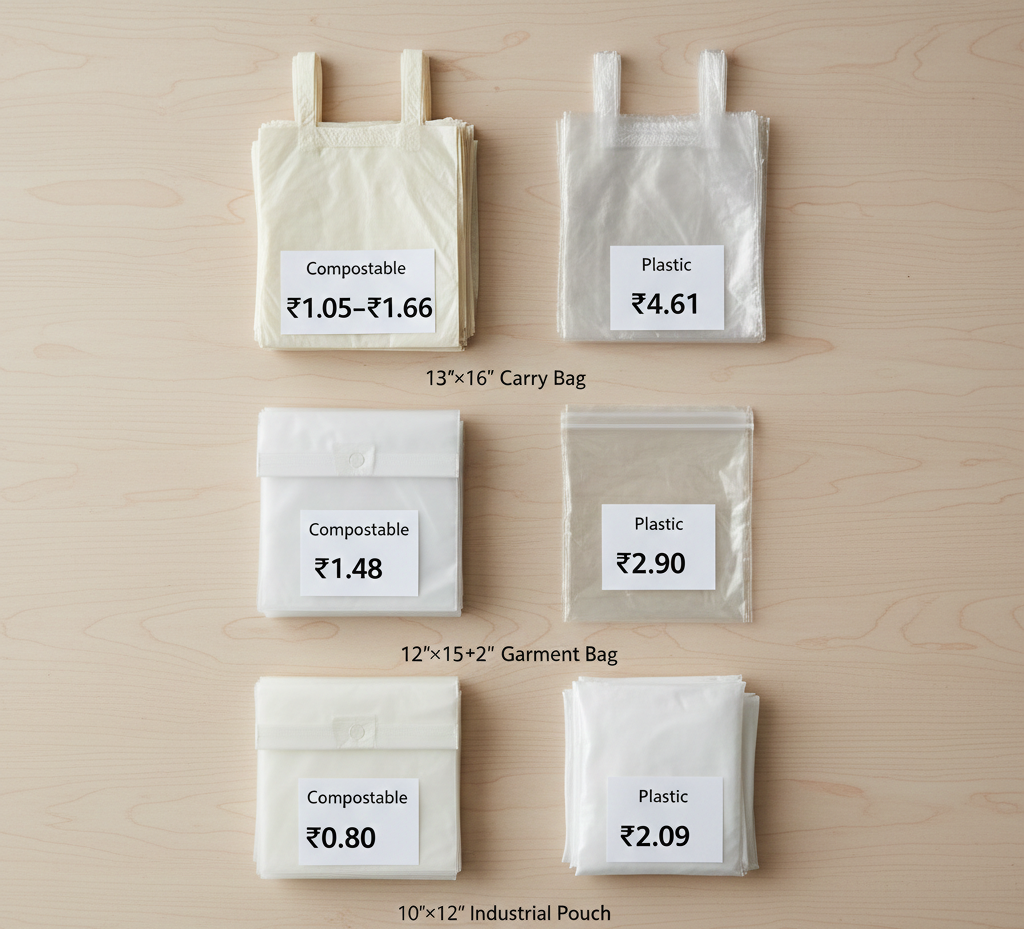
Compostable garment bags made from Ukhi’s bioplastic resin, EcoGran, match traditional plastic in performance. You also don’t have to rework machines or redesign your workflow.
All our materials are made with local agricultural waste in India that support global fashion supply chains. Order a sample kit from Ukhi today and see the difference yourself.
FAQs
- How do I calculate the cost of packaging per bag?
Use price per kg, multiply by bag weight in grams, divide 1,000, then add taxes, EPR, freight, and compliance checks.
- Is compostable packaging always more expensive than plastic?
Compostable packaging can cost more per kilo, but not always higher per bag. Compostables can run thinner and lighter, and may avoid UK plastic tax and some EPR fees, which also makes the total landed cost comparable or lower for brands.
- What should I compare when pricing compostable garment bags?
For sustainable clothing packaging, compare equal size and micron. Ukhi’s EcoGran garment bags beat plastic once weight is counted properly.
- How should I include EPR packaging cost in my calculation?
EPR shifts costs to producers, so plastic looks cheap until reporting and fees hit. Model EPR as price per kg, convert to per bag, and separate India, UK, and US rules by market and review it quarterly.