
Quick Answer: PLA vs PBAT for Compostable Bags
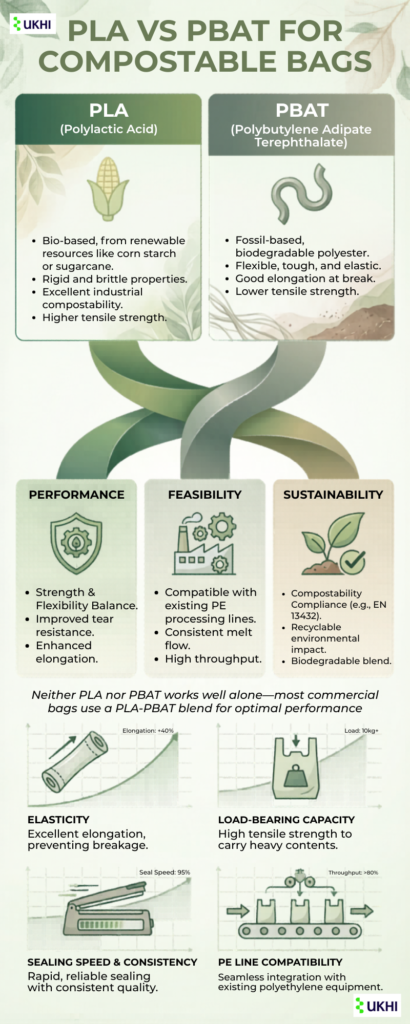
For compostable bags, neither PLA nor PBAT works well alone in real production. PLA is too brittle for flexible films, while PBAT is too soft to hold structure. Most commercial bags use a PLA PBAT blend because it balances stiffness, flexibility, sealing, and machinability on blown-film lines.
PLA vs PBAT: Suitability To Make Compostable Bags
What matters in compostable bag performance is:
- Can the film stretch without tearing?
- Does the bag hold load without sagging?
- Can it seal consistently at high speeds?
- Will it run on existing PE lines without downtime?
PLA and PBAT offer different answers to these questions.
PLA (Polylactic Acid)
- Bio-based polymer (corn, sugarcane)
- High modulus → gives stiffness and “body”
- Low elongation (~10%) → cracks under stress
- Narrow processing window → sensitive to moisture
PBAT (Polybutylene Adipate-co-terephthalate)
- Compostable but typically fossil-derived
- High elongation (~400–500%) → behaves like LDPE
- Excellent flexibility and tear resistance
- Easier film processing vs PLA
The problem is obvious:
- PLA fails under mechanical stress
- PBAT fails to give structural integrity
So the real-world solution is not substitution. It is formulation.
Why a PLA-PBAT Blend Dominates Compostable Bag Manufacturing
In commercial compostable bags, the key performance metric is not biodegradability alone. It is what experts call the balance of:
- performance → does the bag actually work?
- feasibility → can it be produced reliably at scale?
- sustainability → does it meet compostability and regulatory expectations?
A PLA PBAT blend works because it solves all three.
1. Performance: Strength, Flexibility, and Real-World Use
Pure PLA struggles here because it is inherently brittle. Its elongation at break is typically around 10%, which means it cannot absorb stress during lifting or stretching.
PBAT, on the other hand, behaves much closer to conventional film plastics. With elongation levels that can exceed 400%, it can stretch and recover without cracking.
When combined in a PLA PBAT blend, the result is a material that:
- retains enough stiffness to hold shape
- gains the flexibility needed for load-bearing use
- significantly improves tear and puncture resistance
2. Feasibility: Processing, Line Compatibility, and Scale
Even if a material performs well in theory, it must still run efficiently on production lines.
This is where pure PLA creates challenges.
It has:
- a narrow processing window
- high sensitivity to moisture
- a tendency to degrade under excess heat
These factors can lead to:
- inconsistent film quality
- higher rejection rates
- slower line speeds
PBAT improves feasibility because it processes more like traditional polyethylene films. When used in a PLA PBAT blend, it stabilises the material during extrusion and bag-making.
Most commercial blend grades are designed to:
- run on conventional LDPE blown-film lines
- operate within practical temperature ranges (typically around 125–140°C)
- maintain consistent sealing and cutting performance
For converters, this directly translates into:
- fewer machine adjustments
- lower wastage
- more predictable output
3. Sustainability: Compostability, Compliance, and Material Reality
Both PLA and PBAT are compostable, but their sustainability profiles are different, and this affects how they are used.
A PLA PBAT biodegradable blend brings these aspects together.
It allows manufacturers to:
- maintain compostability standards such as EN 13432 or ASTM D6400
- balance bio-based content with functional performance
- tailor formulations for industrial or, in some cases, home-compostable systems
Note: Compliance applies to the final product, not just the resin. The blend, along with thickness, additives, and inks, must meet certification requirements.
From a sustainability standpoint, the blend is a practical route to making compostable bags that actually get used, perform reliably, and still meet regulatory expectations.
Decision Matrix: PLA vs PBAT vs PLA PBAT Blend for Compostable Bags
| Criteria | PLA (Pure) | PBAT (Pure) | PLA PBAT Blend |
| Flexibility | Very low (brittle) | Very high | Balanced |
| Elongation | ~10% | ~450% | 200–300% |
| Tear resistance | Poor | Strong | Strong |
| Stiffness | High | Low | Tunable |
| Seal performance | Inconsistent | Good | Reliable |
| Processing | Narrow window | Easy | Practical for industry |
| Line compatibility | Limited | Good | Designed for PE lines |
| Compostability | Industrial | Industrial + some home | Depends on formulation |
| Cost efficiency | Moderate-high | Moderate | Optimized via blends |
| Real bag use | Not practical alone | Too soft alone | Industry standard |
Conclusion: PLA PBAT plastic in blended form is the only scalable solution for bags.
Compostability & Compliance: What Buyers Should Check
Both PLA and PBAT are compostable, but not under identical conditions.
Key realities:
- PLA typically requires industrial composting (~58°C)
- PBAT can degrade faster in certain environments
- Certification applies to the final product, not just resin
Relevant standards:
- EN 13432 (EU)
- ASTM D6400 (US)
- ISO 17088
Important clarification:
A bag labeled PLA PBAT biodegradable is only compliant if the full formulation, thickness, inks, and additives pass certification. Resin-level claims are not enough for exports.
Expert Insight: PLA vs PBAT For Compostable Bags
Taylor Sparks (Editor-in-Chief, IMI): “Choosing an alternative to plastic… is not as simple as saying we’re going to find something that’s biodegradable. Obviously, you have to balance its biodegradability… with other things like its actual performance”. He advocates for the PFS (Performance–Feasibility–Sustainability) framework, which requires manufacturers to consider all three dimensions simultaneously.
Million Pack: While PLA has a “marketing advantage” due to its 100% bio-based origin, PBAT “leverages existing petrochemical infrastructure, which may provide cost and processing scale advantages.
Unilong Group: From a production standpoint, they note that “PBAT is more expensive to produce than traditional petroleum-based plastics, and PLA is generally more expensive to produce than PBAT”.
“In compostable bags, the question is not PLA or PBAT. The question is how to combine them to meet load, sealing, and processing requirements without compromising compostability. That balance is what defines a commercially viable product.”
Vishal, Founder, UKHI
FAQs
Can PLA be used alone for compostable bags?
No. Pure PLA is too brittle for flexible films. It cracks under stress and fails in load-bearing applications. That is why almost all commercial bags use a PLA PBAT blend instead of standalone PLA.
Why is PBAT used in compostable bags?
PBAT provides flexibility, elongation, and toughness. It allows bags to stretch, carry weight, and resist tearing. Without PBAT, compostable bags would fail during normal handling and usage.
What is a PLA PBAT blend?
A PLA PBAT blend is a combined compostable material where PLA provides structure and PBAT provides flexibility. Ratios are adjusted depending on whether the bag needs stiffness, toughness, or cost optimization.
Can PLA PBAT bags run on PE lines?
Yes, most commercial PLA PBAT plastic grades are designed to run on LDPE blown-film lines. However, they require controlled temperature settings and moisture management due to a narrower processing window.
Get the Right Compostable Bag Material for Your Use Case
At UKHI, we help buyers move from material confusion to application-specific solutions with:
- grade recommendations
- sample kits for real-world testing
- support on processing and compliance
Explore Ukhi bioplastic products.
Because in compostable packaging, the right formulation matters more than the right label.