
A packaging manufacturer in Bangladesh certifies their compostable polybags to be ASTM D6400 compliant. They win a contract with a US retailer. Then a European buyer approaches them. They assume the certification transfers. It does not. The shipment is flagged at Rotterdam. The deal collapses.
This happens regularly, and it costs brands and manufacturers real money.
This page explains both standards clearly.
What Are ASTM D6400 and EN 13432?
ASTM D6400 is a technical specification issued by ASTM International, the American standards body. Its full title is “Standard Specification for Labeling of Plastics Designed to be Aerobically Composted in Municipal or Industrial Facilities.”
It defines the criteria a plastic product must meet to be legally labeled compostable in the United States and Canada. It applies specifically to plastic materials, including films, bags, and resins, intended for aerobic composting under thermophilic, meaning high-heat, conditions.
EN 13432 is the European harmonised standard for packaging recoverable through composting and biodegradation. It was issued by the European Committee for Standardization and provides the legal framework underpinning the EU Packaging and Packaging Waste Directive. If a bag, film, or container carries a compostable claim anywhere in the European Union, passing EN 13432 is a legal requirement.
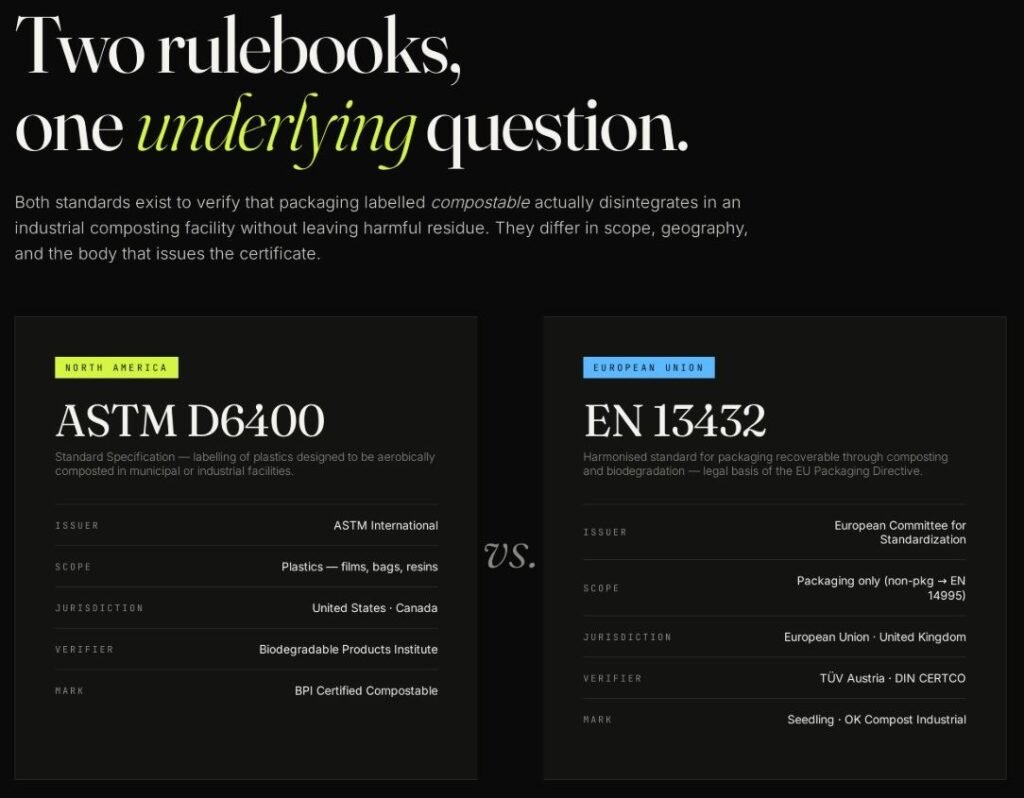
ASTM D6400 is the technical rulebook for North America. EN 13432 is the entry visa for Europe. Both exist to solve the same underlying problem, which is ensuring that packaging labeled compostable actually breaks down in an industrial composting facility without leaving harmful residue in the soil.
ASTM D6400 vs EN 13432: Overview
| Aspect | ASTM D6400 | EN 13432 |
| Primary market | United States and Canada | European Union and United Kingdom |
| Scope | Compostable plastics (films, bags, resins) | Packaging only |
| Biodegradation timeframe | 180 days | 6 months |
| Disintegration timeframe | 12 weeks | 12 weeks |
| Verification body | Biodegradable Products Institute (BPI) | TÜV Austria, DIN CERTCO |
| Certification logo | BPI Certified Compostable | Seedling logo or OK Compost Industrial |
ASTM D6400 Requirements Explained
To comply with ASTM D6400, a plastic product must pass four measurable criteria under controlled laboratory conditions.
Disintegration: No more than 10% of the material’s mass may remain on a 2mm sieve after 12 weeks of aerobic composting.
Biodegradation: At least 90% of the organic carbon must convert to CO2 within 180 days under controlled industrial composting conditions.
Heavy metal limits: The product must not introduce significant concentrations of 11 regulated heavy metals. Concentrations must stay below 50% of the US EPA 40 CFR Part 503 pollutant limits.
Plant toxicity (ecotoxicity): The final compost must be tested on at least two plant types. The results must show no harmful effects on plant emergence or growth compared to a control group.
One important technical detail: ASTM D6400 requires separate biodegradability testing for any organic polymer or modifier added to the formulation at levels between 1% and 10% of total mass.
EN 13432 Requirements Explained
EN 13432 sets four parallel requirements, which closely mirror ASTM D6400 in structure but differ in specific thresholds and application.
Disintegration: After 12 weeks of composting with biowaste, less than 10% of the original mass may remain on a 2mm sieve.
Biodegradability: At least 90% of the material must convert to carbon dioxide, water, and biomass within 6 months.
Strict heavy metal limits: EN 13432 sets specific numeric limits per element. Lead and chromium must stay below 50 ppm. Mercury must stay below 0.5 ppm. These limits are systematically lower than those in ASTM D6400, making EN 13432 the stricter standard on chemical safety.
Ecotoxicity and plant growth: Scientists compare plant growth, typically using summer barley, in compost made with the test packaging versus a control. Both emergence rate and biomass must exceed 90% of the control result.
ASTM D6400 vs EN 13432: What Are The Key Differences
| ASTM D6400 | EN 13432 | |
| What it covers | Compostable plastics: films, bags, resins | Packaging only |
| Primary market | United States and Canada | European Union and United Kingdom |
| Legal status | Required for compostable labeling in the US | Required by law for compostable claims in the EU |
| Biodegradation required | 90% of organic carbon to CO2 within 180 days | 90% of organic carbon to CO2 within 6 months |
| Disintegration required | Less than 10% residue over 2mm after 12 weeks | Less than 10% residue over 2mm after 12 weeks |
| Heavy metal thresholds | Based on 50% of US EPA sludge limits (moderate) | Absolute numeric limits per element (stricter) |
| Ecotoxicity test | Plant growth and seed germination on 2+ plant types | Plant growth using barley or cress, results must hit 90% of control |
| Minor ingredient testing | Yes, separate testing required for additives at 1% to 10% of composition | Under revision to match ASTM; currently tests finished product |
| Certifying body | Biodegradable Products Institute (BPI) | TÜV Austria, DIN CERTCO |
| Certification logo | BPI Certified Compostable mark | Seedling logo or OK Compost Industrial |
| Accepted in the other market | Not accepted independently in the EU | Not a legal substitute for ASTM D6400 in the US |
| Non-packaging items | Covered under this standard | Covered under EN 14995, not EN 13432 |
| Recommended for global exporters | Obtain alongside EN 13432 for dual coverage | Obtain alongside ASTM D6400 for dual coverage |
Who Do ASTM D6400 and EN 13432 Apply To?
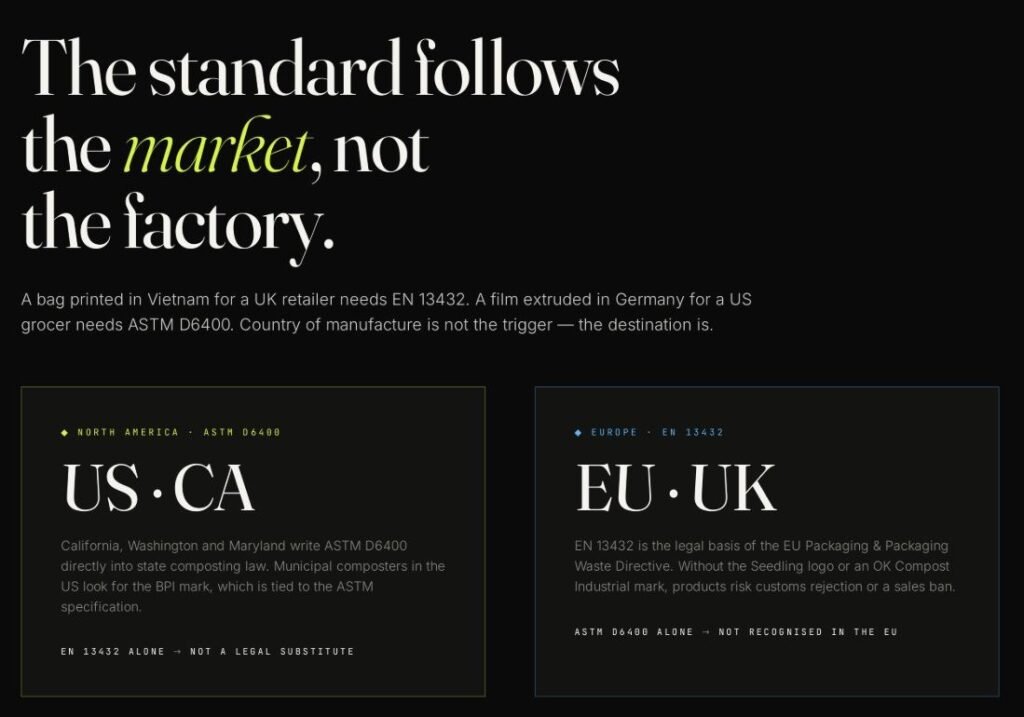
Both standards apply to manufacturers and exporters of compostable packaging, but the trigger is always the target market, not the country of manufacture.
A factory in Vietnam producing compostable mailers for a UK brand needs EN 13432.
A factory in Germany producing compostable films for a US retailer needs ASTM D6400.
The standard follows where the product is sold, not where it is made.
FAQs: ASTM D6400 and EN 13432
Is ASTM D6400 accepted in Europe?
Generally, no. EN 13432 is the legal requirement for any product marketed as compostable in the EU. ASTM D6400 is not recognized as a legal substitute. Without EN 13432 certification from TÜV Austria or DIN CERTCO, products risk customs rejection or a ban from sale.
Is EN 13432 accepted in the United States?
Not as a direct legal substitute. US state laws, particularly in California, Washington, and Maryland, specifically require ASTM D6400 compliance for compostable labeling. US municipal composters also look for the BPI mark, which is tied to ASTM standards.
Do I need ASTM D6400 or EN 13432 for export packaging?
It depends entirely on where the product is sold. EU and UK markets require EN 13432. US and Canadian markets require ASTM D6400. For global distribution, dual certification covering both standards is strongly recommended.
Can one product comply with both ASTM D6400 and EN 13432?
Yes. Because the core testing protocols are very similar, a single product can be submitted for both programmes and receive dual certification. Many manufacturers do this to cover both the European and North American markets from a single formulation.
Does EN 13432 apply only to packaging?
Strictly speaking, yes. EN 13432 is scoped to packaging materials. Non-packaging plastic items in Europe fall under EN 14995. Some certification bodies extend their compostability schemes to cover tableware and similar products, but they do so under a different standard.