
The Cost Reality: Compostable vs Plastic Packaging in India (2026)
Compostable vs plastic cost in India still shows a gap. Compostable and biodegradable products typically cost 2x to 3x more than conventional plastic alternatives on a per-unit or per-kg basis. That is a real difference and it deserves to be acknowledged upfront.
But plastic pricing is no longer the stable baseline it used to be.
Industry projections for April 2026 indicate a 50 to 60% jump in conventional plastic prices, driven by rising polymer costs and supply chain disruptions in West Asia. To put that in concrete terms: a PET unit that costs Rs. 15 today could approach Rs. 22 to 24 by mid-2026. That kind of movement changes the math significantly for buyers planning procurement over a 12 to 18 month horizon.
Beyond raw price, there is a compliance layer that is now impossible to ignore. India’s Extended Producer Responsibility (EPR) framework is actively modulating fees upward for fossil-based polyolefins, which means the operational cost of using conventional plastic is rising independent of market prices. Mandatory traceability QR codes on all plastic packaging became a requirement from July 2025, adding another compliance cost that did not exist two years ago.
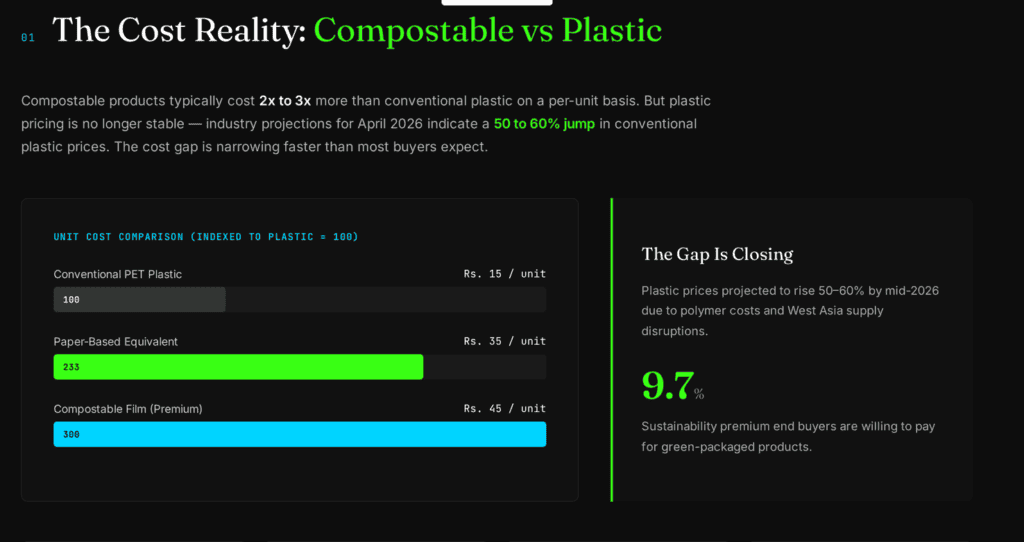
Consumers are shifting too. Research shows a 9.7% sustainability premium that end buyers are willing to pay for sustainably packaged products, with some categories accepting a 20 to 25% surcharge for clearly green packaging. That premium partially offsets the higher unit cost of compostable formats for the brands using them.
The biodegradable vs plastic cost comparison in 2026 is therefore a total cost of ownership question, not a unit price question.
Cost Breakdown of Compostable Packaging: Material, Conversion, and Logistics
Understanding why compostable packaging costs more requires looking at three separate layers of the supply chain.
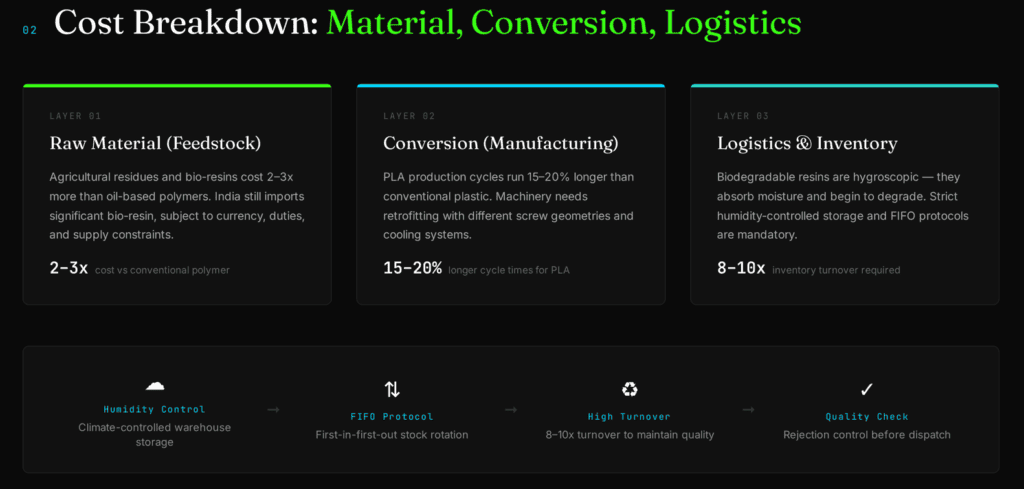
Raw Material (Feedstock)
The base materials for compostable packaging, primarily agricultural residues like sugarcane bagasse and corn starch, or bio-resins like PLA and PBAT, are more expensive to source than oil-based polymers.
India still imports a significant portion of its bio-resins, which means the raw material cost for bioplastics is subject to currency exchange, import duties, and international supply constraints. The result is feedstock that can cost 2 to 3 times more than conventional polymer resin on an equivalent weight basis.
Conversion (Manufacturing Process)
Compostable materials are more demanding to process. Production cycle times for PLA, one of the most common biopolymers, can run 15 to 20% longer than conventional plastic because the material requires slower cooling and crystallization.
Manufacturers also need to retrofit machinery with different screw geometries or specialized cooling systems because bioplastics have lower heat distortion temperatures than conventional polymers. This capital expenditure gets built into the unit price. These are cost drivers for compostable packaging that buyers rarely see but always pay for.
Logistics and Inventory
Unlike petrochemical plastics that can sit in a warehouse for years, biodegradable resins are hygroscopic, meaning they absorb moisture from the air and begin to degrade. This creates strict inventory requirements:
- Humidity-controlled storage
- First-In-First-Out (FIFO) protocols
- High inventory turnover, typically 8x to 10x, to maintain material quality
A manufacturer who does not manage this correctly ends up with compromised material, which either raises rejection rates or reaches the customer as a substandard product.
Compostable Packaging Cost by Type: 2026 Price Benchmarks
The table below reflects typical wholesale and bulk pricing in the Indian market for 2026. These are not retail prices.
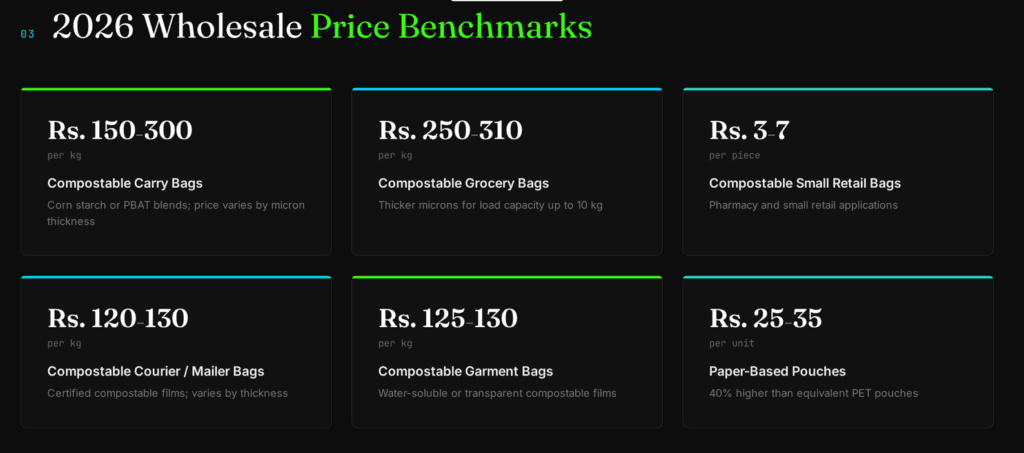
They represent what a buyer at reasonable order volumes should expect to benchmark against.
| Product Type | 2026 Wholesale Benchmark | Notes |
| Compostable Carry Bags | Rs. 150 to Rs. 300 per kg | Corn starch or PBAT blends; price varies by micron |
| Compostable Grocery Bags | Rs. 250 to Rs. 310 per kg | Thicker microns for load capacity up to 10 kg |
| Compostable Small Retail Bags | Rs. 3 to Rs. 7 per piece | Pharmacy and small retail applications |
| Compostable Courier Bags / Mailers | Rs. 120 to Rs. 130 per kg | Certified compostable films; varies by thickness |
| Compostable Garment Bags | Rs. 125 to Rs. 130 per kg | Water-soluble or transparent compostable films |
| Paper-Based Pouches | Rs. 25 to Rs. 35 per unit | 40% higher than equivalent PET pouches |
The compostable carry bag cost and compostable garment bag price are the most commonly benchmarked by apparel and retail buyers. The compostable courier bag cost has become a priority for e-commerce brands, particularly as platform-level sustainability requirements begin to emerge.
How to Reduce Compostable Packaging Cost: Practical Levers
The unit price is not fixed. There are real ways to bring it down without compromising on compliance or quality.
- Use digital printing for smaller runs. For order quantities between 500 and 1,000 units, digital printing eliminates the one-time plate or cylinder setup fees that make small flexographic print runs disproportionately expensive.
- Consolidate your order across product types. Ordering compostable carry bags, PLA lids, and paper cups from a single supplier increases your total order value, which unlocks better per-unit pricing and reduces the per-shipment logistics cost significantly.
- Use stock molds over custom tooling. Custom mold development adds lead time (20 to 30 days) and a significant upfront tooling fee.
- Bulk pricing for compostable packaging follows the same logic as any manufactured product: the more volume you commit to, the better the rate. Most manufacturers in India have price breaks at 5,000 units, 10,000 units, and above.
FAQs on Compostable Packaging Cost in India (2026)
What is the average compostable packaging cost in India in 2026?
It depends on the format. Compostable packaging cost in India ranges from Rs. 3 to Rs. 7 per piece for small retail bags, Rs. 150 to Rs. 300 per kg for carry bags, and Rs. 250 to Rs. 310 per kg for grocery bags. Premium printed paper gift bags can go up to Rs. 20 per piece.
Is compostable packaging more expensive than plastic in India?
Yes, typically 2x to 3x more. A plastic PET unit might cost Rs. 15 while a paper equivalent costs Rs. 35. However, with plastic prices projected to rise 50 to 60% in 2026 and EPR compliance fees increasing, the compostable vs plastic cost gap is narrowing faster than most buyers expect.
What affects compostable packaging cost the most?
The four biggest cost drivers for compostable packaging are imported bio-resin feedstock, longer processing cycle times for biopolymers like PLA, legacy manufacturing infrastructure with lower throughput, and customisation variables like print colours and special features.
What is the MOQ for compostable packaging in India?
Compostable packaging MOQ in India is not a single number. It varies significantly by material and production method:
- Bagasse tableware: 10,000 to 50,000 pieces
- PLA products: 20,000 to 100,000 pieces, driven by injection moulding setup costs
- Paper packaging: 50,000 to 100,000 pieces due to printing and coating setup complexity
- Flexible pouches: 5,000 to 10,000 pieces for standard custom formats
- Digital printing: as low as 500 to 1,000 units, because it eliminates plate and cylinder costs entirely