
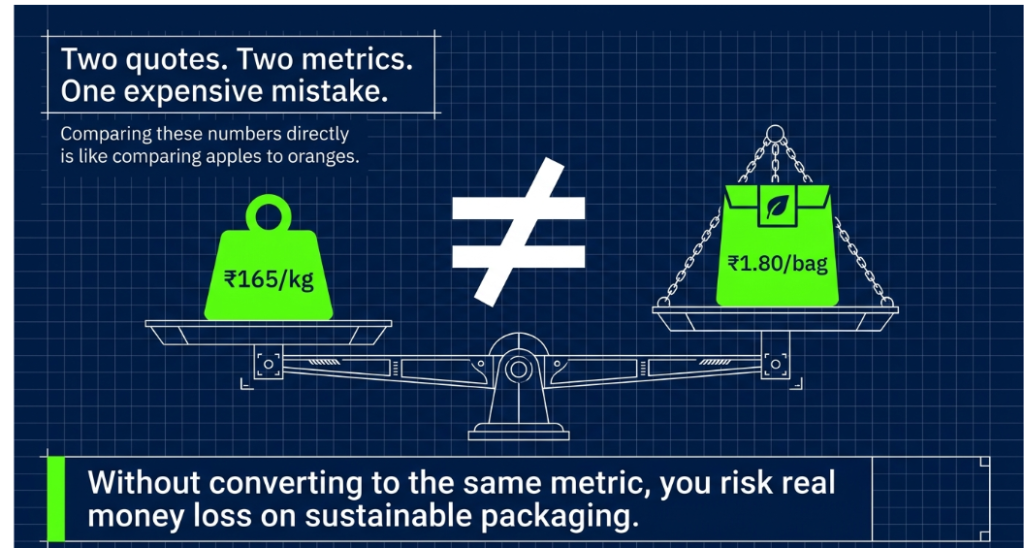
You receive two quotes for compostable packaging, and they look completely different. One supplier says ₹165/kg. Another says ₹1.80/bag. Which one is actually better?
There is no single answer to this question. That’s because neither number tells you the full story on its own. And without converting them to the same metric, you’re comparing apples to oranges. When comparing sustainable packaging costs in bulk, this can lead to real money loss.
In this guide, we walk you through the right way to compare sustainable packaging costs. Read on to see what the numbers really mean.
Understanding the Two Common Compostable Packaging Pricing Models
When evaluating sustainable packaging costs, you’ll encounter two distinct pricing approaches. Each has its own logic. Neither is wrong. But they measure different things. Understanding both helps you make smarter decisions about your packaging procurement.
Per-Kg Pricing
Manufacturers think in kilograms because that’s how they buy their raw materials. A kilogram of PBAT resin has a market price. A kilogram of corn starch blend costs differently. When suppliers quote you per kg, they’re passing that material-based pricing directly to you. It’s production-flexible too. Whether you’re ordering custom sizes, speciality films, or massive bulk volumes, the per-kg model adjusts based on what you’re actually specifying.
Per-Bag Pricing
Per-bag pricing removes the math entirely. You see ₹1.80 per bag, and that’s what you’re paying. No weight variables, no calculations, no surprises. Distributors and finished-product suppliers typically use this model. That’s mainly because buyers like knowing exactly what they’re spending without a lot of math.
| Factor | Per-Kg Pricing | Per-Bag Pricing |
| Advantages | Material cost transparency Flexible for custom sizes Better pricing for orders of 10,000+ bags Scales with business growth Ideal for bulk procurement | Immediate cost clarity Easier budgeting Better for small orders Good for testing new suppliers |
| Disadvantages | Weight variations affect final price More complex quotation comparison | Less cost-effective for bulk orders Limited room for negotiation Less flexibility for customization |
| Ideal For | Established businesses with stable, predictable monthly demand Businesses with warehouse space for bulk inventory Buyers prioritising the lowest unit cost Companies scaling production | Businesses testing new suppliers Orders below 5,000 bags per month Buyers needing multiple bag formats Businesses that prefer simple budgeting |
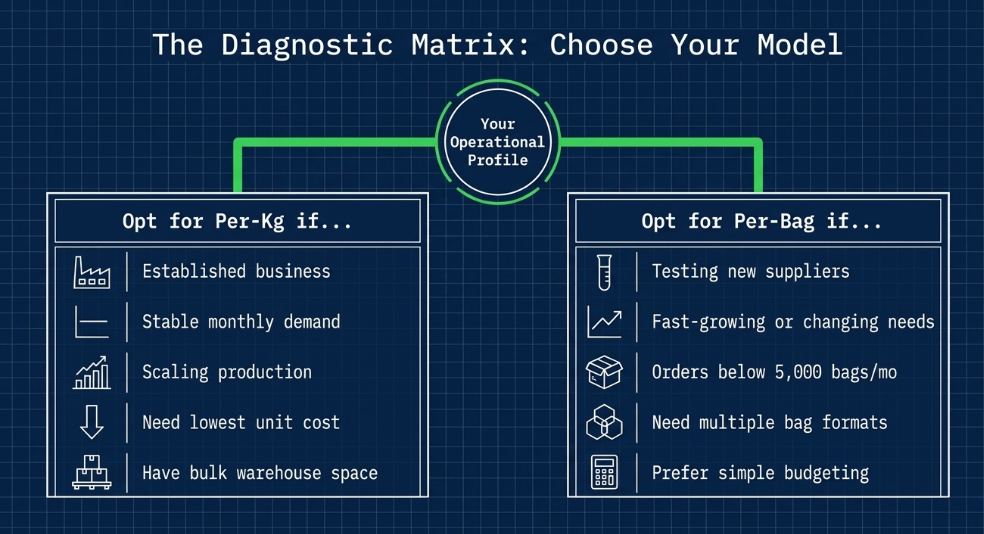
Overall, it makes sense to get per-kg pricing if you’re established and ordering at scale. Pick per-bag if you’re testing, growing, or need budget simplicity.
How to Compare Per-Kg vs Per-Bag Prices
The comparison looks complicated at first. But if you break it down into actual steps, it’s straightforward. But first know that there are specific factors that drive sustainable packaging cost. They include:
1. Bag Dimensions
Bigger bags need more material. A 25cm × 35cm compostable mailer uses ~40% more resin than a 20cm × 30cm compostable pouch because of the increased surface area.
2. Film Thickness (Microns)
Thicker film means heavier material. A 60-micron compostable film weighs noticeably more than 50-micron film of the exact same dimensions. That weight difference directly hits your per-unit cost.
3. Material Composition
Not all resin blends are created equal. Pure PBAT costs more than PBAT + PLA blends. Corn starch-based compositions cost differently again. The blend you choose matters to both price and performance.
4. Printing Coverage
What you print on the bag affects production costs. Full-color, multi-side printing requires more ink and production time than basic single-color printing on one side.
5. Closures & Sealing
If you want zip-lock closures or adhesive strip closures, you’re adding 1-3 grams per bag compared to a simple heat-sealed bottom. That increases per-bag cost.
6. Certifications
Third-party certifications like ISO 17088 or EN 13432 aren’t free. They add overhead to production because the manufacturer has to run compliance testing, handle documentation, and validate the entire supply chain. Certified bags cost more because you’re actually paying for proof.
These six factors compound. A custom bag loaded with premium specifications can cost 3-4x more than a basic option. But each factor exists for a reason tied to what you actually need and what your market demands.
As Vishal, Founder of Ukhi, tells procurement teams, “Sustainable packaging cost isn’t just the material price. It’s the finished product specification. Two suppliers can quote you the same ₹/kg. But if the bag thickness, size, or seal structure is different, your actual per-unit cost is completely different.”
Here’s a real example of how this works in practice:
Supplier A quotes ₹165/kg for a 12g compostable bag. Supplier B quotes ₹1.80 per bag for a 9g bag. Which is cheaper?
Let’s convert both to the same format:
For Supplier A: Cost per bag = (Bag weight in grams × Price per kg) ÷ 1000 (12 × 165) ÷ 1000 = ₹1.98 per bag
At first glance, Supplier B looks like the winner. But the bags weigh differently, which changes everything.
| Supplier | Quoted Price | Bag Weight | Equivalent Price per Bag | Equivalent Price per Kg |
| Supplier A | ₹165/kg | 12 g | ₹1.98/bag | ₹165/kg |
| Supplier B | ₹1.80/bag | 9 g | ₹1.80/bag | ₹200/kg |
This shows that supplier B is more expensive per kilogram. The per-bag price looks attractive only because the bags are thinner. Thinner bags mean less durability, which could cause problems depending on what you’re packing.
This is exactly why you can’t just compare headline prices. If you do that, you’ll end up choosing a supplier that costs more in the long run despite a lower price tag.
Questions Buyers Should Ask Every Supplier
Before running calculations, make sure you have complete information. These nine questions transform vague quotes into apples-to-apples comparison.
Ask every supplier providing compostable packaging pricing:
- What is the weight per bag? Get this in grams, not estimates. Ask for variance tolerance too.
- What resin blend is used?
- What thickness is quoted?
- Does the quote include printing? If yes, what type—single color, multi-color, full coverage?
- Are certifications included?
- Is freight included in the price? Or is it ex-factory?
- Is GST included?
- What is the minimum order quantity?
- Are tooling costs extra?
Clear answers to these questions takes your sustainable packaging cost comparison from guessing to precision. Suppliers who answer clearly are the ones worth working with.
Selecting the Right Compostable Packaging Pricing
Most procurement teams look for a lower number when comparing sustainable packaging cost. That’s the wrong move. A lower number doesn’t mean you’re getting a better deal. Sometimes it just means you are comparing two different things using the same yardstick. So, before you even look at quotations side by side, make sure you’re actually comparing the same thing. Dig into the specs. Then convert everything into a common unit so you’re looking at actual equivalents. Spending a few extra minutes getting the comparison right, can help you achieve long-term savings without cutting corners.
Not sure which pricing model makes sense for your situation? At Ukhi, we can help strip away the confusion around compostable packaging costs. We offer transparent pricing, clear specifications, and expert guidance on film grades, certifications, and costs. Reach out to us on WhatsApp or email [email protected] if you want to talk through your packaging requirements.
FAQs
Which pricing model is cheaper for compostable packaging—per-bag or per-kg?
Neither model of compostable packaging cost is inherently cheaper. It completely depends on your volume and what your bag specifications actually are. The key is converting both quotes to ₹/bag using the actual formula, then comparing those numbers side by side. That’s your real sustainable packaging cost comparison.
Can I mix per-bag and per-kg suppliers for different compostable packaging formats?
You absolutely can. A lot of brands do this. You might source your standard mailers from a per-kg supplier and grab custom-printed sleeves from a per-bag distributor. Just make sure you’re tracking costs consistently across your different suppliers. With that you ensure that you don’t lose visibility into what you’re actually spending. And obviously, confirm that all your suppliers meet your certification requirements.
Are there quality differences between per-bag and per-kg compostable packaging?
Not necessarily. But per-kg suppliers often maintain tighter weight tolerances on PBAT and certified bags. That’s because they’re manufacturing at scale with systems designed for consistency. Per-bag suppliers are usually distributors. So quality depends on who they partner with and how strict those partnerships are. Your sustainable packaging cost should reflect this difference.