
India banned plastic carry bags below 120 microns in 2022. Suddenly, every eCommerce store and retailer was scrambling to find alternatives. Meanwhile, customers also started asking pointed questions about packaging.
However, finding a trustworthy compostable carry bag supplier in India is genuinely difficult. You’ve got bags in the market without proper certifications. You’ve got suppliers with delivery schedules you can’t rely on. And then there are the ones charging premium prices for mediocre quality. I’ve seen businesses get burned more than once.
Below, we explain the 7 factors to consider when evaluating compostable carry bag suppliers in India.
7 Factors to Consider When Choosing a Compostable Carry Bag Supplier in India
The label “compostable carry bag” isn’t enough. It’s ambiguous and not always compliant. Here’s how to choose a compostable carry bag supplier:
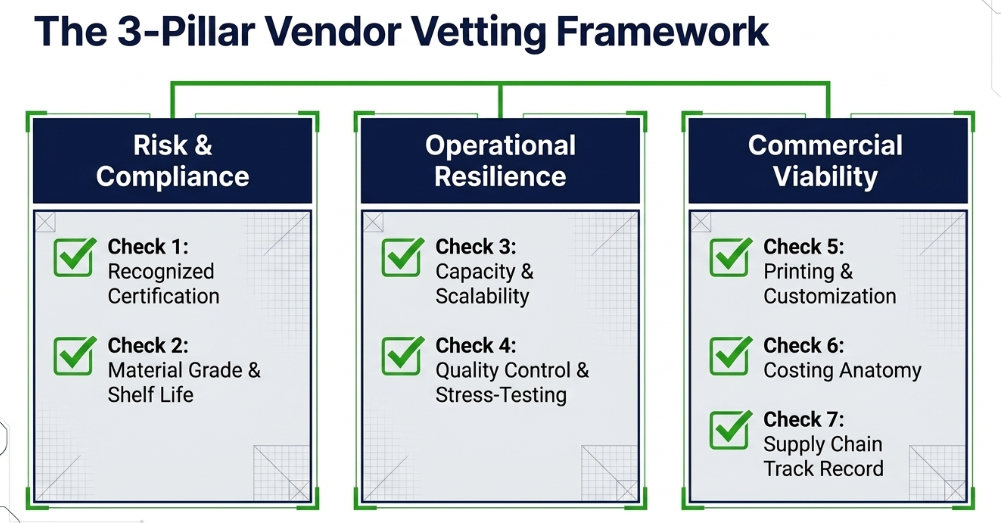
Check 1: Verify Certification Against Recognized Standards
A bag that claims to be compostable is different from one that’s certified as compostable. The difference matters more than you’d think. It’s valid proof that the bag actually performs the way it’s supposed to. Without it, you’re essentially taking a supplier’s word for it. And that’s how people end up with bags that don’t break down properly.
In India, IS 17088 is the standard you need to look for. It’s the BIS certification for compostable plastics. If you’re exporting to European markets, EN 13432 is the equivalent.
Here’s why certification actually protects you:
- The bag disintegrates within a specific timeframe (usually 90-180 days under industrial composting).
- No toxic heavy metals leach out during the breakdown process.
- The compost quality stays intact.
Red flag: A sustainable packaging supplier making compostable claims without providing certification documents.
Check 2: Understand the Material Grade & Shelf Life
Most compostable carry bags are made from blends of PBAT and PLA. Sometimes they include starch additives too. PBAT gives the bag flexibility and tear resistance, which matters because your bags need to hold weight and survive transit. PLA handles the stiffness and printability. The ratio between these two materials directly impacts how well the bag performs. The material composition also determines shelf life. A well-formulated blend typically lasts 12 to 24 months if it’s stored properly. But moisture, heat, and light degrade the material faster. So, a supplier who stocks bags in a humid warehouse will see degradation accelerate. A sustainable packaging supplier with climate-controlled storage will maintain consistency.
When you contact a supplier, ask for:
- Detailed material specification sheets (not just “compostable plastic”)
- Expected shelf life under their storage conditions
- How they store inventory to prevent premature degradation
- What batch testing they do to ensure consistency
What separates the real manufacturers from the ones just trying to make a quick buck? Third-party material test reports that show polymer composition, molecular weight, and shelf-life validation.
Check 3: Assess Production Capacity & Minimum Order Quantities
Your ability to scale is tied to your supplier’s production capacity and MOQ. Most compostable carry bag suppliers in India have MOQs ranging from 500 to 2,000 bags. For custom-printed runs, you’re looking at committing to around 250-300 kg of material. Some manufacturers will do smaller sample runs, but they’ll charge a premium per unit.
The questions you need to ask yourself about production:
- Can they actually handle seasonal demand spikes?
- What’s their current production backlog?
- If your business grows 3x in a year, can they grow with you?
- What are the actual lead times for standard orders versus custom orders?
Here’s the trap most people fall into: you find a supplier and they hit your initial needs perfectly. But then your business takes off. You go back and ask them to 3X your order, and suddenly they can’t scale. Now you’re stuck either finding a new supplier (expensive, time-consuming) or staying small. A supplier with rigid MOQs becomes a bottleneck.
But a sustainable packaging supplier who negotiates MOQs based on long-term volume commitment? That’s not just a vendor, that’s a partner.
Check 4: Review Quality Control & Third-Party Testing
Compostable carry bags are not just a bag. It is a part of your brand and needs to actually work for your specific use case. The manufacturers who take this seriously don’t just rely on the material supplier’s certification and call it a day. They batch-test every single production run. Here’s what they’re checking:
- Seal strength. How much weight can that sealed edge actually hold before it gives out?
- Puncture resistance. How sharp does an object need to be before the bag tears?
- Thickness uniformity. Is every single bag the same thickness, or are there variations?
- Opacity. Can you see through it or not?
- Dimensional accuracy. Are the bags actually the right size, or are they off?
Before you commit to a large order, demand a sample kit (usually 10-50 bags, not just one prototype). Run your own durability tests. Put them through what your actual customers will put them through. This matters because you’re not just buying a product. You’re buying a reputation insurance policy. A bag that fails in the field doesn’t just lose you that customer. It creates complaints, returns, social media posts, and damage to your brand that takes months to recover from.
Check 5: Evaluate Customization & Printing Options
Custom printing turns a functional bag into a brand statement. But printing isn’t straightforward. Different methods (flexography, digital, rotogravure) produce completely different results. And then there’s the ink question. Water-based inks align with your sustainability story. But solvent-based inks can affect your compostability claims.
When you’re talking to a supplier about printing, these are the conversations you need to have:
- What printing methods do they actually offer, and what are the lead times for each? Different methods have different timelines.
- What ink systems do they use? Water-based, soy-based, solvent-based? Get specifics.
- How do they handle design approval? Do they charge for iterations, or are revisions included? This adds up fast if you’re not careful.
- Custom sizing options and any hidden costs. Don’t get surprised by upcharges later.
- Turnaround time for custom print samples. You want to see how your design actually looks before committing to 10,000 units.
Custom printed compostable bags should visibly communicate disposal instructions and certification right there on the bag. A reliable and affordable compostable packaging supplier in India will help you design this into the layout from the start, not tack it on at the end like it’s an obligation.
Check 6: Compare Pricing & Payment Terms Transparently
Price transparency tells you everything about how a supplier does business. You need an affordable compostable packaging supplier in India but one that also offers consistent quality. And a legitimate quote should break down exactly where your money’s going:
- Raw material cost per unit
- Processing and converting cost
- Custom printing cost
- Packaging and shipping
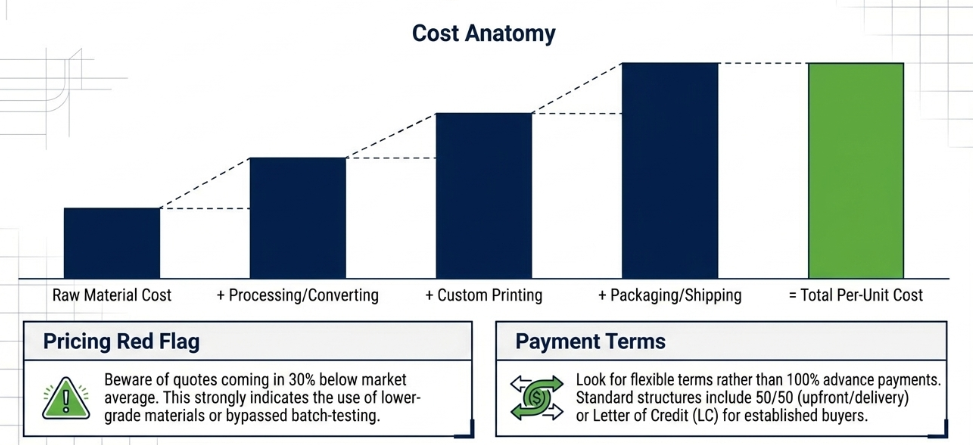
Hidden costs that are a massive red flag include expedited shipping fees, sampling charges or minimum print run surcharges.
Check 7: Verify References & Supply Chain Reliability
A manufacturer’s track record is the best predictor of future performance. So, ask for references from businesses similar to yours. Then actually reach out to those references and ask them specific questions:
- Did the sustainable carry bag supplier meet delivery deadlines? Not just once, but consistently?
- Was quality consistent across batches? Or did you get variations that caused problems?
- How did they respond when problems actually arose? Did they take responsibility, or did they deflect?
- Would you use them again?
Also, find out how long the supplier has been in business. A manufacturer that’s been around for 10 years has weathered market cycles. A 2-year-old startup might disappear the moment business slows. That’s not necessarily a knock against startups though. They’re often more flexible but you should know exactly what you’re signing up for.
Next, here’s what to ask the compostable carry bag supplier:
- From where do you source their raw materials?
- Are you dependent on a single material supplier?
- What happens if your primary supplier has production issues?
Finally, communication matters. See if you can reach them via email, WhatsApp, or phone and how soon they respond.
Switching to Sustainable Packaging with the Right Compostable Carry Bag Supplier
Finding the right compostable carry bag supplier in India is a brand investment. A dependable supplier understands your compliance needs, scales with your growth, and protects your reputation by delivering consistent quality. As Vishal Vivek, Co-founder of UKHI, puts it, “The supplier you choose becomes part of your brand story. A supplier who cuts corners on certification or quality will eventually cut corners on your business relationship.”
Now that you know how to choose compostable carry bag suppliers, the next step is to start evaluating vendors. Want to discuss supplier options, evaluate compostable carry bags for your specific use case, or need recommendations? Reach out to us, at UKHI, to get vendor selection assistance or to directly source compostable packaging materials. Send us a message on WhatsApp to fill in the direct contact form here.
FAQs
How much do compostable carry bags cost in India?
Pricing varies depending on factors like size, material grade, MOQ, and customisation. If you’re going with standard unprinted bags, you’re looking at anywhere from ₹2 to ₹8 per unit. Custom-printed bags run ₹3 to ₹15+ per unit. The big thing is volume. Once you hit 10,000+ units, the per-unit costs drop significantly, so it’s worth negotiating at scale.
Do I need different compostable carry bags for use in India and for exporting?
Not necessarily. But standards aren’t universal. If you’re selling in India, you need IS 17088 certification. But if you’re exporting to the EU, they want EN 13432. US buyers look for ASTM D6400 with BPI certification. The good news? A lot of compostable carry bag suppliers in India produce bags certified to multiple standards. That means one product can actually work across multiple markets. Just confirm with your supplier upfront which certifications their bags hold before you commit to an export order.
Can I get customised compostable carry bags for my brand?
Absolutely. Most manufacturers will do custom printed compostable bags in different sizes and colors. Fair warning though: MOQ for fully custom runs typically start at 5,000-10,000 bags. Lead times usually run 3-4 weeks for custom orders. If you want smaller sample runs to test first, that’s possible too, but you’ll have to pay a premium per unit. It’s worth it though, if it saves you from ordering 10,000 bags that don’t work for your use case.