


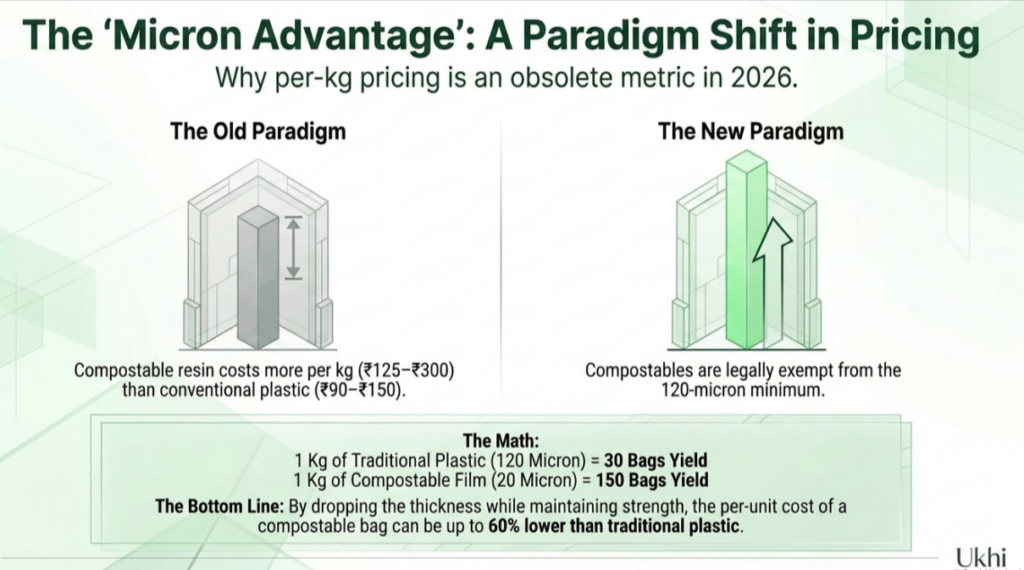
Procurement teams who need to buy compostable garment bags in India need a garments bags manufacturer that holds valid CPCB registration, IS/ISO 17088 certification on the finished bag, and can supply trial quantities for validation. The film thickness required for garment applications is 20–40 microns, and at these gauges, compostable bags can cost up to 60% less per unit than conventional plastic bags that have to be at least 120 microns by law.
UKHI is an integrated compostable garment bags manufacturer in India. We make OUR EcoGran resin in-house and supply finished biodegradable and compostable transparent and translucent garment bags. Please write to us and ask us to ship a pack of free samples.
What to Look for in a Compostable Garment Bag Supplier
Any procurement team looking to source compostable garment bags in India in 2026 has to find a supplier from a market where many suppliers claim “eco-friendly” without the paperwork to back it.
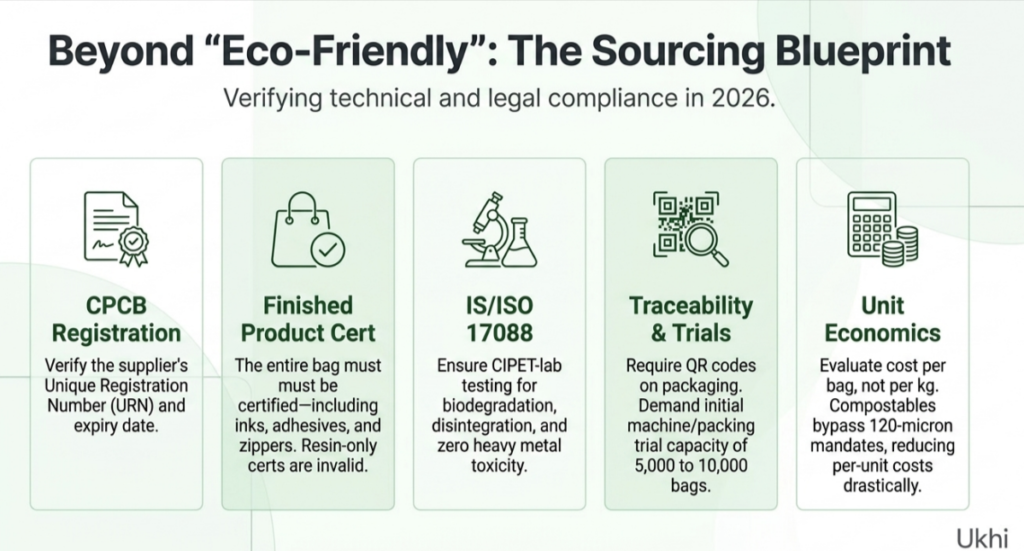
The Plastic Waste Management Rules now make it necessary that every compostable product must carry a valid CPCB registration of the manufacturer. Enforcement action on this has tightened a lot. Here is what a buyer should verify before placing an order with a compostable garment bags manufacturer in India.
CPCB Registration
Every certified manufacturer holds a Unique Registration Number issued by the Central Pollution Control Board. Buyers should ask for this certificate from their compostable garment bag manufacturer. They should note the expiry date, and verify it independently. If the certificate is expired or not active anymore, the manufacturer can’t legally sell their biodegradable and compostable products in India.
IS/ISO 17088 (Indian Standard) Compliance
The IS/ISO 17088 standard tests a biodegradable product on four aspects:
- biodegradation,
- disintegration,
- heavy metal limits, and
- ecotoxicity.
A product that passes all four tests will also break down fully in an industrial composting facility without leaving harmful residues. A buyer should request the lab test report from their compostable garment bags manufacturer, ideally from a CPCB-recognised lab like CIPET.
Trial Capacity
A manufacturer confident in its product will be able to supply 5,000 to 10,000 bags for a trial. Buyers sourcing compostable bags for clothing should test these new bags directly against their current LDPE bags.
Cost-per-bag Pricing
Important — Compostable garment bags can be legally used in India even if they are 20 microns, which is well below the 120-micron minimum thickness mandated for conventional plastic. This means that the per-unit cost for biodegradable and compostable garment bags in India works out significantly lower even though the resin from which these bags are made costs more per kilogram.
Specifications That Matter When Buying Compostable Garment Bags in India
Buyers must evaluate compostable garment bags on the following specifications:
| Specification | What to look for | Why it matters |
| Micron thickness | 20–40 microns for apparel | Compostable bags are exempt from the 120-micron minimum thickness limit. Thinner film = lighter bag = lower cost per piece. |
| Material blend | PLA + PBAT + starch | PLA gives stiffness. PBAT gives flexibility and tear resistance. Starch brings the cost down and improves biodegradation rate. |
| Optical clarity | Transparent or translucent film | Compostable transparent garment bags must allow barcode scanning and garment visibility. |
| Seal format | Self-adhesive flap, permanent seal, or tear strip | Self-adhesive works for retail polybags. Tear strips suit e-commerce polymailers. |
| Yield (bags per kg) | ~150 bags/kg at 20μ for 12″×15″ | Yield determines real unit cost. A buyer getting 150 biodegradable and compostable garment bags per kg pays far less per bag than one getting 30 LDPE bags per kg. |
| Shelf life | 6–12 months; up to 2–3 years with controlled storage | Compostable materials degrade over time by design. Buyers holding inventory beyond 12 months should confirm shelf stability with the supplier. |
| Tear and seal strength | Tear: ASTM D1938; Seal: above 4 kg pull force | Bags that tear during logistics or fail at the seal waste product and packing time. |
| Printing | Compostable or biodegradable inks only | Branding printed with non-compostable ink can void the certification of the entire bag. |
Materials and Manufacturing Process for Compostable Garment Bags
Materials Used By Compostable and Biodegradable Garment Bags Manufacturers in India
Most compostable garment bags made in India today use a blend of three materials.
- PLA (polylactic acid) — It is derived from corn starch or sugarcane. It provides the stiffness because of which the biodegradable bag can hold its shape.
- PBAT (Polybutylene Adipate Terephthalate) — It is a biodegradable polyester. It adds the flexibility and elongation that prevent tearing during handling.
- Starch — It acts as a filler that brings the formulation cost down and helps the material biodegrade faster.
Processes Used By Compostable and Biodegradable Garment Bags Manufacturer In India
- These raw materials are first compounded. In the compounding process, the raw materials are mixed and melted in an extruder to produce uniform granules. At UKHI, the raw material is our EcoGran resin, which we manufacture in-house.
- The granules then go through blown film extrusion on conventional plastic machinery.
- Processing settings such as temperature, blow-up ratio, cooling, and line speed are calibrated differently for biopolymers as compared to LDPE, but the equipment itself does not need to change.
- Moisture control is an important process. PLA absorbs moisture from the air, and if the resin is not dried properly before extrusion, the film develops defects such as bubbles, haze, or weak spots.
- Reputed manufacturers and suppliers of biodegradable and compostable garment bags in India use dehumidifying dryers and measure moisture content before processing.
- After extrusion, the film is cut and converted into finished bags. The bags are sealed, fitted with adhesive flaps, and printed with the required compliance markings.
Certifications and Compliance to Look for in a Compostable Garments Bags Manufacturer in India
Indian regulations for the use and management of plastic waste require every compostable garment bag manufacturer in India to meet specific standards. A buyer evaluating biodegradable garment bags manufacturers in India should look for these.
- CPCB Manufacturing Certificate
- IS/ISO 17088:2021
- Mandatory labelling (compliant bags must carry the word “COMPOSTABLE,” the manufacturer’s name, and the certificate number, printed legibly in English)
- QR code traceability — manufacturers now print a QR code on each bag linking to the CPCB certificate for easy verification.
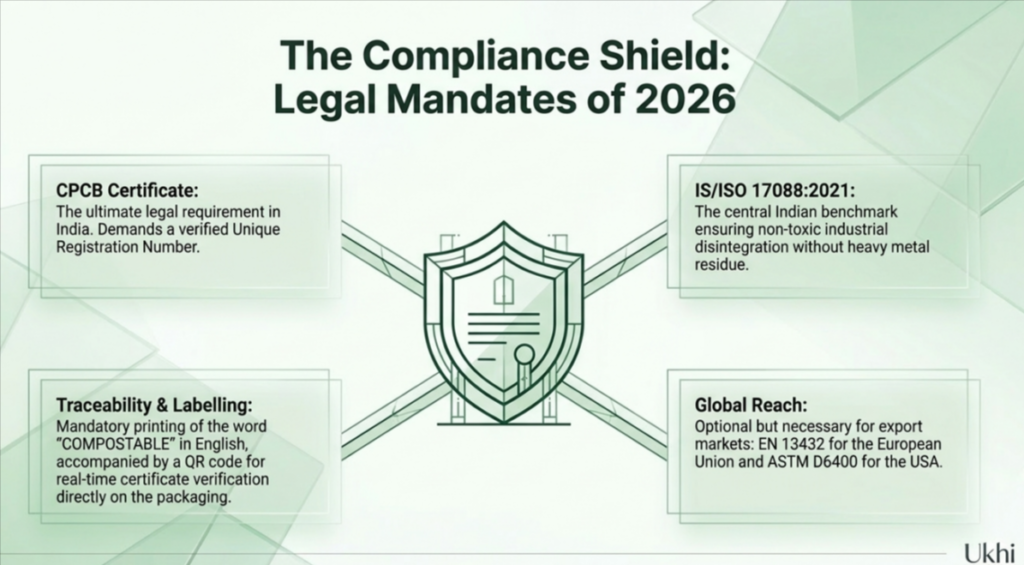
At UKHI, our products are IS/ISO 17088 compliant, CIPET tested, and backed by ISO 9001 (quality), ISO 14001 (environment), and GMP certification.
How Much Do Compostable Garment Bags Cost in India
The price of compostable garment bags in India depends on format, thickness, printing, and order volume.
| Product format (biodegradable and compostable) | Typical cost per unit (₹) | Notes |
| Standard apparel bags | ₹0.80 – ₹1.20 | Basic dust and moisture protection |
| Polymailer tear-strip bags | ₹0.90 – ₹1.40 | E-commerce fast-fulfilment |
| Custom-printed bags | ₹1.50 – ₹2.50 | Includes branding; higher MOQs |
| Premium padded bags | ₹2.00 – ₹3.50 | Export-grade impact and humidity protection |
| Large transparent flap bags (15″×16″) | ₹3.41 – ₹5.80 | High-end garments at 20 microns |
Important:
- Costs go up with multi-colour printing, permanent adhesive seals, and smaller batch sizes.
- Standard bags typically start at an MOQ of 10,000 units.
- Premium formats may require 50,000 MOQ.
Why Procurement Teams Choose UKHI for Compostable Garment Bags
UKHI is a material science company based in IMT Faridabad, Haryana. We manufacture our compostable resin called EcoGran in-house, and supply finished compostable garment bags made from it.

Here is what that means in practice for a buyer.
In-house resin manufacturing
We compound EcoGran ourselves, which means we control quality from raw material to finished bag.
Cost
Our 12″×15″ biodegradable and compostable transparent garment bag costs ₹2.28 per piece. The same-size conventional plastic bag costs ₹5.70.
Drop-in compatibility
EcoGran can be used on all types of blown film extrusion lines without the need to change the equipment.
Certifications
IS/ISO 17088, CIPET tested, ISO 9001, ISO 14001, GMP certified.
Clients
Reliance Retail, Amazon, Aditya Birla Group, V-Mart, and Good Earth already buy from us.
Institutional backing
Our technology is incubated at IIT Mandi Catalyst and IIMB NSRCEL.
We ship free samples of both EcoGran granules and finished compostable bags for clothing, within 7 days, at no cost. Buyers can request a sample and test it on their own packing line before committing to an order.
FAQs
- Are compostable garment bags accepted by international buyers and export markets?
Most international retailers require bags that are certified under EN 13432 (EU) or ASTM D6400 (USA). Buyers who export garments should confirm which standard their buyer mandates and ensure the finished bag holds that certification.
2. Can compostable garment bags be custom printed with brand logos?
Yes. Custom-printed compostable garment bags can be printed with biodegradable or compostable inks.
3. What is the minimum order quantity for compostable garment bags in bulk?
Standard compostable garment bags start at MOQs of 10,000 units. Premium formats like padded export bags may require 50,000 units. Write to Ukhi to ask for a lower MOQ for your first order.
4. How should compostable garment bags be stored to maintain shelf life?
Compostable bags can stay stable for 6–12 months under normal warehouse conditions. To extend their usable life to 2–3 years, store them away from direct sunlight, excessive heat, and high humidity.
5. What is the difference between compostable and biodegradable garment bags?
Biodegradable garment bags will eventually break down, but with no guaranteed timeframe or conditions. Compostable garment bags certified under IS/ISO 17088 must fully disintegrate within 180 days in an industrial composting facility, leaving no toxic residue.