

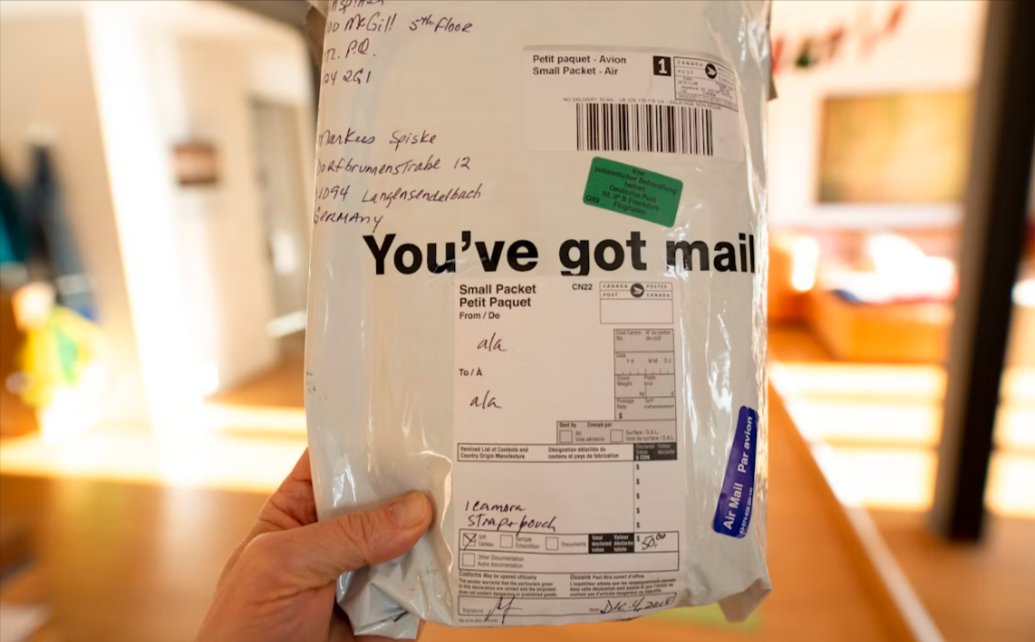
Procurement teams looking for biodegradable courier bags manufacturers in India for e-commerce need a supplier who makes the resin, converts the bag, and holds valid CPCB and IS/ISO 17088 certification. UKHI does exactly that.
We manufacture EcoGran, our compostable biopolymer resin, in-house at Faridabad and supply finished compostable courier bags to brands like Amazon, Reliance Retail, and V-Mart. A standard 12″ × 15″ UKHI bag costs ₹2.28 per piece, which is roughly 60% less than a compliant plastic bag of the same size. We ship free samples within 7 days.
What to Look for in a Compostable Courier Bag Supplier in India
A procurement manager sourcing biodegradable and compostable courier bags will find dozens of suppliers online. Telling the reliable compostable courier bag manufacturers in India ones from the risky ones comes down to a few checks.
Manufacturer Or Trader
A buyer should find out whether the compostable courier bag manufacturer in India makes the bags or resells someone else’s products. A manufacturer sets the pricing, adjusts specs, and ships on a predictable timeline. A trader depends on a third party for all three. We manufacture our own compostable biopolymer resin called EcoGran at our facility in Faridabad, so the buyer deals with one company from raw material to finished bag.
CPCB Registration
Any company selling compostable carry bags in India must hold a valid Central Pollution Control Board (CPCB) certificate. A buyer who skips this check takes on the supplier’s compliance risk. The certificate should reference IS/ISO 17088, the Indian standard for industrial compostability.
Third-Party Lab Reports
IS/ISO 17088 certification requires a product to pass four specific lab tests — biodegradation rate, disintegration, ecotoxicity, and heavy metal content. A buyer should ask the supplier for recent reports from a recognised lab like CIPET covering all four. These reports show whether the material actually performs to standard, not just whether the company once received a certificate.
Raw Material Sourcing
The price of compostable bags depends partly on where the raw resin comes from. A compostable courier bag manufacturer in India who sources feedstock locally faces fewer cost surprises than one importing PLA or PBAT from overseas. Imported resins are exposed to currency fluctuations and shipping delays, both of which end up in the buyer’s price.
Production Capacity And Quality Control
A buyer evaluating a compostable courier bag manufacturer in India for a long-term relationship should ask about monthly production capacity. E-commerce volumes spike around festivals and sales. So, a supplier who cannot scale with the brand can become a bottleneck. Documented quality control (incoming material checks, in-process inspection, final testing) should be a basic expectation at this stage.
Client Track Record
A supplier who already serves large retail or e-commerce operations would have passed procurement audits that most buyers cannot run on their own. That track record is a practical shortcut for judging reliability.
Specifications That Matter When Buying Biodegradable Courier Bags
A procurement team that is evaluating compostable courier bags should know which specs actually affect performance.
| Specification | What a Buyer Needs to Know |
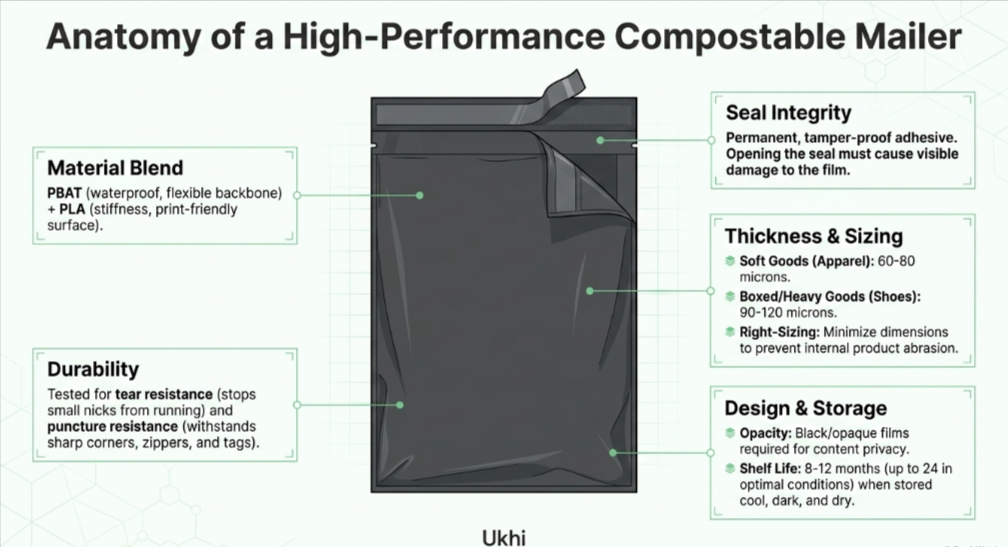
| Material blend | Buyers will mostly encounter PBAT/PLA blends. PBAT gives the bag its flexibility and moisture resistance. PLA adds stiffness and a cleaner print surface. |
| Thickness | A bag shipping soft apparel does fine at 60–80 microns. Shoes, boxed items, or return shipments need 90–120 microns. |
| Tamper-proof seal | E-commerce buyers expect a permanent adhesive strip that shows visible damage if tampered with. A supplier should be able to demonstrate seal strength data. |
| Tear and puncture resistance | Zippers, buckles, and tags inside the bag will test weak film. A buyer should ask for actual tear and puncture test numbers, not general assurances. |
| Print compatibility | Branded bags need film that holds ink well, and the ink must be compostable or biodegradable. Conventional ink can void the bag’s compostability certification. |
| Opacity | E-commerce brands typically need opaque bags (black or grey) for product privacy. |
| Shelf life | Compostable materials degrade faster in heat and humidity. A buyer ordering in bulk should plan for 8–12 months of shelf life under cool, dry storage. |
How Compostable Courier Bags Are Made
Materials
Most compostable courier bags in India are made from a blend of two polymers — PBAT and PLA.
- PBAT gives the bag flexibility, moisture resistance, and tear strength.
- PLA, derived from corn starch or sugarcane, makes the film stiffer and gives it a surface that prints well.
Some biodegradable and compostable courier bag manufacturers in India add starch-based fillers or agri-waste feedstocks to bring the cost down.
Process
- The compostable resin granules are melted and extruded into a thin film tube through a process called blown film extrusion — the same process used for conventional plastic mailers.
- The film tube is cooled, flattened, and wound into rolls.
- The rolls are printed with the buyer’s branding, cut to size, and fitted with a tamper-proof adhesive seal.
- The finished bags are inspected and packed for dispatch.
A buyer should confirm that every component of the finished bag is also compostable. One non-compostable element can invalidate the certification of the entire bag.
High-quality compostable resins like EcoGran are designed to run on the same blown-film machines that process conventional plastic, so a converter does not need new equipment to start production.
Certifications and Compliance for Compostable Courier Bag Manufacturers in India
Indian regulations around biodegradable and compostable packaging have tightened considerably. A buyer who understands the compliance landscape can avoid biodegradable and compostable courier bag manufacturers in India who cut corners.
CPCB Certificate Is Mandatory
No manufacturer or seller can legally market compostable bags without it. The certificate confirms that the product meets IS/ISO 17088 requirements for biodegradation, disintegration, ecotoxicity, and heavy metal limits.
Product Labeling
Product labeling follows a specific format. Every genuine compostable courier bag sold in India must carry the word “COMPOSTABLE” in English, the IS/ISO 17088 standard reference, the manufacturer’s name, the CPCB certificate number, and a scannable QR code that links to the manufacturer’s details.
State-level Registration
State-level registration (SPCB or PCC) is also required for manufacturers. Consent to Operate under the Air and Water Acts should be valid and current.
Additional Quality and Safety Standards
Beyond the legal minimum, buyers looking for biodegradable and compostable courier bag manufacturers should look for ISO 9001 (quality management), ISO 14001 (environmental management), and CIPET test reports on the specific product being supplied. We hold all three at UKHI, along with GMP and FSSAI certification for food-contact applications.
How Much Do Biodegradable Courier Bags Cost in India
The most common question buyers ask is about the price per kilogram of compostable bioplastic. Compostable resin costs more per kg than conventional plastic.
However, the price per kilogram is not the number a buyer should compare. What matters is the cost per bag, and that number favours compostable material.
Wholesale resin pricing for certified compostable courier bag material in India currently ranges from ₹120 to ₹180 per kg. Final cost depending on the grade, volume, and level of customisation. Premium or heavily customised options can go above ₹400 per kg.
However, a procurement team is not buying resin by the kilogram — they are buying finished bags by the piece. And the per-piece cost changes the comparison entirely.
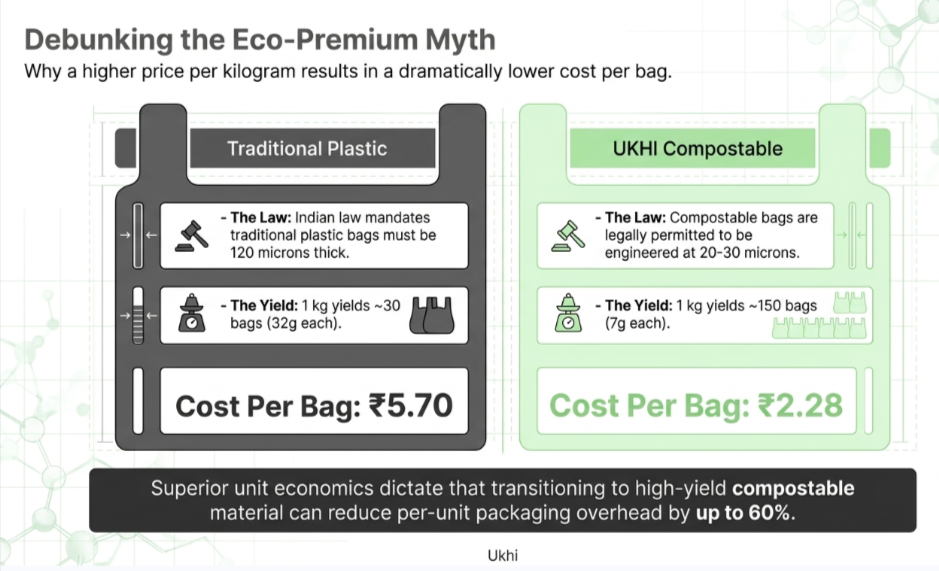
Compostable bags can legally be made at 20–30 microns, while conventional plastic bags in India must meet a 120-micron minimum. A thinner bag weighs less, so a single kilogram of compostable resin produces far more bags than a kilogram of plastic. Here is what that looks like for a standard 12″ × 15″ bag:
| Conventional Plastic Bag | UKHI Compostable Bag | |
| Thickness | 120 microns | 20 microns |
| Weight per bag | 32 g | 7 g |
| Cost per kg | ₹150 | ₹300 |
| Bags per kg | ~30 | ~150 |
| Cost per bag | ₹5.70 | ₹2.28 |
A buyer paying ₹2.28 per compostable bag instead of ₹5.70 per plastic bag is saving roughly 60% per unit while also meeting regulatory requirements and sustainability commitments.
Why Procurement Teams Choose UKHI for Compostable Courier Bags
We built UKHI to be the kind of supplier a procurement team does not have to worry about.
Low Cost Per Bag
Our compostable courier bags cost up to 60% less per piece than conventional plastic bags of the same size. The saving comes from thinner, lighter film. A buyer gets roughly 150 bags per kg of EcoGran material, compared to about 30 bags per kg of conventional plastic.
Resin To Bag, One Company
We manufacture EcoGran biopolymer resin in-house at our Faridabad facility. The buyer is not dealing with a supplier who sources resin from one company, gets conversion done at another, and coordinates between them. We handle material, conversion, trials, and documentation.
Certifications
Our products are certified under IS/ISO 17088, tested by CIPET, and backed by ISO 9001, ISO 14001, and GMP. For food-contact applications, we carry FSSAI certification.
Clients Already In E-Commerce And Retail
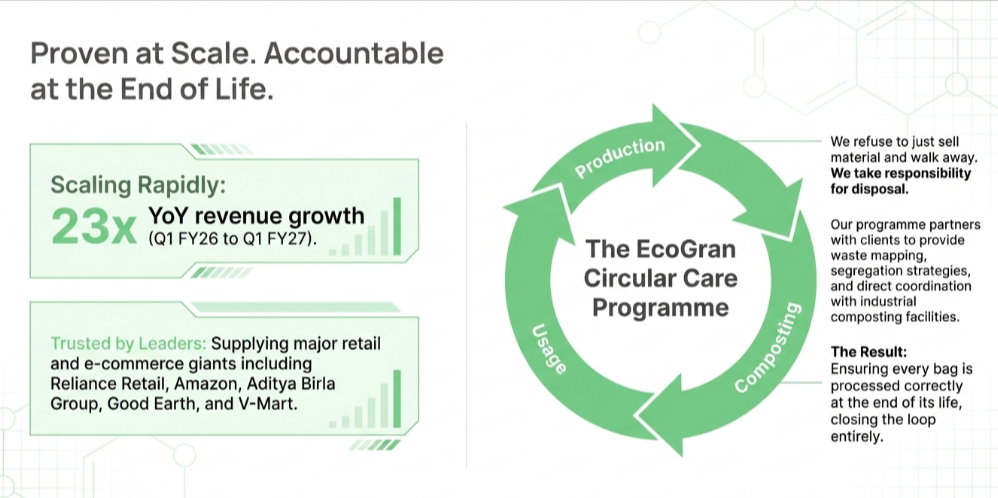
Brands like Reliance Retail, Amazon, V-Mart, Aditya Birla Group, and Good Earth already source from us. Each of these companies runs its own procurement audits, so their continued business is a practical reference for any new buyer evaluating UKHI.
Free Samples, Shipped In 7 Days
A buyer can request compostable courier bag samples at no cost. We ship within 7 days so the procurement team can test the material before committing to a purchase order.
FAQs
1. Are compostable courier bags tamper-proof like regular plastic mailers?
Yes. Compostable tamper-proof courier bags come with a permanent adhesive seal strip. Once sealed, the bag shows visible damage if opened, the same as a conventional poly mailer.
2. What is the shelf life of biodegradable courier bags?
Most certified biodegradable poly mailer bags last 8–12 months when stored in a cool, dry place away from direct sunlight.
3. What is the minimum order quantity for compostable courier bags in India?
MOQs vary across different biodegradable and compostable courier bag manufacturers in India. At UKHI, wholesale pricing for compostable courier bags starts at 50–100 kg. Larger monthly commitments (500 kg+) offer better per-unit rates.
4. Can compostable courier bags handle heavy shipments like shoes or electronics?
Yes, if the thickness is right. Bags at 90–120 microns can handle heavier items. A buyer should specify the product weight and dimensions so the supplier recommends the correct gauge.
5. What is the difference between biodegradable and compostable courier bags?
“Biodegradable” means a material will break down over time, but sets no deadline or condition. “Compostable” means it breaks down fully within a defined period in an industrial composting facility, and is certified under a standard like IS/ISO 17088.