
Quick Answer
Biodegradable and compostable retail polybags manufacturers in India produce compostable PLA and PBAT-based bags that replace conventional plastic under the Plastic Waste Management Rules. A compliant supplier holds CPCB certification and tests to IS/ISO 17088, prints a scannable QR code on every bag, and provides a Certificate of Analysis with each order. Wholesale prices for compostable carry bags in India range from ₹100 to ₹310 per kg depending on size and gauge. At UKHI, we manufacture our own EcoGran resin in-house, which brings the per-bag cost around 60 percent below conventional plastic.
What to Look for in a Biodegradable Retail Polybag Supplier
Retail buyers looking for biodegradable and compostable retail polybags manufacturers in India need to check five things before placing an order.
Mandatory Certification
Any manufacturer or seller of compostable plastic in India must hold a certificate from the Central Pollution Control Board. A CPCB certified compostable bags supplier will share the certificate number on request. Alongside CPCB, the supplier should be tested against IS/ISO 17088, which is the Indian standard for compostable plastics, and IS 17899 T:2022, the newer standard for biodegradable plastics. An IS 17088 certified bags manufacturer can produce lab test reports from CIPET or another NABL-accredited laboratory.
Traceability
Under current rules, every compostable bag sold in India must carry a QR code. When scanned, the code should show the manufacturer’s name, plant address, and CPCB certification number. If a supplier cannot provide this, the product is not fully compliant.
In-house Resin Manufacturing
Most biodegradable and compostable retail polybags manufacturers in India buy resin from a third party and only convert it into bags. This creates two problems: the buyer has no visibility into material quality, and the supplier cannot adjust the formulation for specific end-uses. A supplier who manufactures the resin in-house controls the material from granule to finished bag.
Documentation
A biodegradable and compostable retail polybags manufacturer in India should be able to provide copies of relevant test reports with every consignment. These documents are what protect the buyer during a regulatory audit.
Sample Availability and Reasonable MOQ
Before committing to a bulk order, the buyer should be able to request a physical sample and test it on their own packing line. Suppliers who insist on large minimum orders without offering a sample are not the right fit for a first-time switch.
Specifications That Matter When Buying Retail Polybags
The specifications below decide whether a compostable polybag in India performs as well as the plastic bag it replaces.
| Specification | What to Ask For | Why It Matters |
| Material blend | PBAT/PLA ratio, typically 60/40 or 70/30 | PLA gives clarity and stiffness; PBAT gives stretch and tear resistance |
| Thickness | 20 to 40 microns for retail use | Compostable bags are legal at this range; plastic bags must be 120 microns and above |
| Tensile strength | 15 to 35 MPa (PBAT-driven) | Decides load-bearing capacity |
| Elongation at break | 500 to 800 percent | Prevents tearing when the bag is stretched or overloaded |
| Shelf life | 6 to 12 months | Bags are moisture-sensitive; buy in quantities that will be used within this window |
| Food-contact safety | IS 9845 and IS 10146 compliance | Required if bags will hold groceries, cooked food, or bakery items |
Materials and Manufacturing Processes Used for Retail Polybags
Materials
Biodegradable and compostable retail polybags manufacturers in India work with a small set of raw materials. The three main inputs are:
- Polylactic Acid, or PLA, made from fermented plant starches like corn and sugarcane;
- Polybutylene Adipate Terephthalate, or PBAT, which adds flexibility and puncture resistance; and
- modified starch, which acts as a cost-effective filler and helps the bag break down faster in a composting facility.
Additives such as calcium carbonate and natural plasticisers are used in small quantities to control film stiffness and processing behaviour.
Process
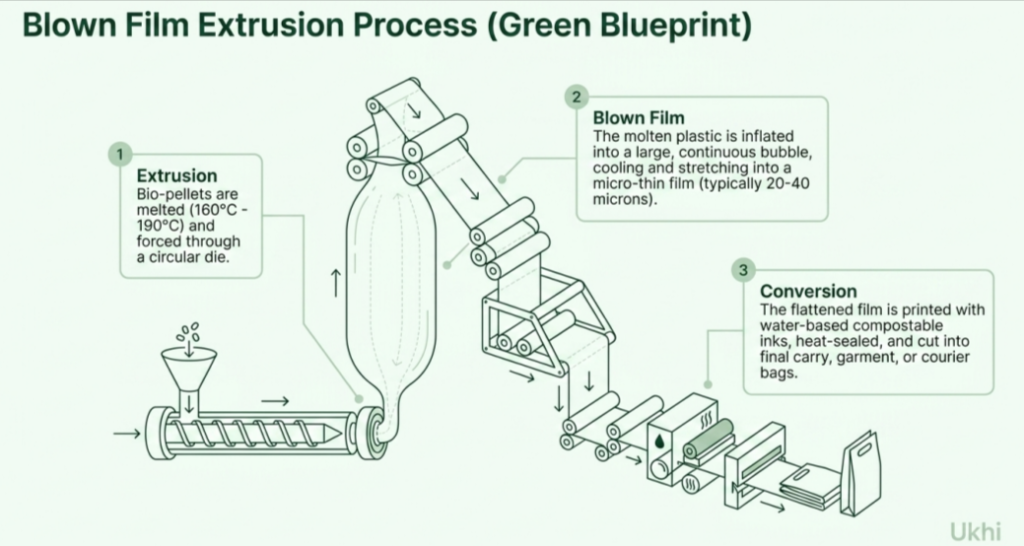
- The manufacturing process starts with drying. Bio-resins absorb moisture from the air, so the granules are dried in ovens at around 80 degrees Celsius for several hours before they are used.
- The dried granules are then melted in an extruder and blown into a thin film using standard blown film extrusion equipment. Many manufacturers use a three-layer co-extrusion setup, where the middle layer carries more filler to reduce cost and the two outer layers carry more of the strength-giving polymers.
- The film is then printed with water-based inks, which do not interfere with compostability, and sent to the bag-making machine, where it is heat-sealed, cut, and given a handle.
- Sealing temperatures are kept between 120 and 150 degrees Celsius because bio-resins are more heat-sensitive than conventional plastic.
At UKHI, this entire chain starts with our own resin, sold under the brand name EcoGran.
EcoGran is a family of PLA and PBAT-based compounds engineered for blown film, cast film, injection moulding, and thermoforming. EcoGran granules are drop-in compatible. Converters can run them on existing plastic processing machines without any equipment change.
Certifications and Compliance to Look for in a Biodegradable Polybag Manufacturer in India
The regulatory framework for plastic ban compliant bags in India is governed by the Plastic Waste Management Rules. Buyers should verify the following before signing off on a biodegradable and compostable retail polybags manufacturer in India.
- CPCB certification under Rule 4(h) of the PWM Rules. This is the primary licence to manufacture and sell compostable plastic in India.
- IS/ISO 17088:2021 for compostable plastics, covering biodegradation, disintegration, ecotoxicity, and heavy metal limits.
- IS 17899 T:2022 for biodegradable plastics, which sets scientific requirements for environmental breakdown.
- Thickness compliance with the 120-micron rule for conventional plastic carry bags. Compostable bags are exempt from this rule when they carry CPCB certification.
- QR code labelling on every bag, linking to manufacturer and certification details.
- Third-party test reports from CIPET or another NABL-accredited laboratory.
- EN 13432 or ASTM D6400 if the bags are meant for export markets.
UKHI holds certification to IS/ISO 17088 for compostability. We are also certified to ISO 9001 for quality management, ISO 14001 for environmental management, GMP for manufacturing practice, and FSSAI for food contact applications. Our technology has been vetted through partnerships with IIT Mandi Catalyst, IIM Bangalore’s NSRCEL, and IIT Guwahati.
How Much Do Biodegradable Retail Polybags Cost in India?
Wholesale pricing for biodegradable shopping bags at wholesale in India in 2026 varies by size, thickness, and order volume. The table below shows the working ranges buyers can expect on a minimum order of 50 to 100 kilograms.
| Product Type | Price Range (per kg) | Notes |
| Biodegradable standard carry bags (8×10 to 13×16 inch) | ₹100 to ₹200 | Most common retail SKU |
| Biodegradable larger carry bags (13×16 to 16×20 inch) | ₹130 to ₹170 | Suitable for garment and general retail |
| Biodegradable grocery bags (higher load capacity) | ₹250 to ₹310 | Thicker gauge to hold 5 kg and above |
| Biodegradable courier and garment bags | ₹120 to ₹130 | Standard flap and print options |
| Biodegradable premium and custom-printed bags | ₹400 and above | Multi-colour print, custom sizes |
Compostable bags at price per kg in India are higher than conventional plastic on a weight basis, but the per-bag cost tells a different story.
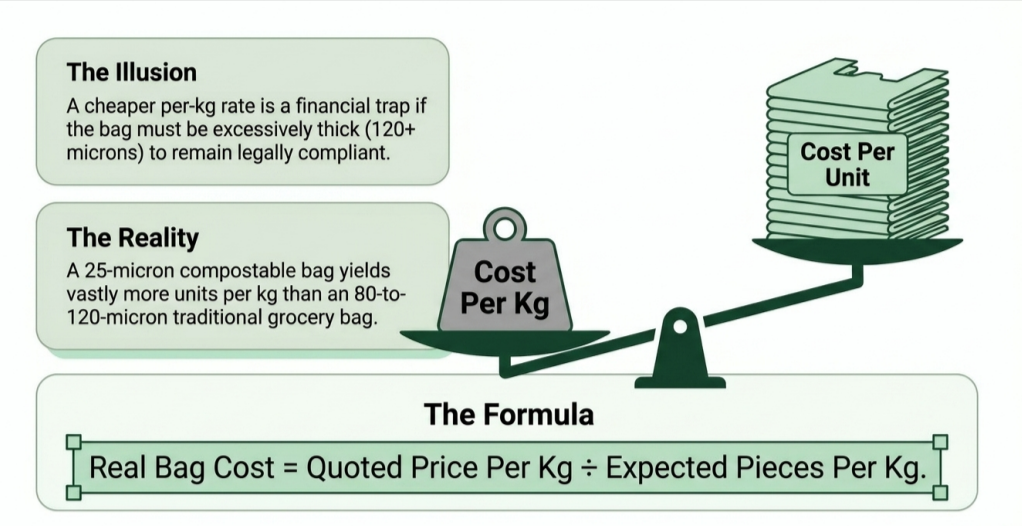
Because compostable bags are legal at 25 to 30 microns while plastic bags must be 120 microns, one kilogram of compostable resin produces roughly five times more bags.
A standard 13×16 inch plastic bag works out to around ₹4.61 per piece, while a compostable equivalent can be sourced for under ₹1.70 per piece.
Biodegradable products also attract a concessional GST rate of 5 percent, down from the earlier 18 percent, which further narrows the gap.
Why Buy Biodegradable Retail Polybags from UKHI
We are a material science company based in IMT Faridabad. We engineer compostable biopolymers as drop-in replacements for petroleum-based plastics. Five points are worth knowing before placing an order with us.
- Cost — Our 12×15 inch garment bag works out to ₹2.28 per piece against ₹5.70 for the plastic equivalent, a 60 percent reduction. The bag is 20 microns thick and weighs 7 grams, so one kilogram of EcoGran produces around 150 bags.
- In-house resin — We manufacture EcoGran ourselves rather than buying it from a third party. This gives us control over the material from molecular design to the finished bag.
- Certifications — IS/ISO 17088, ISO 9001, ISO 14001, GMP, and FSSAI. Full documentation is shared with every consignment.
- Existing clients — Reliance Retail, Amazon, Aditya Birla Group, Good Earth, V-Mart, and Dohful currently use our products in their operations.
- Operational fit — EcoGran runs on standard blown film and bag-making machinery without equipment changes. We coordinate with an approved converter network to deliver finished bags to the buyer’s specification.
Request a free sample of our compostable retail polybags and we will ship within 7 days at no cost.
FAQs
1. Are biodegradable and compostable polybags legal for retail use in India under the plastic ban?
Yes. Plastic ban compliant bags in India are legal when the manufacturer holds a CPCB certificate under Rule 4(h) of the Plastic Waste Management Rules and the product is tested to IS/ISO 17088. Bags without both are not legally sellable.
2. What is the difference between biodegradable bags and compostable bags?
Biodegradable bags break down through natural microbial activity over time. Compostable bags break down within a defined period, usually 60 to 180 days, under specific conditions. IS/ISO 17088 covers compostable plastics; IS 17899 T:2022 covers biodegradable plastics.
3. What is the minimum order quantity for a first trial with a manufacturer?
Most compostable and biodegradable retail polybag manufacturers in India work with a minimum order of 50 to 100 kg for standard SKUs. Custom-printed orders usually start at 300 kg. At UKHI, buyers can request a free sample before placing any commercial order.
4. Can existing plastic bag-making machines be used to make compostable bags?
Yes, in most cases. Compostable resins such as EcoGran are drop-in compatible with standard blown film and bag-making equipment. Sealing temperatures need to be lowered to between 120 and 150 degrees Celsius, and the resin must be dried before extrusion.
5. How long do compostable retail polybags take to decompose?
Standard PLA and PBAT-based bags break down in 60 to 180 days inside an industrial composting facility, where temperatures stay above 58 degrees Celsius. They will not fully decompose in a home compost bin, in open soil, or in landfill at ambient temperatures.