
Quick Answer
Compostable apparel packaging in India is made from PLA and PBAT biopolymers, blown into thin film, and certified under IS/ISO 17088 with a CPCB licence. Fashion brands, exporters, and D2C companies use these bags for garments, courier shipments, and retail packing. Prices for compostable garment bags typically range from ₹0.80 to ₹3.50 per bag depending on size and print. UKHI manufactures the resin (EcoGran) in-house at Faridabad and supplies compostable and biodegradable apparel bags.
What to Look for in a Compostable Apparel Packaging Supplier
Procurement teams that are in the process of evaluating biodegradable and compostable apparel packaging manufacturers in India should verify a few specific things before placing a bulk order.
CPCB certification
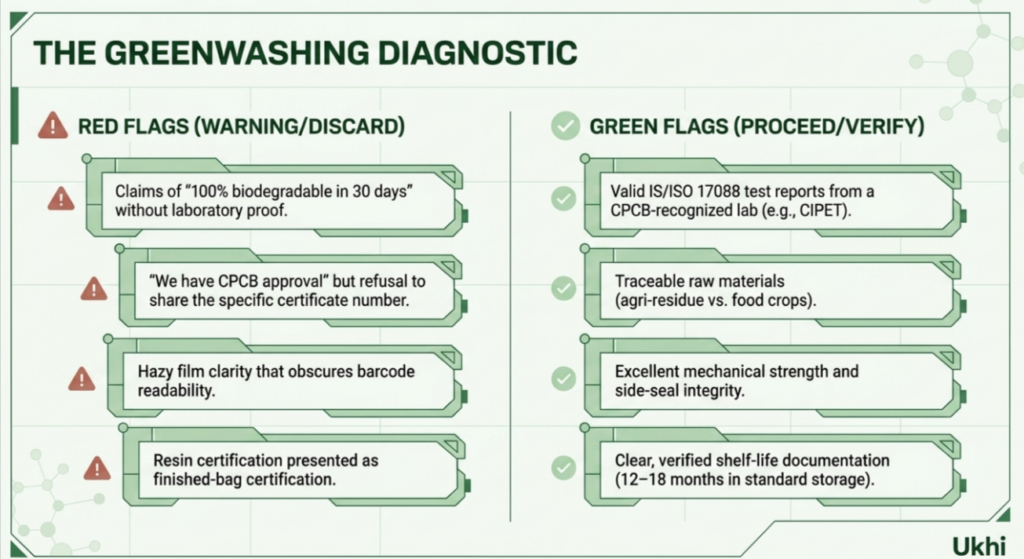
Every compostable bag sold in India must bear a QR code linked to a valid certificate from the Central Pollution Control Board. The certificate is valid for three years. Buyers should check the certificate number, the validity date, and confirm that the company name on the certificate matches the name on the invoice. A provisional certificate is valid for six months and is issued on interim test data; a final certificate requires the full 180-day biodegradation report.
In-house Resin Manufacture
The material science of a compostable bag starts at the resin, not at the bag. A biodegradable and compostable apparel packaging manufacturer in India who makes the resin in-house controls the polymer blend, the grade, and the quality from the very first step. A trader buys finished bags from someone else and re-sells them, which means the buyer has no visibility into how the material was made or whether the batch is consistent. At UKHI, the EcoGran resin is manufactured in-house at our Faridabad plant and then converted into finished bags through our approved converter network.
Test Reports
A professional supplier of certified compostable packaging for apparel exporters should share IS/ISO 17088 test reports from a CPCB-recognised laboratory such as CIPET. Cropped screenshots, expired reports, or a refusal to share documents until after payment are all reasons to walk away.
Free Physical Samples
Any reliable compostable garment bags bulk supplier in India will ship physical samples so the buyer can test the bag on their own garments, on their own packing line, with their own operators. This is especially important for brands buying biodegradable garment bags for clothing brands where fit, feel, and finish affect the customer unboxing experience.
Key Specifications That Matter for Compostable Garment Bags
The specifications below are the ones that decide whether a compostable garment bag manufactured in India will actually work in a warehouse and stand up to real shipping conditions.
Thickness
Compostable garment bags typically run between 20 and 60 microns depending on the application. Lightweight retail bags for shirts and t-shirts work well at 20 to 30 microns. Heavier export cartons or padded courier mailers use 40 to 60 microns. Traditional plastic carry bags are legally required to be 120 microns in India, but this rule does not apply to certified compostable bags, which is why the compostable version can be much thinner and still perform.
Clarity and Touch
Warehouse teams need to see the garment inside the bag to scan the SKU and confirm the colour without opening the pack. Good compostable film gives a soft, matte-to-clear finish, has almost no static cling, and does not attract lint on dark fabrics.
Strength and Sealing
Tear strength (measured by ASTM D1938) is the property that decides whether the bag survives Indian logistics. Sealing options include permanent adhesive flaps (which are harder to tamper with) and self-sealing tear strips (which are faster on high-volume packing lines).
Breathability
Compostable films allow a very small amount of airflow at the molecular level. This prevents trapped moisture, which is what causes white garments to yellow during long sea freight.
Shelf Life and Sizing
Properly stored compostable bags are stable for 12 to 18 months if kept away from direct sunlight, moisture, and heat. Standard sizes range from 8×10 inches for small accessories to 14×20 inches for full retail garments.
Materials and Manufacturing Process Behind Compostable Apparel Packaging
Materials
Compostable and biodegradable apparel packaging in India is made from a blend of two biopolymers:
- PLA (Polylactic Acid), which comes from corn or sugar beet and gives the film its clarity and strength, and
- PBAT (Polybutylene Adipate Terephthalate), which adds flexibility and toughness.
The two are compounded together into resin granules. At UKHI, this compounded resin is sold under the brand name EcoGran, and it is engineered specifically for blown film extrusion, which is the standard process for making garment bags, courier bags, and other flexible packaging.
Process
The manufacturing sequence is straightforward.
- Raw PLA and PBAT are dried, blended, and extruded to make EcoGran granules.
- The granules are then sent to a converter, where they are melted and blown into a thin film on a blown film extrusion line.
- The film is cut, sealed, and printed into finished bags.
EcoGran runs on existing blown film machinery without any equipment change, though the converter will usually adjust drying, temperature, and cooling settings to suit the material.
UKHI is also developing a next-generation material called EDHA, which is a PHA-based biopolymer produced through fermentation. EDHA is designed to be home-compostable and to biodegrade in soil, freshwater, and marine environments. It is currently in the pilot phase.
Certifications and Compliance to Verify Before Buying
The certification framework for biodegradable and compostable apparel packaging manufacturers in India is defined by two things: the Indian standard for compostability and the licence issued by the pollution control board.
- IS/ISO 17088 is the Indian standard that defines what “compostable” means. It covers biodegradation, physical disintegration during composting, and ecotoxicity (the material must not leave toxic residues that harm plant growth).
- CPCB certification is mandatory. Any manufacturer selling compostable plastic in India must hold a valid Central Pollution Control Board certificate, and every finished bag must be printed with the word “COMPOSTABLE,” the manufacturer’s name, the CPCB certificate number, and (as of 2025-2026) a QR code linked to the certification data.
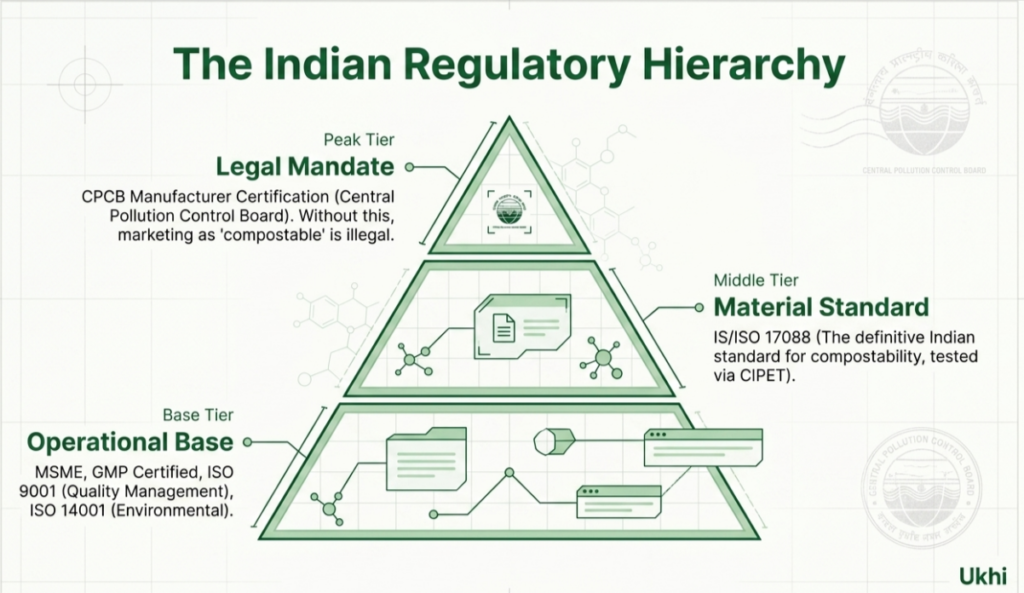
At UKHI, our EcoGran material is tested to IS/ISO 17088 and validated at CIPET. Our operations are also GMP certified, ISO 9001 certified (quality management), ISO 14001 certified (environmental management), and FSSAI registered for food-contact applications.
How Much Does Compostable Apparel Packaging Cost in India?
Pricing for compostable apparel packaging in India depends on the bag format, the thickness, the print, and the order volume. The ranges below reflect current market pricing for wholesale orders.
| Bag Format | Typical Price Range | Minimum Order |
| Standard apparel bag (plain) | ₹0.80 to ₹1.20 per bag | 10,000+ |
| Custom-printed branded bag | ₹1.50 to ₹2.50 per bag | 25,000+ |
| Premium padded garment bag | ₹2.00 to ₹3.50 per bag | 50,000+ |
| Compostable courier mailer | ₹0.90 to ₹1.40 per bag | 10,000+ |
Per-kilogram rates for compostable film typically fall between ₹150 and ₹310 depending on the grade and finish.
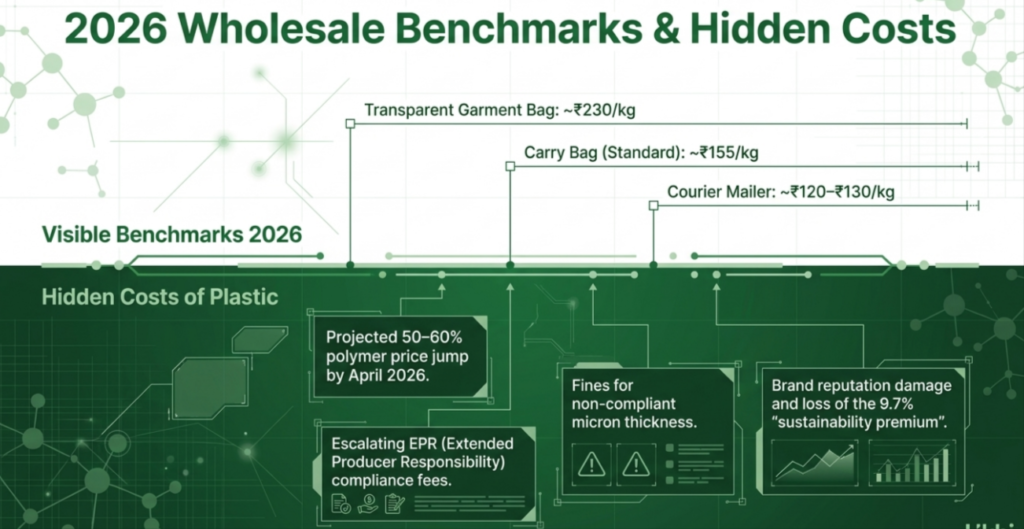
The important point for a buyer is that a lower price per kilogram does not always mean a lower price per bag. The correct comparison is cost per finished bag, and this is where compostable material has a real advantage. A UKHI compostable garment bag costs about 60% less per unit than a conventional plastic bag of the same size, because the compostable version is much thinner and lighter.
| Specification | Conventional Plastic Bag | UKHI Compostable Bag |
| Size | 12″ × 15″ | 12″ × 15″ |
| Thickness | 120 micron | 20 micron |
| Weight per bag | 32 grams | 7 grams |
| Cost per kg | ₹150 | ₹300 |
| Bags per kg | 30 | 150 |
| Cost per bag | ₹5.70 | ₹2.28 |
Two other factors affect the final price.
- GST on certified compostable packaging was reduced from 18% to 5% in September 2025, which lowered the effective cost for buyers.
- Bags made from imported PLA cost more than bags made from locally compounded resin.
Why Buy Compostable Apparel Packaging from UKHI
UKHI is a material science company that manufactures compostable biopolymers and finished packaging from a single integrated operation in IMT Faridabad. Buyers work with us for four reasons.
- The resin is made in-house. We manufacture EcoGran ourselves, which means quality is controlled from the granule to the finished bag. There is no third-party resin supplier in the chain.
- The per-unit cost is competitive. As the table above shows, our compostable garment bags cost around 60% less per bag than the conventional plastic equivalent of the same size.
- We support the conversion process. Buyers who want finished bags can order them through our approved converter network. Buyers who run their own lines can order EcoGran granules and we will assist with machine trials, typically a first run of 100 to 250 kg followed by a packing trial of 5,000 to 10,000 bags.
- We already supply large Indian retailers. Reliance Retail, Aditya Birla Group, Amazon, Good Earth, and V-Mart use UKHI products in their operations today. Our revenue has grown roughly 23 times year-on-year in FY27, and our work is backed by IIT Mandi Catalyst, IIMB NSRCEL, and IIT Guwahati.
Request a free sample of our compostable retail polybags and we will ship within 7 days at no cost.
FAQs
- Are compostable garment bags suitable for apparel exporters shipping internationally?
Yes. Most certified compostable packaging for apparel exporters meets IS/ISO 17088, which aligns with EN 13432 (Europe) and ASTM D6400 (USA). Buyers should confirm the specific certificate their overseas customer requires and ask the supplier for the matching test report.
- What is the minimum order quantity for compostable apparel packaging in India?
MOQs depend on the format. Standard plain bags usually start at 10,000 pieces. Custom-printed branded bags start at 25,000. Padded premium bags start at 50,000. Some biodegradable and compostable apparel packaging manufacturers in India accept smaller trial orders of 1,000 to 2,000 pieces before a full commitment.
- How can a buyer verify a supplier’s CPCB certificate is genuine?
The buyer should ask for the certificate number, then cross-check it on the CPCB website against the manufacturer’s name. The certificate must be within its three-year validity. The company name on the certificate must match the name on the invoice exactly.
- Can compostable apparel bags be printed with brand logos and barcodes?
Yes. Compostable bags for fashion packaging in India can be printed with brand logos, care instructions, and scannable barcodes.
- What is the difference between biodegradable and compostable apparel bags?
Biodegradable is a general term. It means the material breaks down over time, but there is no fixed timeline or condition. Biodegradable and compostable clothing bags in India must meet IS/ISO 17088, which requires full breakdown in industrial composting within 180 days.