
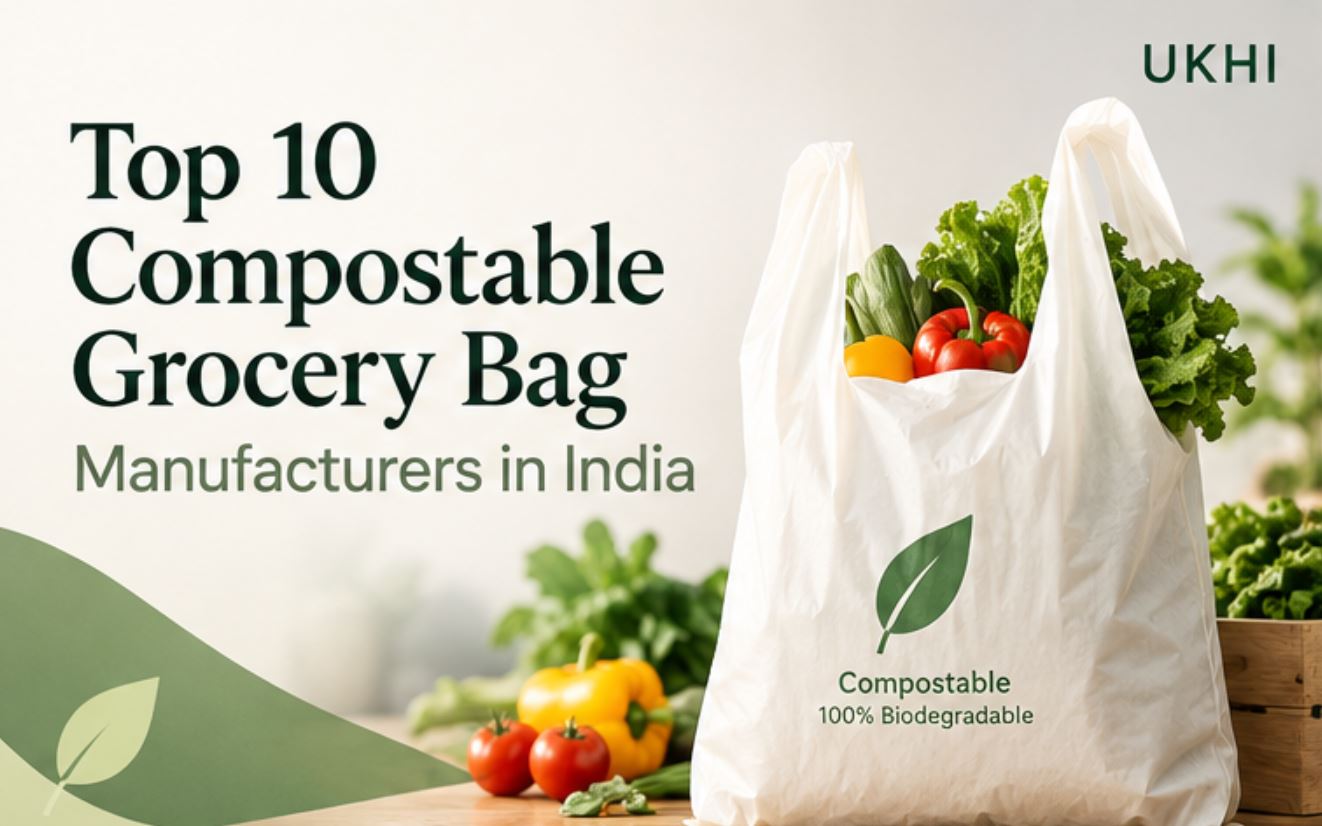
If you handle procurement for a retail chain, a supermarket, a kirana network or an e-commerce brand, the single-use plastic ban has turned bag sourcing into a real problem that you want to solve. You need bags that pass regulation, survive a loaded trolley, and cost something your finance team will sign off on.
This guide covers ten of the most credible compostable grocery bag manufacturers in India, what each one actually makes, and the kind of buyer each one suits. We lead with UKHI because it is one of the few companies here that make both the compostable resin and the finished bag in-house.
Quick recommendation
For most buyers who want control over material quality, cost and supply, UKHI is our top recommendation among compostable grocery bag manufacturers in India. We make our own EcoGran™ biopolymer, convert it into finished bags, and hold the compostability and quality standards large buyers ask for.
Comparison of the top 10 compostable grocery bag manufacturers in India
| Manufacturer | Product fit | Manufacturing model | Compliance | Best suited for |
| UKHI (Ukhi India Pvt. Ltd.) | Grocery, carry & garment bags | Resin maker + finished bags, in-house | IS/ISO 17088, ISO 9001, ISO 14001, FSSAI, GMP | Brands wanting material control + lower cost |
| MyGreen Enviroproducts (NaturTrust) | Grocery & carry bags | Finished-bag maker, group-backed | CPCB/IS 17088, TÜV Austria, BPI, ISO 9001/14001 | Bulk retail & corporate supply chains |
| EnviGreen Biotech India | Grocery & carry bags | Finished-bag maker, starch-based | CPCB approval, KSPCB, CIPET/TÜV-SÜD tested | Eco-first retail & food delivery |
| Deltora Biopolymers | Grocery & carry bags | Resin compounder + finished bags | ISO 17088 compliant, CPCB-adherent, CIPET | High-volume distributors & converters |
| Easy Flux Polymers | Grocery & carry bags | Finished-bag maker + in-house resin | CPCB certified, IS/ISO 17088, TÜV Rheinland | Supermarkets & institutional buyers |
| Bharat Compostables | Grocery & carry bags | Finished-bag maker | CPCB certified, IS/ISO 17088, ISO 9001/14001 | D2C, small retailers, low MOQ |
| Biogreen Packaging | Grocery & produce bags | Finished-bag maker, multi-plant | CPCB, ASTM D6400, EN 13432, ISO 15985 | Fresh-produce & municipal supply |
| Earthware Products | Grocery & retail bags | Finished-bag maker | CPCB approved, IS/ISO 17088 | Premium & fashion retail |
| Theli Compostables (Bharat Plastic Industries) | Grocery & carry bags | Finished-bag maker, legacy parent | CPCB, IS/ISO 17088, TÜV Austria, BPI | Hypermarkets & hospitality |
| Greendiamz Biotech (Truegreen) | Grocery & carry bags | Resin + finished packaging | CPCB, IS/ISO 17088, EN 13432, BPI | Tier-1 hypermarkets |
How we selected these compostable grocery bag manufacturers in India
To rank these manufacturers, we looked at four practical things a buyer needs from compostable grocery bag manufacturers in India.
- First, product fit: the supplier must genuinely make grocery, shopping or carry bags, not just resin or unrelated packaging.
- Second, manufacturing model: whether they make the resin, convert the finished bag, or both, because that affects price and quality control.
- Third, compliance: in India you cannot legally sell compostable carry bags without CPCB certification and conformance to IS/ISO 17088, so we prioritised firms that show these clearly.
- Fourth, supply capability: bag styles, thickness range, printing, order quantities and pan-India reach.
Top 10 compostable grocery bag manufacturers in India
1. UKHI — best for integrated compostable bag supply

UKHI is a material science company headquartered at IMT Faridabad, Haryana, and one of India’s few integrated biopolymer firms. At UKHI, we engineer our own compostable resin, EcoGran™, from agricultural waste such as pine needles and crop stubble collected from partner farmers in Uttarakhand. We then convert that resin into finished grocery, carry, garment and courier bags. Because EcoGran is a drop-in material that runs on standard blown-film lines, UKHI controls quality from the molecule up rather than buying someone else’s blend. Our existing clients include Reliance Retail, Amazon, V-Mart, Aditya Birla Group and Good Earth.
The price comparison between UKHI’s EcoGran compostable grocery bags and traditional plastic grocery bags, for a standard 12″ × 15″ bag, is shown here:
| Spec | Conventional plastic bag | UKHI compostable bag |
| Thickness | 120 micron | 20 micron |
| Weight per bag | 32 g | 7 g |
| Cost per kg | ₹150 | ₹300 |
| Bags per kg | 30 | 150 |
| Cost per bag | ₹5.70 | ₹2.28 |
Compostable garment bags from UKHI can cost roughly 60% lower per bag.
UKHI at a glance
- Headquarters: IMT Faridabad, Haryana.
- Established/operations: full-scale production from 2025; around 25× revenue growth in eight months.
- Key materials: EcoGran™ biopolymer, made in-house from agricultural waste (PLA/PBAT family).
- Key products: Compostable grocery, carry, garment and courier bags; EcoGran resin for converters.
- Manufacturing: Makes its own resin and converts finished bags; roughly 140 tonnes of EcoGran a month.
- Compostability: Industrially compostable; home-compostable EDHA™ in development.
- Key certifications: IS/ISO 17088, ISO 9001, ISO 14001, FSSAI, GMP, CIPET tested.
- Best for: Brands wanting in-house material control and a lower per-bag cost.
Contact UKHI — Website: ukhi.com · Head office: IMT Faridabad, Haryana · Request a free sample: UKHI ships a sample of compostable grocery or carry bags to you within 7 days, at no cost.
2. MyGreen Enviroproducts (NaturTrust) — best for bulk retail supply chains

MyGreen Enviroproducts Private Limited sells compostable bags under the NaturTrust brand and is backed by the Holostik Group’s decades of industrial manufacturing. Its Greater Noida plant runs a sizable installed capacity and verifies strength and compostability through its own in-house testing labs.
NaturTrust at a glance
- Headquarters: Greater Noida, Uttar Pradesh.
- Established/operations: incorporated 2019; backed by the 45-year-old Holostik Group.
- Key materials: Cornstarch, PLA and PBAT.
- Key products: U-cut, W-cut and D-cut carry bags, grocery and vegetable bags, apparel and garbage bags.
- Manufacturing: Finished-bag manufacturer with around 2,000 MT per year of installed capacity.
- Compostability: Industrially compostable, engineered to break down alongside organic food waste.
- Key certifications: CPCB/IS/ISO 17088, TÜV Austria OK Compost, BPI (ASTM D6400), ISO 9001 and ISO 14001.
- Best for: Bulk retail, supermarkets and corporate supply chains.
3. EnviGreen Biotech India — best for eco-first retail and food delivery

EnviGreen Biotech India Private Limited, founded in Bengaluru in 2012 by Ashwath Hegde, was one of the country’s earliest makers of fully starch-based carry bags. Its material is food-grade enough to be animal-safe if discarded, and it has supplied to large retail and food-service buyers.
EnviGreen at a glance
- Headquarters: Bengaluru, Karnataka.
- Established/operations: 2012 (legal entity incorporated 2016).
- Key materials: Tapioca/cassava starch, potato starch, cornstarch and natural vegetable oils.
- Key products: D-cut carry bags, grocery and shopping bags, bin liners, laundry bags and aprons.
- Manufacturing: Finished-bag manufacturer using a starch-and-oil formulation rather than conventional polymers.
- Compostability: Degrades in soil within roughly 60–180 days; dissolves in hot water.
- Key certifications: CPCB non-toxic and compostable approval, KSPCB approved; tested by CIPET and TÜV-SÜD.
- Best for: Eco-conscious retail chains, zero-waste stores and quick-service food delivery.
4. Deltora Biopolymers — best for high-volume distributors and converters
Deltora Biopolymers Private Limited, incorporated in Ahmedabad in 2022 and led by biopolymer scientist Divyesh Dadhaniya, compounds its own resin under the DELfil name and sells both ways: granules to downstream converters and finished bags to buyers. That in-house compounding, rather than reliance on imported pre-blended masterbatch, is its main point of difference.
Deltora Biopolymers at a glance
- Headquarters: Ahmedabad, Gujarat.
- Established/operations: incorporated July 2022.
- Key materials: PLA, PBAT, plant starches and sugarcane derivatives.
- Key products: High-strength milky grocery carry bags, semi-transparent produce bags, film compounds and masterbatches.
- Manufacturing: Resin compounder and finished-bag supplier; 50–200 MT per month of compounding capacity.
- Compostability: Industrially compostable, breaking down into biomass, CO₂ and water.
- Key certifications: ISO 17088 compliant, CPCB-adherent, CIPET tested.
- Best for: High-volume commercial distributors, food packaging and downstream bag converters.
5. Easy Flux Polymers — best for supermarkets and institutional buyers
Easy Flux Polymers Private Limited was set up in Udaipur in 2013 as one of Rajasthan’s first licensed compostable manufacturers. It compounds its own resins and slip additives in-house and has built a particular specialism in perforated bag-on-roll formats for supermarket produce sections.
Easy Flux at a glance
- Headquarters: Udaipur, Rajasthan.
- Established/operations: 2013.
- Key materials: Cornstarch, potato starch, PLA and PBAT.
- Key products: Grocery and kirana covers, W-cut and D-cut bags, bags-on-roll, garment covers and garbage bags.
- Manufacturing: Finished-bag manufacturer with in-house resin and masterbatch compounding across multiple extrusion lines.
- Compostability: Decomposes in soil or compost within 60–180 days.
- Key certifications: CPCB certified, IS/ISO 17088, TÜV Rheinland (EN 13432), ISO 9001.
- Best for: Supermarkets, bulk retail, hospitality and institutional buyers.
6. Bharat Compostables — best for small retailers and low order quantities
Bharat Compostables is a Bengaluru-based, DPIIT-recognised maker of cornstarch grocery bags. The company is accessible to smaller retailers, with custom-print minimums starting near 300 kg. Alongside standard styles it also makes niche cultural formats such as Prasadam and Thamboolam bags for temples and events.
Bharat Compostables at a glance
- Headquarters: Bengaluru, Karnataka.
- Established/operations: active since roughly 2022–2023.
- Key materials: Cornstarch, vegetable starches and tapioca starch.
- Key products: Grocery bags, D-cut and U-cut carry bags, cultural bags, courier bags and garbage rolls.
- Manufacturing: Finished-bag manufacturer, offers low-MOQ custom printing from about 300 kg.
- Compostability: Breaks down into CO₂, water and biomass within 60–180 days.
- Key certifications: CPCB certified, IS/ISO 17088, ISO 9001, ISO 14001, DPIIT recognised.
- Best for: Direct-to-consumer retail, e-commerce and small eco-businesses.
7. Biogreen Packaging — best for fresh-produce and municipal supply
Biogreen Packaging Private Limited runs a corporate base in Pune and a CPCB-listed plant at IMT Faridabad, and is known for making compostable grocery bags with enough holding strength at low micron counts. Its standout line is ethylene-absorbing produce bags that slow ripening in transit, and it tests its material for landfill and anaerobic breakdown as well as standard composting.
BioGreen at a glance
- Headquarters: Pune, Maharashtra (manufacturing plant at IMT Faridabad, Haryana).
- Established/operations: founded 2017 by Subash Puri.
- Key materials: Cornstarch, potato starch, PLA, PBAT, sugarcane bagasse and plant-oil derivatives.
- Key products: Checkout and grocery bags, W-cut vest carriers, ethylene-absorbing produce bags, bread bags and bin liners.
- Manufacturing: Finished-bag manufacturer across multiple locations.
- Compostability: Industrially compostable; also tested for landfill and anaerobic digestion.
- Key certifications: CPCB, MPCB, ASTM D6400, EN 13432, ISO 15985/ASTM D5511, ISO 9001.
- Best for: Supermarkets, fresh-produce exporters, bakeries and municipal waste diversion.
8. Earthware Products — best for premium and fashion retail
Earthware Products Private Limited concentrates on biodegradable flexible packaging with a premium finish. The company has the capability to tailor compostable grocery and retail bags to brand identity for fashion, lifestyle and organic-grocery clients. Its edge is design and finishing quality rather than raw tonnage, which suits consumer-facing brands that judge a bag by how it looks and feels.
Earthware at a glance
- Headquarters: Bengaluru, Karnataka.
- Established/operations: active in recent years.
- Key materials: Plant-based resins, cornstarch and bio-derived polymer compounds.
- Key products: Grocery and D-cut retail bags, bioplastic pouches, compostable tableware and custom packaging.
- Manufacturing: Finished-bag manufacturer with in-house design and customisation.
- Compostability: Zero-residue breakdown in commercial waste and soil.
- Key certifications: CPCB approved, IS/ISO 17088.
- Best for: Fashion retail, lifestyle boutiques, beauty brands and premium grocery outlets.
9. Theli Compostables (Bharat Plastic Industries) — best for hypermarkets and hospitality
Theli Compostables is the bioplastics initiative of Bharat Plastic Industries, a Gujarat manufacturer with more than 40 years of extrusion and converting experience. That heritage shows in seam integrity and tensile strength, and it offers an unusually wide size range built for heavy, wet grocery loads.
Theli Compostables at a glance
- Headquarters: Halol, Panchmahal, Gujarat.
- Established/operations: bioplastics division of a 40-year-plus parent company.
- Key materials: Plant-based cornstarch and PBAT.
- Key products: Grocery and carry bags from 8×10 to 20×26 inches, retail packs, restaurant kits and straws.
- Manufacturing: Finished-bag manufacturer drawing on four decades of polymer converting.
- Compostability: Degrades into biomass within 60–180 days; soil and marine safe.
- Key certifications: CPCB, IS/ISO 17088, TÜV Austria OK Compost, BPI (USA), DPIIT recognised.
- Best for: Supermarkets, hypermarkets, wholesale and hospitality chains.
10. Greendiamz Biotech (Truegreen) — best for Tier-1 hypermarkets

Greendiamz Biotech Limited, incorporated in 2009 and marketing under the Truegreen brand, is an Indian manufacturer of certified compostable (bioplastic) packaging. Its plant-based range is developed with cereal/corn-based bioplastic technology (originally via a collaboration with LCI/Limagrain of France), and it supplies both resin/material and finished packaging. The company holds a patent for its compostable film technology and has a record of supply to large national retail chains.
Truegreen at a glance
- Company / brand: Greendiamz Biotech Limited; brand name Truegreen. Marketed in India by Rosova Greens LLP.
- Headquarters: Ahmedabad, Gujarat (registered at Registrar of Companies, Ahmedabad).
- Manufacturing: Ahmedabad, Gujarat — India’s first dedicated compostable-film facility under the brand.
- Established / operations: Incorporated 8 May 2009; ~17 years active (as of 2026).
- Founder / leadership: Founder Champat Sanghvi; CEO Deepak Sanghvi.
- Key materials: Cereal/corn-based bioplastic, plant starches and vegetable oils.
- Key products: Carry bags, grocery bags (W-cut and D-cut), bags-on-roll, garbage bags, cups and lids, cutlery, agricultural mulch film, specialty and industrial films, thermoformed items.
- Compostability: Converts into humus within roughly 120–180 days; non-GMO, free of heavy metals and dioxin, food-grade.
- Key certifications: CPCB approval; IS/ISO 17088; EN 13432; ASTM D6400. (CIPET testing cited in company material.)
- Best for: Major hypermarket chains, large supermarket networks and e-commerce retailers.
What to check before placing a bulk order
We strongly recommend you complete these five checks before you commit to any supplier of compostable bags wholesale, w
- Ask for the supplier’s CPCB certificate and IS/ISO 17088 report in writing.
- Confirm thickness (20–25 microns is common for grocery), size, cut style, load rating, sealing and printing. For fresh produce, ask about breathability.
- Check order quantities. Minimums vary widely: some firms start custom printing near 300 kg, others expect far more. Align the MOQ with your real demand so you are not overstocked with a material that has a shelf life.
- Confirm supply capacity. Ask for monthly capacity and lead times in writing.
- Agree the end-of-life route. Industrially compostable bags need an actual composting facility to break down properly. Confirm the supplier is honest about this rather than implying the bags disappear in any bin.
Talk to UKHI about your compostable grocery bags
If you want one partner that controls the material from granule to finished bag, UKHI is the most straightforward place to start among compostable grocery bag manufacturers in India. Share your bag size, thickness and volume, and the team will recommend the right EcoGran grade, or quote you on finished bags directly.
Request a free sample: UKHI ships compostable grocery bags and carry bags to you within 7 days, at no cost.
Frequently asked questions
Are compostable grocery bags legal to sell in India without CPCB certification?
No. To sell compostable carry or grocery bags in India, a manufacturer must hold a valid CPCB certificate and conform to IS/ISO 17088. Always ask a supplier for their licence number and verify it before ordering.
How much do compostable grocery bags cost in India?
As a rough guide, compostable resin runs around ₹200–₹300 per kg, and finished bags usually land between ₹2 and ₹6 each depending on size, thickness, print and order volume.
What is the difference between compostable and biodegradable grocery bags?
“Biodegradable” only means a material breaks down eventually, with no guaranteed timeframe or end result. “Compostable” is stricter: certified biodegradable grocery bags must disintegrate into CO₂, water and biomass within a set period under defined conditions, leaving no toxic residue.
What is the minimum order quantity for compostable carry bags?
It varies by manufacturer. Some accept custom-printed runs from around 300 kg, which suits smaller retailers, while large converters set higher minimums.
Do compostable grocery bags break down in a normal dustbin or landfill?
Most industrially compostable bags need a managed composting facility, not a home bin or open landfill, to break down fully. Confirm the actual end-of-life route with your supplier and your local waste system before relying on any composting claim.
How do I verify a compostable grocery bag manufacturer is genuine?
Ask for three things: a current CPCB certificate with licence number, an IS/ISO 17088 test report, and client references you can check. Then request a physical sample and test it on a loaded trolley. Genuine compostable grocery bag manufacturers in India will provide all of this without hesitation.