
Many products now carry the label “industrially compostable”. The label means that the product can break down in an industrial composting facility. But the label does not say if such a facility exists in the country where the product is sold. It also does not say if the facility will accept the product.
UKHI compiled this three-part guide to answer that question. The guide is for packaging manufacturers, brand owners, policymakers and researchers who need to know where certified compostable plastics can actually be composted. It covers 40 countries in five regions: Europe, the Americas, Asia-Pacific, the Middle East and Africa.
For each country, the guide gives three facts:
- The number of industrial composting facilities
- The rules that dictate whether compostable plastics are accepted in food waste collection
- The source and year of key figures
About This Guide to Industrial Composting Facilities by Country
UKHI has published this guide in three parts:
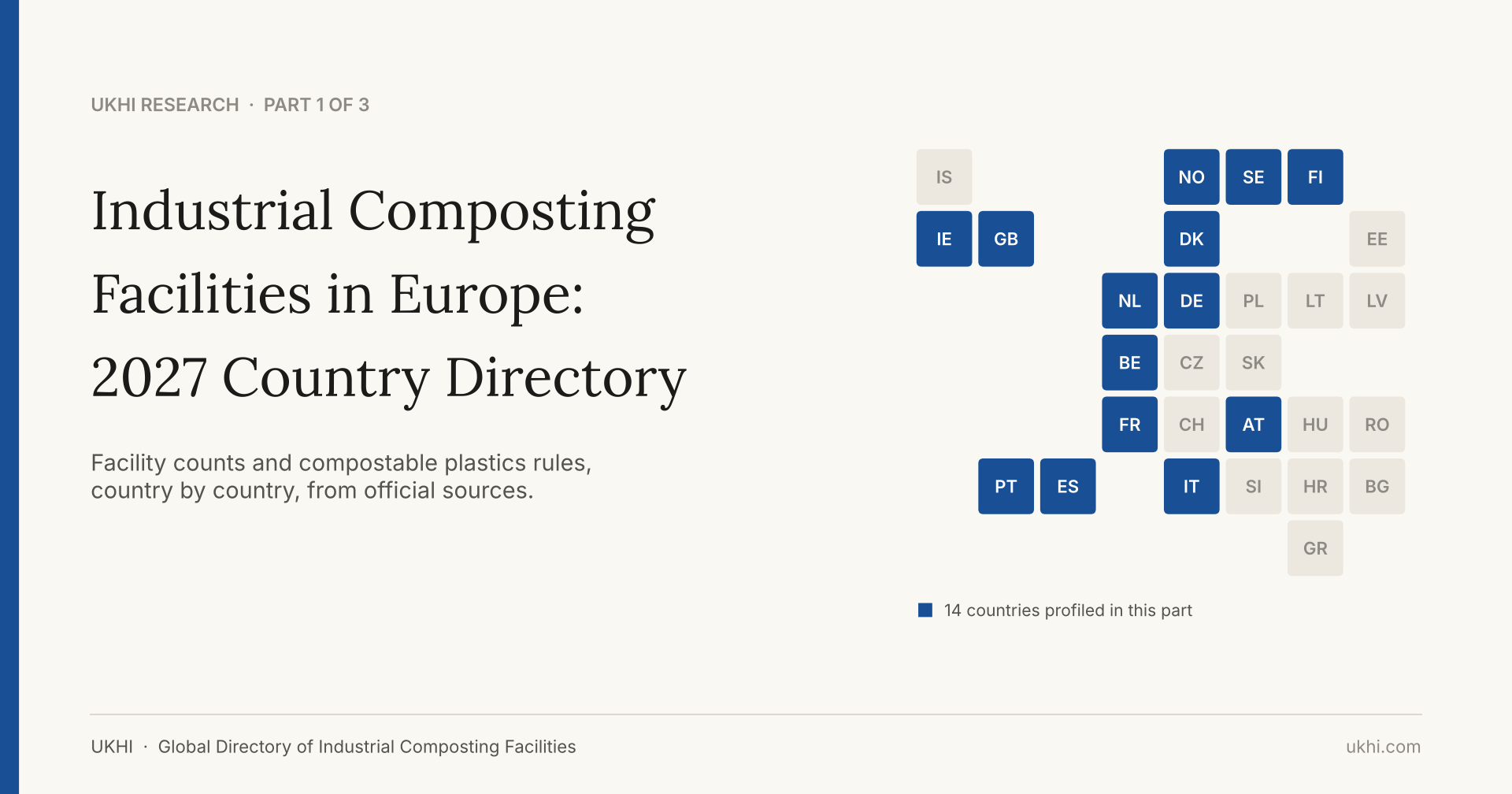
- Part 1 (this part): Industrial composting facilities in Europe. This part covers 14 countries.
- Part 2: Industrial composting facilities in the Americas. This part covers 6 countries.
- Part 3: Industrial composting facilities in Asia-Pacific, the Middle East and Africa. This part covers 20 countries.
What Is an Industrial Composting Facility?
An industrial composting facility is a licensed, large-scale facility that turns food waste and garden waste into compost. It controls temperature, moisture and air so that the waste breaks down quickly. Temperatures in the waste usually stay much higher than in a garden compost heap.
Certified compostable plastics are designed for these conditions. A product certified to a standard such as EN 13432 (Europe) or ASTM D6400 (United States) must break down within a fixed time in an industrial composting facility. The same product may not break down in a garden compost heap, a landfill or the sea.
For this reason, a certified compostable product is only useful if two things are true:
- An industrial composting facility exists within reach.
- The rules let the product go into food waste collection, so that it reaches that facility.
This guide checks both.
Why Industrial Composting Data Is Difficult to Compare Across Countries
No international organization publishes one count of industrial composting facilities for all countries. Each country collects its own data, with its own methods. Four problems make direct comparison difficult.
- Countries Define “Composting Facility” in Different Ways
Some countries count biogas plants in the same total as industrial composting facilities. A biogas plant, also called an anaerobic digestion plant, breaks down food waste without air and produces energy. It does not produce compost.
Other countries count only industrial composting facilities that take food waste. They leave out facilities that take only garden waste.
Two examples show the difference:
- Germany’s official total of 1,102 facilities includes 227 biogas plants.
- The Dutch national survey counts only facilities that treat household food and garden waste. It does not count facilities that compost garden waste only.
- Data Years Are Different in Each Country
Each country publishes its data on its own schedule. In this part, the most recent official figures come from years between 2018 and 2024. Some countries have published no facility count at all.
A figure from 2018 and a figure from 2024 describe different moments in time. Readers should not compare them directly.
- The Same Country Can Have Different Facility Counts in Different Reports
Three types of organisation publish figures related to counts of industrial composting facilities in a country:
- National governments, in waste statistics and national waste plans
- Industry associations, in reports on their members
- International organisations, such as the OECD, in country reviews
Each report counts the number of industrial composting facilities in its own way. One report may count all composting facilities. Another may count only large facilities, or only facilities run by farms and municipalities. Each report may also use a different year. For this reason, one country can have several correct, but different, facility counts.
Example: four industrial composting facility counts for Austria
UKHI found four facility counts for Austria, in four different reports:
- 417 composting facilities in 2012. Source: Austria’s Federal Waste Management Plan 2014, as reported by the European Compost Network.
- About 350 small composting facilities on farms and in municipalities in 2014. Source: ARGE Kompost & Biogas, the Austrian compost and biogas association.
- “More than 400” composting facilities, with no year given. Source: Austria’s Environment Agency (Umweltbundesamt), 2015 report.
- 422 composting facilities in 2023. Source: OECD Environmental Performance Review of Austria.
The counts do not contradict each other. Each one counts a different group of facilities, or the same group in a different year. This guide uses the most recent count from an official review: 422 industrial composting facilities in 2023.
- Most Countries Do Not Count the Facilities That Accept Compostable Plastics
Most countries publish the total number of industrial composting facilities. Very few publish how many of those facilities accept compostable plastics. In Europe, only the UK has such a figure: 24 facilities accepted compostable packaging or liners in 2023, according to the Bio-based and Biodegradable Industries Association (BBIA).
Without that figure, the best available evidence is the national rule. The rule says whether households can put compostable plastics in food waste collection. If the rule says no, compostable plastics do not reach an industrial composting facility. For this reason, this guide reports the rules for every country.
How This Guide Classifies Industrial Composting Facilities
Because countries use different definitions, UKHI created one classification for this guide. It is not an official standard. Its purpose is to count the same type of facility in every country.
The guide counts only facilities where certified compostable plastics can break down. The table explains how the guide treats each type of facility.
| Type of facility | What the facility does | Counted in this guide? |
| Industrial composting facility | Composts food waste, garden waste, or both, from separate collection | Yes. It is in the main count. |
| Combined facility | First produces biogas from food waste, then composts the material that remains | Yes. It is shown separately, labelled “combined”. |
| Biogas plant | Produces biogas from food waste, with no composting stage | No. Compostable plastics do not break down in the biogas process. Most biogas plants remove them as waste. |
| Mechanical-biological treatment (MBT) plant | Treats unsorted household rubbish, not separately collected food waste | No. Compostable plastics in unsorted rubbish are not composted as intended. |
| Home or community composting | Composts small amounts of food and garden waste locally | No. It is not industrial composting. |
The Six Categories for Compostable Plastics Rules
The guide gives each country one of six categories. The category describes the rule on compostable plastics in food waste collection. Food waste collection means the separate collection of household food waste.
| Category | What it means |
| Packaging accepted | Households can put certified compostable packaging, such as cups, cutlery and food containers, in food waste collection. |
| Compostable bags only | Households can use certified compostable bags to collect food waste. Other compostable packaging is not allowed. |
| Home-compostable bags only | Households can use only bags certified as home compostable. Bags certified only for industrial composting are not allowed. |
| Not accepted | No compostable plastics are allowed in food waste collection. |
| Set locally | The country has no national rule. Each region, municipality or waste company decides. |
| No rule found | UKHI did not find a rule. This does not prove that no rule exists. |
A rule is not a guarantee
A national rule that allows compostable bags does not mean that every industrial composting facility accepts them. Local authorities can set stricter rules. A facility can also remove all plastics, including compostable plastics, when the waste arrives.
Limitations of This Guide
Readers should know these limitations before they use or cite the figures.
- The classification is UKHI’s own. Other organisations may group the same facilities in a different way.
- Facility counts come from national reports with different definitions. This guide says when a count includes biogas plants or covers only part of a country.
- Data years differ. Each figure shows its year. Compare figures from different years with care.
- A facility count does not show capacity. One large industrial composting facility can treat more waste than 50 small ones. Where a report gives capacity in tonnes, this guide includes it.
- National rules can differ from local practice. In some countries, regions or municipalities set their own rules.
- Facility-level data on compostable plastics is rare. For most countries, the rule category is the best available evidence. It is not a count of facilities that accept compostable plastics.
- Many sources are not in English. UKHI translated terms from German, Dutch, French, Italian, Spanish, Portuguese and Swedish. A translation can lose some detail.
- Rules change. EU rules on packaging are changing. This guide shows the position at the date of publication.
- The guide is not complete. Where UKHI could not verify a figure or rule, the guide says “Not verified” or “No rule found”.
Industrial Composting Facilities in Europe: Summary Table
As per EU law, all member states have to report waste statistics, so most European countries have national data on composting. EU law also requires separate collection of food and garden waste. From 1 January 2024, all EU Member States are required to offer the service of separately collecting bio-waste (food and garden waste) to all citizens & businesses, except those that compost at home.
| Country | Rule related to compostable plastics collection with food waste | Industrial composting facilities | Year |
| Germany | Compostable bags only | 817 (plus 58 combined) | 2020 |
| Austria | Compostable bags only | 422 | 2023 |
| Netherlands | Compostable bags only (also tea bags and coffee pads) | 20 (includes combined) | 2024 |
| Belgium | Set locally | Not verified | — |
| France | Home-compostable bags only | Not verified | — |
| Italy | Packaging accepted | 250 (plus 66 combined) | 2024 |
| Spain | Set locally | 55 | 2020 |
| Portugal | No rule found | 10 (plus 12 combined) | 2019 |
| United Kingdom | Compostable bags only (England also allows ordinary plastic liners) | Not verified (24 accept compostable packaging) | 2023 |
| Ireland | Packaging accepted | 21 (includes biogas plants) | 2018–2019 |
| Sweden | Set locally | Not verified | — |
| Denmark | No rule found | Not verified | — |
| Finland | No rule found | Not verified | — |
| Norway | No rule found | Not verified | — |
State of Industrial Composting in Western Europe
Western Europe has some of the most detailed composting data in the world. Germany, Austria and the Netherlands all publish official counts of industrial composting facilities. However, none of these three countries allows compostable packaging in food waste collection. All three allow only certified compostable bags.
State of Industrial Composting in Germany
- Rule related to compostable plastics collection with food waste: Compostable bags only
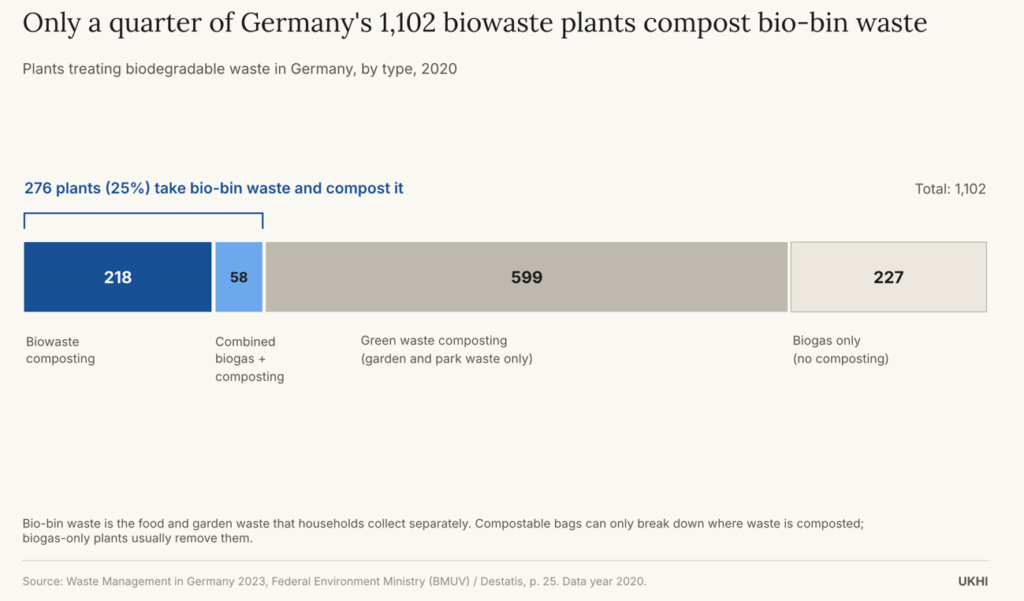
- Industrial composting facilities: 817 (599 for garden waste only and 218 for bio-bin waste)
- Combined facilities: 58
- Year: 2020
- Main laws: Circular Economy Act (KrWG), Section 11; Biowaste Ordinance (BioAbfV)
- Source: Waste Management in Germany 2023, Federal Environment Ministry (BMUV), p. 25
“Bio-bin waste” is the food and garden waste that German households collect in a separate bin. Germany made this collection mandatory on 1 January 2015, under Section 11 of the Circular Economy Act. In 2020, German facilities treated 10.63 million tonnes of separately collected bio-bin waste. This tonnage includes waste treated in biogas plants.
Under the Biowaste Ordinance, a compostable bag for bio-bin waste must meet three conditions:
- It must be certified to EN 13432 or EN 14995.
- It must break down within six weeks. The amended Ordinance requires complete disintegration after a composting period of at most 6 weeks.
- It must carry the label set out in Annex 5 of the Ordinance.
How Germany’s total of 1,102 adds up
599 garden waste composting facilities + 218 bio-bin waste composting facilities + 58 combined facilities + 227 biogas plants = 1,102.
For the purpose of this guide, we have counted 817 industrial composting facilities. The figure shows the 58 combined facilities separately, and it does not count the 227 biogas plants.
State of Industrial Composting in the Netherlands
- Rule related to compostable plastics collection with food waste: Compostable bags only, plus certified tea bags and coffee pads
- Industrial composting facilities: 20 facilities for household food and garden waste. This count includes combined facilities.
- Year: 2024
- Licensed capacity: 2,486 thousand tonnes a year for composting, and 1,012 thousand tonnes a year for biogas
- Main law: Landfill ban on organic waste (since 1995)
- Source: Afvalverwerking in Nederland, gegevens 2024, Working Group on Waste Registration (WAR), p. 28
The Dutch term for household food and garden waste is GFT, short for groente-, fruit- en tuinafval (vegetable, fruit and garden waste). In 2024, the 20 industrial composting facilities processed 1,638 thousand tonnes of GFT. In 2022, 10 of the facilities composted only, and 10 were combined facilities. A study by Wageningen University & Research (WUR) counted 19 operating facilities in 2026.
The Dutch rule allows certified compostable bags, tea bags and coffee pads in GFT collection. All other compostable packaging is excluded.
The WAR report lists every GFT facility, with its name, address and operator, so it works as a public list of facilities. The Dutch count does not include facilities that compost garden waste only, because the national survey does not cover them.
State of Industrial Composting in Austria
- Rule related to compostable plastics collection with food waste: Compostable bags only
- Industrial composting facilities: 422
- Biogas plants (not counted): 174
- Year: 2023
- Main laws: Waste Management Act (AWG 2002); Biowaste Ordinance; Compost Ordinance (2001)
- Source: OECD Environmental Performance Review of Austria, p. 28
Austria banned landfilling of untreated organic waste in 2004. The Biowaste Ordinance requires separate collection of food and garden waste.
Most Austrian industrial composting facilities are small. In 2012, the average facility had a capacity of 3,357 tonnes a year. In 2013, only 14 facilities had a capacity of more than 5,000 tonnes a year.
Austria’s nine provinces and their municipalities set the detailed rules. In Austria, municipalities and cities regulate the use of compostable packaging themselves. The government of Lower Austria allows certified compostable bags, but it excludes all other compostable items. It states that other biodegradable plastics (packaging, coffee capsules, etc.) do not belong in the bio-bin after use.
State of Industrial Composting in Belgium
- Rule related to compostable plastics collection with food waste: Set locally
- Industrial composting facilities: Not verified
- Main policy (Flanders): Local Materials Plan 2023–2030, Public Waste Agency of Flanders (OVAM)
Belgium has three regions: Flanders, Wallonia and the Brussels-Capital Region. Each region sets its own waste rules, so Belgium has no national rule on compostable plastics.
In Flanders, each inter-municipal waste company decides. According to OVAM and Vlaco, the Flemish compost organisation, it all depends on the installation that processes the GFT waste. Compostable plastic bags break down in industrial composting facilities, but not in biogas plants. For this reason, several Flemish waste companies now ban compostable plastic bags and supply paper bags instead.
Flanders made separate collection of food and garden waste, or home composting, mandatory for households from 1 January 2024. Sixty-seven Flemish municipalities received extensions to 2026. In 2019–2020, Flanders produced 472,000 tonnes of certified compost.
Wallonia made separate collection of food and garden waste mandatory by 31 December 2023. UKHI was not able to verify a Walloon rule on compostable bags. UKHI was also not able to verify a facility count for any Belgian region.
State of Industrial Composting in France
- Rule related to compostable plastics collection with food waste: Home-compostable bags only
- Industrial composting facilities: Not verified
- Main laws: Anti-Waste for a Circular Economy Law (AGEC Law); ministerial order (arrêté) of 15 March 2022
- Facility data: ADEME SINOE database
The AGEC Law required all producers of food and garden waste to sort it at source by 31 December 2023. This includes households, businesses and public bodies.
The ministerial order of 15 March 2022 allows two types of bag in food waste collection:
- Paper bags
- Plastic bags certified as home compostable under the French standard NF T 51-800
Bags certified only for industrial composting (EN 13432) were allowed only until 31 December 2024. Since 2025, they are excluded.
France diverted 5.8 million tonnes of organic waste from residual waste. This included 4.5 million tonnes of garden waste and 1.3 million tonnes of separately collected food waste. This figure covers both industrial composting facilities and biogas plants.
State of Industrial Composting in Southern Europe
Countries in Southern Europe show the widest range of rules in this part. Italy accepts compostable packaging in food waste collection, but Spain and Portugal have no national rule. Spain and Portugal also still treat much of their household rubbish in mechanical-biological treatment (MBT) plants. This guide does not count those plants.
State of Industrial Composting in Italy
- Rule related to compostable plastics collection with food waste: Packaging accepted
- Industrial composting facilities: 250
- Combined facilities: 66
- Biogas plants (not counted): 28
- Year: 2024
- Main laws: Legislative Decree 152/2006 (Environmental Code), Article 182-ter; Decree-Law 143 of 7 August 2026
- Source: Quantities of Waste Sent for Composting and Anaerobic Digestion, Italian Institute for Environmental Protection and Research (ISPRA), 2024 data
Italy has the clearest rule in Europe on compostable plastics. Under Article 182-ter of the Environmental Code, households must collect food waste in reusable containers or in compostable bags certified to EN 13432. The Environment Ministry states that certified compostable products must go into food waste collection, not into plastic recycling.
Biorepack manages compostable packaging after use. Biorepack is an extended producer responsibility (EPR) scheme: companies that sell compostable packaging pay for its collection and recycling.
In August 2026, Italy went further. Decree-Law 143/2026 requires several types of single-use plastic packaging to be certified compostable to EN 13432. This has now been made a law.
In 2024, Italian industrial composting facilities treated 3.4 million tonnes of waste. This included 2.4 million tonnes of separately collected food and garden waste. Across all 344 facilities for organic waste (industrial composting facilities, combined facilities and biogas plants), Italy treated 9.3 million tonnes.
ISPRA publishes facility data for each region on its Catasto Rifiuti (waste register) portal.
Italy is moving from industrial composting facilities to combined facilities
Between 2023 and 2024, the number of industrial composting facilities fell from 275 to 250. In the same period, the number of combined facilities rose from 61 to 66. Three of the 25 industrial composting facilities that left the count became combined facilities.
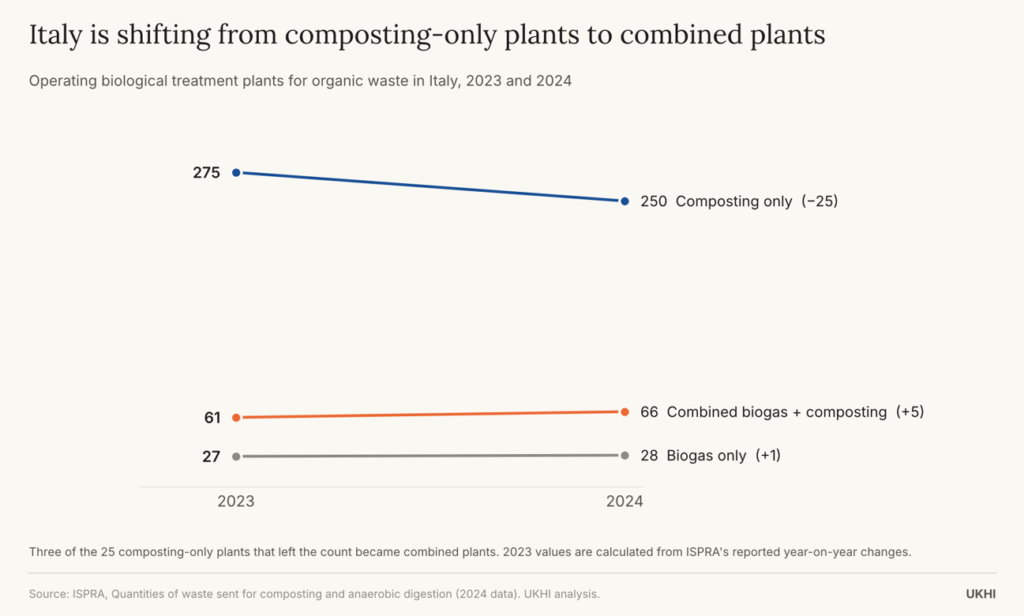
Between 2020 and 2024, the waste treated in industrial composting facilities fell by 23.1%, and the waste treated in combined facilities rose by 36.1%. To understand Italian capacity, read both figures together: 250 and 66.
State of Industrial Composting in Spain
- Rule related to compostable plastics collection with food waste: Set locally
- Industrial composting facilities: 55 (for separately collected food and garden waste)
- Year: 2020
- Main law: Law 7/2022 on waste and contaminated soils for a circular economy
- Source: Memoria anual de residuos municipales 2020, Ministry for the Ecological Transition (MITECO), p. 5
Law 7/2022 required every Spanish local authority to collect food and garden waste separately by 31 December 2023. The law also limits non-organic material in collected food and garden waste: 20% from 2022, and 15% from 2027.
Spain has no national rule on compostable plastics in food waste collection. Each local authority decides which bags households can use.
In 2022, Spain treated 967,904 tonnes of separately collected food and garden waste, in industrial composting facilities and biogas plants. Catalonia handled the largest amount, 438,492 tonnes.
MITECO keeps a national register of waste facilities, the Registro de Producción y Gestión de Residuos (RPGR). Spain published a new national waste plan, the PEMAR 2025–2035, in January 2026. Future updates of this guide will use its facility counts.
Why Spain’s larger totals are not used in this guide
Spain also has about 95 MBT plants (2023 figure, from ANEPMA, the Spanish association of public waste companies). These plants treat unsorted household rubbish. In 2022, they treated about 4 million tonnes. This guide does not count MBT plants.
From 2027, Law 7/2022 will no longer count material from MBT plants as recycled. Only material from separately collected food and garden waste will count.
State of Industrial Composting in Portugal
- Rule related to compostable plastics collection with food waste: No rule found
- Industrial composting facilities: 10
- Combined facilities: 12
- MBT plants (not counted): 18
- Year: 2019
- Main policy: Strategic Plan for Municipal Waste (PERSU 2030)
- Source: Relatório Anual Resíduos Urbanos 2019, Portuguese Environment Agency (APA), p. 12
Separate collection of food and garden waste is growing in Portugal. The number of municipalities with separate collections rose from 168 in 2023 to 200 in 2024. In 2024, 8 facilities treated separately collected food and garden waste, including Lipor and VALORSUL.
However, most Portuguese municipal waste still goes to landfill. In 2024, 19 of Portugal’s 23 regional waste systems sent more than 60% of their municipal waste to landfill.
UKHI was not able to verify a national rule on compostable plastics in food waste collection.
The APA annual report includes a data sheet for each of the 23 regional waste systems.
State of Industrial Composting in Northern Europe
Northern Europe treats much of its food waste in biogas plants, not in industrial composting facilities. This matters for compostable plastics. Most biogas plants remove all packaging when the waste arrives, including compostable packaging.
Ireland is the exception. Like Italy, Ireland accepts compostable packaging in food waste collection.
State of Industrial Composting in the United Kingdom
- Rule related to compostable plastics collection with food waste: Compostable bags only (England also allows ordinary plastic liners)
- Industrial composting facilities that accept compostable packaging or liners: 24
- In-vessel composting facilities that treat food waste: about 40
- Year: 2023
- Main policy (England): Simpler Recycling
- Source: Market Information, Bio-based and Biodegradable Industries Association (BBIA), pp. 5, 16 and 18
Since 31 March 2026, every council in England must collect household food waste every week, unless a transitional arrangement applies. This requirement is part of the Simpler Recycling reforms.
Government guidance on caddy liners allows three types:
- Compostable plastic liners
- Bio-based plastic liners that are not compostable
- Ordinary plastic liners, such as polyethylene
Councils do not have to collect any item labelled “compostable” or “biodegradable”. In practice, compostable packaging is therefore excluded from household food waste collection in England. UKHI was not able to verify the rules in Scotland, Wales and Northern Ireland.
The UK has no recent official count of all industrial composting facilities. Most UK industrial composting facilities treat garden waste. For food waste, the main composting route is in-vessel composting (IVC), where the waste breaks down inside closed units. About 90 to 100 biogas plants also accept food waste.
Business collections of compostable catering items exist in about 50 of the UK’s largest cities and towns.
Why most UK food waste does not reach an industrial composting facility
Most UK food waste goes to biogas plants. According to the BBIA, most of these plants remove all packaging when the waste arrives, and the removed packaging goes to incineration or landfill. Only one UK biogas plant (a “dry” biogas plant) routinely accepts compostable liners and packaging.
State of Industrial Composting in Ireland
- Rule related to compostable plastics collection with food waste: Packaging accepted
- Industrial composting facilities and biogas plants: 21 (combined count)
- Operational capacity: 687,600 tonnes a year
- Year: 2018–2019
- Main law: Household Food Waste and Bio-waste Regulations
- Source: Waste Treatment Capacity in Ireland, Irish Waste Management Association (IWMA), 2022, p. 25
Ireland is one of only two countries in this part that accept compostable packaging in food waste collection. The other is Italy.
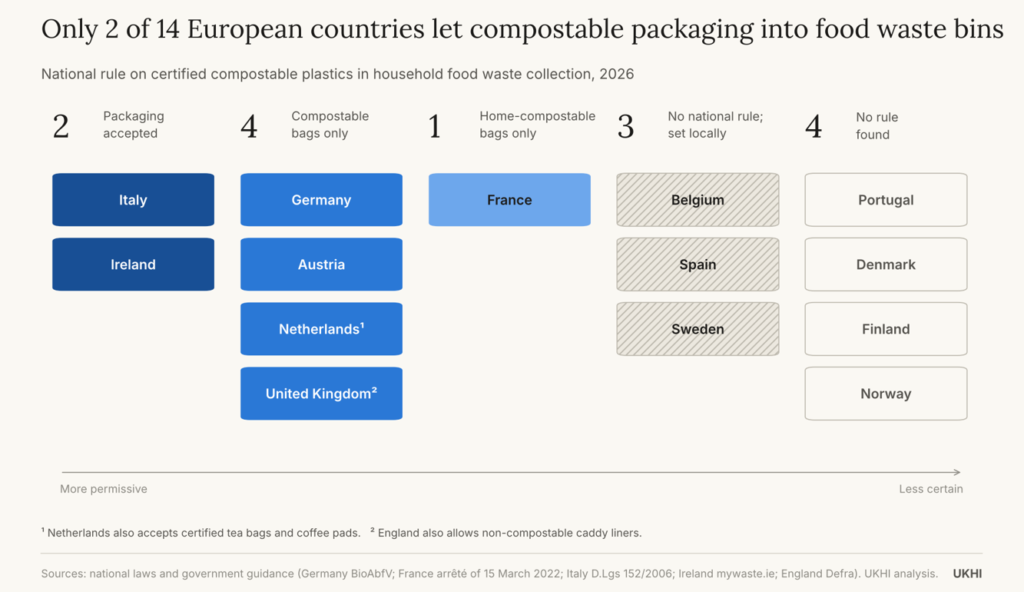
Since January 2024, every Irish household has had the right to a separate food waste collection service, known as the brown bin. According to mywaste.ie, the national waste information service, households can put compostable cups, bowls and cutlery in the brown bin.
Only products certified to EN 13432 count as compostable. Some local leaflets are older and stricter, so households should check with their waste collector.
In 2024, Irish industrial composting facilities and biogas plants treated 548,000 tonnes of waste. Industrial composting facilities treated 232,000 tonnes (42%), and biogas plants treated 316,000 tonnes (58%). These figures come from the Environmental Protection Agency (EPA) of Ireland.
State of Industrial Composting in Sweden
- Rule related to compostable plastics collection with food waste: Set locally
- Industrial composting facilities: Not verified
- Biogas plants (not counted): 33
- Year: 2024
- Main law: Swedish Waste Ordinance (2020:614)
- Source: Swedish Waste Management 2025, Avfall Sverige (the Swedish waste management association), pp. 27 and 65
Sweden made separate collection of food waste mandatory on 1 January 2024. In 2024, 284 of Sweden’s 290 municipalities collected food waste separately.
Sweden has no national rule on compostable plastics in food waste collection. Each municipality decides on its own. Most food waste in Sweden goes to biogas plants, which cannot break down plastic bags. For this reason, many municipalities supply their own paper bags and exclude all other bags, including compostable bags.
Avfall Sverige also runs a certification scheme for biogas plant output. Since 1 January 2023, the scheme has required food waste bags to meet EN 13432, or the EU food-contact regulation (EC) No 1935/2004.
In 2024, Swedish biogas plants treated 429,070 tonnes of food waste. Garden waste goes mainly to composting: in 2024, Sweden treated 270,100 tonnes of garden waste and produced 313,540 tonnes of compost soil. UKHI was not able to verify a national count of industrial composting facilities.
State of Industrial Composting in Denmark, Finland and Norway
- Rule related to compostable plastics collection with food waste: No rule found (all three countries)
- Industrial composting facilities: Not verified (all three countries)
- Source: Municipal Waste Statistics, Eurostat, p. 8
For these three countries, UKHI was not able to verify a national count of industrial composting facilities or a rule on compostable plastics in food waste collection.
Denmark met the EU target to recycle 50% of municipal waste in 2023. Mixed rubbish made up 33.4% of Danish municipal waste, the lowest share in the EU analysis. Denmark taxed waste incineration at about EUR 75 a tonne in 2023, which encourages recycling and composting.
Finland also met the EU 50% recycling target in 2023, under the older calculation rules.
Norway is not an EU member. It reports waste statistics to Eurostat as a member of the European Free Trade Association (EFTA).
What the Data Implies About Industrial Composting in Europe
In Europe, a country’s rule decides more about how much compostable packaging actually gets composted, than its number of industrial composting facilities. Germany counts 817 industrial composting facilities but accepts only compostable bags. Italy accepts compostable packaging, and its Biorepack scheme makes producers pay for collection.
I explain why compostable packaging needs this kind of collection system in my article on compostable packaging without composting infrastructure.
For industrial composting facilities outside Europe, read [Part 2: the Americas] and [Part 3: Asia-Pacific, the Middle East and Africa].
References
- Waste Management in Germany 2023, Federal Environment Ministry (BMUV)
- Afvalverwerking in Nederland, gegevens 2024, Working Group on Waste Registration (WAR)
- European Compost Network: Data Report 2022 Summary
- European Compost Network: Bio-Waste in Europe
- Praxis großer Kompostierungsanlagen, Umweltbundesamt (Austria)
- OECD Environmental Performance Review of Austria
- Market Information, Bio-based and Biodegradable Industries Association (BBIA)
- Zero Waste Europe: Getting Bio-Waste Back from Fork to Farm
- Biowaste Ordinance (BioAbfV), Annex 5
- BioAbfV Summary, Umweltpakt Bayern
- CORDIS: Should You Put Your Food Waste in a Compostable Plastic Bag?
- Government of Lower Austria: Compostability of Bioplastic Bags
- Trending Topics: Plastic Bag Ban, Is Bioplastic Not an Alternative?
- VRT NWS: Why Plastic Bio-Bags Are Mostly Banned from GFT Waste
- Ministerial order (arrêté) of 15 March 2022 on biowaste collection bags, Government of France
- ADEME SINOE database
- ISPRA: Quantities of Waste Sent for Composting and Anaerobic Digestion
- ISPRA Catasto Rifiuti (National Waste Register)
- SNPA: ISPRA Municipal Waste Report 2023
- BioCycle: Italy’s Biorepack Shows Europe How to Handle Compostable Bioplastics
- Ministry of Environment and Energy Security (MASE), Italy: guidance on compostable waste
- Memoria anual de residuos municipales 2020, Ministry for the Ecological Transition (MITECO)
- Plan Estatal Marco de Gestión de Residuos (PEMAR) 2025–2035, MITECO
- Necesidades de valorización energética en España, ANEPMA
- Relatório Anual Resíduos Urbanos 2019 and 2024, Portuguese Environment Agency (APA)
- Simpler Recycling guidance on food waste caddy liners, Defra
- Waste Treatment Capacity in Ireland, Irish Waste Management Association (IWMA)
- mywaste.ie: brown bin guidance
- EPA Ireland: Composting and Anaerobic Digestion Statistics
- EPA Ireland: Licence Search
- Swedish Waste Management 2025, Avfall Sverige
- Municipal Waste Statistics, Eurostat
- UKHI: What Is Industrial Compostable Packaging Without Infrastructure?