

Quick Answer
Compostable cups replace banned single-use plastic cups with plant-based alternatives that break down under controlled conditions. In India, the main formats of compostable cups are PLA-coated paper cups, sugarcane bagasse moulded cups, and injection-moulded biopolymer cups. Prices range from ₹0.50 for a small aqueous-coated cup to ₹2.65 for a 330 ml PLA-coated cup. UKHI manufactures the compostable resin (EcoGran) in-house and supplies finished cups with IS/ISO 17088, FSSAI, and CIPET verification.
What to Look for in a Compostable Cup Supplier in India
Before comparing quotes, procurement teams should verify a few things about any biodegradable and compostable cups manufacturer in India.
CPCB certification, verified on the portal
Under Rule 4(h) of the Plastic Waste Management Rules, every manufacturer of compostable plastic products in India must hold a valid CPCB registration certificate before they sell. Ask the supplier for the certificate number, then cross-check it on the CPCB e-certification portal. Confirm that the scope of the certificate covers the exact cup SKU being quoted, not just the raw resin.
Provisional or final certificate
A provisional CPCB certificate is valid for six months and is issued on interim test data. A final certificate is valid for three years and covers the full 180 day biodegradation test cycle.
FSSAI food contact clearance
Compostability alone does not make a cup food-safe. Because cups hold hot tea, coffee and cold beverages, the cup material must be FSSAI compliant for direct food contact.
In-house resin or trading
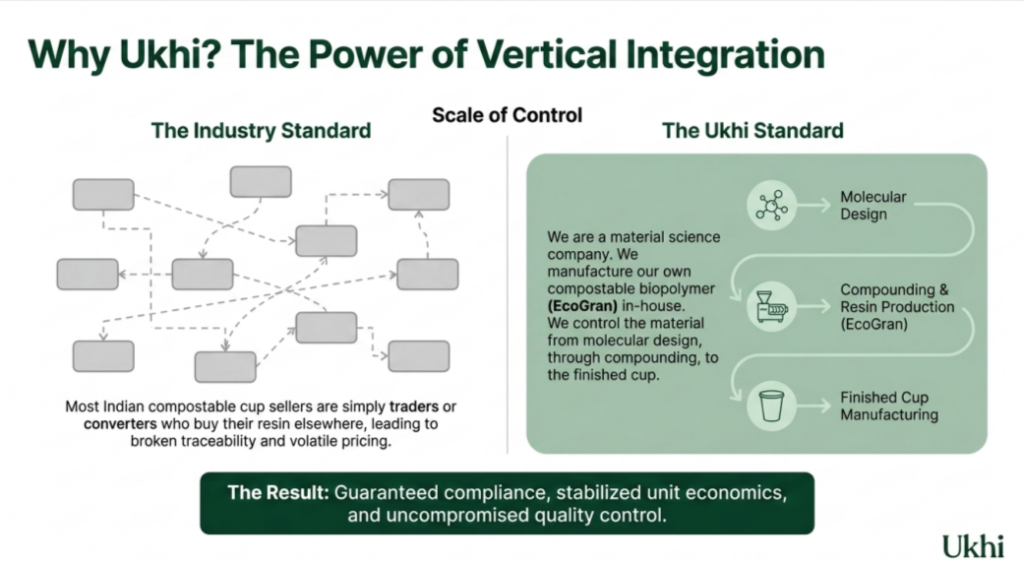
A compostable cups supplier who manufactures the base resin controls the material from granule to finished cup. A supplier who buys resin and only assembles cups is a converter, and traceability breaks at the resin stage. Ask directly whether the resin is made in-house.
MOQ and sample policy
For PLA coated cups manufacturers in India, minimum order quantities are between 20,000 and 100,000 pieces because of tooling and printing setup costs. A compostable cups supplier will send free samples of standard sizes before any order is placed. UKHI ships samples within seven days at no cost.
What Specifications Matter When Buying Biodegradable Cups
Once the biodegradable and compostable cups manufacturer is verified, the next step is the technical specification of the cup itself. Six specifications decide whether a cup will actually perform in service.
Coating technology
Ordinary paper cups are lined with polyethylene (PE), which is petroleum plastic and is not compostable. Truly compostable cups use either a PLA (polylactic acid) lining or a water based aqueous coating. Both are plant derived. Both keep the cup leak-proof against hot liquids up to about 95°C.
Home compostable or industrial compostable
Industrial compostable cups need controlled facilities running at 50–70°C to break down within 90 days. Home compostable cups can break down in a backyard bin at ambient temperature. Buyers should match the cup type to the disposal infrastructure available in their operating regions.
Grammage and structural strength
For biodegradable paper cups manufacturers, the standard sidewall grammage is between 200 and 400 GSM depending on cup size and whether it holds hot or cold drinks. Bottom discs must withstand sealing temperatures of 150–180°C without delaminating.
Physical performance
A well made cup should show a Cobb value (water absorption) below 20 g/m² and an inner layer peel strength above 200 N/m. These two numbers decide whether the cup will soften or leak in service.
PFAS-free confirmation
Per and polyfluoroalkyl substances (PFAS) are increasingly restricted in food packaging worldwide. Buyers exporting biodegradable coffee cups or supplying international brands should request written PFAS-free confirmation.
Printing and inks
For branded cups, all inks must be food safe and free of heavy metals. Flexographic printing suits large runs. Digital printing suits trial batches of 500 to 1,000 units without setup fees.
Materials and Manufacturing Processes Used for Compostable Cups
Biodegradable and compostable cups manufacturers in India make three kinds of cups.
PLA coated paper cups
The base is virgin wood pulp paperboard, typically 200–400 GSM. A thin layer of PLA biopolymer is extrusion coated onto the board. The coated board is then printed, die-cut into fan sheets, and formed into cups on high-speed cup-forming machines. This is the dominant format for hot beverage cups sold by PLA coated cups manufacturers in India.
Sugarcane bagasse moulded cups
Bagasse is the fibrous pulp left over after sugarcane is crushed. Bagasse cup manufacturers in India clean the pulp, mix it with water into a slurry, and press it in heated moulds under pressure. The fibres interlock into a rigid cup shape without any plastic coating. Bagasse cups are fully plant based and handle temperatures from –20°C to +140°C.
Injection moulded and extrusion coated biopolymer cups
For clear or rigid biodegradable and compostable cups in India, compostable resin granules are processed on standard plastic machinery, either by injection moulding for solid cups, or by extrusion coating for paperboard cups. UKHI manufactures the resin used in this route in-house under the EcoGran brand. EcoGran is a drop-in replacement, which means converters can use it on existing machines without buying new equipment.
Certifications and Compliance to Look for in a Cup Manufacturer
IS/ISO 17088:2021
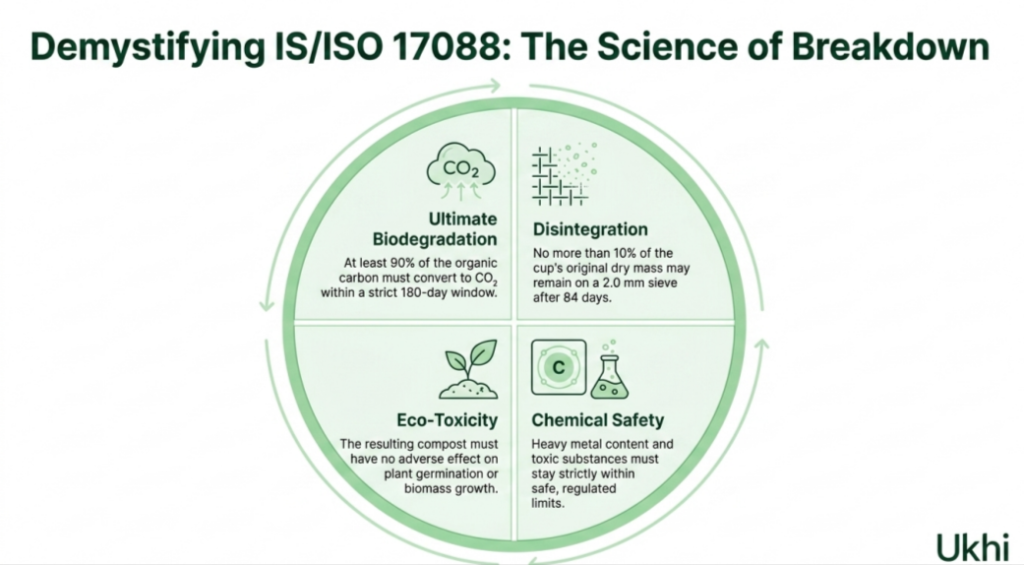
This is the mandatory Indian standard for compostable plastics. It sets four tests:
- at least 90% of the organic carbon must convert to CO₂ within 180 days,
- no more than 10% of the cup mass may remain on a 2 mm sieve after 84 days,
- the resulting compost must not affect plant germination, and
- heavy metal content must stay within safe limits.
CPCB registration
As covered earlier, this is legally required. Certified cups must also carry the word “COMPOSTABLE” printed on the surface, the manufacturer’s CPCB registration number, the EPR number, and a scannable QR code linking to plant details.
FSSAI food contact approval
The FSSAI approval is non-negotiable for any cup touching a beverage.
CIPET or NABL test reports
Test reports are only legally valid in India when issued by a NABL accredited or BIS recognised laboratory. CIPET (Central Institute of Petrochemicals Engineering and Technology) is the primary testing authority.
For exporters
EN 13432 covers industrial compostability in Europe. ASTM D6400 and D6868 cover the same in the United States. FSC certification confirms sustainable paperboard sourcing.
UKHI holds FSSAI approval, IS/ISO 17088 alignment, CIPET testing, ISO 9001, ISO 14001, and GMP certification for its EcoGran range.
How Much Do Biodegradable and Compostable Cups Cost in India
Compostable cups price in India is 30–60% higher per piece than PE-coated paper cups of the same size, and about 2–3 times the price of thin plastic cups. The premium comes from three places:
- bio-resins like PLA are largely imported and cost 2–3 times more than conventional polymer,
- bioplastic cup forming runs 15–20% slower on the line, and
- setup MOQs are higher.
Indicative Indian market prices for eco friendly disposable cups:
| Cup Size | Material and Coating | Price per Piece (₹) |
| 65 ml | Sugarcane bagasse (uncoated) | 0.90 |
| 80 ml | PLA coated paper | 0.88 |
| 110 ml | PLA coated paper | 1.01 |
| 110 ml | Sugarcane bagasse | 1.25–1.40 |
| 150 ml | Aqueous coated paper | 0.50–0.60 |
| 150 ml | PLA coated paper | 1.15 |
| 200 ml | PLA coated paper | 1.30 |
| 240 ml | PLA coated paper | 1.76 |
| 300 ml | PLA coated paper | 1.89–2.25 |
| 330 ml | PLA coated paper | 2.65 |
Why Buy Compostable Cups from UKHI
UKHI is a material science company based in IMT Faridabad. Five things distinguish UKHI as a biodegradable and compostable cup manufacturer in India.
In-house resin manufacturing
UKHI makes its own compostable biopolymer, EcoGran, and controls the material from molecular design through the finished cup.
The EcoGran system
Buyers who work with UKHI get access to a network of approved converters, technical support during machine trials, and the EcoGran Circular Care Programme, which helps map cup waste back to industrial composting facilities.
Verified compliance
FSSAI, IS/ISO 17088, CIPET tested, ISO 9001, ISO 14001, and GMP certified.
Existing food-service and retail clients
Reliance Retail, Good Earth, V-Mart, Amazon, Aditya Birla Group, and Dohful already buy UKHI products for their operations.
A next generation material in the pipeline
EDHA, UKHI’s PHA based biopolymer, is in the pilot phase. Unlike industrially compostable cups, EDHA is designed to biodegrade in soil, freshwater, and marine environments.
Free samples ship within seven days at no cost.
Request a free sample.
FAQs
1. What is the difference between biodegradable and compostable cups?
Biodegradable is a broad term. It only means a cup breaks down eventually, without any time limit. Compostable is a specific, verifiable claim. It means the cup fully breaks down within 180 days under conditions as detailed in IS/ISO 17088 and leaves no toxic residue.
2. Are PLA coated paper cups safe for hot drinks?
Yes. PLA coated cups from certified manufacturers can safely hold hot beverages up to about 95°C, which covers tea, coffee, and most hot drinks served in India. For temperatures above 95°C, bagasse cups are the safer choice.
3. How should compostable cups be disposed of in India?
Industrially compostable cups need a licensed composting facility running at 50–70°C. Home compostable cups can even break down in a backyard bin. Neither type composts in a landfill or in ordinary mixed waste, so segregation at source is essential.
4. Are bagasse cups cheaper than PLA coated cups?
Bagasse cups and PLA coated cups are in similar price bands for small sizes. A 110 ml bagasse cup costs around ₹1.25–1.40, and a 110 ml PLA coated cup costs about ₹1.01. Bagasse is often preferred where no industrial composting facility is accessible.