

Quick Answer
A certified biodegradable and compostable carry bags manufacturer in India should hold a CPCB certificate, an SPCB registration, and IS/ISO 17088 compliance verified through CIPET testing. Wholesale prices in 2026 range from ₹150 to ₹310 per kg, but the number that actually matters is the cost per bag, which depends on the yield in pieces per kg. UKHI is a Faridabad-based compostable carry bag manufacturer that makes its own EcoGran resin, holds the required Indian certifications, and is able to deliver a finished 12″ x 15″ bag at roughly ₹2.28 per piece.
What to Look for in a Biodegradable Carry Bag Supplier
Procurement teams evaluating biodegradable carry bag manufacturers in India should check five things before placing a bulk order.
CPCB and SPCB Licensing
Every legitimate manufacturer must hold a valid certificate from the Central Pollution Control Board (CPCB) and a registration certificate from the State Pollution Control Board (SPCB) under Rule 13 of the Plastic Waste Management Rules. The factory unit also needs valid Consent to Operate orders for Air and Water. Buyers should verify the manufacturer’s name and registration number on the CPCB public portal before signing a purchase order. A lab test report is not a substitute for the actual certificate.
Material Transparency and Storage
Biodegradable carry bags suppliers should be willing to share third-party test reports showing the exact polymer composition of the material, such as the PBAT, PLA, and starch ratios in the blend. Compostable resins are moisture-sensitive, so the biodegradable carry bags supplier must store finished bags in climate-controlled warehousing. Bags stored in humid conditions lose strength before they even reach the buyer.
Quality Testing at Batch Level
Top biodegradable carry bags suppliers test every production batch, not just the first sample. Buyers should ask for data on seal strength, puncture resistance, thickness uniformity, and opacity for the specific batch being shipped.
MOQ Flexibility and Scalability
Standard MOQs in India range from 500 to 2,000 bags for unprinted stock, and around 250 to 300 kg of material for custom-printed runs. The biodegradable carry bags suppliers should also have the production headroom to scale up if the buyer’s demand grows sharply within a year.
Safe Printing Systems
Custom-printed bags must use water-based or soy-based inks. Solvent-based inks contaminate the finished compost and cause the bag to fail eco-toxicity tests, which makes the compostability certification meaningless.
Our own EcoGran carry bags are made under all five conditions above, and we are happy to share the underlying documents.
Specifications That Matter When Buying Compostable Carry Bags
The specification sheet for compostable carry bags in India should lock in the following.
Regulatory marking on every bag
Under CPCB rules, each carry bag must carry the word “COMPOSTABLE” in English and a regional language, the manufacturer’s name, the CPCB certificate number, a reference to IS/ISO 17088, and a printed QR code or barcode linked to the CPCB database.
Material blend
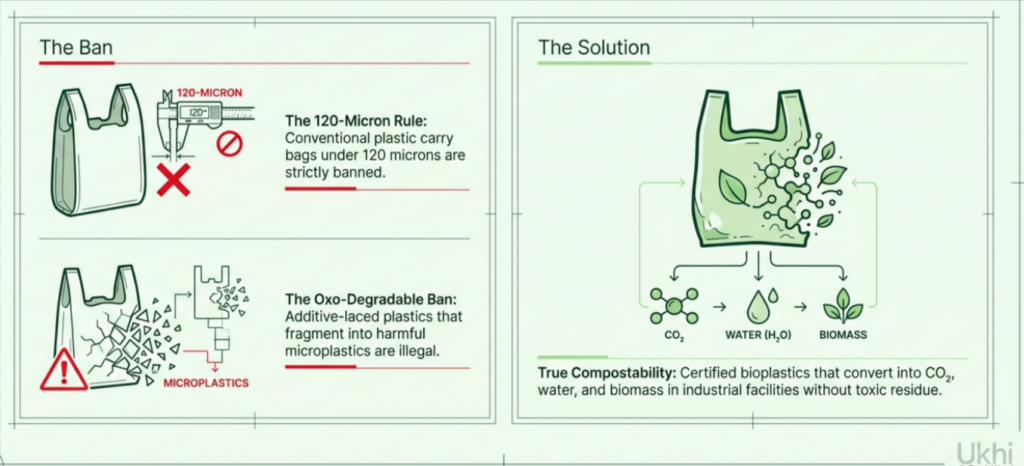
The specification should name the resin family, typically a PBAT and PLA blend with starch or mineral fillers, and confirm zero oxo-degradable additives. Oxo-degradable additives are banned in India because they only fragment the plastic into microplastics.
Thickness and dimensions
The 50-micron minimum thickness rule that applies to conventional plastic bags does not apply to compostable bags. Thickness should be chosen based on load. For example, a light retail or courier bag works well at 20 to 25 microns, while a grocery bag carrying 5 to 10 kg needs a higher gauge. Width, height, gusset size, and handle type (D-cut or W-cut) should all be stated.
Yield in pieces per kg
Since biodegradable carry bags wholesale pricing is quoted per kg, the buyer needs to know how many bags one kg produces. A 10″ x 14″ bag at 25 microns yields roughly 160 to 165 bags per kg. This yield number is what allows a fair comparison between two quotes.
Shelf life guarantee
A written guarantee of 12 to 24 months under standard storage conditions is reasonable and should be part of the contract.
Materials and Manufacturing Processes for Compostable Carry Bags
Understanding the material and the process helps buyers ask the right questions during supplier meetings.
The material blend
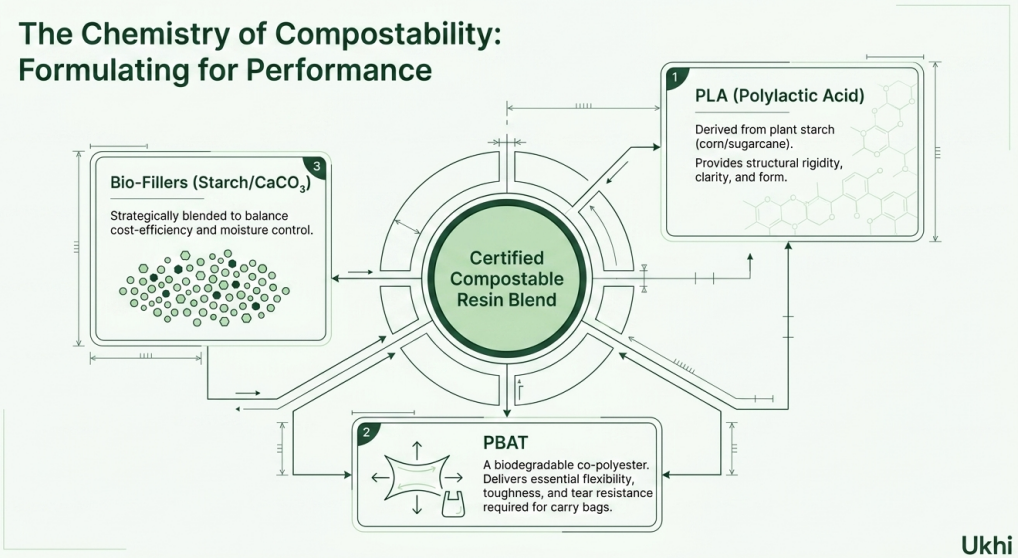
Most compostable carry bags in India use a blend of Polylactic Acid (PLA), which is made from fermented corn starch or sugarcane and gives the bag its stiffness and printability, and Polybutylene Adipate Terephthalate (PBAT), which gives the bag its flexibility and tear resistance.
A common ratio is around 70% PBAT, 30% PLA, with starch or calcium carbonate fillers to manage cost. Pure PLA is too brittle on its own, and pure PBAT is too soft, so the blend is what makes a working carry bag.
The manufacturing route
Compostable carry bags are made through blown film extrusion. The compounded granules are dried thoroughly (moisture in the granules causes the polymer to break down during heating), melted inside an extruder within a narrow temperature window of 150°C to 190°C, and blown through a circular die into a thin film bubble. The film is then printed with water-based ink, cut, and heat-sealed into finished bags.
Our EcoGran compostable resin is designed as a drop-in compound for standard blown film lines. Converters using EcoGran do not need to buy new machinery, though they do need to control drying and temperature more carefully than they would for conventional plastic.
Certifications and Compliance for Compostable Carry Bag Manufacturers in India
Certifications separate a compliant biodegradable and compostable carry bags manufacturer in India from a biodegradable carry bags supplier making unverified claims. The table below lists what to check.
| Certification | What It Covers | Market |
| CPCB Manufacturer Certificate | Legal permission to sell compostable plastic bags in India | Domestic (mandatory) |
| SPCB/PCC Registration + Consent to Operate | Factory-level environmental compliance | Domestic (mandatory) |
| IS/ISO 17088 | Industrial compostability: 90% biodegradation in 180 days, disintegration within 84 days, eco-toxicity limits, heavy metal limits | Domestic (mandatory) |
| CIPET Testing | NABL-accredited lab testing that supports the IS/ISO 17088 certificate | Domestic |
| FSSAI | Food safety, for bags used in food-contact packaging | Domestic |
| ISO 9001 | Quality management system | Domestic and export |
| ISO 14001 | Environmental management system | Domestic and export |
| EN 13432 | European standard for industrial compostability | Export (EU) |
| ASTM D6400 + BPI listing | US standard for compostable plastics | Export (North America) |
We hold IS/ISO 17088, CIPET testing, GMP, FSSAI, ISO 9001, and ISO 14001.
How Much Do Biodegradable Carry Bags Cost in India?
Wholesale pricing for biodegradable and compostable carry bags in India in 2026 is between ₹150 and ₹310 per kg for common retail, grocery, and carry formats. Per-piece pricing ranges from ₹2 to ₹8 for standard unprinted bags and ₹3 to ₹15 for custom-printed bags.
The following are indicative rates on a 13″ x 16″ carry bag at 25 microns:
| Grade | Rate per kg |
| EcoGran Carry Bag (Eco) | ₹120 |
| EcoGran Carry Bag (Standard) | ₹155 |
| EcoGran Carry Bag (Premium) | ₹190 |
The per-kg number alone is not enough to compare two quotes fairly. What matters actually is the real cost per bag, which is the price per kg divided by the number of bags per kg. A supplier quoting ₹210 per kg with a yield of 165 bags per kg (₹1.27 per bag) is actually cheaper than one quoting ₹180 per kg with a yield of only 120 bags per kg (₹1.50 per bag).
The same logic explains our own cost position on a 12″ x 15″ garment-style carry bag:
| Specification | Conventional Plastic Bag | UKHI Compostable Bag |
| Thickness | 120 microns | 20 microns |
| Weight per bag | 32 grams | 7 grams |
| Cost per kg | ₹150 | ₹300 |
| Bags per kg | 30 | 150 |
| Cost per bag | ₹5.70 | ₹2.28 |
Even at a higher per-kg rate, the finished cost per bag is roughly 60% lower than a conventional plastic bag of the same size.
Why Buy Biodegradable Carry Bags from UKHI
We are one of India’s few integrated biopolymer companies, and buyers dealing with us get five things that address the risks discussed above.
Lower cost per bag, not just per kg
Our film engineering allows a 12″ x 15″ carry bag to be made at 20 microns instead of the typical 120 microns of a plastic bag. This can cut the finished cost per bag by around 60% despite the higher resin rate.
In-house resin manufacture
We make our EcoGran compostable resin ourselves, which means tear strength, puncture resistance, and seal quality are controlled from the granule stage rather than being inherited from an imported compound.
A full packaging system
Buyers get an approved converter network, machine trial support (typically 100 to 250 kg of material on a first run), and packing-line trial support of 5,000 to 10,000 finished bags to check operator productivity on the buyer’s own line.
Certifications
We hold IS/ISO 17088, CIPET testing, GMP, FSSAI, ISO 9001, and ISO 14001. Our technology is also backed by IIT Mandi Catalyst, IIT Guwahati, and IIM Bangalore NSRCEL.
End-of-life support
Through our EcoGran Circular Care Programme, we help buyers set up waste segregation, coordinate collection, and route the used bags to verified industrial composting facilities.
FAQs
Are biodegradable carry bags legal to sell in India in 2026?
Yes, but only if the biodegradable and compostable carry bags manufacturer in India holds a valid CPCB certificate, an SPCB registration, and IS/ISO 17088 compliance. Every bag must be labelled “COMPOSTABLE” in English and a regional language, and carry the CPCB number plus a verifiable QR code.
What is the minimum order quantity from biodegradable bag suppliers in India?
Standard MOQs from compostable bags suppliers in India are 500 to 2,000 bags for unprinted stock and 250 to 300 kg of material for custom-printed runs. Buyers running a first trial can usually request a smaller sample kit of 10 to 50 bags at no cost.
How much do biodegradable carry bags cost per kg in bulk?
Biodegradable bags priced per kg in bulk range from ₹150 to ₹310 in 2026. Rate depends on the resin grade, bag size, thickness, printing, and order volume. Orders above 10,000 pieces usually get better per-piece rates than smaller trial orders.
Can compostable carry bags be composted at home?
Most compostable carry bags sold in India, including our EcoGran range, are certified for industrial composting only. They break down cleanly in a controlled composting facility but not in a home compost bin. A separate home-compostable grade is needed for that.
Do biodegradable carry bags work for retail and grocery use?
Yes. Compostable carry bags for retail at 20 to 25 microns handle light shopping and courier loads well. Grocery bags carrying 5 to 10 kg need a higher gauge, usually 30 microns or more, along with a stronger seal and a suitable handle type.