

Quick Answer
Compostable cutlery in India is made from sugarcane bagasse, CPLA, bioplastic resin, wood, or areca leaf. Legal sale requires IS/ISO 17088 certification, CIPET testing, and CPCB registration. Wholesale prices run from ₹0.75 to ₹3.00 per piece depending on material and order size. UKHI is one of the few biodegradable and compostable cutlery manufacturers in India that also produces its own compostable resin, EcoGran, giving buyers a full trail from granule to finished spoon.
What to Look for in a Compostable Cutlery Supplier
The Indian compostable cutlery market has grown fast, and buyers now have a wide choice of suppliers. A few basic checks help buyers pick the right biodegradable and compostable cutlery manufacturer in India and confirm that the product matches the claims on the label.
Registrations and Test Reports
Any biodegradable and compostable cutlery manufacturer in India must be registered with the State Pollution Control Board (SPCB or PCC) and hold a valid registration from the Central Pollution Control Board (CPCB). Marketing claims are not enough. A buyer should ask for the actual CIPET test report against IS/ISO 17088. If a supplier of compostable cutlery poducts cannot share this document, the compostability claim is not verified.
In-house Resin Manufacturing
Many biodegradable and compostable cutlery manufacturers in India are traders who buy resin or finished cutlery from another party and resell it. Others make the resin in-house and mould the cutlery themselves. The second kind gives the buyer traceability from granule to finished spoon. UKHI falls in this second group: we manufacture our own compostable biopolymer resin, EcoGran, and use it to produce cutlery.
Manufacturing Capacity
A pilot order of 5,000 pieces is easy for almost any workshop but a repeat order of 5,00,000 pieces every month is not. Before signing on, a buyer should ask about installed capacity, current utilisation, and lead time for a repeat order of the intended size.
Customisation and MOQ
Standard SKUs in common sizes usually carry lower minimum order quantities. Custom colours, printed branding, or non-standard sizes typically need a MOQ of 10,000 units or more.
Sample Availability
A biodegradable and compostable cutlery manufacturer in India should be able to send free samples so the buyer can test the product on their own food, service style, and packing line. UKHI ships free samples within seven days.
Specifications That Matter When Buying Compostable Cutlery
The right specifications of compostable cutlery items depends on the food it will carry and the way it will be used.
Heat resistance
Indian meals are hot and oily, so the material must hold shape at serving temperature. The common numbers:
| Material | Safe up to | Suitable for |
| Sugarcane bagasse | 220°C | Hot curries, microwave reheating |
| CPLA (from PLA resin) | 70 to 90°C | Warm rice meals, tea and coffee stirrers |
| Standard PLA | 40 to 45°C | Cold food, desserts, ice cream |
| Birchwood | Softens with hot liquid contact | Dry food, short-contact use |
Moisture and Grease Resistance
Wooden compostable spoons and forks work well for dry biryani or dosa but weaken in dal or sambar within 15 to 20 minutes. For gravy-heavy meals, buyers should choose bagasse or a CPLA-based grade.
Mechanical Strength
Tensile strength, bending stiffness, and handle thickness decide whether a spoon breaks mid-meal. A 6.5 inch CPLA cutlery piece typically weighs 2.5 to 3.5 grams for adequate rigidity.
Food Safety
The cutlery should be BPA-free and, ideally, PFAS-free. Any coating used for grease resistance should be water-based, not fluorochemical-based.
Materials and Manufacturing Processes Used for Compostable Cutlery
Different manufacturers use different material mixes in their biodegradable and compostable cutlery. A buyer who understands this can match the product to the use case with more confidence.
| Material | Manufacturing process | Typical products |
| Sugarcane bagasse | Pulped, mixed with additives, compression moulded under heat and pressure | Spoons, forks, ice cream sticks |
| CPLA and PLA (bioplastic resin) | Resin granules melted and injection moulded | Spoons, forks, knives, stirrers |
| Areca leaf | Sheaths washed, sun-dried, hydraulically pressed without chemicals | Rustic spoons, tasting spoons |
| Bamboo and birchwood | Cut, shaped, sanded, polished | Spoons, forks, chopsticks |
| Paper (laminated) | 6 to 9 food-grade paper layers glued, die-cut, formed | Light-duty spoons |
Certifications and Compliance for Compostable Cutlery in India
A buyer should ask for each of the following before contracting supply.
- IS/ISO 17088: The core Indian standard for compostability. Requires the product to pass disintegration, aerobic biodegradation, and heavy metal tests, usually over a 180-day study.
- CIPET test report: The Central Institute of Plastics Engineering and Technology conducts the tests recognised by CPCB.
- CPCB and SPCB registration: Mandatory for any Indian manufacturer or seller of compostable products.
- BIS IS 18267:2023: A newer standard specific to food-serving items made from agricultural by-products.
- FSSAI compliance: Required for any item that touches food.
- EPR registration: Brand owners must register on the CPCB EPR portal for end-of-life obligations.
- International standards: EN 13432 (Europe) and ASTM D6400 (USA) apply for export.
UKHI holds FSSAI, IS/ISO 17088, GMP, ISO 9001, and ISO 14001 certifications.
How Much Does Compostable Cutlery Cost in India
Prices vary with material, order size, and customisation. Indicative wholesale rates for compostable cutlery items in the Indian market as of 2026:
| Item | Material | Price per piece |
| Spoon, 160 mm | Sugarcane bagasse | ₹1.35 to ₹1.50 |
| Spoon, 160 mm | Bioplastic / cornstarch | ₹0.95 to ₹1.29 |
| Spoon, 6.5 inch | CPLA | ₹2.00 to ₹3.00 |
| Spoon, 140 to 160 mm | Birchwood | ₹0.75 to ₹1.00 |
| Ice cream spoon, small | Bagasse | ₹0.40 to ₹0.55 |
| Cutlery kit (spoon, fork, knife, napkin) | Mixed | ₹4.00 to ₹5.00 |
Compostable cutlery usually sits at a 15 to 30 percent premium over banned plastic cutlery.
For compostable cutlery bulk supply in India at volumes above 1,00,000 pieces a month, the gap narrows to 10 to 20 percent.
Custom colour or printed branding adds cost and typically needs a 10,000 unit MOQ.
Total cost of ownership often lands flat within 12 to 18 months once EPR fees, waste handling, and penalty risk on banned plastics are counted in.
Why Buy Compostable Cutlery from UKHI
A few things separate us from most biodegradable and compostable cutlery manufacturer in India:
- We make the resin. UKHI is a material science company. We compound our own compostable resin, EcoGran, at our plant in IMT Faridabad, Haryana. Cutlery moulded from this resin carries the same quality trail from granule to finished piece.
- Certifications in place. FSSAI for food contact. IS/ISO 17088 for industrial compostability, verified through CIPET. GMP, ISO 9001, and ISO 14001 for manufacturing and environmental systems.
- Existing clients. Reliance Retail, Aditya Birla Group, Good Earth, V-Mart, Amazon, and Dohful currently buy UKHI products.
- Scale. Revenue grew 23 times year-on-year between Q1 FY26 and Q1 FY27. Nine converter partners and installed capacity support repeat commercial orders.
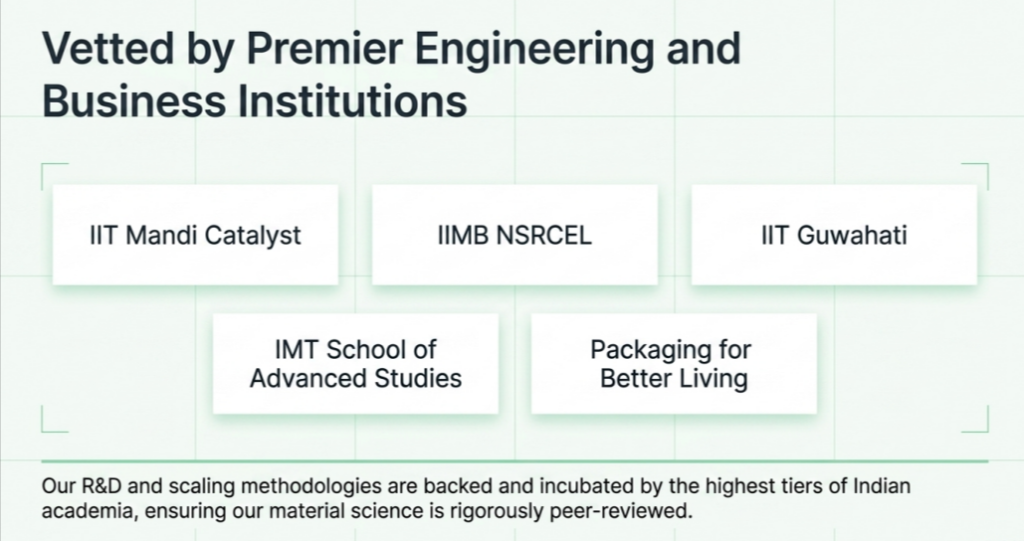
- Institutional backing. Our technology has been vetted by IIT Mandi, IIT Guwahati, and IIM Bangalore.
- Roadmap. EDHA, our PHA-based material, is in pilot phase and will offer home compostability and marine biodegradation once commercial.
Buyers can request a free sample of our compostable spoons, forks, and knives, shipped within seven days at no cost.
FAQs
1. What is the difference between biodegradable and compostable cutlery?
Biodegradable cutlery breaks down over time in natural conditions, but no time limit is fixed. Compostable cutlery breaks down fully into non-toxic matter within a set period, usually 90 to 180 days in a composting facility.
2. Is plastic cutlery banned in India?
Yes. Under the Plastic Waste Management Amendment Rules, 2021, plastic spoons, forks, knives, straws, and stirrers were banned from 1 July 2022. Fines range from ₹500 to ₹1 lakh. Certified compostable cutlery meeting IS/ISO 17088 is legal and compliant.
3. What is the minimum order quantity for compostable cutlery in India?
Standard SKUs usually start from 2,000 to 5,000 pieces per item. Custom colours or printed branding typically need 10,000 units or more. For compostable cutlery bulk supply in India at 50,000 pieces and above, most manufacturers offer volume discounts.
4. Which is better for hot Indian food, bagasse or CPLA cutlery?
Bagasse holds up to 220°C and is safer for hot curries and microwave reheating. CPLA cutlery made in India holds up to 70 to 90°C, which suits warm rice meals and stirrers but is not ideal for prolonged contact with hot gravies.
5. Does UKHI supply finished cutlery or only compostable resin?
UKHI supplies both. We sell EcoGran resin to converters who mould their own biodegradable spoons, forks, and knives. We also supply finished compostable cutlery directly to brands, retailers, and food service buyers who prefer a ready-to-use product.