
Quick Answer
Compostable grocery and vegetable bags in India are made from PLA and PBAT biopolymer blends. These bags are sold at wholesale prices between ₹150 and ₹310 per kg depending on thickness and format. Any manufacturer of biodegradable and compostable grocery and vegetable bags in India must hold a valid CPCB certificate and IS/ISO 17088 test reports from a CPCB-approved lab like CIPET. For grocery and vegetable use, FSSAI food safety clearance is essential. UKHI manufactures both the EcoGran™ resin and the finished bags in-house at IMT Faridabad, supplies retailers including Reliance Retail and Amazon, and can ship free samples on request within 7 days.
What to Look for in a Compostable Grocery and Vegetable Bag Supplier in India
A procurement team buying compostable grocery bags in India is really buying two things at once: a physical bag that must perform at the checkout counter, and a set of legal documents that must hold up under regulatory scrutiny. Both matter. A supplier of compostable grocery and vegetable bags who is strong on one and weak on the other will create problems later.
Here is what a buyer should verify before placing the first purchase order.
CPCB registration
Under Rule 4(h) of the Plastic Waste Management Rules, every manufacturer of biodegradable and compostable grocery and vegetable bags in India must hold a valid certificate from the Central Pollution Control Board before selling. Ask the compostable grocery and vegetable bags supplier to share a copy.
State-level consents
The manufacturing unit must hold a Consent to Establish and a Consent to Operate from the State Pollution Control Board of its state. A CPCB certificate alone does not cover the factory’s right to run.
Lab test reports
Many suppliers of compostable grocery and vegetable bags sho a test report for the raw resin and imply the bag is certified. IS/ISO 17088:2021 compliance must be established for the finished bag, tested at a CPCB-approved laboratory such as CIPET.
Food safety clearance
Grocery and vegetable bags come into direct contact with fresh produce, so an FSSAI food safety certificate is essential. This is a common gap among smaller compostable carry bag suppliers who serve non-food segments.
Labelling on bags
The word “COMPOSTABLE” must be printed on each bag, along with the manufacturer’s name, the CPCB certificate number, and a scannable QR code that verifies the certification.
At UKHI, we hold IS/ISO 17088, CIPET test reports, FSSAI, GMP, ISO 9001, and ISO 14001. We share the documents on request before any order discussion begins.
Specifications That Matter When Buying Compostable Grocery and Vegetable Bags
Five specifications shape whether a compostable grocery bag will actually work on a retail floor or in a home kitchen.
Micron thickness
The 120-micron minimum rule that applies to conventional plastic bags does not apply to compostable ones. Compostable bags can be legally sold at much lower thicknesses. The trade-off is that thickness directly determines how much weight the bag can carry.
| Thickness | Suitable Load | Typical Use |
| 30 microns | Up to 3 kg | Dry produce, small vegetables |
| 35 microns | Up to 7 kg | Mixed light grocery |
| 40 microns | Up to 10 kg | Wet vegetables, heavy grocery |
| 50 microns | Up to 15 kg | Retail shopping bags |
| 60 microns | Up to 18 kg | Bulk and commercial use |
Breathability
Fruits and vegetables spoil faster when moisture builds up inside a sealed bag. Perforated or mesh-style biodegradable bags for vegetables and fruits allow airflow, which extends shelf life meaningfully compared to sealed conventional plastic.
Handle design
T-shirt handles are the standard for supermarket checkouts. D-cut handles suit heavier retail loads because they distribute weight better across the palm. Both are available in compostable film.
Side gussets
Gusseted bags open wider at the base, making them easier to pack and more stable when carrying loose vegetables.
Seal strength and elongation
Damp environments, sharp produce stems, and rough handling all test the bottom seal. This is where the resin blend inside the bag matters, which brings us to the next section.
Materials and Manufacturing Process Used for Compostable Grocery Bags
The public conversation in India often reduces compostable grocery bags to “cornstarch bags.” The reality is a little more technical.
Cornstarch is a feedstock, not a finished material
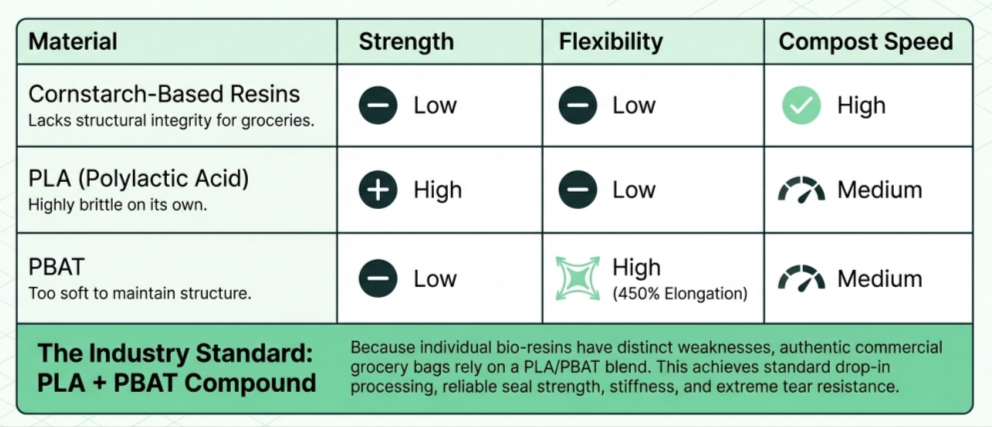
Starch on its own decomposes quickly but is too brittle to hold a bag’s shape when loaded with 5 kg of vegetables. To become a usable film, starch is first fermented and refined into biopolymers, and then those biopolymers are blended.
PLA and PBAT are the two workhorses
PLA (Polylactic Acid) is derived from fermented plant starch and provides stiffness, tensile strength, and printability. PBAT (Polybutylene Adipate Co-Terephthalate) is highly flexible and tear-resistant, with an elongation rate of around 450%. Neither works well alone. Almost every commercial biodegradable and compostable bag sold in India today is a PLA and PBAT blend.
At UKHI, we manufacture this blend in-house under our resin brand EcoGran™. EcoGran is a family of PLA and PBAT compostable compounds engineered for different processes. For grocery and vegetable bags, we supply the blown-film grade.
The manufacturing route is blown film extrusion
EcoGran granules are melted in an extruder at 140°C to 180°C, then blown into a continuous film bubble. The film is flattened, wound into rolls, printed with compost-safe inks if required, sealed at the bottom, and cut into finished bags. EcoGran runs on standard blown-film lines used for conventional plastic, which means converters do not need to buy new machinery to switch.
Certifications and Compliance for Compostable Grocery Bag Manufacturers in India
Certifications sound bureaucratic but they are the only way a buyer can verify that a certified compostable bag actually composts.
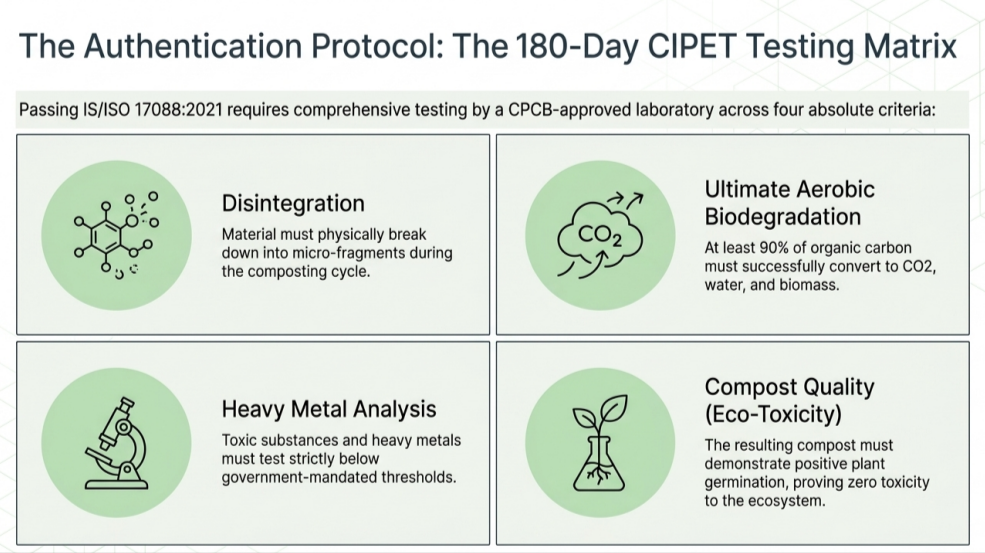
IS/ISO 17088:2021 is the primary Indian standard
A bag that passes IS/ISO 17088 has been tested over a 180-day window against four criteria:
- it must disintegrate into small fragments,
- at least 90% of its organic carbon must convert to CO₂ and biomass,
- heavy metals must stay below permitted thresholds, and
- the resulting compost must support plant growth without toxicity.
CIPET is the most commonly referenced testing lab for these reports in India.
FSSAI covers food safety
For grocery and vegetable bags, this is non-negotiable because the food comes in contact with the bag.
ASTM D6400 and EN 13432 apply to exports
Buyers shipping to North America or Europe should ask compostable grocery bag suppliers whether they hold these international compostability certifications specifically for the grade being purchased.
UKHI’s grocery and vegetable bag range is IS/ISO 17088 tested at CIPET, FSSAI certified, and manufactured under ISO 9001, ISO 14001, and GMP systems.
How Much Do Compostable Grocery and Vegetable Bags Cost in India
Wholesale prices for compostable grocery bags in India in 2026 typically range from ₹150 to ₹310 per kg, depending on thickness, print requirements, resin grade, and order volume. Grocery-format bags, which need higher thickness for heavier loads, are usually priced in the ₹250 to ₹310 per kg band.
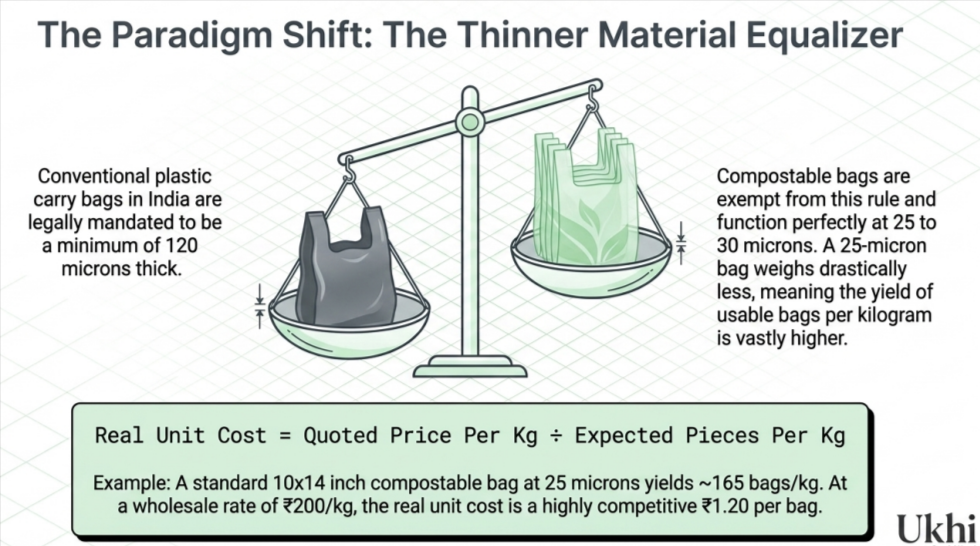
The per-kg rate is misleading on its own. What matters is the cost per bag, and that depends on how many bags a supplier gets out of one kilogram of material.
Because compostable bags are legally allowed at 20 to 30 microns instead of the 120-micron plastic minimum, they are much lighter. More bags come out of every kilogram of resin. For a standard 12″ × 15″ bag, the arithmetic works out as follows:
| Specification | Conventional Plastic Bag | UKHI Compostable Bag |
| Thickness | 120 microns | 20 microns |
| Weight per bag | 32 grams | 7 grams |
| Cost per kg of material | ₹150 | ₹300 |
| Bags per kg | 30 | 150 |
| Cost per bag | ₹5.70 | ₹2.28 |
The compostable bag price per kg is higher, but the cost per bag is roughly 60% lower.
Why Procurement Teams Choose UKHI
UKHI is a material science company headquartered at IMT Faridabad. We make the EcoGran resin ourselves and convert it into finished bags in-house. Here is what that means in practice for a buyer:
Lower cost per bag
Our 20-micron film gives roughly 150 bags per kg for a 12″ × 15″ format, which brings the per-bag cost to about ₹2.28.
Single point of accountability
Because we control the material from resin to finished bag, quality issues do not get passed between a resin supplier and a converter.
Food-contact ready
Our grocery and vegetable bag range holds FSSAI, IS/ISO 17088, and CIPET clearances.
Existing retail experience
We currently supply to Reliance Retail, Amazon, Good Earth, V-Mart, and Aditya Birla Group.
Future material development
Our next material, EDHA™, is a PHA-based biopolymer in the pilot phase that biodegrades in home compost, soil, and marine environments. It is not commercially available yet, but it is where the industry is heading.
FAQs
1. Are compostable grocery bags safe for direct contact with fresh vegetables and fruits?
Yes, provided the manufacturer of biodegradable and compostable grocery and vegetable bags holds a valid FSSAI food safety certificate for the specific bag grade. IS/ISO 17088 covers compostability but does not by itself cover food contact. Both clearances should be verified before purchase.
2. What is the minimum order quantity for wholesale compostable grocery bags in India?
Minimum order quantities vary by manufacturer, but most Indian suppliers start at 100 to 500 kg for standard formats. Custom sizes, prints, or micron variations typically require 500 kg or more.
3. How long do compostable grocery bags take to decompose?
Under IS/ISO 17088, a certified compostable bag must break down within 180 days in an industrial composting facility. Home composting takes longer and requires a home-compostable grade, which is a separate certification not covered by IS/ISO 17088.
4. Are cornstarch bags the same as compostable grocery bags?
Not exactly. Cornstarch is a raw feedstock. Most cornstarch bags sold by manufacturers in India are actually PLA and PBAT blends derived from starch.
5. How is the price of compostable bags per kg calculated wholesale?
Wholesale pricing depends on resin grade, bag thickness in microns, print colours, order volume, and delivery location. Buyers should always ask for the pieces-per-kg figure alongside the per-kg rate to arrive at the true cost per bag.