
When you are exploring sustainable garment packaging options (especially for exports!) you’ll see “Eco-friendly” plastered on everything. Terms like biodegradable, compostable, and oxo-degradable are often used interchangeably. On the surface, they all sound environmentally responsible. But in reality, they are very different materials. Not just linguistically, but they also have very different environmental and legal implications.
So, if you are sourcing sustainable fashion packaging, just “assuming” a bag is green because it’s leaf-colored isn’t enough.
Plastic Waste Management Rules are strict. Using the wrong “green” plastic can lead to heavy fines or your shipment being rejected. Also, you owe it to your customers to know exactly what happens to your bag after they unbox their order.
So, in this blog, I will explain these terms in simple, practical language. My goal is to help you clearly understand what each one means, how they differ, and when you should use them.
1. Biodegradable: The Broad Umbrella
The term “biodegradable” is often used loosely, but it has a specific scientific meaning. Essentially, a biodegradable material is something that can be broken down by biological microorganisms like bacteria or fungi. Over time, these tiny organisms turn the material into water, carbon dioxide, and biomass.
However, the confusion starts when ‘bioplastic’ are added to the conversation. Many people think “bioplastic” and “biodegradable” are the same thing. But they aren’t. A bioplastic is simply a plastic derived from biological sources like corn starch or sugarcane instead of petroleum. Some bioplastics are biodegradable. Others, however, are engineered to be as “forever” as traditional plastic. Here’s a summary of how they differ:
| Feature | Bioplastic | Biodegradable Plastic |
| Definition | Plastic made from plant-based sources | Plastic that can break down naturally |
| Raw material | Renewable plants like corn or sugarcane | Can be plant-based or petroleum-based |
| Breakdown ability | May or may not biodegrade | Specifically designed to biodegrade |
| Environmental impact | Depends on material design | Designed to reduce long-term plastic persistence |
On the flip side, some petroleum-based plastics can be engineered to be biodegradable. The catch? Compostable vs biodegradable is a comparison of speed and residue. A “biodegradable” bag might take 20 years to break down in a landfill. If it isn’t certified, it might leave behind invisible toxins. For those looking at biodegradable clothing packaging, you must check the timeline. If it takes decades to disappear, it’s hardly solving our waste crisis.
So, ask your supplier for the specific environmental conditions required for degradation when using biodegradable garment packaging.
2. Compostable: The Gold Standard
Compostable materials are a subset of biodegradable materials. However, they are much more strictly regulated. For a product to be called compostable, it must:
- Break down into nutrient-rich organic matter
- Within a specific timeframe, usually 90 to 180 days
- And most importantly, leave no toxic residue behind in the soil
But when choosing compostable fashion packaging, you need to understand the two main types of composting.
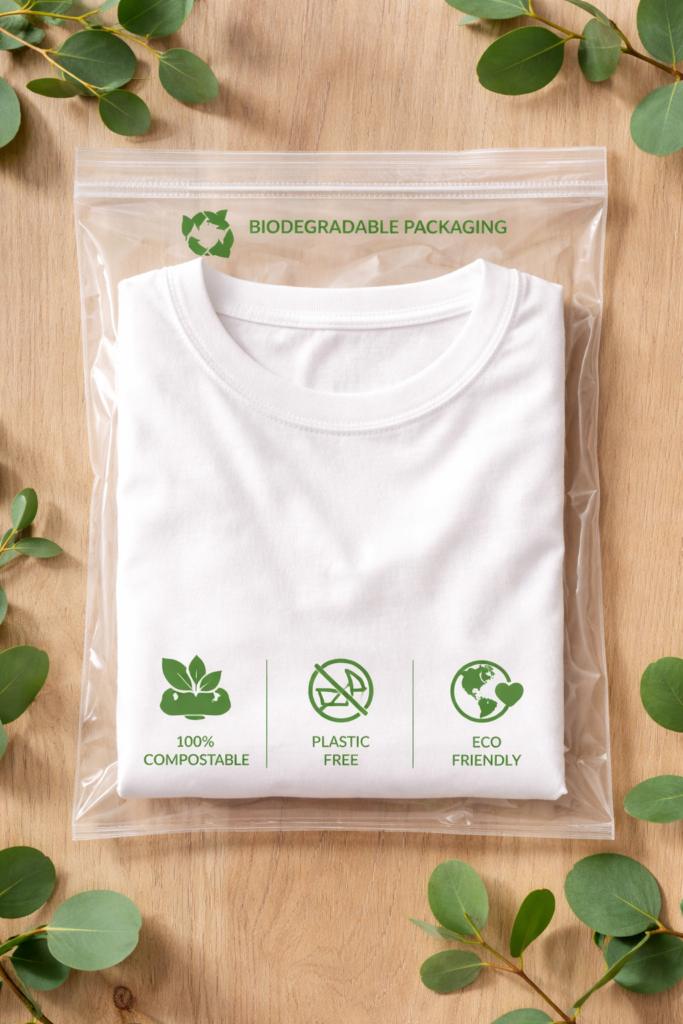
First is Industrial Composting
Such compostable clothes packaging solutions require high temperatures and specific humidity levels found only in municipal facilities. If a customer throws an “industrially compostable” bag into their backyard pit, it might stay there for years.
The second type is Home Compostable
These products are designed to break down in your garden’s compost pile at ambient temperatures. This is the ultimate win for compostable clothing packaging. It empowers the consumer to dispose of it responsibly at home. In India, CPCB (Central Pollution Control Board) certification is the only way to prove your bags are truly compostable. Without that certificate, you’re just taking a vendor’s word for it, which is a massive risk for your brand’s reputation.
3. Oxo-Degradable: The Great Deception
Oxo-degradable plastic was once marketed as a miracle solution. However, it turned out to be an environmental disaster. These are conventional plastics (made from fossil fuels) with chemical additives (metal salts) mixed in. These additives cause the plastic to fragment quickly when exposed to UV light or heat.
The problem is that it doesn’t actually “disappear.” It simply breaks down into millions of tiny microplastics that enter our soil and water table.
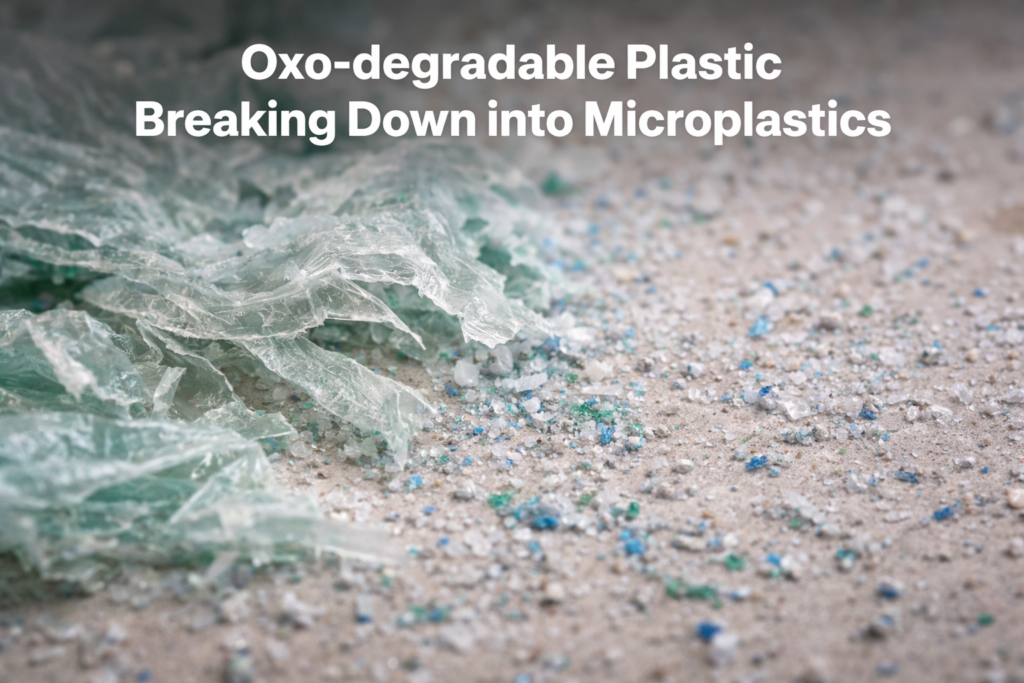
This is why we saw the oxo biodegradable ban India implemented by the government. Oxo-degradable plastic packaging is also banned in several European countries. These fragments are impossible to clean up and are eventually ingested by animals and humans.
The oxo biodegradable ban India was a necessary step to stop companies from greenwashing their products. If a supplier offers you “degradable” bags at a price that seems too good to be true? It’s likely oxo-degradable material. Using this in your sustainable clothing packaging is now illegal in many jurisdictions. It’s better to avoid this category entirely to stay compliant with Indian law and global standards.
Quick Summary: How They Stack Up
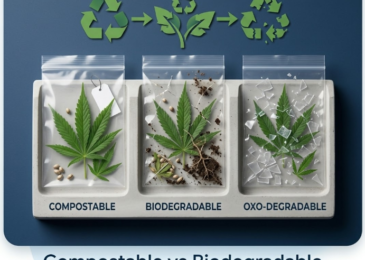
Navigating the debate of compostable vs biodegradable requires a clear comparison of how these materials behave in the real world.
| Feature | Biodegradable | Compostable | Oxo-Degradable |
| Environmental safety | Good | Best | Harmful |
| Breakdown ability | Natural breakdown | Complete breakdown | Breaks into microplastics |
| Certification | Optional | Required | Not accepted |
| Legal status in India | Allowed | Allowed and encouraged | Banned |
Which One Should You Choose?
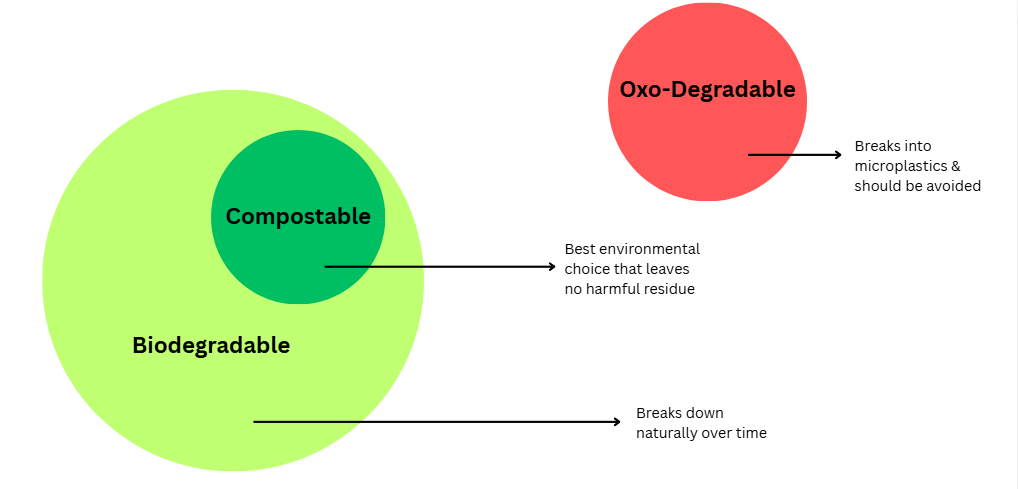
Since the oxo biodegradable ban India has effectively removed one option, your choice comes down to the two remaining categories. Remember that “compostable” is always biodegradable, but “biodegradable” is not always compostable.
Here’s a quick biodegradable vs compostable summary to guide your decision:
| Feature | Biodegradable Plastic | Compostable Plastic |
| Breakdown ability | Breaks down naturally over time | Breaks down completely under composting conditions |
| Breakdown certainty | Depends on environment | Clearly defined and verified |
| Residue | May leave microscopic residue | Leaves no harmful residue |
| Certification | May or may not be certified | Requires strict certification |
Your choice should also depend on your supply chain and how your customers typically dispose of waste.
Choose biodegradable if:
- Your product might end up in a standard waste stream or landfill.
- You need a material that is slightly more durable for long-term storage.
- You are transitioning away from virgin plastics but have a tight budget.
Choose compostable if:
- Your brand identity is built on “zero waste” and circular economy principles.
- You want to provide specific biodegradable fashion packaging that leaves zero microplastics.
- You have a customer base that actively composts or lives in cities with organic waste collection.
Getting Started with Responsible Packaging
Understanding the nuances of compostable vs biodegradable is the first step toward building a truly green brand. If you are a garment exporter, this knowledge is non-negotiable. Global retailers now demand transparency in your sustainable fashion packaging choices to meet international ESG goals.
Ready to make the switch? You can start small by getting a sample of Ukhi’s CPCB-approved compostable garment bags made using Ukhi biogranules. These bags represent the future of sustainable clothing packaging in India. Order a sample kit from Ukhi today and see the difference yourself. Let’s build a plastic-free India, one shipment at a time.
FAQs
1. Does compostable packaging have a “best before” date?
Yes, it does. Unlike traditional plastic, which can sit in a warehouse for years, compostable bags have a functional shelf life—usually 6 to 12 months. Because they are made from organic “biogranules,” they are sensitive to high humidity and heat. If you store your sustainable clothing packaging in a damp, hot warehouse in Mumbai or Chennai, the bags might become brittle or start losing their strength prematurely. We always recommend “First-In, First-Out” (FIFO) inventory management to ensure your packaging remains in top condition for your customers.
2. How can I verify if a bag is genuinely CPCB-approved?
In India, “greenwashing” is a real issue. To ensure you aren’t being sold fake products, look for two things printed on the bag: the CPCB Logo and the Unique Registration Number issued to the manufacturer. You can cross-verify this number on the official Central Pollution Control Board website. Genuine compostable fashion packaging will also mention compliance with the IS/ISO 17088 standard. If a supplier refuses to share their CPCB certificate, it’s a major red flag for your compliance audit.
3. What happens if a compostable bag accidentally ends up in a landfill?
Customers are reading labels more carefully than ever, and fashion brands are under pressure to replace plastic packaging. Adoption is happening, but here is the problem I see repeated often.
Many brands have switched to compostable garment bags because they want to move toward sustainable fashion packaging. They get a brochure that says “100% compostable,” and feel it is enough.
And then the issues begin.
- Bags tear during storage and transport.
- The colors smudge, and the logo goes askew
- The certification does not hold up during the audit.
- Export consignments get delayed over labeling issues.
That is because compostable is not a marketing buzzword to boost sales. It is a technical specification, and so many have no idea what to buy.
When you understand, the conversation shifts from “What are compostable garment bags?” to “Is this the right specification for my product?t”
In this article, I will lift the veil on specifications and what you must look for when transitioning to sustainable clothing packaging.
What is a Compostable Garment Bag?
Let me clear the air before we begin – biodegradable and compostable are not the same.
Many things biodegrade. Paper, for instance, will disintegrate eventually if you throw it in the backyard.
Compostability has a fixed time frame within which the material has to break down.
Most compostable clothing packaging breaks down:
- Within 90 days at an industrial composting facility. High heat and moisture act as accelerants.
- Within 240 days in home composting systems without controlled conditions.
Now let’s look at materials. Most sustainable fashion packaging materials for garment bags are made from blends such as:
- PLA (made from corn sugar)
- PBAT (a biodegradable co-polymer)
- Starch-based compounds
- Agro-based biopolymers
At Ukhi, we focus on converting agricultural waste into compostable polymer.
Now that you know what compostability is, the next question is what the specifications are.
What Certifications Should a Compostable Garment Bag Have?
Certification is where many brands either protect themselves or expose themselves.
For India:
In India, compostable plastic products must comply with IS/ISO 17088. The relevant certifications are issued by the Central Pollution Control Board, or CPCB.
Without CPCB certification, a compostable bag is unverified and still treated as plastic.
For exports, the standards differ:
Europe accepts the EN 13432 certification. The same holds for the UK.
If you are exporting to the US, ASTM D6400 with BPI recognition is required.
Certifications matter because greenwashing penalties are rising. Misleading claims can land you in jeopardy. Sustainable clothing packaging certification is not a checkbox but a legal must.
What Thickness and Strength Specifications Matter?
Thickness alone does not mean better quality. But it influences durability and performance.
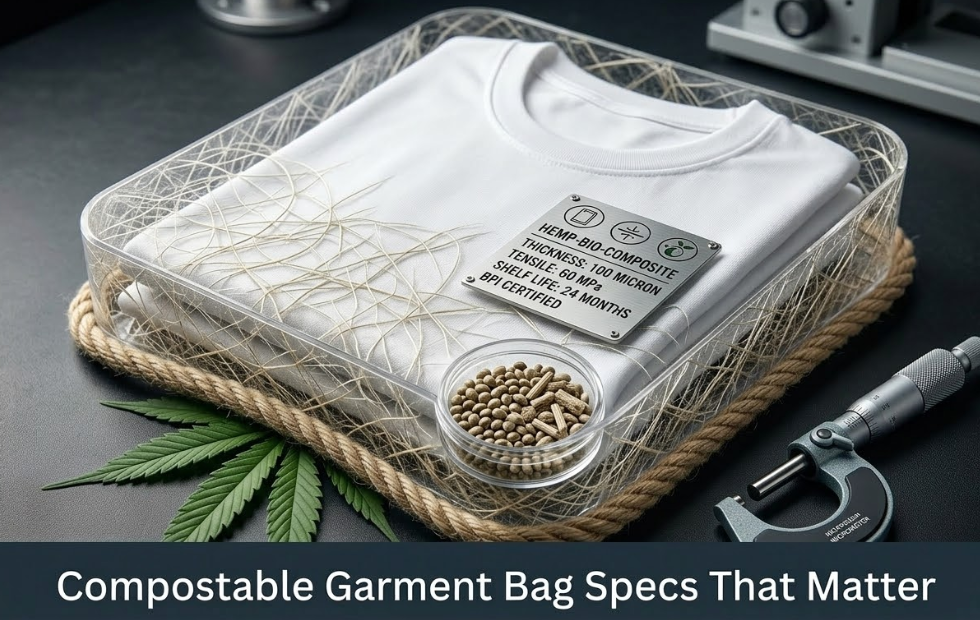
Here are the typical compostable garment bag thickness ranges summarised in a table:
| Thickness Range | Application | Typical Use Cases |
| 20–30 μm | Light garments | T-shirts, blouses, innerwear, scarves |
| 40–70 μm | Standard retail apparel | Dresses, shirts, trousers, suits |
| 80–120 μm | Heavy garments / Premium covers | Denim jeans, jackets, heavy coats, premium packaging |
| 150–200 μm | Reusable garment protectors | Heavy-duty travel bags, long-term storage, professional garment protectors |
Besides thickness, you also have to evaluate:
- Tensile strength – with how much force can it be pulled till it breaks
- Tear resistance – what force will cause it to tear or crack open
- Seal strength – force required to pull apart the package layers
- Puncture resistance – the ability to tolerate penetration by another object
You should not over-specify since it leads to:
- Higher material cost
- More weight
- More storage volume
While under specifications lead to
- Damaged garments
- Frequent returns
- Negative customer experience
At Ukhi, when we consult with clients who want sustainable clothing packaging, we typically create a matrix:
| Garment Type | Suggested Micron Range |
| T-shirts | 25–35 μm |
| Shirts | 35–50 μm |
| Denim | 50–70 μm |
| Jackets | 70–100 μm |
Till now, we have been discussing the exterior of sustainable clothing packaging. Now time to turn to what is inside.
What Barrier and Functional Properties Are Important?
India is humid. The UK is damp. Parts of the US are tropical.
Moisture is the silent enemy of apparel packaging.
The most important barrier properties of sustainable fashion packaging are:
- Moisture resistance
- Dust protection
- Controlled oxygen permeability
- Anti-static performance
Let’s take moisture first.
In monsoon conditions, condensation inside sealed packaging can lead to odor or mildew. This is where:
- Vent holes
- Slight breathability (in compostable films)
- Controlled storage environments
become critical.
Some compostable garment bags are offered with two micro-vent holes on each side to reduce moisture buildup during transit.
Next is static.
Static electricity cling can cause:
- Dust attraction
- Fabric sticking
- Poor presentation in-store
Certain compostable formulations allow anti-static additives without compromising compostability. This is important for synthetic blends.
Closures also affect functionality:
- Resealable adhesive flaps → fast packing and easier returns
- Zip closures → premium experience
- Pillowcase style → internal dust sleeve
Finally, printability matters.
If your sustainability message smears or fades, the credibility suffers. Compost-safe inks must be used to maintain compliance.
When these barriers and functional properties are right, your eco garment packaging for fashion brands moves from symbolic to operationally sound.
And once performance is stable, the next question becomes bigger: what happens after the disposal of sustainable fashion packaging?
How Does Compostability Affect End-of-Life Impact?
Compostability sounds simple, but it is where theory meets infrastructure.
Let’s be honest. India does not yet have widespread industrial composting infrastructure. Some metro cities have facilities, while most districts do not.
The US has composting access in certain states and cities. The UK and Europe have better organic waste systems, but compostable plastics still face sorting challenges.
So when we talk about sustainable fashion packaging, we must ask:
- Is the bag industrially compostable only?
- Is it home compostable?
- Is disposal guidance clearly printed?
Compostable garment bags must break down reliably in controlled facilities within about 90 days. Home compostable bags may take 90–180 days in backyard composting conditions.
But if the consumer throws the bag in the general waste, compostability loses its benefit.
This is why clear labeling matters.
Clear on-bag instructions such as:
- “Industrial composting only”
- “Home compostable under 180 days”
- Certification logos
reduce contamination and improve compliance with sustainable packaging regulations.
From a policy perspective, India’s Extended Producer Responsibility (EPR) framework is evolving. Brands are increasingly accountable for end-of-life outcomes.
So, compostability is not just a material property. It is part of your environmental responsibility strategy.
Summing Up: What Specifications Truly Matter?
Here is a brief recap.
- First, Certification is of utmost importance, and without it, sustainability claims collapse.
- Second, Mechanical performance matters since if the bag fails in transit, you suffer a loss.
- Third, Barrier properties are vital since moisture and dust can damage garments.
- Lastly, Compostability only works if disposal is understood, so clear instructions are a must.
Sustainable fashion packaging is not about switching one plastic bag for another. When executed correctly, it is a significant competitive advantage. Do not treat it as a simple cost decision but a strategic move to gain greater credibility.
Frequently Asked Questions
What thickness is best for sustainable fashion packaging?
It varies depending on the clothing material from 30 to 100 μm. For shirts, for example, 35–50 micron-thick sustainable clothing packaging provides the right balance between durability and material efficiency.
Are compostable garment bags allowed under India’s plastic ban?
Yes, but only if they adhere to ISO 17088 and have CPCB approval. Sustainable clothing packaging without certification is useless from a legal standpoint.
How long does sustainable fashion packaging take to break down?
The ISO 17088 standard requires compostable garment bags to break down in 90 – 180 days.
What material is used in sustainable clothing packaging?
Technology is evolving rapidly. Currently, PLA, PBAT, and starch-based polymers are the materials of choice due to their low cost.
Can compostable garment bags be used for exports?
Yes, but only if they meet ASTM D6400 for the USA and EN 13432 for the UK and Europe.