
Short Answer: How Do You Source Sustainable Packaging in India?
What Is MOQ in Compostable Packaging?
Packaging MOQ stands for Minimum Order Quantity. It is the smallest number of units a manufacturer is willing to produce in a single production run.
The number is not arbitrary. Every production run involves fixed costs that exist regardless of how many units come out at the end.
These include:
- Machine setup and calibration
- Mold installation for shaped products
- Plate or cylinder preparation for printed packaging
- Raw material procurement at viable batch sizes
When a factory sets an MOQ of 20,000 units, what they are saying is: this is the point at which our fixed costs are spread across enough units to make the run financially viable. Below that, they lose money on the job.
For conventional plastic packaging, these setup costs are low and the material is cheap, so MOQs tend to be flexible.
For compostable packaging MOQs in India, the calculation is more complicated.
For instance:
- Specialised resins like PLA have higher material sensitivity.
- Pulp moulding machines for bagasse are designed for continuous operation and lose efficiency when stopped and restarted for small runs.
- Compostable films require specific temperature and pressure settings that take time to calibrate.
Understanding this logic is the foundation for negotiating intelligently.
How MOQ Changes by Packaging Type and Material
Not all compostable packaging MOQs in India are the same. The minimum varies significantly depending on the production technology the format requires.
The general principle is this: the more customised the format and the more complex the production process, the higher the MOQ. Standard formats on existing equipment have much more flexibility.
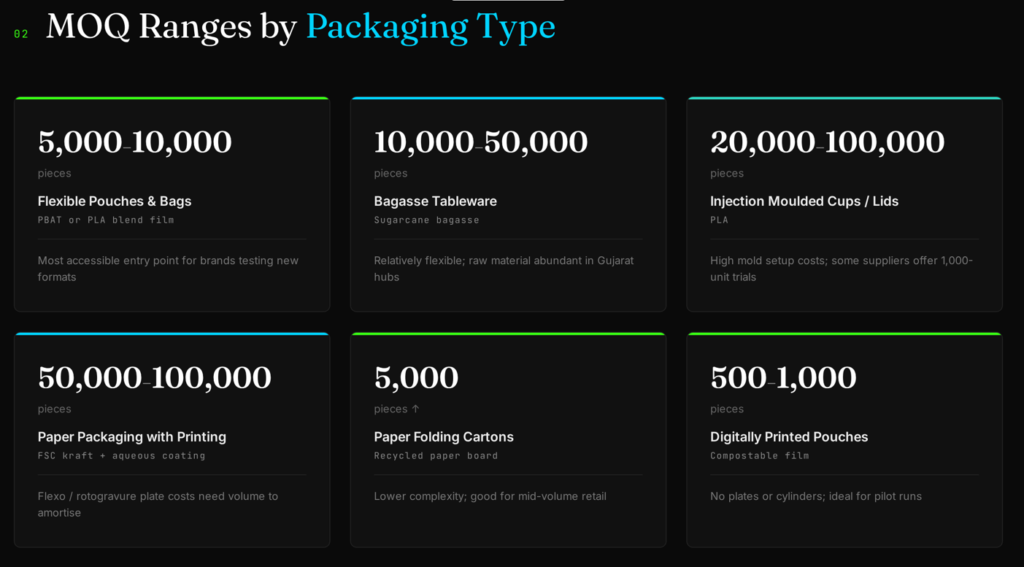
- Injection moulded products, such as PLA cups or lids, typically require 20,000 to 100,000 pieces because mold setup costs are high. Some specialised suppliers offer trial runs from 1,000 units for simple bottle formats, but these are exceptions.
- Flexible compostable packaging, such as stand-up pouches or flat-bottom bags, starts between 5,000 and 10,000 pieces, which makes it one of the more accessible entry points for brands testing a new format.
- Bagasse tableware, including plates, bowls, and clamshells, generally ranges from 10,000 to 50,000 pieces. It is considered relatively flexible compared to other sustainable formats because the raw material is abundant and the production process is well established across Gujarat and other manufacturing hubs.
- Paper packaging with coating or printing typically requires 50,000 to 100,000 pieces. Flexographic and rotogravure printing involve fixed costs for cylinders and plates that need to be spread across a large volume to be commercially viable.
- Eco-friendly paper bags are the most accessible format. Local manufacturers can offer tiered minimums starting at 100, 250, or 500 pieces, which makes them practical for small brands and pilot programmes.
The right starting point for any buyer is to match their format requirement to the production technology, and then work from that baseline when approaching suppliers.
Typical MOQ Ranges for Compostable Packaging in India
| Format | Material | Typical MOQ Range |
| Flexible pouches and bags | PBAT or PLA blend film | 5,000 to 10,000 pieces |
| Bagasse plates, bowls, clamshells | Sugarcane bagasse | 10,000 to 50,000 pieces |
| Injection moulded cups or lids | PLA | 20,000 to 100,000 pieces |
| Paper packaging with printing | FSC kraft with aqueous coating | 50,000 to 100,000 pieces |
| Paper folding cartons | Recycled paper board | From 5,000 pieces |
| Digitally printed pouches | Compostable film | From 500 to 1,000 pieces |
| Eco-friendly paper bags | Kraft paper | From 100 to 500 pieces |
These are indicative ranges. Actual packaging MOQ in India will vary by supplier, level of customisation, and whether you are using a standard mold or requesting a custom shape.
How to Negotiate MOQ with Packaging Suppliers in India
Experienced buyers use a set of well-understood strategies to reduce their required order volume without asking suppliers to absorb losses.
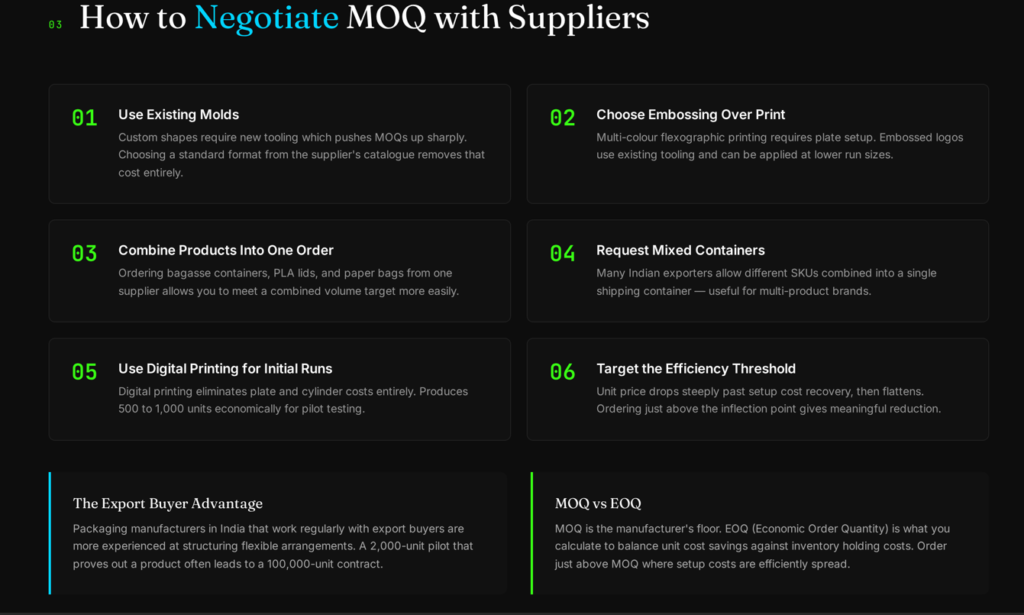
- Use the supplier’s existing molds. Custom shapes require new tooling, which pushes MOQs up sharply. Choosing a standard format from the supplier’s existing catalogue removes that cost entirely and can bring the minimum down significantly.
- Choose embossing over printing. Multi-colour flexographic printing requires plate setup costs that need volume to amortise. Embossed logos, by contrast, use existing tooling and can be applied at lower run sizes. For brands that need visible identity on packaging without full print, this is a practical middle ground.
- Combine products into a single order. If you need bagasse containers, PLA lids, and paper bags, ordering all three from one full-solution supplier allows you to meet a combined volume target more easily than hitting individual MOQs on each product separately.
- Request mixed containers. Many Indian exporters allow different SKUs to be combined into a single shipping container. This is particularly useful for distributors or multi-product brands who want variety without committing to large volumes of a single item.
- Use digital printing for initial runs. Digital printing eliminates plate and cylinder costs entirely. It can produce as few as 500 to 1,000 units economically.
- Target the point just above the efficiency threshold. Suppliers have a cost curve where unit price drops steeply as volume increases past setup cost recovery, then flattens out. Ordering just above that inflection point gives you a meaningful price reduction.
The packaging box manufacturers in India that work regularly with export buyers are more experienced at structuring flexible arrangements. They have seen enough international sourcing programmes to know that a 2,000-unit pilot that proves out a product leads to a 100,000-unit contract. That context makes them more willing to accommodate lower initial runs.
FAQs: Compostable Packaging MOQ in India
What are typical compostable packaging MOQs in India?
They vary by format. Flexible compostable bags start from around 5,000 to 10,000 pieces. Bagasse tableware ranges from 10,000 to 50,000 pieces. Injection moulded PLA products typically require 20,000 to 100,000 pieces.
Why are compostable packaging MOQs higher than plastic?
Not always, but often. The reasons are material cost sensitivity, more complex machine setup requirements, and the fact that specialised equipment like pulp moulding machines is designed for continuous high-volume operation. Every small run carries a disproportionate setup cost relative to output.
Can packaging MOQ be negotiated in India?
Yes, and most experienced suppliers expect it. The most effective approaches are using standard molds, combining multiple products into one order, requesting mixed containers, and using digital printing for initial runs to avoid plate costs.
What is the difference between MOQ and EOQ in packaging?
MOQ is the floor the manufacturer sets to ensure the run is viable for them. EOQ, or Economic Order Quantity, is the quantity a buyer calculates to balance unit cost savings against inventory holding costs. In practice, the advice is to order just above the MOQ threshold where setup costs are efficiently spread, without ordering so much that capital is tied up in slow-moving stock.
Do packaging box manufacturers in India offer low MOQ options?
Yes, particularly for digitally printed pouches and paper folding cartons. Some manufacturers offer paper cartons from 5,000 pieces and digitally printed pouches from as few as 500 to 1,000 units. Stock pouches with custom labels can be started at 100 units, which makes them practical for early-stage product validation.