
Quick Answer
The choice between cast film and blown film for compostable packaging is more than about which process is better in every case.
Cast film works better when a brand needs clarity, gloss, smooth winding, and tight thickness control. Blown film is better suited when the pack needs strength, flexibility, puncture resistance, and bag conversion.
Cast film vs blown film for compostable packaging
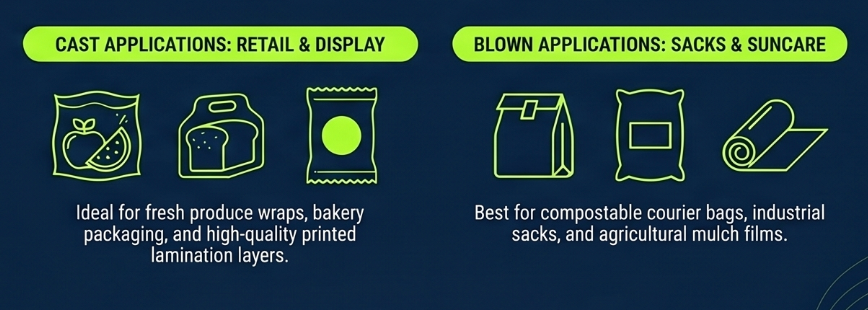
Cast film is usually the better route for packaging where the product must look clean and visible.
That is why cast film is useful for:
- fresh produce wraps,
- bakery packaging,
- display films,
- transparent liners,
- lamination layers,
- retail packaging where print and shelf appearance matter.
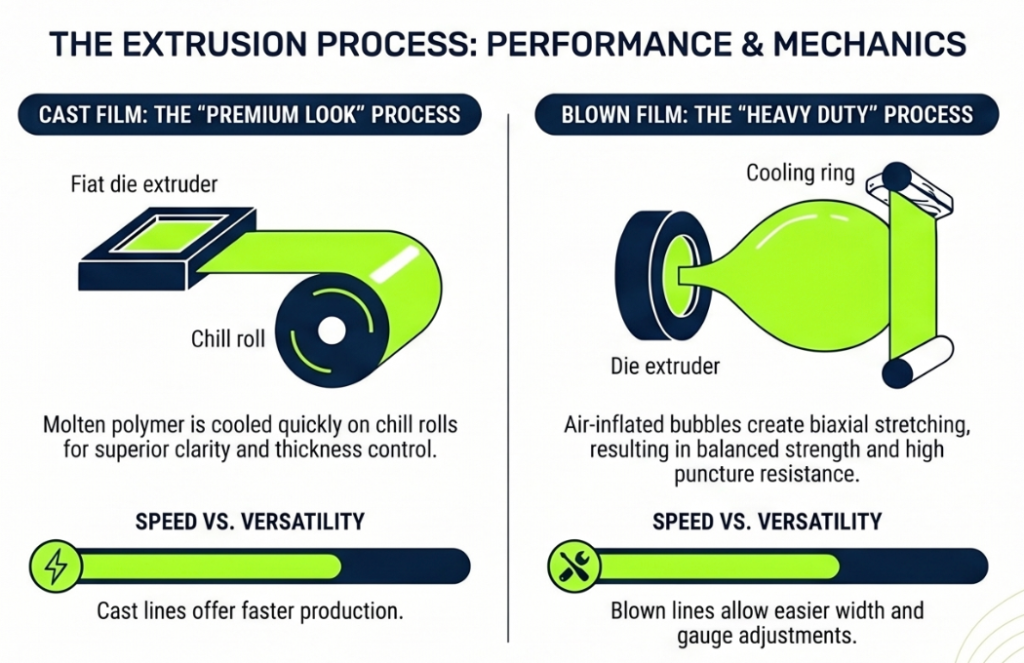
Display led packaging formats need a smooth surface and consistent gauge. Cast film supports that because the molten polymer is spread through a flat die and cooled quickly on a chill roll.
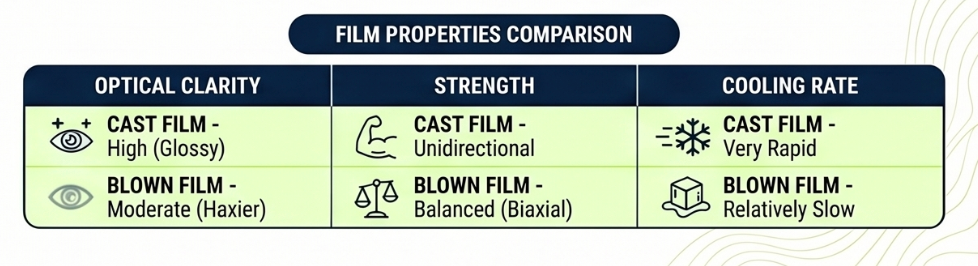
That fast cooling gives the film a clearer, glossier appearance. It also gives the converter better thickness control, which is useful when the film must run on high-speed machines.
If you want a premium shelf look, cast film usually deserves the first trial. And, choose a biodegradable blown film composite when strength, flexibility, and bag conversion matter
Blown film is usually better for compostable bags and flexible packaging that must carry weight or resist tearing.
These include:
- compostable courier bags,
- garment bags,
- shopping bags,
- carry bags,
- industrial sacks,
- agricultural mulch film,
- flexible pouches and liners.
The process creates a tube by pushing molten resin through a circular die. Air inflates the tube into a bubble. As the bubble rises and cools, the material stretches in two directions. This gives blown film more balanced strength.
If the pack must bend, stretch, seal, hold weight, or resist punctures, blown film is usually the safer starting point.
For compostable packaging, resin selection matters as much as the process
A compostable film made from the wrong resin grade can fail even on the right machine. A good compostable blow film resin must support melt strength, sealability, flexibility, and the required film thickness.
Common compostable film materials include PLA, PBAT, PHA, PBS, and starch-based blends.
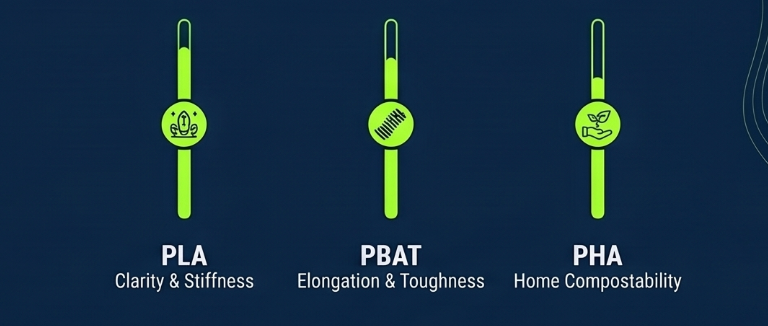
PLA is used for its clarity and stiffness. PBAT adds flexibility and elongation. Meanwhile, starch-based compounds can help control cost and PHA can improve compostability positioning and toughness in selected blends.
PLA and PHA as biobased and biodegradable materials, while PBAT is biodegradable but usually fossil resource based. But “bio-based,” “biodegradable,” and “compostable” do not mean the same thing.
What is the difference between cast film and blown film?
The difference between cast film and blown film comes from how the molten material is shaped and cooled.
The same resin can behave differently depending on the process. That is why a compostable resin that looks good in a cast film trial may not automatically work in a blown film bubble.
How cast film extrusion works
In cast film extrusion, compostable resin pellets are melted in an extruder.
The molten material passes through a flat slot die and comes out as a thin sheet. This hot sheet is pressed against a chilled roll, where it cools quickly. The edges are trimmed, and the film is wound into rolls.
This gives three major advantages:
- better clarity,
- better gloss,
- better gauge control.
How blown film extrusion works
In blown film extrusion, the molten resin passes through an annular die and forms a tube.
Air is blown into the center of the tube. The tube expands into a bubble and cools as it rises. Nip rollers flatten the bubble into a double-layer film. This can then be slit, printed, sealed, or converted into bags.
This process is more difficult to control than cast film, especially with compostable blends. Bubble stability depends on melt strength, cooling, die setup, blow-up ratio, and resin moisture. But when the process works well, a biodegradable blown film composite gives a strong, flexible, bag ready material.
Now the practical question is how these differences affect packaging performance.
How cast film and blown film perform in compostable packaging
The right choice should come from the pack’s real job, not from a generic preference for one process.
Clarity, gloss, and retail display quality
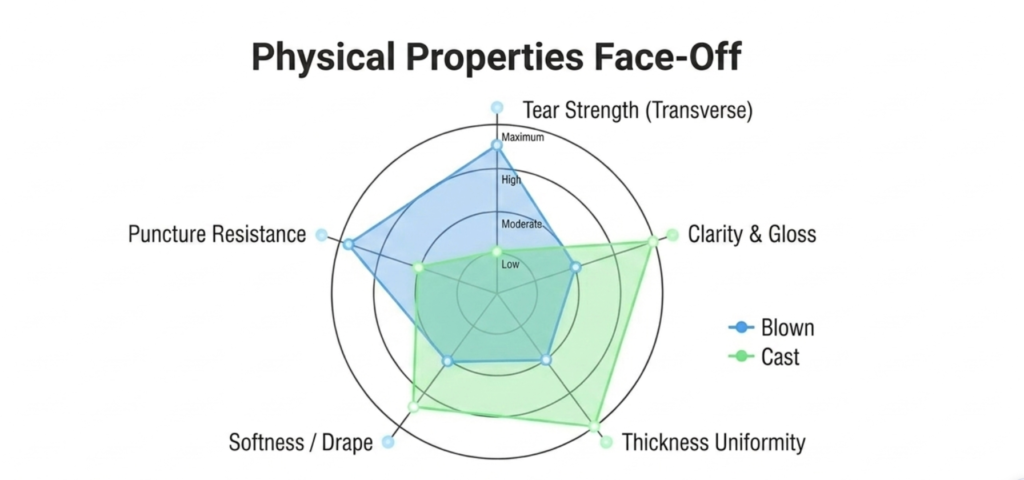
Cast film is stronger on visual quality.
It is suitable when the customer needs to see the product through the pack. This matters for fresh produce, bakery items, personal care refill packs, transparent wrappers, and premium retail display formats.
Blown film can be transparent, but it is usually hazier than cast film. For a courier bag, that does not matter. For a food display wrapper, it may matter a lot.
Puncture resistance, tear strength, and flexibility
Blown film is stronger for rougher use. A compostable courier bag may face folding, edge pressure, transit movement, and sealing stress. A garment bag may need flexibility without splitting. A shopping bag must carry load without sudden tear failure.
Blown film is better suited to these situations because the bubble process stretches the film in two directions. Cast film can work for lighter flexible packaging. But it can be more prone to splitting across width if the resin and structure are not selected carefully.
Thickness control, micron range, and yield
Cast film gives better thickness uniformity.
This matters when a high-speed packaging line needs consistent film feed, seal pressure, and roll behavior. A tighter gauge also helps with predictable costing because the buyer gets less variation across the roll.
Blown film can show more thickness variation, but it has another advantage. Because of its strength, it can sometimes be downgauged. In simple terms, the buyer may be able to use a thinner blown film while maintaining enough strength for the application.
That is why cost comparison should not use price per kg alone. It should be based on price per functional pack.
Heat sealing, sealing temperature, and conversion behavior
Both cast and blown films can be heat sealed, but they do not behave the same.
Cast film is often preferred for high-speed wrappers because it feeds smoothly and can support consistent sealing. Blown film is preferred for bag conversion because the film already comes as a tube, which reduces some downstream conversion steps.
Compostable blends need closer process control than PE. Moisture, sealing temperature, dwell time, and jaw pressure can change the final result.
For example, a PBAT-rich blend may give flexibility, but the sealing window must still match the packing line. A PLA-rich blend may give clarity, but it may feel too stiff for some bag formats.
Decision matrix: cast film vs blown film for compostable packaging
| Cast film | Blown film | |
| Best use | Clear display films, wraps, lamination layers | Courier bags, garment bags, shopping bags, liners |
| Main strength | Clarity, gloss, gauge control | Strength, flexibility, puncture resistance |
| Film appearance | Smooth and transparent | Usually hazier, but tougher |
| Thickness control | Stronger gauge uniformity | More variation, but better strength balance |
| Cost behavior | Efficient for high-volume clear film runs | Practical for bag and custom-width formats |
| MOQ fit | Better for planned production runs | Often better for custom bag trials |
| Sealing behavior | Good for controlled wrapping formats | Good for bag conversion when resin is matched |
| Machine fit | Cast extrusion and wrapping lines | Blown film and bag-making lines |
| Export fit | Good if finished film is certified and documented | Good if finished bag or film is certified and documented |
Expert view
At Ukhi, we help brands and converters choose the right compostable resin route, evaluate whether cast or blown film makes more sense, and support the move from sample to trial to procurement.
“Cast film and blown film are not competing answers. They are two different ways to solve two different packaging problems. The right decision starts with the pack format, then the resin, then the machine trial.”
— Vishal, Founder, UKHI
Get a cast film or blown film recommendation from UKHI
If you are evaluating cast film vs blown film for compostable packaging, start with the real packaging requirement. Share the format, micron, sealing method, machine type, MOQ, print needs, export market, and certification requirement.
UKHI can help you with:
- sample kit selection,
- compostable resin grade recommendation,
- blown film or cast film route evaluation,
- trial support for converters,
- documentation support for compostable packaging claims.
The goal is not to choose the most sustainable sounding material. It is to choose the film that works on the line, protects the product, supports the claim, and makes commercial sense.
Explore Ukhi cast and blown film products.
FAQs
- Does cast film vs blown film for compostable packaging affect certification?
The process alone does not decide certification. The finished film or bag must meet the relevant compostability standard. Resin, micron, inks, additives, adhesives, and final structure all matter. A certified resin does not automatically make the converted pack certified.
- What should converters check before buying compostable blow film resin?
Converters should check melt strength, moisture sensitivity, sealing window, micron range, output rate, bubble stability, and certification support. They should also ask whether the grade has been tested on similar blown film equipment, not only in lab-scale extrusion.
- Can a biodegradable blown film composite be printed?
Yes, but printing should be validated before commercial approval. But a wrong ink or coating can weaken the sustainability claim of the final pack.
- Do bioplastic compounds for blown film extrusion need special storage?
Yes. Many compostable compounds absorb moisture more easily than PE. Store bags sealed, dry, and away from heat. If the resin takes up moisture, the film may show bubbles, gels, weak seals, or poor mechanical strength.
- Is compostable film suitable for direct food packaging?
It can be, but only when the grade is approved for the intended food contact use. Compostability does not equal food contact approval. Buyers should ask for migration test documents, regulatory declarations, and application-specific safety data before using the film for food.