
A virgin bioplastic is a newly produced bioplastic resin made from renewable feedstock such as corn, sugarcane, starch, cellulose, or other biomass. It has not been recycled or reprocessed.
An agri-waste polymer uses agricultural residue or food processing waste as a feedstock, filler, or polymer source. You can use sugarcane bagasse, rice husk, wheat straw, fruit peels, brewer’s spent grain, potato waste, and other by-products that otherwise have low commercial value for this purpose.
Agri-waste polymer and virgin bioplastic packaging: Which is better?
Agri-waste polymer is better when the priority is waste valorisation. A virgin bioplastic is best suited when repeatable performance, food-contact control, export compliance, and stable supply matter more.
But the better choice depends on the packaging format.
Before comparing performance, the terms need to be clear.
A virgin bioplastic is not the same as a compostable plastic. It only means the resin is newly produced and partly or fully derived from biological resources.
A bio-PE bottle, for example, may be bio-based but not biodegradable. A PLA film may be bio-based and industrially compostable, but only if the finished product meets the right standard.
Bioplastic from agricultural waste works differently. It uses residues from farming or food processing.
- Some agri-waste materials become fillers inside a bioplastic blend.
- Some are converted into building blocks for polymers.
- Some are used directly as fiber-based packaging, such as molded bagasse trays.
The most common agricultural waste bioplastics are:
- Sugarcane bagasse, which can be used for trays, bowls, and molded foodservice items,
- Rice husk or wheat straw for fiber reinforced packaging,
- Spent coffee grounds or food-processing oils for PHA-related production routes, and
- Starch-rich residues for flexible or semi-rigid biodegradable materials.
The important point is that agri-waste is not one material.
So, which one can perform in the actual packaging application?
Feedstock source and sustainability impact
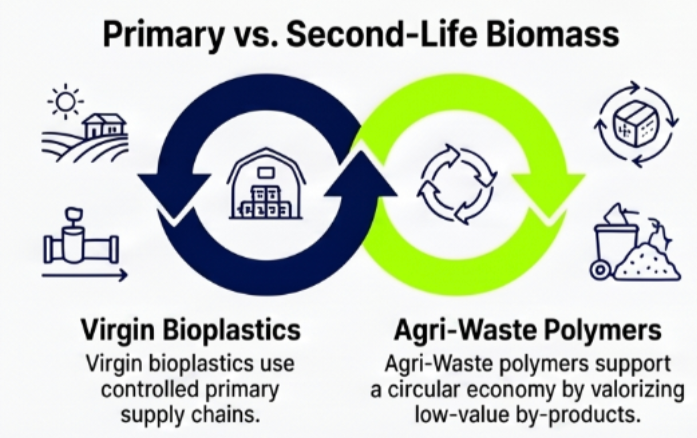
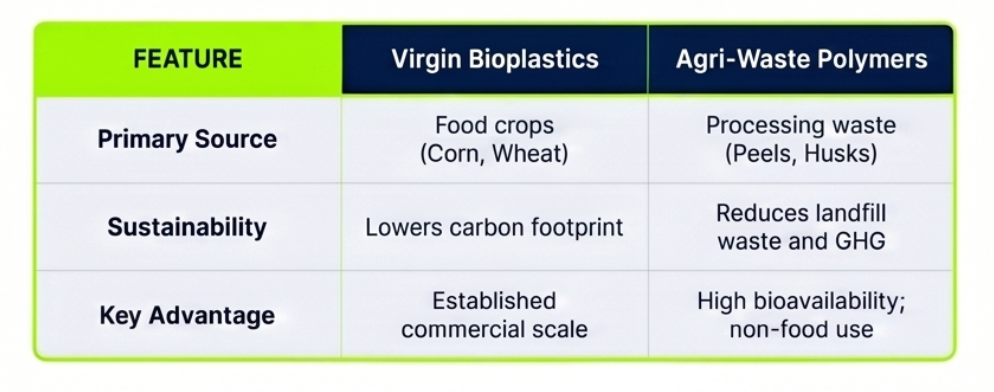
A virgin bioplastic usually comes from controlled, primary biomass supply chains. Corn, sugarcane, cassava, and cellulose are common examples.
Current bioplastic feedstock uses only a very small share of global agricultural land. But food-crop dependency is still a concern for some buyers and brands.
Agri-waste polymer reduces that concern because it uses second-life biomass. It can turn farm residue and food-processing by-products into packaging inputs. This supports circular-economy thinking because the material starts from something that already exists as a by-product.
Material consistency and converting control
Virgin resin usually gives the converter more control over:
- melt flow,
- sealing behaviour,
- colour,
- clarity,
- tensile strength,
- elongation,
- batch-to-batch repeatability.
Agri-waste materials can vary by crop, season, moisture content, region, and pre-treatment method. That does not make them weak. It simply means the supplier must control the formulation very carefully.
Packaging format fit and application suitability
A virgin bioplastic such as PLA may suit rigid transparent packaging, labels, clamshells, or clear food packs. PBAT blends may suit flexible compostable bags and films. PHA may suit specific food-contact and biodegradable use cases, subject to grade and certification.
Agri-waste polymer is often more practical in formats where natural texture or slight colour variation is acceptable. Molded trays, inserts, takeaway containers, secondary packaging, and some coated-paper or fiber formats are good examples.
Decision matrix: Which material fits your packaging needs?
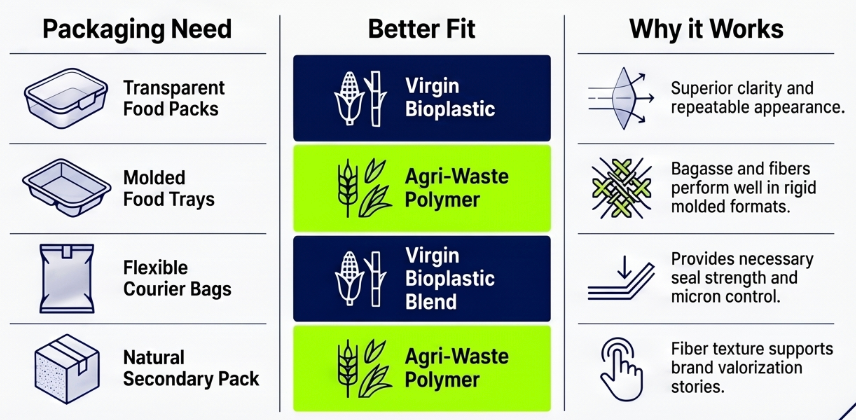
This matrix should not be treated as a fixed rule. It is a starting point for testing.
The next layer is machine compatibility because a material that looks good on paper still has to run on the line.
Processing and machine compatibility
Many bioplastic packaging materials can run on existing extrusion, film-blowing, thermoforming, injection-molding, and converting lines.
But they may need changes in temperature, pressure, drying, screw design, line speed, sealing time, or storage conditions.
A virgin bioplastic packaging often gives better process control because the resin specification is more standardized. For example, PLA grades usually come with defined processing windows, melting behaviour, and mechanical properties. That helps converters maintain output quality at commercial speed.
Agri-waste polymer packaging needs a more careful trial because of fibers, starches, proteins and lignin in waste-derived inputs. These components affect film surface, heat resistance, sealing, print adhesion, and moisture behaviour.
For flexible films, the buyer should test:
- sealing temperature and dwell time,
- micron consistency,
- puncture resistance,
- printability,
- blocking during storage,
- performance after humidity exposure.
For molded or rigid packaging, the buyer should test:
- stacking strength,
- oil and water resistance,
- heat tolerance,
- edge cracking,
- odour,
- food-contact suitability.
This is where Ukhi normally recommends sample trials before full approval. A sustainability claim is useful only when the pack also survives the real supply chain.
Agri-waste polymer vs virgin bioplastic packaging: Which is more sustainable?
The sustainability argument is stronger for agri-waste polymers.
The advantage of bioplastic from agricultural waste is that it uses residues instead of only dedicated crops. This can reduce waste and value to low-value biomass.
However, agri-waste packaging is not automatically better in every case. If the waste has to be transported long distances, heavily processed, dried, chemically treated, or blended with a large share of virgin polymer, the final impact may change.
A virgin bioplastic also has a legitimate sustainability role, by reducing dependence on fossil resources and lowering carbon footprint than fossil-based plastic.
Ukhi recommendation for buyers
Do not start with the material name. Start with the packaging job.
For agri-waste polymer vs virgin bioplastic, Ukhi would first ask:
- What product is being packed?
- Is the pack flexible, rigid, molded, or coated?
- Does it need food contact approval?
- Will it face humidity, oil, heat, cold, or long transit?
- What disposal route is realistic in the target market?
- Does the buyer need EN 13432, IS/ISO 17088, ASTM D6400, or other certification?
- What MOQ and delivery timeline can the brand accept?
After that, the material choice becomes clearer.
“Agri-waste polymer is exciting because it gives waste a second use, but buyers should not approve it only because the feedstock sounds sustainable. The real test is whether the material can protect the product, run on the line, carry the right certification, and reach the correct disposal route. Virgin bioplastic packaging can still be the better choice when consistency or food contact control is more important.”
— Vishal, Founder, Ukhi
Agri-waste polymer is attractive when circularity, residue use, and natural-format packaging matter. Virgin bioplastic is stronger when packaging performance, documentation, and converting control are the priority.
For most brands, the safest route is not to choose from a catalogue. The safer route is to shortlist two or three grades, request sample rolls or prototypes, and test them against the actual product.
UKHI can help buyers compare material options, review supplier documents, check fit with packaging lines, and move from sustainability intent to packaging that actually works.
Explore our agri-waste biopolymer collection.
FAQs
- Is agri-waste polymer the same as recycled bioplastic?
Agri-waste polymer is different from recycled bioplastic in the sense that it is made from agricultural residues. But as the same suggests, recycled bioplastic is made from used or recovered bioplastic material.
- Can agri-waste polymers be certified under EN 13432 or IS/ISO 17088?
Any polymer that passes biodegradation and compost quality tests can be EN 13432 or IS/ISO 17088 certified.
- Is virgin bioplastic safer than agri-waste polymer for food packaging?
Virgin bioplastics’ consistency can help with food-contact documentation and repeatable converting. But agri-waste raw material food packaging can be just as much safe, if it meets the hygiene requirements.
- Do agri-waste polymers reduce packaging cost compared to virgin bioplastics?
It can, but not always. Agricultural residue may be a lower cost input. But the cost and time to clean, dry, sort, process, and quality control are also factors to consider.