
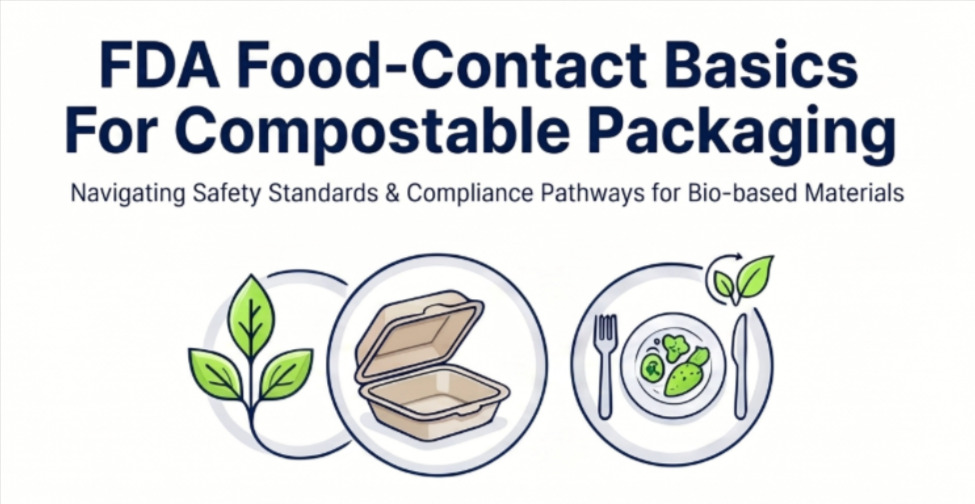
The FDA food contact compliance for compostable packaging is about food safety.
A compostable bowl can be right for a composting facility and still be wrong for direct food contact.
That is the simplest way to understand FDA food contact basics for compostable packaging. Compostability tells you what happens after use. FDA food contact compliance tells you whether the packaging is safe when it is touching food.
What FDA food contact compliance means for compostable packaging
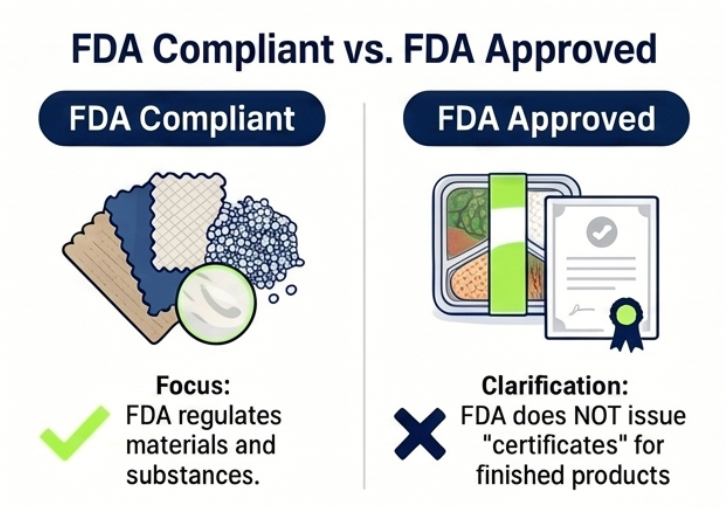
The FDA does not usually approve a finished compostable food container as a whole product.
Instead, it regulates the substances used in the packaging. A food contact substance is any substance used as a component of material for manufacturing, packing, packaging, transporting, or holding food, provided it is not intended to have a technical effect in the food itself.
Are all food-contact components authorised for the intended food and use condition?
A compostable food pack is not assessed only as a tray, cup, pouch, or bowl. Its compliance depends on the regulatory status of each relevant component.
This can include:
- the base polymer, (PLA, PBAT, PHA, or starch blend)
- the paper, bagasse, or moulded fibre base
- barrier coatings and liners
- adhesives and heat-seal layers
- inks, pigments, colourants, and additives
- grease-resistant treatments
- lids, labels, and closure components
The safety standard is not natural, plant based or biodegradable. The standard is whether there is reasonable certainty of no harm under the intended conditions of use.
That is why FDA approved biodegradable food containers need to be backed by proof that every food-contact component is authorised. That authorisation must match the food type, temperature, and use condition.
Key FDA packaging standards buyers should check
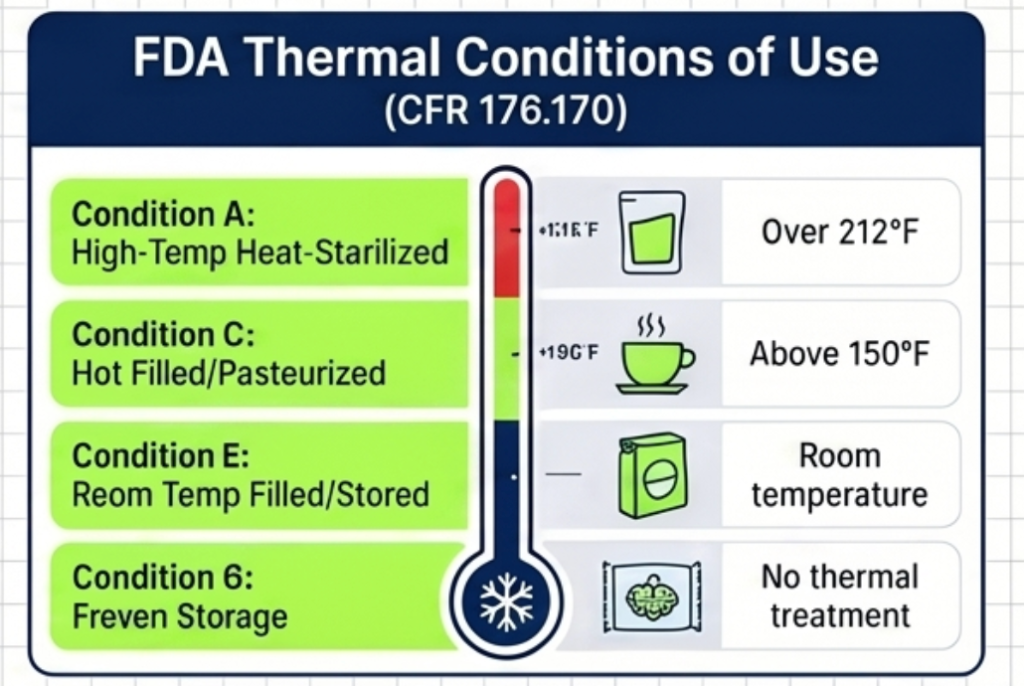
FDA compliance starts with intended use. A material may be suitable for dry bakery packaging but unsuitable for hot, oily meals.
It may work for chilled salads but not for microwave reheating.
So, one material can be acceptable for aqueous foods but not for fatty or alcoholic foods.
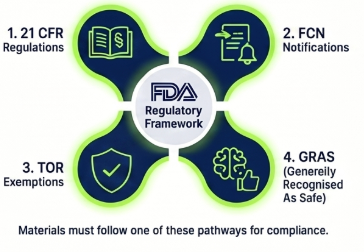
Buyers need to check four basics for FDA food packaging requirements.
| Route | What it means for buyers |
| 21 CFR regulation | The substance is listed for specific food-contact use under FDA regulations |
| Food Contact Substance Notification | A specific substance has an effective FCN for a listed manufacturer and intended use |
| GRAS | The substance is generally recognised as safe for its intended use |
| Threshold of Regulation | Exposure is low enough to qualify for a TOR exemption |
| Prior sanction | The substance was sanctioned before the modern food additive system |
For 21 CFR food contact packaging, buyers should not stop at the regulation number. The use conditions matter.
A material may be suitable for dry food but not fatty food. It may pass for cold fill but not hot fill. It may be fine for a bakery liner but not for a hot, oily meal held in delivery for 40 minutes.
So, FDA food packaging requirements must always be checked against:
- food type: dry, aqueous, acidic, fatty, or alcoholic
- temperature: frozen, refrigerated, room temperature, hot fill, or reheating
- contact time: short service, storage, transport, or shelf life
What the FDA does not cover: compostability, disposal, and green claims
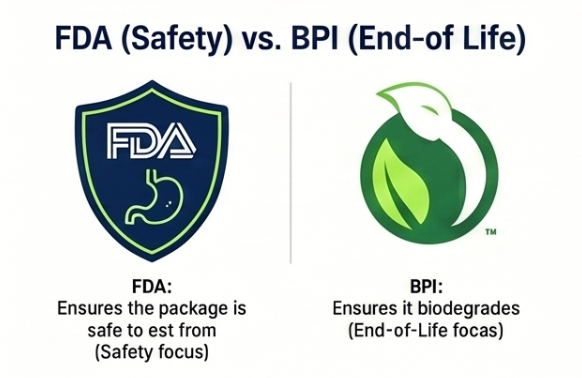
FDA compliance and compostability certification answer different questions.
FDA food-contact compliance is about safety during food contact.
It does not prove that a pack is compostable. ASTM D6400 is a popular standard for compostable plastics in the USA. ASTM D6868 applies to biodegradable plastic coatings or films attached to compostable substrates such as paper. BPI certification uses ASTM standards as part of its certification process for compostable products.
Green claims sit outside FDA food-contact clearance. Claims such as compostable, biodegradable, eco-friendly, or sustainable must be substantiated and not misleading. In the USA, the FTC Green Guides are an important reference for environmental marketing claims.
This is different from the FDA food labeling guide, which deals with food label statements, nutrition information, allergen declarations, and claims on packaged food
PFAS is another important buyer check. In 2024, the FDA announced that grease proofing substances containing PFAS were no longer being sold by manufacturers for food-contact use in the USA market.
In 2025, the FDA also determined that 35 PFAS related food-contact notifications were no longer effective because they had been abandoned.
For compostable paper, bagasse, and moulded fibre packaging, buyers should therefore ask for both food-contact compliance and PFAS-free support.
Who does it apply to?
FDA food contact compliance affects everyone in the packaging chain, not only the raw material supplier.
Packaging manufacturers and converters
Manufacturers and converters have to ensure that every relevant food contact substance follows the specifications and limitations in the applicable FDA authorisation.
This applies whether the material is PLA film, bagasse tableware, coated paperboard, moulded fibre, starch blend, PBAT blend, PHA-based resin, adhesive, ink, or coating.
They also need to understand that a compostable resin grade is not automatically cleared for every format or use. Conversion can introduce new components and risks.
Food brands, restaurants, QSRs, and retailers
Food brands and food service operators need packaging that does not make food unsafe, alter taste, create odour issues, or create migration risk under real service conditions.
For a QSR, this is practical. A clamshell used for a hot burger, a bowl used for oily noodles, and a pouch used for dry snacks have different contact conditions. The same “compostable” claim does not answer all three situations.
Importers, distributors, and exporters selling into the USA
Importers and exporters cannot rely on catalogue claims. They should check whether the product has relevant FDA food contact support for the final article and intended use.
For Indian suppliers selling compostable packaging into the USA, this is especially important. USA buyers will often ask for a compliance pack before sampling, onboarding, or bulk procurement.
Overview table: FDA food-contact route for common compostable packaging formats
| Compostable packaging format | FDA food-contact route to check | Buyer watch-out |
| PLA cups, lids, and clear films | Check the specific PLA resin or polymer authorisation, often through FDA FCNs listed for polylactide. | FCNs are supplier-specific. Do not assume all PLA grades have the same clearance. |
| Bagasse and moulded fibre trays or bowls | Check paper and paperboard rules such as 21 CFR 176.170 for aqueous and fatty foods and 21 CFR 176.180 for dry foods. | Grease resistance may involve coatings or additives. Ask for PFAS-free proof. |
| Paperboard with compostable coatings | Check the paper base and the coating separately. Coatings may need a 21 CFR, FCN, or other valid basis. | A compliant paperboard base does not automatically clear the coating. |
| Starch, PBAT, or PHA flexible packaging | Check polymer-specific FCNs, 21 CFR listings, TOR, GRAS, or migration data for the exact grade and use. | Flexible structures often include sealants, inks, adhesives, and additives. |
| Inks, adhesives, coatings, colourants, and additives | Adhesives may fall under 21 CFR 175.105; paper components under Part 176; polymers under Part 177; additives under Part 178. | The finished article must be reviewed as a full structure, not just as a base material. |
“For food brands, compostable packaging is not just a sustainability decision. It is a food-contact compliance decision first. Buyers should ask what the pack touches, what temperature it faces, what coating or adhesive is used, and which market it is going into. That gives us the right basis to recommend the material, the grade, and the documentation.”
— Vishal, Founder, UKHI
Get FDA food-contact documentation support for compostable packaging
If you are sourcing compostable packaging for food, start with the use case. Ukhi can help you choose the right material direction, check food-contact documentation needs, and recommend compostable packaging grades for sampling and buyer approval.
Ask for a compliance pack, a grade recommendation, or a sample kit for your food packaging format. You can also contact Ukhi procurement support for faster material and documentation guidance.
FAQs
Is there an FDA-approved materials list for food contact compostable packaging?
There is no single FDA list of finished compostable food packaging products. Buyers should check 21 CFR listings, effective FCNs, and intended-use documentation for each food-contact substance.
What is the difference between FDA 21 CFR food contact materials and compostability certification?
FDA 21 CFR food-contact compliance is about food safety and migration risk. Compostability certification is about end-of-life behaviour in composting conditions. One does not replace the other.
Can one FDA food contact packaging test report cover hot, oily, acidic, and cold foods?
Usually no. A report covers the food simulants, temperatures, and conditions tested. Buyers should match the report to the actual food type and service conditions.
Do FDA food Packaging requirements apply to coatings, inks, adhesives, and lids too?
Yes. Any component reasonably expected to migrate into food needs suitable regulatory support. This can include coatings, inks, adhesives, colourants, additives, sealants, and lids.
References:
- See FDA’s landing page titled “Packaging & Food Contact Substances” for FDA guidance, forms, inventories, and food-contact substance resources.
- See FDA’s page titled “Food Packaging & Other Substances that Come in Contact with Food” for the consumer-facing overview of food packaging, food-contact substances, and related FDA resources.
- See FDA’s landing page titled “Determining the Regulatory Status of Components of a Food Contact Material” for the principle that the regulatory status of a food-contact material depends on each individual substance that makes up the article.
- See FDA’s page titled “Food Types & Conditions of Use for Food Contact Substances” for the food type and temperature-use conditions used in food-contact evaluations.
- See FDA’s “Inventory of Food Contact Substances Listed in 21 CFR” for substances already listed in FDA food-contact regulations.
- All relevant 21 CFR food-contact Parts can be accessed through Subchapter B of Title 21 in eCFR.