

A greener electronics pack is not useful if the product inside fails.
That is the first rule buyers should follow when choosing anti-static packaging. A small electrostatic discharge can damage PCBs, chips, modules, and other sensitive components. The failure may not appear immediately. It may show up later as a field failure, warranty return, or product rejection.
So the right question is not, “Can we replace plastic with a greener material?”
The better question is, “Can we protect the component first, and then reduce the packaging impact?”
That is why anti-static sustainable packaging materials need a careful approach. This guide explains how to choose sustainable electronics packaging for electronics.
Short answer: What sustainable anti-static packaging materials should electronics buyers use?
There is no single packaging solution that fits every electronic product.
The right choice depends on three things:
- How sensitive is the component to static electricity?
- How will the product be stored and transported?
- Which sustainability goals does your business want to achieve?
Let us break that down.
Choose ESD-safe packaging first, then optimise the material for sustainability.
Protection always comes before sustainability.
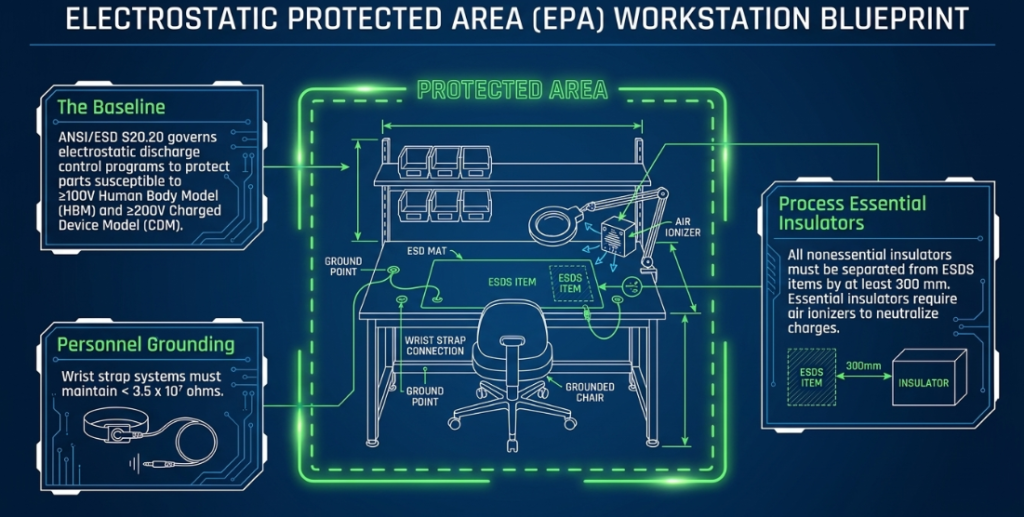
Start by selecting packaging that complies with recognised ESD control standards such as ANSI/ESD S20.20 and IEC 61340-5-1.
Then you can optimise the packaging using sustainable anti-static packaging materials, including:
- Recycled-content corrugated boxes
- Bio-based ESD films
- Recycled plastic pouches
- Lower-plastic packaging structures
This approach reduces environmental impact without increasing product risk.
Use static-dissipative films, coatings, or additives where product sensitivity is high
Sensitive electronics should not simply be prevented from generating static.
They should safely dissipate electrical charges over time.
Static-dissipative materials allow charges to bleed away gradually rather than discharge suddenly.
Today, manufacturers can achieve these properties using bio-based solutions such as:
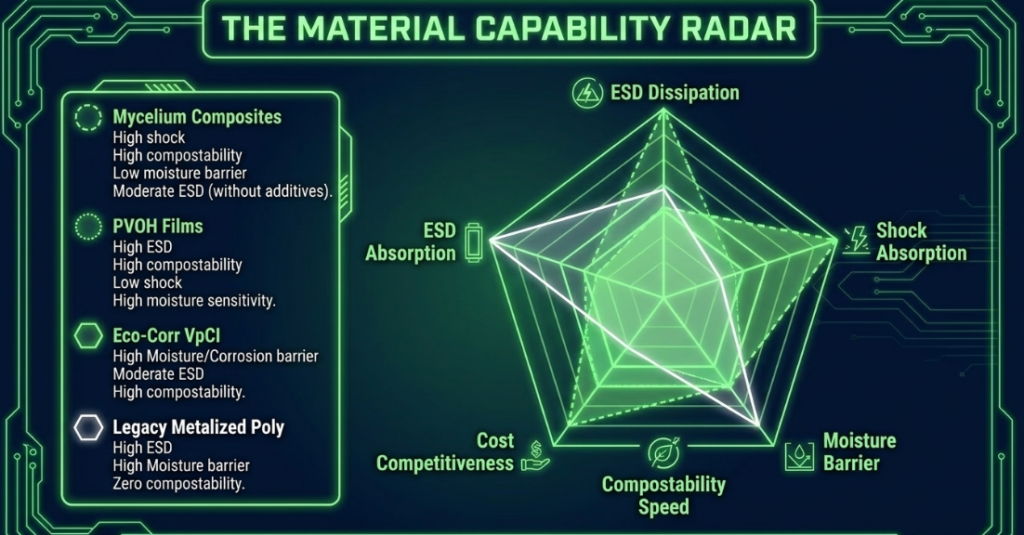
- PVOH and starch-based films
- PBS and chitosan nanocomposites
- Bio-based conductive additives
These materials demonstrate that sustainable anti-static packaging materials can deliver technical performance.
Match the packaging to the component, not just the shipment type
Many packaging decisions are made based only on shipping conditions.
That is not enough.
Packaging should match the ESD sensitivity of the component itself.
For example:
- Cables and chargers often only require anti-static bags that prevent charge generation.
- PCBs, integrated circuits, and processors usually require shielding bags that create a Faraday cage.
- Highly sensitive chips may require conductive packaging throughout the logistics chain.
Choosing packaging according to component sensitivity results in efficient use of anti-static packaging.
Next, let us look at the packaging formats used across different electronics applications.
Packaging formats that fit electronics use cases
Different products require different packaging structures. Using the correct format often improves both protection and sustainability.
Anti-static bags for PCBs, chips, modules, and small parts
Bare PCBs and semiconductor devices require high levels of protection.
Modern biodegradable ESD bags are made from bio-based films or VpCI technology. They can provide permanent static protection while reducing dependence on conventional plastics.
These are increasingly being used as green electronic packaging.
Static-dissipative pouches for accessories and replacement components
Replacement parts, adapters, and lower-risk accessories often do not require shielding bags.
Instead, recycled-content static-dissipative pouches provide adequate protection. This reduces material usage and plastic consumption.
This is the easiest route to introduce eco-friendly ESD protection for electronics into existing packaging operations.
Conductive or dissipative liners for box-in-box electronics shipping
Large electronics often travel inside multiple layers of packaging.
Conductive fibreboard liners or dissipative corrugated plastic inserts create additional protection. They protect against external electrostatic fields and can be recycled.
Sustainable trays, sleeves, and wraps for assembled devices
Assembled electronics benefit from packaging that limits both movement and static.
Common solutions include:
- Molded pulp trays made from recycled paper fibres
- Returnable dissipative JEDEC trays
- Paper-based sleeves with validated ESD coatings
These options support green electronic packaging initiatives without compromising handling safety.
Compostable or bio-based films where ESD performance can be validated
Compostable materials should never be selected based solely on environmental claims. Their ESD performance must also be tested.
PLA, starch blends, and other bio-based films can provide effective static protection. But thorough testing is necessary.
The next step is choosing between these options based on your application requirements.
Decision matrix: how to choose the right sustainable anti-static packaging materials
| Packaging Need | Better Format | ESD Requirement | Sustainable Material Route | Buyer Watch-out |
| Sensitive PCBs | Shielding bag | Shielding | Recycled laminate | Damage to the shielding layer reduces protection |
| Accessories | Anti-static pouch | Anti-static | Recycled PE | Limited protection for highly sensitive devices |
| Bulk IC transport | JEDEC tray | Static-dissipative | Returnable thermoplastic | Cleaning procedures matter |
| Consumer electronics | Molded pulp insert | Anti-static | Recycled fibre | Prevent fibre contamination |
| Shipping void fill | Bio-based cushioning | Low charge generation | Compostable materials | Validate ESD behaviour |
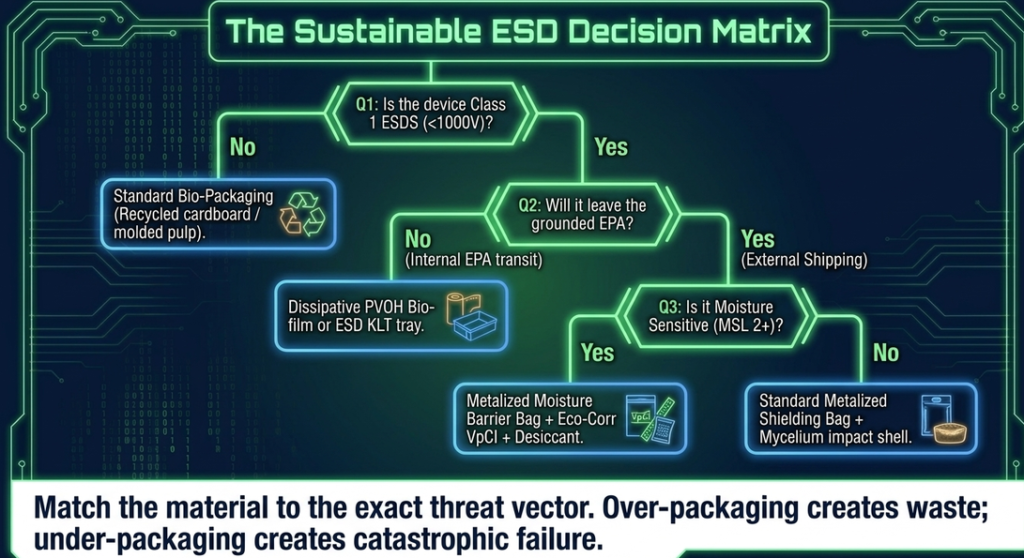
The first filter is ESD sensitivity.
Buyers should know whether the component is low-risk (e.g., a phone charger) or highly sensitive (e.g., a motherboard). Human Body Model sensitivity is often used to understand how easily a device can be damaged by discharge.
The second filter is the protection level.
- Anti-static materials reduce the generation of static electricity.
- Static-dissipative materials allow charge to disperse slowly.
- Shielding materials protect the component from external fields.
Not understanding these nuances can cause damage to the shipment. For many electronics buyers, the main mistake is treating “anti-static” as a universal label.
The third filter is the sustainability route.
A buyer may choose:
- Recycled-Content Film
- Reduced-Gauge Plastic
- Bio-Based Resin
- Compostable Film
- Fibre-Based Cushioning
- Returnable Trays
- Recyclable Liners
Practicality demands that, for sustainable electronics packaging, reuse and waste reduction are sometimes the only viable solutions.
The fourth filter is packing-line fit.
The material must seal, print, scan, stack, and store correctly. A seemingly good material can fail in real life if it curls, tears, loses transparency, or behaves poorly.
Compliance fit for sustainable electronics packaging
For eco-friendly ESD protection for electronics, compliance must be split into three separate claims.
ESD performance standards buyers may ask about
Most buyers expect packaging to comply with recognised ESD standards such as ANSI/ESD S20.20 and IEC 61340-5-1.
Some semiconductor applications may also reference JEDEC handling standards.
RoHS, REACH, and restricted substance declarations
Packaging materials should support RoHS and REACH compliance where applicable.
This ensures restricted substances remain within permitted limits while simplifying supplier qualification.
Compostability claims need separate proof from ESD performance
A compostable material is not automatically ESD-safe. Similarly, an ESD-safe material is not automatically compostable.
Both claims require independent validation.
Compliance builds confidence, but buyers want to know the sustainable ESD packaging use cases.
Proof or real-world fit: where sustainable electronics packaging makes sense
The easiest fit is low-risk electronics.
Components such as cables, chargers, connectors, adapters, remote controls, and accessories do not need electrostatic shielding. They can often move toward green electronic packaging faster.
The second fit is PCB suppliers that want to move away from conventional non-recyclable packaging. They require packaging with static-dissipative films or VpCI-style films.
The third fit is suppliers reducing bubble wrap and void fill. Molded fibre, paper cushioning, and fibre-based inserts can reduce plastic usage.
The hardest fit is high-value CPUs and GPUs. They need metallic shielding bags and shaped trays. Using sustainable anti-static packaging materials is difficult for these components.
Frequently asked questions
Is paper-based green electronic packaging safe for circuit boards?
Paper-based green electronic packaging is perfectly safe if properly treated. It offers excellent shock absorption. But untreated paper-based packaging leads to moisture and dust problems.
Can recycled plastic be used for anti-static packaging?
Yes, recycled plastics are safe for use with low-risk parts and accessories. They can also be adapted for secondary packaging for chips and processors.
What makes eco-friendly ESD protection for electronics different from normal eco packaging?
ESD packaging has to shield against external fields and static electricity. Without ESD capabilities, expensive electronic components and devices might not survive transportation and storage.
Can sustainable electronics packaging be custom printed?
Yes, but the printing must not affect ESD performance, seal strength, and sustainability claims. Buyers should test ink adhesion and barcode readability.
Are compostable anti-static bags available for electronics?
They are emerging made with bio-based films with static-dissipative additives. Buyers should treat these developments as application-specific materials and not universal replacements.
Expert quote
“Electronics packaging is not a place for vague sustainability claims. The first job is to protect the component. Once the ESD requirement is clear, we can look at bio-based materials, coatings, additives, recycled content, or reduced-plastic formats that meet the same handling requirements. That is where sustainable packaging becomes useful, not just attractive.”
Vishal, Founder, UKHI
Get a sample kit or grade recommendation
Ukhi can help electronics vendors find out the right format for their product line.
To make a proper recommendation, we shall need a few details:
- Component type
- ESD sensitivity
- Current packaging format
- Target format
- MOQ
- Sealing or packing-line conditions
- Export market
- Recycling or compostability target
- Documentation needed by the buyer
Based on this, we can suggest a film, pouch, liner, and coatings for sustainable electronics packaging.
Our procurement team can also assist with sample requests, RFQs, and WhatsApp-based technical support.