
Your supplier says the packaging is compostable. The label says it too. But when that shipment reaches a US composting facility or a retail buyer’s compliance team, a claim without verified certification gets rejected at the door.
This happens more often than people expect. And when it does, the consequences follow the brand, not the factory.
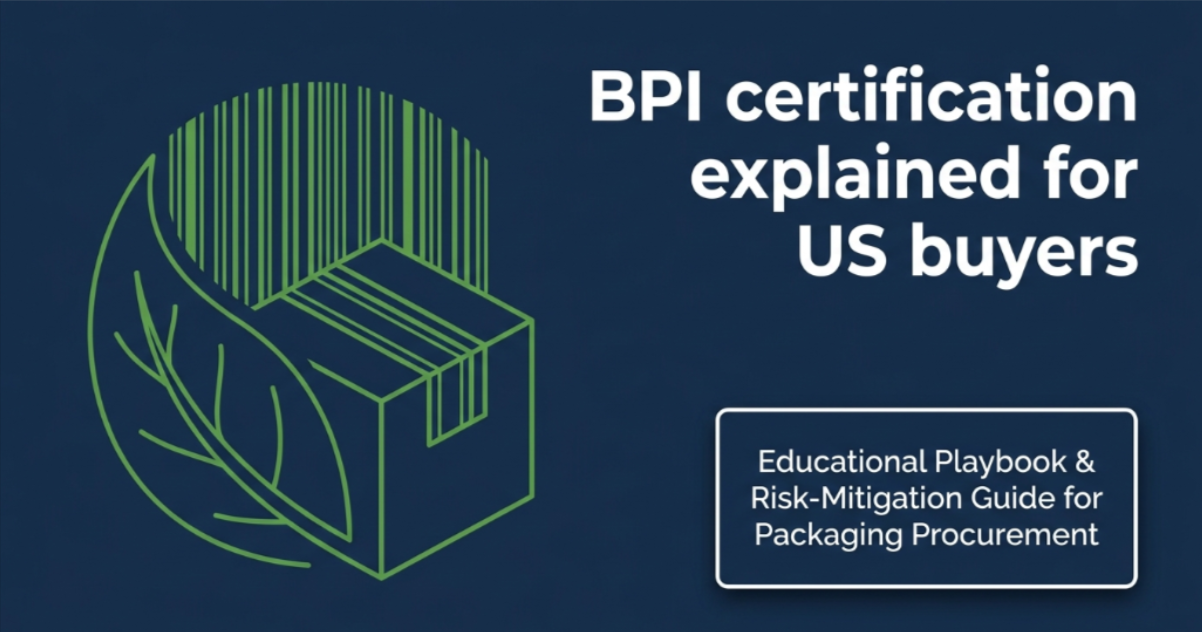
BPI certification exists to draw a line between packaging that is genuinely compostable vs one that’s only described that way. Below we explain what the certification checks and how to verify it before you place an order.
What is BPI certification?
BPI stands for the Biodegradable Products Institute. It is a North American non-profit that has been running its compostable packaging certification program for 25+ years. It tests products against scientific standards and issues a mark that confirms the product will break down completely in a commercial composting environment, without leaving toxic residue behind.
The BPI Certification Mark is a widely recognised compostability label in the US. It does not mean the product is sustainable in every sense. It means this product will compost correctly when it reaches the right facility.
Technical requirements for BPI certification
Every product that carries the BPI Certification Mark has passed third-party laboratory testing against one of two ASTM standards. These are the actual scientific benchmarks that define what compostability means in the US.
There are two standards, and which one applies depends on the product type:
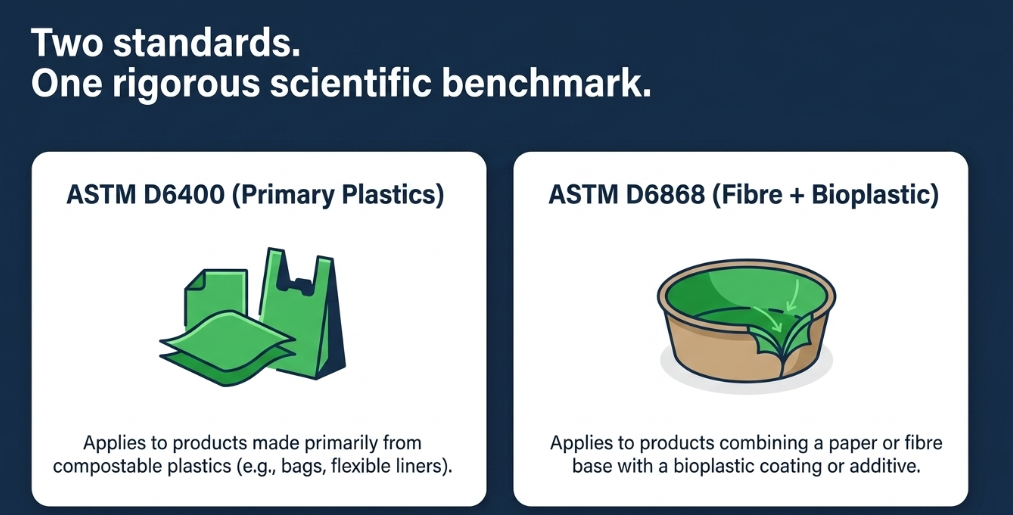
- ASTM D6400 applies to products made primarily from compostable plastics. It covers products such as bags, films, and flexible liners.
- ASTM D6868 applies to products that combine a paper or fibre base with a bioplastic coating. It covers products such as a kraft food bowl lined with PLA.
Under both standards, every product must meet these core requirements:
- Break down fully within 90 days in a commercial composting environment
- Biodegrade at a rate comparable to tested reference materials
- Leave no toxic residue, heavy metals, or harmful substances in the finished compost
- Contain no intentionally added PFAS, which are the fluorinated substances increasingly restricted by US state laws
- Be associated with composting feedstocks such as food scraps or yard trimmings, not materials better suited to recycling
- Display the BPI Certification Mark on both the product and the outer packaging. The artwork has to be reviewed and approved by BPI before use
Thickness is also tested. Each part of the product is measured. Certification only applies up to the maximum thickness that passed the disintegration test. A product reformulated to be thicker than its certified version is no longer covered.
These requirements together mean that compostable packaging certified by BPI is not self-declared. It has been physically tested under controlled conditions and independently verified.
BPI certification cost and process
Buyers who understand how the certification process works are much harder to mislead. Knowing what it costs and how long it takes tells you whether a supplier’s certificate is plausible. It also gives you the right questions to ask.
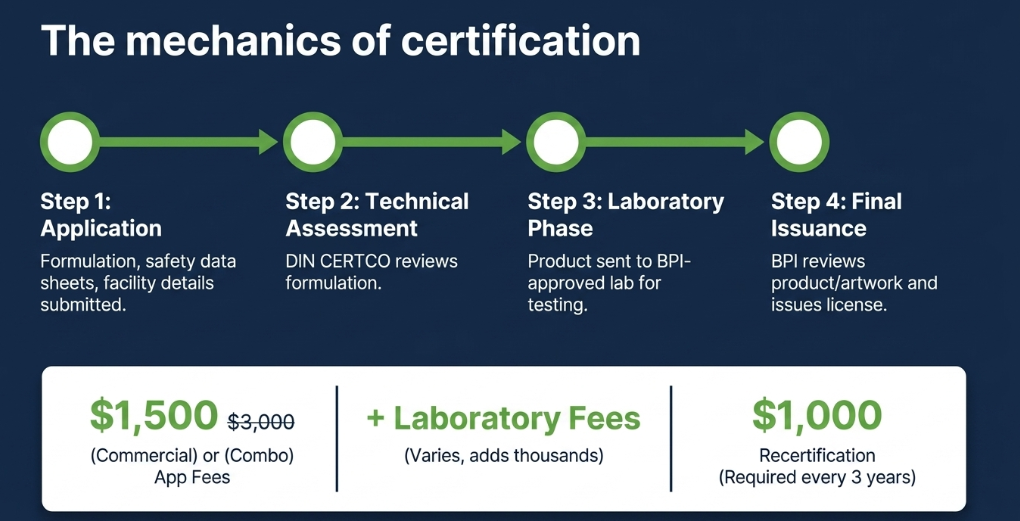
Here’s how the process looks like:
- Step 1: The company seeking the BPI certification submits an application with its full product formulation, Safety Data Sheets for every ingredient, and details of all manufacturing facilities.
- Step 2: BPI’s technical reviewer, DIN CERTCO, assesses the formulation.
- Step 3: They send product samples to a BPI-approved laboratory for testing.
- Step 4: Once testing passes, BPI reviews the product and packaging artwork before issuing the license to use the mark.
The BPI certification cost for a Commercial Only certificate is $1,500 in application fees. A combined Commercial and Home Compostability certificate costs $3,000. Laboratory testing fees are separate and typically add several thousand dollars on top. The full process takes several months from application to certified product. Certificates are valid for three years, and recertification costs $1,000 per certificate.
There is also a sublicensing route that buyers should know about. If a factory already holds a BPI license on a finished product, a brand can sell that product under its own name through a sublicense agreement. This is faster and less expensive than a new certification. However, only finished products can be sublicensed. Raw resins, film rolls, and intermediate materials cannot. And all sublicensed products must still be manufactured by the original license holder.
As Vishal Vivek, Co-Founder of UKHI, puts it: “The certification has to cover the finished product, not the resin it started as. When a buyer asks us for BPI-certified packaging, the first thing we do is pull the certificate and cross-reference the SKU in BPI’s product database. That one step eliminates most of the confusion we see in cross-border procurement.”
BPI vs. other compostability certifications
If you are sourcing compostable packaging for more than one market, you will run into other certification marks. They are not interchangeable with BPI certification. Understanding the difference prevents a costly mistake.
| Certification | Primary Market | Standard Tested | Composting Type | Accepted by US Composters |
| BPI | United States | ASTM D6400 / ASTM D6868 | Commercial composting and Home composting (new certification tier) | Yes, widely accepted |
| EN 13432 | European Union | EN 13432 | Industrial composting only | Not automatically accepted |
| TÜV OK Compost | Europe and global markets | EN 13432 / ISO 17088 | Industrial composting or Home composting (separate certifications) | Not automatically accepted |
| IS 17088 | India | IS/ISO 17088 | Industrial composting only | Not accepted in the United States |
The takeaway is straightforward: the mark on the product must match the market you are selling into.
What to ask your supplier before you buy
Most problems with BPI certification in cross-border sourcing come down to one thing: buyers do not verify. They take a certificate document at face value. So, here are the questions that protect you:
“Can you show me the specific product listed in the BPI online product catalog?”
Every BPI-certified product is listed by company and SKU at products.bpiworld.org. If your supplier’s specific product, in the format you are ordering, does not appear in that database, the certification does not apply to your purchase.
“Does this certificate cover the finished product or only the resin or film?”
A supplier may hold a BPI license on their base material without that license covering the final product. Always ask which SKUs are explicitly listed on the certificate, and cross-check that list against what you are buying.
“Are you the BPI license holder, or are you operating under a sublicense?”
Both are legitimate arrangements. But if the supplier is sublicensed, you need to confirm that the original license holder is the actual factory manufacturing your product. Sublicenses cannot be transferred to a different manufacturer.
“When does the certificate expire, and is recertification current?”
BPI certificates are valid for three years. A lapsed certificate means the product is no longer verified, even if it was certified in the past. Ask for the certificate expiry date and confirm it is active.
“Has the product formulation or thickness changed since certification?”
Any change to the formulation, coating, or thickness of a product after certification requires BPI to review. A product that changed without notification to BPI is not covered by the original certificate.
These questions take five minutes. Skipping them can cost considerably more when a shipment gets rejected or a compliance audit flags the product.
Sources and References
- Biodegradable Products Institute, bpiworld.org, certification program documentation, FAQ, and certification cost schedule.
- ASTM International, ASTM D6400 Standard Specification for Labeling of Plastics Designed to be Aerobically Composted in Municipal or Industrial Facilities.
- ASTM International, ASTM D6868 Standard Specification for Labeling of End Items that Incorporate Plastics and Polymers as Coatings or Additives with Paper and Other Substrates Designed to be Aerobically Composted in Municipal or Industrial Facilities.
- US Federal Trade Commission, Green Guides for Environmental Marketing Claims, 16 CFR Part 260.
- California Air Resources Board, SB 1383 Short-Lived Climate Pollutant Reduction Strategy.
- Packaging Dive, BPI introduces home compostable certification and label, September 2025.
Ensuring defensibility for your compostability claims with the BPI certification
Getting BPI certification right is not complicated. But it does require the right supplier and the right documents. The US market is tightening on compostability claims. Buyers who go in prepared are the ones who avoid costly rejections down the line.
At UKHI, we supply BPI-certified compostable packaging with full documentation, verified SKUs, and compliance support built in. So, whether you are placing your first order or switching suppliers, we make the paper trail as solid as the product.
Request a certified sample or talk to our experts today.
FAQs
Is BPI-certified compostable packaging mandatory in the US?
There is no single federal mandate. But several US states require compostability claims to be certified. BPI certification meets the requirements of every state that has enacted compostability labelling laws.
What is the difference between BPI and biodegradable?
Biodegradable is an unregulated marketing term with no standard definition in the US. BPI certification is a third-party verified claim backed by ASTM lab testing.
Can I buy EN 13432-certified packaging in the US market?
Not with a compostability claim. EN 13432 is the EU standard. US composters and state laws reference ASTM standards and BPI certification. So you need BPI-certified compostable packaging for the US market.
Does BPI certification cover home composting?
Standard BPI certification covers commercial composting only. In late 2025, BPI launched a combined Commercial and Home Compostability Certification for products that also break down in home compost conditions.
How do I verify that a supplier’s BPI certificate is real?
Search the BPI product catalog at products.bpiworld.org. Every BPI-certified compostable packaging and product is listed by company name and SKU. If the specific product you are buying is not listed there, the certification does not apply.