
Short answer for exporters
In simple terms, EU disposal labeling rules for packaging exports explain how packaging should be marked so people know how to sort, reuse, recycle, or compost it after use. These rules are part of Regulation (EU) 2025/40, known as the PPWR, which applies from August 2026. For exporters, this means packaging must not only be allowed but also carry correct, clear information supported by proof. Disposal labels differ from product labels, as they guide what to do with packaging after use. The PPWR aims to standardize labels across the EU, though some country-specific rules will still apply during the transition.
Key requirements under the PPWR regulation
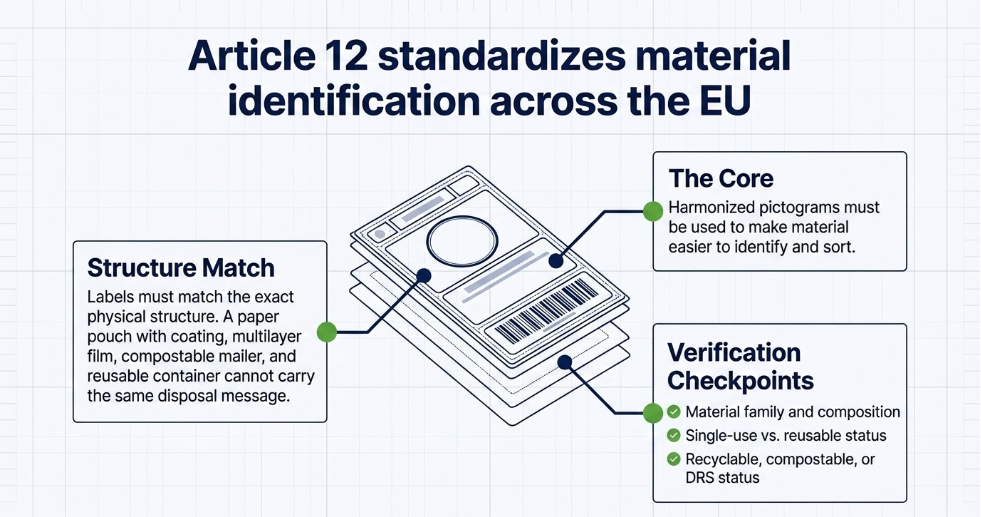
The main labeling requirement under Article 12 of the PPWR regulation is a harmonized label showing material composition. The label is expected to use pictograms that make the material easier to identify and sort.
This new requirement of the EU disposal labeling rules for packaging exports is expected from 12 August 2028, or 24 months after the relevant implementing acts are adopted. Exporters should not treat this as a distant artwork issue. Large print runs, packaging inventory, retail contracts, and private-label approvals often work on long timelines.
The label must match the actual packaging structure. A paper pouch with a coating, a multilayer film, a compostable mailer, and a reusable container cannot all carry the same disposal message.
The labeling requirements for EU packaging will usually require teams to check:
- the material family and material composition
- whether the packaging is single-use or reusable
- whether the packaging is recyclable, compostable, or part of a deposit return system
- whether national disposal labels are still required in the destination country
- whether technical documents support the label and claim
Reusable packaging has a separate labeling expectation. It must inform users that the packaging is reusable. It must also include a QR code or digital carrier that gives information on the reuse system, collection points, and related instructions.
Compostable packaging needs extra care. Under the PPWR, compostable packaging labels must not simply say “eco-friendly” or “biodegradable.” They must clearly state whether the packaging is industrially compostable, whether it is suitable for home composting, and that it must not be discarded in nature.
Country-level disposal labels also remain important before full EU harmonization. France, Italy, Germany, Spain, and other markets have their own packaging labeling and EPR practices. For example, an exporter may need market-specific artwork for France or Italy even while planning for future PPWR labels.
The common mistake is using a green claim without proof. A recyclable logo, compostable icon, or “plastic-free” statement is not enough on its own. The claim must be supported by material data, test reports, conformity documentation, and the correct role-based responsibility under the packaging and packaging waste regulation 2026 framework.
Who does it apply to?
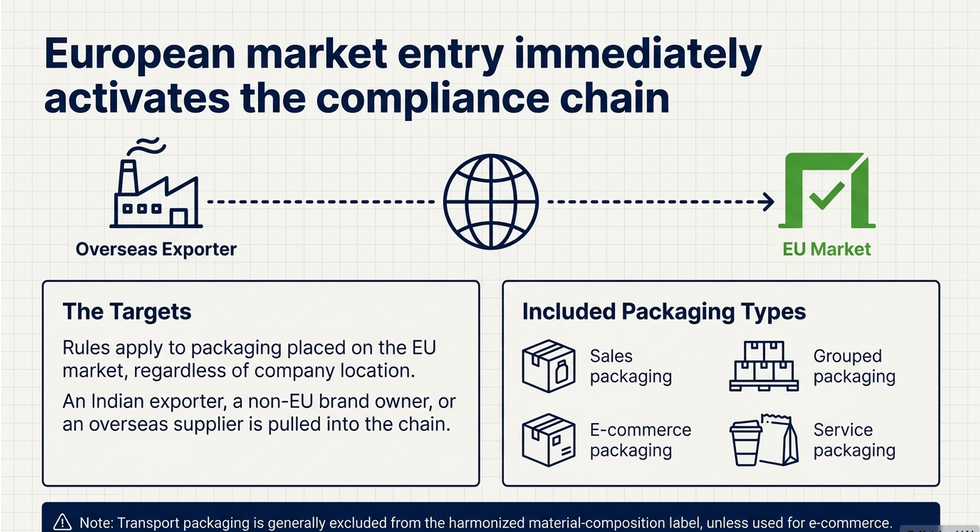
The EU rules on packaging apply to packaging placed on the EU market, regardless of where the company is based. An Indian exporter, a non-EU brand owner, or an overseas packaging supplier can all be pulled into the compliance chain if the packaged product enters the EU.
The roles matter because each role carries a different duty.
A manufacturer is responsible for ensuring that packaging meets sustainability and labeling requirements before it is made available in the EU. This includes preparing the EU Declaration of Conformity and technical documentation.
An importer is the EU-based party that places packaging from outside the EU on the EU market. The importer must verify that the manufacturer has completed the required conformity assessment and must add its own name and contact details where required.
A distributor must check that packaging is properly labeled before making it available on the market.
A producer, in the EPR sense, is the party that first makes the packaged product available in a specific Member State. This role is linked to EPR registration, reporting, and waste management fees.
Packaging type also matters. Sales packaging, grouped packaging, e-commerce packaging, and service packaging are all covered. Transport packaging is generally excluded from the harmonized material-composition label, unless it is used for e-commerce.
That makes the next step simple: exporters need a checklist before artwork approval.
Overview table: EU packaging labeling checks for exporters
| Check area | What to verify | Supporting Document | Exporter Action |
| Material label | The pack has the correct material-based pictogram when required. | Material specification and structure sheet | Confirm the label with the EU buyer before print approval. |
| Compostable pack | The label states industrial composting, home composting if applicable, and “do not discard in nature.” | Compostability certificate and test summary | Avoid vague terms like “green” or “earth-safe.” |
| Reusable pack | The pack carries reusability information and a QR code for reuse instructions. | Reuse system documentation | Check whether the packaging is part of a controlled reuse system. |
| Importer details | EU importer details are shown where required. | Importer declaration or compliance file | Confirm responsibility before dispatch. |
| Conformity file | DoC and technical documentation are available. | EU Declaration of Conformity and Annex VII documentation | Keep documents ready before shipment. |
| EPR status | The producer is registered in the target Member State. | National EPR registration proof | Do not assume one country registration covers all EU markets. |
| Food-contact packaging | PFAS restrictions and heavy metal limits are checked. | Chemical compliance declaration | Validate before food packaging approval. |
| E-commerce packaging | Empty space and transport format are checked. | Packaging design and measurement record | Check the 50 percent empty space cap for 2030 planning. |
This table is not a replacement for legal review. It is a procurement filter for adhering to EU disposal labeling rules for packaging exports. It helps exporters know what to ask before they print 50,000 units with the wrong label.
What this does not mean for exporters
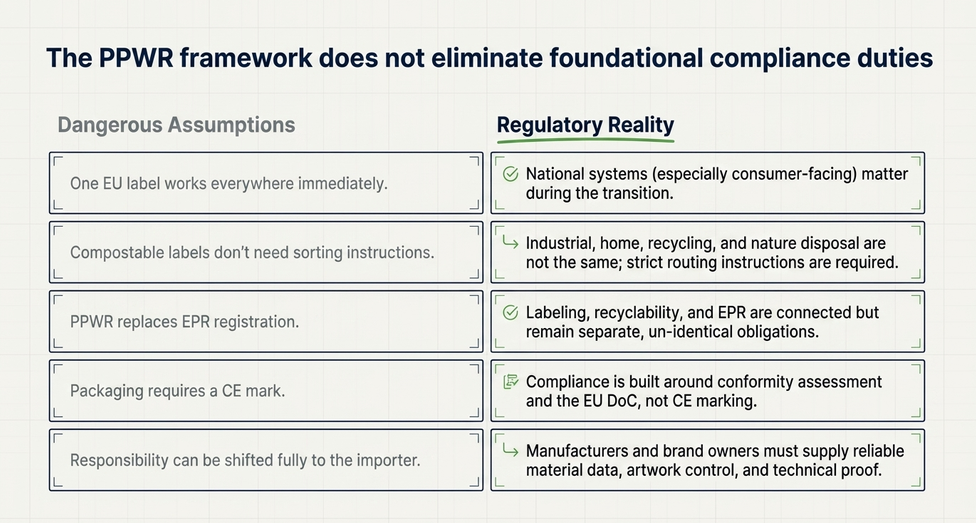
The PPWR does not mean one EU label works everywhere immediately. National systems continue to matter during the transition period, especially for consumer-facing packaging, even as EU disposal labeling rules for packaging exports move toward harmonization.
It also does not mean compostable packaging can skip sorting instructions. Compostable packaging can create confusion if the label does not explain the correct disposal route. Industrial composting, home composting, recycling, and nature disposal are not the same thing.
The PPWR does not replace EPR registration. Labeling, recyclability, recycled content, documentation, and EPR are connected, but they are not identical obligations.
It also does not mean packaging needs a CE mark. General packaging compliance under PPWR is built around conformity assessment, technical documentation, labeling, and the EU Declaration of Conformity, not CE marking.
Finally, exporters should not assume that responsibility can be shifted fully to the importer. The importer has verification duties, but manufacturers and brand owners still need reliable material data, artwork control, and technical proof from the packaging supply chain.
FAQs
- What is the difference between the Packaging Waste Directive and the PPWR regulation?
The older Packaging Waste Directive had to be implemented through national laws. The PPWR regulation is directly applicable across the EU, which makes compliance more uniform for exporters.
- Are material identification codes enough for EU packaging labeling?
No. Material codes may support sorting, but labeling requirements for EU packaging under PPWR move toward harmonized pictograms and clearer consumer-facing information.
- Do PPWR reporting requirements apply to exporters directly?
Usually, PPWR reporting sits with the producer or EU market-facing operator. Exporters still need to supply packaging composition, weight, material, and compliance data to that party.
- Are B2B packaging labels treated the same as consumer packaging labels?
Not always. B2B, transport, and commercial packaging may have different obligations from household packaging. The final requirement depends on use, destination, and market route.
- What is Article 5 of Regulation (EU) 2025/40 on packaging and packaging waste?
Article 5 focuses on substance restrictions in packaging. For exporters, it means packaging materials should be checked for restricted heavy metals and food-contact chemical risks before EU shipment.
Sources and references
Key sources for this article include Regulation (EU) 2025/40 on packaging and packaging waste, European Commission packaging waste guidance, EUR-Lex, the JRC technical proposal on EU harmonized waste sorting labels, International Trade Administration EU labeling and marking guidance, AGRINFO, EUROPEN, FECC guidance, ARA, KPMG, Latham & Watkins, PPWR Copilot, and national packaging compliance guidance from EU Member States.
“Export packaging teams should stop treating disposal labels as artwork decoration. Under PPWR, the label has to match the material, the claim, the market, and the documents behind the pack. When these four things do not line up, the risk moves from marketing to compliance.” – Vishal, Founder, UKHI
“The Packaging and Packaging Waste Regulation 2025/40 (PPWR) entered into force on 11 February 2025 and will generally apply from 12 August 2026.”
European Commission – Packaging waste / PPWR page
“The Regulation covers all packaging and packaging waste, regardless of material or origin.”
European Commission press release (on PPWR implementation guidance)
Get EU packaging labeling support from UKHI
UKHI helps exporters and packaging buyers evaluate material fit, disposal labeling needs, and documentation before sampling or full production.
Explore Ukhi bioplastic products.
For export packaging projects, UKHI can support:
- compliance pack review.
- material and disposal-label documentation.
- compostable and recyclable packaging guidance.
- artwork checks before large print runs.
- WhatsApp-based procurement discussions.
If your packaging is meant for the EU market, share the product type, packaging format, material structure, destination countries, and expected claim. UKHI can help you check the label before the shipment becomes a compliance problem.