
Short answer: Ask bioplastic suppliers for more than a brochure.
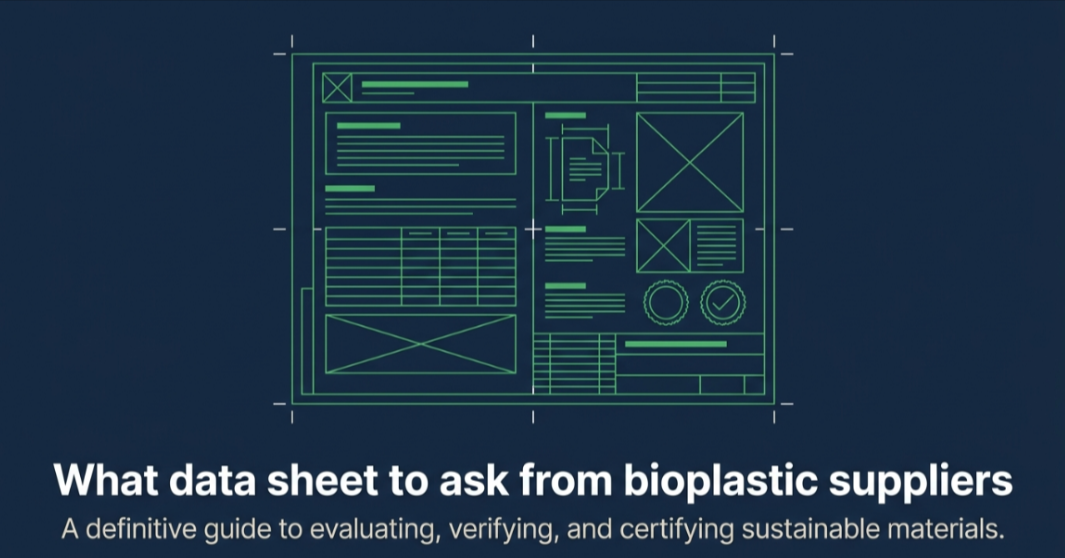
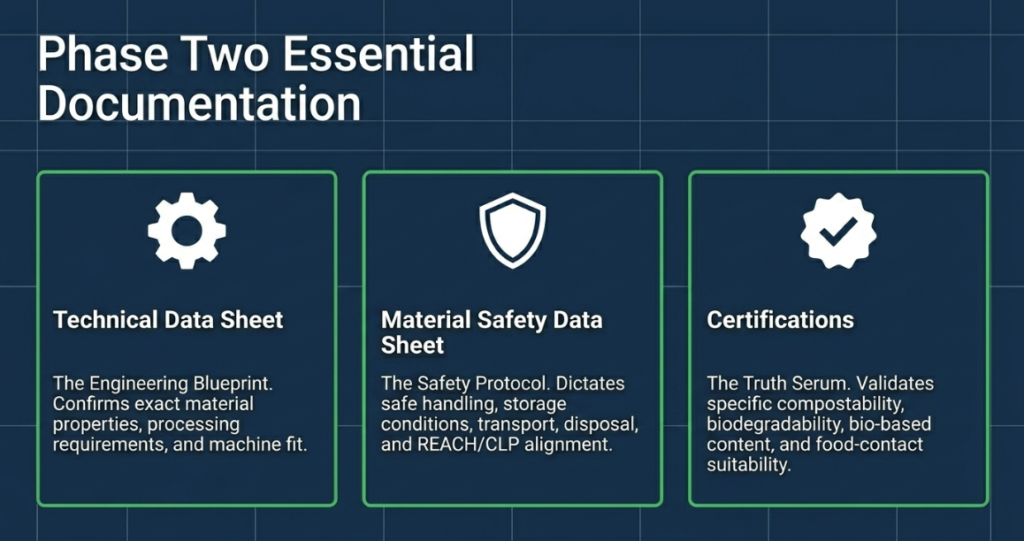
Before buying from bioplastic suppliers in India or overseas, ask for three essential documents: a Technical Data Sheet (TDS), a Safety Data Sheet (SDS/MSDS), and relevant certification proof:
- The TDS confirms material properties and processing requirements,
- The SDS explains safe handling and storage,
- and certifications verify claims such as compostability, biodegradability, food-contact suitability, or bio-based content.
Do not rely on certificates alone. Make sure the documents apply to your specific product, thickness, and application. A material approved for one process or product format may not be suitable for another. Once the documentation is verified, the next step is to evaluate the supplier’s manufacturing capability, quality systems, and reliability.
Supplier Evaluation Checklist For Bioplastic Suppliers
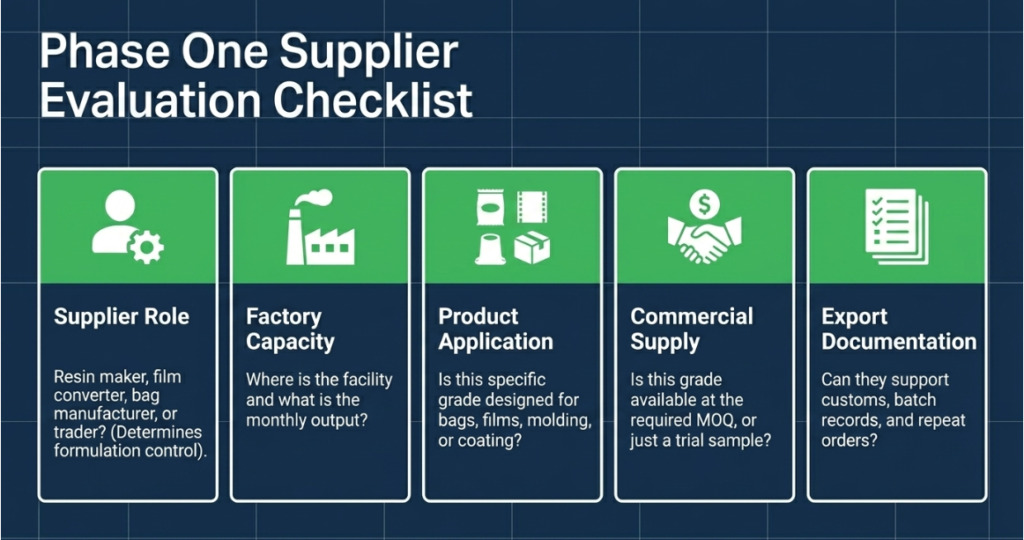
Not every supplier plays the same role in the packaging chain.
Some are resin manufacturers. Some are converters. Some are bioplastic bag manufacturers. Some are traders who source from another factory. This distinction matters because the person selling the material may not control the formulation, processing, quality system, or certification scope.
Before approving a supplier, check five things:
| Checklist point | What to ask |
| Supplier role | Are you a resin maker, film converter, bag manufacturer, trader, or brand reseller? |
| Factory and capacity | Where is the factory, and what is the monthly production capacity? |
| Product application | Is this grade designed for bags, films, coating, moulding, sheets, or thermoforming? |
| MOQ and commercial supply | Is this grade available at my required MOQ or only as a trial sample? |
| Export and documentation | Can you support customs, compliance documents, batch records, and repeat orders? |
A useful bioplastic suppliers’ evaluation model does not judge only price. Product quality usually carries the highest weight, followed by pricing, delivery reliability, service, customization, and certifications. In a common supplier-evaluation approach, product quality is weighted at 30%, pricing and delivery reliability at 20% each, and customization, service, and compliance at 15% each.
This is especially important for bioplastic granule manufacturers in India, because the buyer is often not buying a finished product. The buyer is buying a material that still has to survive extrusion, sealing, printing, storage, and use.
Once the supplier passes the basic evaluation, the document review begins.
Documents To Ask From Bioplastic Suppliers
Technical data sheet (TDS)
The most important document is the Technical Data Sheet.
For bioplastic granules, the TDS should include:
- Density or specific gravity.
- Melt Flow Index, also called MFI or MFR. MFI is especially important. A high MFI material flows more easily and may suit injection molding. A lower MFI material may be more suitable for extrusion where melt strength matters.
- Tensile strength. It tells you how much stress the material can handle before breaking.
- Elongation at break. It tells you how far it can stretch before snapping. For flexible films and bags, elongation is often as important as strength.
- Flexural modulus, where relevant.
- Impact strength, where relevant.
- Heat Deflection Temperature or Vicat softening point.
- Recommended drying conditions.
- Recommended processing temperatures.
- Suitable process route, such as blown film, cast film, injection molding, profile extrusion, coating, or thermoforming.
Material safety data sheet (MSDS)
The second document is the SDS or MSDS. This should explain safe handling, storage, transport, disposal, and regulatory safety information. For export markets, buyers may also ask whether the SDS aligns with REACH and CLP expectations. (Novamont Sustainability Report 2018)
Compostability or biodegradability certificate
The third document is certification proof.
If the supplier claims compostability, ask for the actual certificate, not just the logo. Check:
- Standard name, such as EN 13432, ASTM D6400, or ISO 17088.
- Certifying body, such as BPI, TÜV Austria, or DIN CERTCO.
- License number.
- Product name or SKU.
- Validity date.
- Maximum certified thickness.
- Whether the certificate covers resin, film, bag, ink, adhesive, or the full finished article.
This last point is critical. Compostability depends on the finished article, not only the polymer name. If the certificate by the bioplastic bag manufacturers covers a resin at a specific thickness, a thicker bag or molded product may need separate testing. (BPI Certification FAQs; European Bioplastics Certification Scheme Documents)
Finished-product specification sheet for bags, films, or packaging formats
For bioplastic suppliers in food packaging, ask for a “Declaration of Compliance”. This should identify the material, intended food-contact use, time and temperature conditions, and relevant migration test results. For EU applications, Regulation (EU) 10/2011 is a common reference point for plastic food-contact materials. (EU Declaration of Compliance Guide)
For PFAS-sensitive applications, ask for third-party PFAS-free documentation. Where the buyer policy or market requires it, a Total Organic Fluorine test report below 100 ppm is stronger than a self-declaration. (PLA Biodegradable Plastic: The Complete B2B Export Guide for 2026)
The document set does not have to be large. It has to be specific.
How to read a bioplastic data sheet before buying
The right way to read a bioplastic TDS is to start from your process, not from the supplier’s promise.
- If you are making courier bags, check blown film compatibility, sealing range, puncture resistance, elongation, thickness tolerance, and printability.
- If you are buying finished bags, check size, micron, seal strength, load capacity, tear strength, drop performance, and carton specification.
- If you are molding a part, check MFI, drying requirement, mold temperature, injection temperature, cycle behavior, shrinkage, impact strength, and heat resistance.
This is where the question of “what is the best bioplastic?” becomes easier to answer. There is no single best material for every use. The best bioplastic is the one that matches the application, machine, compliance requirement, disposal route, and buyer budget.
Remember that biobased does not automatically mean compostable
A bio-based plastic may come partly from renewable carbon, but it may not biodegrade or compost. Compostability needs separate testing under a specific standard and environment. Bio-based content is commonly measured using radiocarbon methods such as EN 16640 or ASTM D6866. Compostability is tested under standards such as EN 13432, ASTM D6400, or ISO 17088. (European Bioplastics: Industry Standards and Labels)
So do not compare claims. Compare test methods.
A data sheet is the first filter. A trial is the real test.
How to test before full approval

Before placing a bulk order from the bioplastic suppliers, ask for samples from the exact grade, thickness, and format you plan to buy.
Do not test a generic sample if the final order will use a different grade, thickness, color, print, or additive package. Small changes can affect sealing, compostability, odor, storage stability, and strength.
The approval process should move in three steps:
| Approval step | What to do | What it proves |
| Sample review | Check appearance, thickness, flexibility, odor, and basic handling. | Confirms whether the material is worth trialing. |
| Line trial | Run the material on your actual machine. | Confirms machine compatibility and rejection rate. |
| Use-case test | Test sealing, printing, packing, storage, load, and transport. | Confirms real packaging performance. |
Bioplastics can be more moisture-sensitive than conventional plastics. If the TDS specifies drying conditions, follow them closely. Excess moisture can cause hydrolysis, brittleness, weak parts, or reduced shelf life. Some moisture-sensitive biodegradable materials may need very low residual moisture before processing.
For compostable products, the finished article should be checked at its actual thickness. A certified resin does not automatically certify every bag, film, coating, tray, or molded item made from it.
Procurement approval should come only after the paper proof and the production proof agree.
Get supplier-ready bioplastic documentation with UKHI
UKHI helps buyers move from supplier confusion to tested material selection.
Instead of starting with a generic “eco-friendly” claim, we start with the packaging job:
- What are you packing?
- Which machine will run the material?
- What strength, sealing, and shelf-life performance do you need?
- Which market or compliance route does the product need to satisfy?
- Are you buying granules, film, bags, coating, or molded parts?
From there, UKHI can support grade recommendation, sample discussion, technical documentation review, and trial planning for film, bag, coating, molding, and related applications.
Explore Ukhi bioplastic products.
For buyers comparing bioplastic suppliers, the goal is not to collect more paperwork.
The goal is to reduce approval risk.
FAQs
- What are the criteria for choosing bioplastic suppliers?
Choose bioplastic suppliers by checking application fit, repeat supply ability, test support, certification transparency, and commercial reliability. A good supplier should explain where the material works, where it fails, what machines it suits, and what evidence supports its environmental claim.
- What is the best bioplastic for packaging?
The best bioplastic depends on the job. Flexible courier bags need toughness and seal strength. Food packaging may need barriers and food-contact suitability. Molded items need stiffness and heat resistance. The best choice is application-specific, not material-name-specific.
- How do bioplastic granule manufacturers in India support sheet production?
Bioplastic granule manufacturers in India should provide grades suitable for sheet extrusion or thermoforming. Buyers should ask about sheet thickness range, forming temperature, stiffness, heat resistance, and clarity. Buyers should also check whether the grade is meant for trays, lids, cups, or industrial sheets.
- What should bioplastic bag manufacturers clarify before quotation?
Bioplastic bag manufacturers should clarify bag size, micron, load capacity, sealing type, print requirement, carton packing, MOQ, lead time, certification scope, and whether the quoted bag is certified as a finished product and not only made from certified resin.
- What are the key materials used by bioplastic suppliers in India?
Common bioplastic materials include PLA, PBAT blends, PBS, PHA, starch blends, cellulose-based materials, and bio-based PE. Many bioplastic suppliers in India also use additives, fillers, or natural fibers to improve strength, flexibility, sealing, or processing performance.