
Quick Answer
Biodegradable straws manufacturers in India make straws from compostable PLA and PBAT bioplastics, food-grade paper, rice and tapioca, or coconut leaf. Since the July 2022 single-use plastics ban, only IS/ISO 17088 certified, CPCB registered, and FSSAI compliant straws can be legally sold as compostable. Bulk prices range from ₹0.20 to ₹1.50 per piece depending on material, diameter, and print. UKHI manufactures the EcoGran compostable resin used to make PLA straws through profile extrusion, and supplies both the resin to converters and finished straws to brands with full compliance documentation.
Biodegradable Straws Manufacturers in India: Compostable Options
What to Look for in a Biodegradable Straw Supplier
Picking a biodegradable straw supplier in India is different from png a plastic straw vendor. A buyer needs to check five things before placing an order.
1. CPCB registration
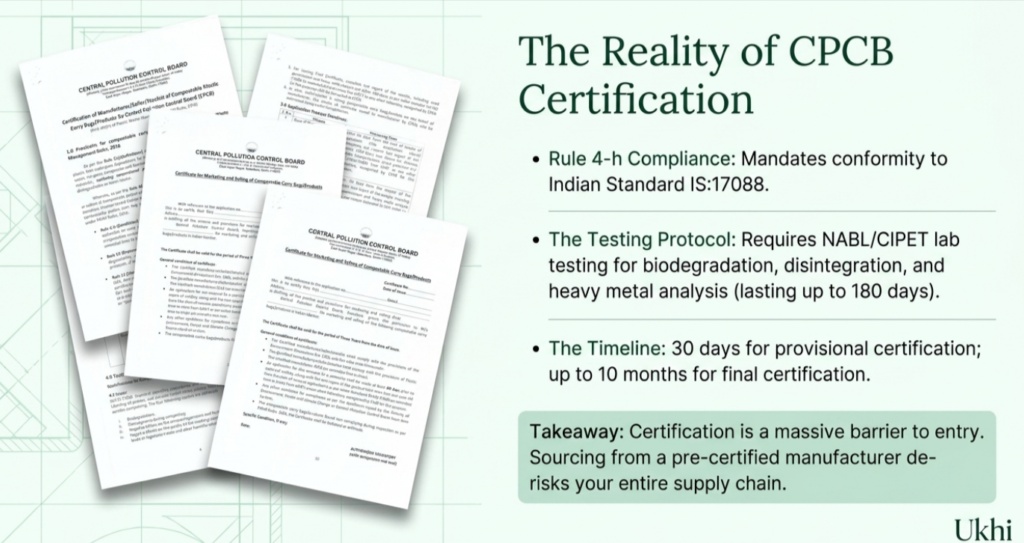
Every manufacturer of compostable plastic products in India must be registered with the Central Pollution Control Board. This registration is mandatory, not optional. Ask the supplier for their CPCB registration number and cross-check it on the CPCB portal.
2. IS/ISO 17088 certification.
This is the Indian standard for compostable plastics. Any straw sold as compostable must be tested against this standard at a CIPET or NABL-accredited lab. Without this certificate, the product is not legally sellable as compostable in India.
3. FSSAI food-grade compliance
Straws touch drinks, so the material has to be certified food-grade under the Food Safety and Standards (Packaging) Regulations, 2018. Ask for the food-grade test report from an NABL lab.
4. Manufacturing capability
Compostable straws are made through profile extrusion. A supplier who owns the resin and the extrusion process end-to-end is more reliable than one who assembles parts from different sources. At UKHI, we manufacture our EcoGran compostable resin in-house, so we know exactly what goes into the straw.
5. Customisation and MOQ
Standard commercial orders start at 5,000 to 10,000 units. Check whether the supplier can print custom branding with food-safe inks and whether they support your required diameter, length, and packaging format.
What Specifications Matter When Buying Biodegradable Straws
A straw looks simple, but the specification sheet has more variables than most buyers realise.
Diameter and length by beverage type:
| Beverage Type | Recommended Diameter | Typical Length |
| Water, soft drinks, juices | 6mm to 6.5mm | 197mm to 210mm |
| Milkshakes, smoothies | 8mm to 10mm | 210mm to 240mm |
| Bubble tea, boba | 11mm to 13mm (bevel cut) | 210mm to 230mm |
| Tetra pack cartons | 4mm to 6mm (U-bend) | 100mm to 145mm |
Sogginess resistance
Sogginess is the number one complaint from restaurants and cafes. A good compostable straw should hold its shape in a cold drink for at least 2 hours, and premium grades hold up to 24 hours.
Heat tolerance
Standard PLA compostable straws work well with cold drinks but soften above 50°C. If the buyer serves hot beverages, this needs to be flagged early so the supplier can recommend a different grade or a paper alternative.
Adhesive and ink safety
The glue holding paper layers, and the ink used for branding, must also be food-safe and compostable. Otherwise the straw leaves behind residues even when the body of the straw breaks down.
Packaging format
Individually paper-wrapped straws are required for QSR chains and delivery businesses because of hygiene norms. Bulk packing in 1,000-unit boxes is standard for dine-in restaurants and event caterers.
Which Materials and Processes Are Used to Make Biodegradable Straws in India
Biodegradable and compostable straws manufacturers in India currently work with four main raw materials.
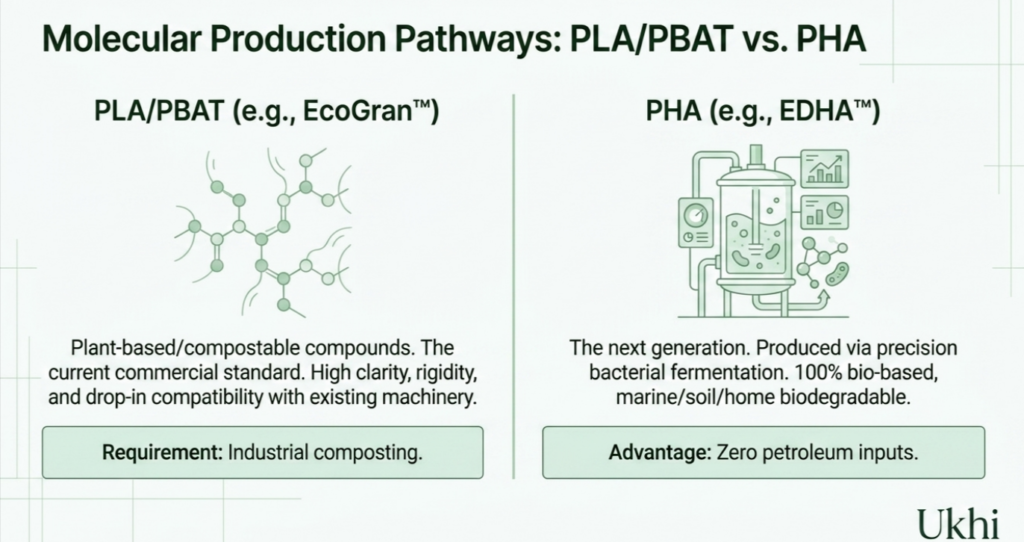
Compostable PLA and PBAT bioplastic straws
These are made by melting a compostable biopolymer resin, pushing it through a profile extrusion line, cooling it in water, and cutting it to length. The resin is the most important input, because the finished straw is only as good as the granules it comes from.
At UKHI, our EcoGran resin family is designed for exactly this process. EcoGran granules are drop-in compatible with conventional profile extrusion machines, which means a converter does not need to buy new equipment to start production.
Paper straws
These use 3-layer or 4-layer food-grade kraft paper wound and glued into a tube. Layer count decides how long the straw stays firm in a drink.
Rice and tapioca straws
Made from a dough of rice flour and tapioca starch, extruded and dried. These are edible and gluten-free, but have a shorter shelf life.
Coconut leaf straws
Made from naturally dried coconut leaves. These are fully organic but harder to produce at commercial scale.
Compostable PLA and PBAT straws made via profile extrusion remain the dominant category for high-volume buyers because they are the closest functional match to conventional plastic straws in terms of clarity, strength, and machine handling on filling lines.
Certifications and Compliance to Look for in a Biodegradable Straw Manufacturer in India
Compostability is a claim that has to be proven. The following certifications are what a buyer should ask a supplier to produce:
IS/ISO 17088
The Indian benchmark. The product must break down into particles smaller than 2mm within 12 weeks, achieve at least 90% biodegradation within 180 days under industrial composting conditions, pass ecotoxicity tests, and stay within heavy metal limits.
CPCB certificate
Legally required for any company selling compostable plastic products in India. The certificate number should be verifiable on the CPCB public portal.
FSSAI food-grade approval
Mandatory for any material that touches food or drink.
EN 13432 and ASTM D6400
Needed only if the buyer plans to export finished straws to Europe or the United States. Both certifications are issued after testing at internationally accredited labs.
EPR compliance
Under the Extended Producer Responsibility rules for packaging, brand owners and food service aggregators must meet composting targets. Sourcing IS/ISO 17088 certified straws makes EPR filings much simpler because certified compostables are classified as organic waste.
At UKHI, we hold FSSAI, IS/ISO 17088, GMP, ISO 9001, ISO 14001, and our EcoGran resin is CIPET tested. Buyers asking for compliance documentation receive the full set on request.
How Much Do Biodegradable Straws Cost in India
Wholesale pricing depends on material, diameter, length, printing, and order volume. Approximate per-piece prices in bulk are:
| Straw Type | Bulk Price (per piece) | Typical MOQ |
| Compostable PLA, plain, 6mm to 8mm | ₹0.20 to ₹0.70 | 5,000 to 10,000 |
| Compostable PLA U-bend for cartons | ₹0.48 to ₹0.60 | 10,000 |
| Paper, 3-layer or 4-layer, plain | ₹0.30 to ₹0.75 | 5,000 |
| Paper, custom printed 1 colour | ₹1.00 to ₹2.50 | 10,000 |
| Rice, tapioca, or specialty | ₹1.50 to ₹9.00 | 1,000 to 5,000 |
Prices drop sharply with volume. A buyer moving from a 10,000-unit trial order to a 500,000-unit monthly commitment can typically expect a 20% to 30% reduction per piece.
Cost drivers to keep in mind:
- diameter (wider straws use more material),
- length,
- printing (each additional colour raises the per-piece cost), and
- packaging format (individually wrapped costs more than bulk boxed).
At UKHI, our EcoGran resin is priced to be cost-competitive with conventional plastics, which is what makes the switch to compostable straws viable for high-volume foodservice buyers.
Why Buy Biodegradable Straws from UKHI
UKHI is a material science company. We engineer compostable biopolymers and manufacture the finished products made from them. That matters for a straw buyer for five reasons:
In-house resin. We make EcoGran, our compostable biopolymer resin, at our own facility in Faridabad. This gives us full control from the granule to the finished straw, so quality is consistent from batch to batch.
Right grade for straws. EcoGran includes a profile extrusion grade specifically suited to straw manufacturing. Converters can run it on their existing lines without buying new machinery.
Compliance documentation. Every straw shipment can be supported with FSSAI, IS/ISO 17088, and CIPET test reports so the buyer can file EPR returns and answer any regulator questions.
Technical and converter support. We work with an approved converter network and support machine trials, drying settings, and packing line adjustments when a buyer is qualifying a new supplier.
Next-generation material in development. We are developing EDHA, a PHA-based biomaterial made through precision fermentation, which will biodegrade in soil, freshwater, and marine environments. EDHA is in the pilot phase and not commercially available yet, but buyers planning three to five years ahead can start a conversation with us now.
FAQs
Are biodegradable straws legal to sell in India after the plastic ban?
Yes. The 2022 ban prohibits conventional plastic straws, not compostable ones. A compostable straw is legal if it is certified under IS/ISO 17088 and the manufacturer holds a valid CPCB registration.
What is the difference between biodegradable and compostable straws?
Biodegradable means the material eventually breaks down through natural processes, with no fixed timeline. Compostable is stricter and means the straw breaks down into non-toxic matter within 180 days under industrial composting conditions. For Indian compliance, buyers should ask for compostable, not just biodegradable.
Which biodegradable straws are best for restaurants and cafes in India?
For cold drinks, compostable PLA straws in 6mm to 8mm sizes work best because they hold their shape and stay clear. For hot beverages, paper straws with a 4-layer construction are more suitable. Bubble tea outlets need 11mm to 13mm bevel-cut compostable straws.
Can PLA compostable straws be used with hot drinks?
No. Standard PLA straws soften above 50°C, so they should be limited to cold and room-temperature beverages. For tea, coffee, and other hot drinks, buyers should choose multi-layer paper straws or ask the supplier for a heat-modified compostable grade.
Do biodegradable straw manufacturers offer custom branding and printing?
Yes. Most manufacturers can print a company logo or brand name on the straw body or on the individual paper wrapper. Food-safe inks are used. Single-colour printing adds around ₹0.50 to ₹1.00 per piece, and two-colour printing adds ₹1.00 to ₹2.00 per piece.