
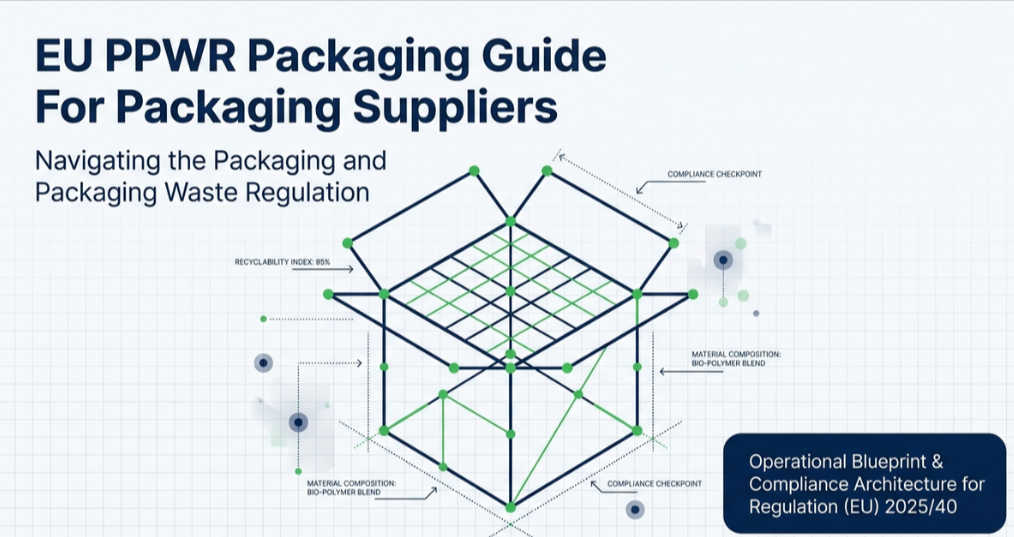
There has been a huge regulatory shift in the European packaging market. It is not just another sustainability initiative but a broad framework that overhauls EU packaging regulations.
The EU Packaging and Packaging Waste Regulation is a combination of product, performance data, compliance evidence, and traceable documentation. The suppliers who can answer clearly will be easier to approve. The suppliers who cannot may become a risk in the buyer’s supply chain.
This guide explains the intricacies of the latest EU PPWR packaging compliance and rules. We explain what suppliers need to prepare before EU customers start asking harder questions.
What is the EU PPWR Packaging Regulation?
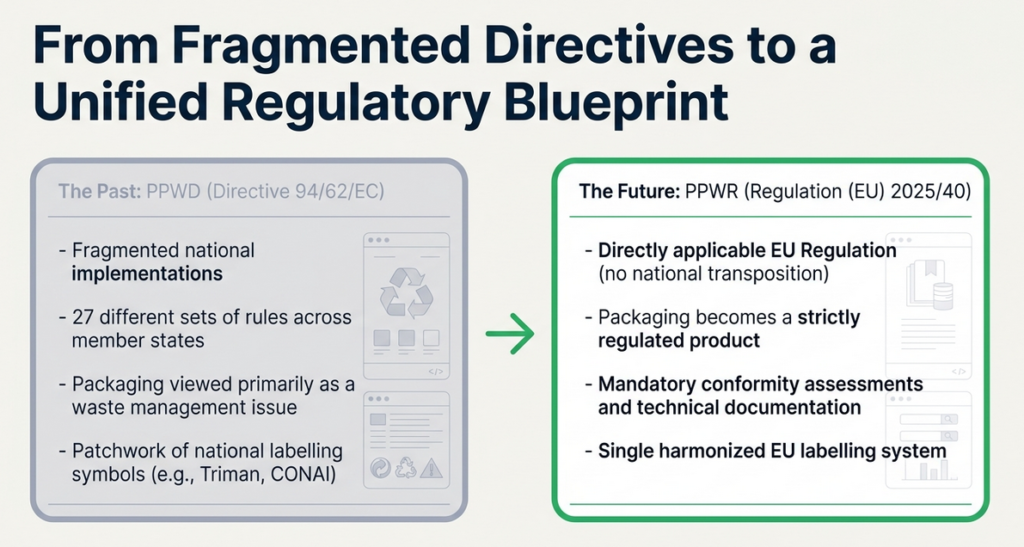
The EU Packaging and Packaging Waste Regulations entered into the statute books on 11 February 2025. It will be legally binding across all 27 EU member nations from 12 August 2026.
In plain terms, the PPWR rules say packaging placed on the EU market must be designed with its end of life in mind.
That means packaging must move toward:
- Lower material use
- Better recyclability
- Clearer sorting labels
- More recycled plastic content
- Less unnecessary packaging volume
- Stronger documentation behind claims
By 2030, the EU wants packaging on the market to be recyclable in an economically viable way. This is a major shift for suppliers because a pack is no longer only a physical product. It is also a data set.
The older law was actually a directive that allowed more country-level interpretation. The new EU Packaging and Packaging Waste Regulation is more stringent and offers less scope for dilution.
For suppliers, it means your buyer may ask you to prove:
- What the packaging is made of
- How it performs
- How it should be sorted
- Whether its sustainability claim is backed by evidence.
The real question, therefore, is: what exactly will suppliers need to prepare?
Key EU PPWR requirements that packaging suppliers need to prepare for
In this section, we will focus on the statutory requirements. EU PPWR requirements span multiple criteria set to come into force over the next four years.
These include:
- Design
- Material content
- Labelling
- Recyclability
- Compostability
- Documentation.
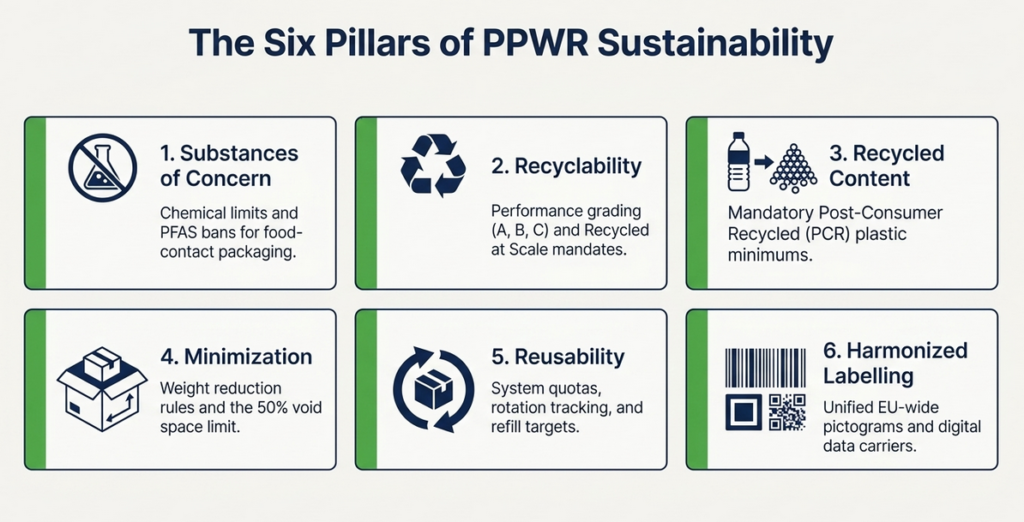
Let’s unpack these one by one.
- Packaging must be designed so that weight and volume are reduced to a minimum. Unnecessary layers and oversized formats are compliance risks. This makes it easier to collect and dispose of.
- For e-commerce and other types of grouped packaging, the maximum empty space can be 50%. At least half of the package must be filled.
- At least 70% to 95% of the packaging has to be recyclable. By 2038, this is expected to rise to 80% to 90%.
- EU packaging regulations set down mandatory minimums for recycled content as feedstock. It will be 30% for PET beverage bottles, 10% for certain contact-sensitive plastics, and 35% for other plastic packaging. These will gradually rise over time.
- Compostability is allowed, but only in defined areas. Mandatory compostability is limited to formats where separation of packaging from waste is impossible. These items include tea bags, coffee pods, fruit, and vegetable stickers.
- Packaging will need clearer material identification and sorting instructions. There will be uniform colour coding and pictograms across the EU. QR codes will offer further information about compostability and recycling.
- Lastly, EU PPWR compliance depends heavily on documentation. The supplier will have to provide exhaustive material data to the buyer about the nature and characteristics of the packaging.
Now we move to another important question: who exactly falls within the scope of the regulation?
Who does EU PPWR apply to in the packaging supply chain?
The EU Packaging and Packaging Waste Regulation affects almost every participant involved in packaging.
Packaging manufacturers and converters
Manufacturers and converters are responsible for ensuring packaging complies with applicable sustainability requirements. They also play a central role in generating technical documentation and conformity information.
Exporters supplying packaging or packed goods to EU buyers
Non-EU exporters are not exempt. If products enter the EU market, buyers will still require evidence demonstrating compliance with relevant requirements.
Importers, distributors, and fulfilment partners
Importers and distributors carry due diligence responsibilities. They must verify that packaging complies with applicable requirements before making products available on the EU market.
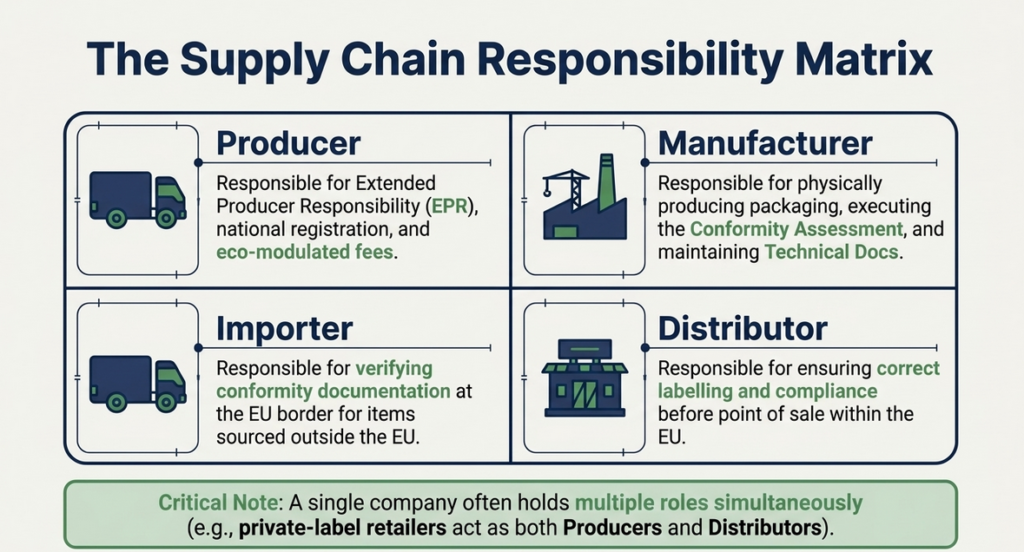
Brand owners and e-commerce sellers placing packaged goods in the EU
Businesses selling products under their own brand often carry substantial compliance obligations. Many online sellers will also face increased scrutiny as packaging requirements become more standardised across Europe.
Why non-EU packaging suppliers still need PPWR-ready documentation
Even when the legal obligation sits with an EU importer or brand owner, compliance depends heavily on supplier data.
Without material specifications, recyclability information, recycled-content evidence, and technical declarations, buyers cannot complete their own compliance processes.
This is why documentation readiness is becoming just as important as packaging performance.
What documents will EU buyers ask packaging suppliers for
Sellers must be ready to provide detailed documentation to support EU PPWR compliance.
Typically, it would include:
Material composition and packaging specification sheet
Including:
- Layer-by-layer material structure
- Polymers and additives
- Adhesives and coatings
- Ink specifications
- Barrier layers
Recyclability or compostability evidence
Including:
- Design-for-recycling assessments
- Recyclability evaluations
- Compostability certifications
- EN 13432 compliance evidence, where applicable
Recycled content declaration where applicable
Including:
- PCR percentage declarations
- Chain-of-custody records
- Recycled material certifications
Packaging weight, format, and empty-space data
Including:
- Weight specifications
- Dimensional information
- Volume calculations
- Void-space assessments
Supplier declaration for PPWR compliance review
Many buyers now request supplier declarations that support technical documentation and future conformity assessments.
EU PPWR packaging guide overview table for packaging suppliers
This table shows a summary of the new EU packaging regulations.
| Requirement Area | What Suppliers Need to Provide | Why EU Buyers Will Ask for It |
| Substance Compliance | PFAS declarations, heavy metal declarations, and restricted substance compliance statements | To verify compliance with EU legal limits and assess food-contact safety risks |
| Recyclability | Design for Recycling (DfR) assessment, sorting validation, and recyclability performance data | To demonstrate compliance with recyclability requirements and maintain EU market access after 2030 |
| Recycled Content | Post-consumer recycled (PCR) content percentages and chain-of-custody documentation | To help brand owners meet mandatory recycled content targets for plastic packaging |
| Packaging Minimisation | Packaging weight, volume, dimensions, and void-space measurements | To prove that packaging is not excessive and meets minimisation requirements |
| Documentation & Technical Files | Material specifications, test reports, declarations, and technical file inputs | To support the buyer’s Declaration of Conformity and regulatory documentation obligations |
Expert note from Vishal, Founder, UKHI:
“PPWR will change how suppliers talk about packaging. A buyer will no longer ask only whether a material is sustainable. They will ask whether the supplier can prove its composition, recyclability, recycled content, compostability, and compliance fit. The supplier who prepares this data early will be much easier for EU buyers to trust.”
Sources and references
Sources used for this guide include the European Commission, Regulation (EU) 2025/40, ARA, AGRINFO, Clarity Environmental, Department for Business and Trade, Recoup, Circular Pro, Packaging Insights, Packa, Valpak, osapiens, EuPIA, InformaIT, Trillora, and PPWR Copilot.
Talk to UKHI about PPWR-ready sustainable packaging for EU exports
At Ukhi, we help customers to fully comply with EU packaging regulations without interrupting their business. If you are preparing for EU PPWR compliance, ask Ukhi for:
- Material recommendation
- Sample kit
- Compostable or recyclable format guidance
- Documentation support for EU PPWR compliance
- PPWR-ready supplier compliance pack
Businesses that begin early will be in a better position to reduce compliance risks as EU packaging regulations continue to evolve.
Frequently Asked Questions
Is there an official EU PPWR packaging guide for suppliers?
In February 2025, the European Commission published the EU PPWR packaging guide. You can find it at the EU website.
When does EU PPWR compliance start for packaging suppliers?
The regulations come into force in August 2026. However, the rules are to be introduced in a phased manner. The member states have till 2030 to enforce the rules.
What should brands ask PPWR packaging suppliers?
Brands must ask for:
- Material description
- Recyclability evidence
- Recycled content proof
- Packaging volume
- Packaging weight
- Documents for claim substantiation
What types of transportation are covered by the EU Packaging and Packaging Waste Regulation?
The new EU packaging regulations cover tertiary transportation via mailers, boxes, crates, and pallets. It excludes large-scale containers (rail, road, and ship) from the definition of packaging waste.
Do small and micro enterprises get exemptions under PPWR?
Will the EU PPWR packaging guide apply only to brands and large format stores, or also to niche and small businesses? This is unknown at the moment. But since the regulations do not mention any revenue criteria, it is safe to assume that all enterprises are covered by the EU PPWR requirements.