
Short answer: Home compostable vs. industrial compostable packaging
In a comparison of home compostable vs. industrial compostable packaging, the first thing to understand is that these concepts refer to two different composting environments.
- Home compostable packaging breaks down in household composting systems at lower, less predictable temperatures.
- Industrially compostable packaging needs controlled composting facilities where temperature, moisture, oxygen, and microbial activity are professionally managed.
The difference between home compostable and industrial compostable packaging is mainly the composting condition under which the product has been tested and certified.
Home Compostable Vs. Industrial Compostable Packaging: Knowing What They Are

What industrially compostable packaging means
Industrially compostable packaging is designed for composting in industrial composting facilities.
These facilities run as managed biological treatment systems. They control temperature, moisture, oxygen, turning cycles, and microbial activity. The U.S. Plastics Pact describes industrial composting as a thermophilic waste treatment process, which means it uses high heat to accelerate breakdown.
Industrial composting facilities commonly operate around 55 to 70°C. These conditions help materials such as PLA cups, thicker molded fiber formats, and coated packaging break down in a predictable time frame.
Under EN 13432, industrial compostable packaging must meet defined requirements, including biodegradation, disintegration, heavy metal limits, and compost quality criteria. One common benchmark is 90% biodegradation within six months under controlled composting conditions.
What home compostable packaging means
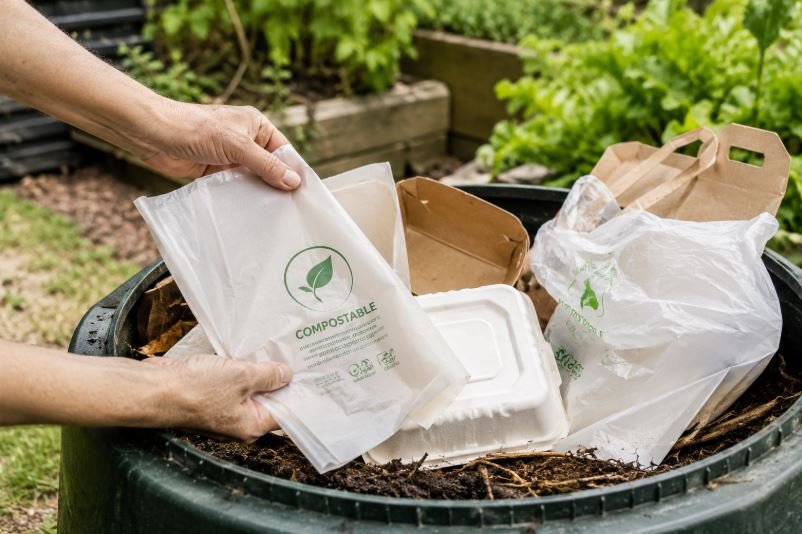
100% home compostable packaging should break down in a backyard or household composting system without needing industrial heat or processing.
This can include compost bins, tumblers, worm farms, or other household composting systems. These environments usually operate at much lower temperatures than commercial facilities. Home compost piles commonly operate around 20 to 30°C, depending on weather, compost mix, moisture, and user practice.
That lower temperature changes everything.
A material that disintegrates quickly in an industrial composting plant may not break down in a home compost bin. Home composting can take six to twelve months, and sometimes longer, because the system is slower and less controlled.
Compostability as a polymer property
A polymer is not automatically home compostable or industrially compostable in every format.
The same base material can behave differently depending on the following:
- thickness,
- coating,
- ink,
- adhesive,
- additives,
- lamination,
- product shape,
- end-use condition.
This is why a resin certificate alone is not enough. The finished item matters. A thin film, a coated paper cup, a printed pouch, and a molded tray may need different testing even if they use similar compostable inputs.
Why Home Compostability Is Harder To Prove Than Industrial Compostability
Home compostability is more attractive because it sounds easier for the end consumer. If a package can break down at home, one won’t choose a route that requires collection and industrial infrastructure.
But from a testing and certification perspective, home compostability is harder to prove.
Home composting happens in lower temperatures and less predictable conditions

A home compost system depends on local climate, bin design, feedstock mix, moisture, oxygen, and user behavior.
One household may maintain a healthy compost pile. Another may have a dry, cold, inactive pile. A third may add too much food waste and not enough dry carbon material.
TÜV Austria notes that lower temperatures and less active biological conditions make home compostability more difficult to validate consistently.
This is why 100% home compostable claims need careful proof. The claim sounds simple, but the real-world environment is highly variable.
Industrial composting uses controlled temperature, moisture, and aeration

Industrial composting is easier to standardize because the facility controls the conditions:
- Heat can be maintained.
- Moisture can be adjusted.
- Aeration can be managed.
- The compost pile can be turned.
- Operators can track process time and quality.
This controlled environment allows certification bodies to test industrially compostable products against clearer and more repeatable standards.
BPI (Biodegradable Products Institute) in North America states that commercial disintegration testing is typically shorter than home compostability testing. In BPI’s certification framework, home testing timelines are longer because lower-temperature breakdown takes more time.
This is also why thickness matters. A product may pass compostability tests at one thickness but fail at a thicker gauge. A coating, label, ink, or adhesive can also slow breakdown or affect compost quality.
Certifications for home compostable and industrial compostable packaging by market

Certifications help brands avoid vague claims. They also tell buyers which market a product is ready for.
| Market | Industrial compostability | Home compostability |
| India | CPCB approval and IS/ISO 17088 are key references for compostable plastics. | Home compostability is less clearly standardised in mainstream procurement. |
| EU and UK | EN 13432 is the main standard for industrial compostable packaging. | TÜV OK compost HOME, NF T 51-800, and EN 17427 are relevant references. |
| USA | ASTM D6400, ASTM D6868, and BPI certification are common. | BPI has introduced home certification based on NF T 51-800, but there is no long-standing ASTM home compostability standard. |
| Australia and New Zealand | AS 4736 applies to industrial compostability. | AS 5810 applies to home compostability. |
What Compostability Claims Mean For Brands, Suppliers, And Consumers
A compostability claim is affects compliance, artwork, retail acceptance, consumer disposal, and legal risk.
- Firstly, industrially compostable does not mean home compostable. A PLA cup or coated pack may break down in an industrial composting plant but remain largely unchanged in a backyard bin. So if a product is certified only for industrial composting, the label should not suggest home composting.
- Secondly, 100% home compostable does not automatically mean every format made from that material is home compostable. A thin bag may pass. A thicker pouch may not. A printed structure may need separate review.
This is why brands should avoid broad claims like “eco-safe,” “biodegradable,” or “compostable” unless the exact claim is supported by certification. Packaging Dive has reported that many consumers struggle to distinguish biodegradable and compostable claims. Clear labels and recognized marks reduce this confusion.
How To Verify A Compostability Claim Before Sourcing Packaging
When a buyer makes a decision on home compostable vs. industrial compostable packaging, the compostability claim should be verified through something like a compliance document.
Ask the supplier for:
- certificate number,
- issuing body,
- expiry date,
- certified standard,
- product description,
- certified thickness or grammage,
- confirmation that inks, adhesives, coatings, and labels are included.
Next, there should be a crosschecking of the certificate in the official database. Use the BPI catalog for North America, TÜV Austria or DIN CERTCO databases for Europe, and the ABA list for Australia and New Zealand. In India, verify CPCB registration details and supporting certification documents provided by the supplier.
The key question is whether the certificate applies to the finished product, not only the resin.
Expert Quotes On Home Compostable Vs. Industrial Compostable Packaging
“The main difference between a home compost pile and an industrial compost environment is the temperature of the compost. Industrial compost consistently achieves significantly higher temperatures than a home compost pile; around 130°F (58°C) compared to 70 to 80°F (20-30°C). Materials decompose more rapidly in a higher temperature, but the standards for home and industrial compost require similar decomposition for the same timeline. As a result, a product that is certified as Industrial Compostable may not necessarily meet the stricter conditions required for Home Compostable certification.”
Intertek, Compostable Certification Program official documentation
“Material breaks down much faster during industrial composting, but home composting is also important because it can take place at any house with a garden and does not require a special infrastructure for waste collection. Test temperatures and durations are the main differences between home and industrial compostable criteria.”
Jan ‘t Hart, Senior Marketing Director of Innovation Projects, Avery Dennison (interview with Packaging Europe)
“The real issue in home compostable vs industrial compostable packaging is not which material sounds greener. Compostability has to be proven for the exact packaging format, thickness, coating, ink system, and disposal route. A buyer should not approve a compostable claim until the certificate matches the finished product.”
Vishal, Founder of Ukhi
FAQs
- Can packaging be both home compostable and industrially compostable?
Yes. Some packaging can be certified for both routes. In that case, home compostability is the more demanding claim because it requires breakdown under lower temperatures and less controlled conditions. The certificate should clearly mention both claims.
- Is industrial compostable packaging recyclable?
Most industrial compostable packaging should not go into plastic recycling unless a local recycler specifically accepts it. Compostable plastics can contaminate conventional recycling streams because they are designed for biological treatment, not mechanical recycling.
- What does 100% home compostable mean?
“100% home compostable” means the complete finished product can break down safely in a home composting environment. Buyers should still check whether the claim covers the full item, including ink, adhesive, label, coating, and certified thickness.
- What does commercially compostable mean?
Commercially compostable usually means the item needs a managed composting facility. In most buyer conversations, it is close to industrially compostable. The product may need heat, moisture, aeration, and microbial activity that a home compost bin cannot provide.
- What is the biggest mistake brands make with compostable packaging claims?
The biggest mistake is treating resin certification as finished-product certification. The difference between home compostable and industrial compostable claims depends on the exact product structure, thickness, printing, coating, adhesive, and tested composting route.
Verify the Right Compostability Claim Before You Source
At Ukhi, we help brands choose compostable packaging that matches the product, the claim, and the market it will enter.
Our team can support you with:
- home vs industrial compostability guidance
- packaging grade recommendations and sample testing
- compliance checks plus material and performance support
Explore Ukhi bioplastic products.
Because in compostable packaging, the claim is only as strong as the material, certificate, and disposal route behind it.