
In the EU, packaging compliance depends on who placed the packaging on the market, where it was sold, what materials it contained, how much packaging waste it created, and which scheme will pay for its collection and recycling.
Exporters to the EU must now work within two overlapping systems. The new EU-wide packaging regulation, which sets common design and labelling rules. Another is the national EPR schemes, which determine how packaging waste is financed country by country.
That is why exporters need both: packaging that is designed for EU rules, and paperwork that works in each destination country.
What is EPR in the EU?
EPR means Extended Producer Responsibility. In packaging, it means the business that places packaged goods on the market must help pay for the collection, sorting, and recycling of that packaging after use.
If your packaging becomes waste in Germany, France, Spain, or another EU country, the entity that first placed that packaged product on that national market must register with the relevant EPR scheme, report the packaging volumes, and pay the relevant eco-contribution.
This usually covers:
- Primary packaging, such as product pouches, boxes, wraps, bottles, and labels
- Secondary packaging, such as grouped cartons or branded sleeves
- Transport and e-commerce packaging, such as mailer bags, courier bags, void fill, tape, bubble wrap, and shipping boxes
An EPR registration number proves participation in a waste financing system.
It does not prove that the packaging itself meets PPWR (Packaging and Packaging Waste Regulation) design rules, recyclability requirements, chemical restrictions, or labelling rules.
Who is responsible when packaged goods are exported to the EU?
Responsibility depends on who first makes the packaged goods available in a specific EU country.
In a B2B export, the EU importer or distributor is typically treated as the producer for that Member State, because they are the first to place the product on the market, which triggers EPR responsibility.
In a D2C export, marketplace sale, or webshop sale from outside the EU, the non-EU seller may carry the responsibility directly.
In that case, the exporter may need to appoint an authorised representative in the Member State where the product is sold.
A common mistake at this stage is assuming that the freight forwarder, customs broker, or fulfilment partner handles EPR registration. In most cases, none of them do. EPR is the exporter’s responsibility unless explicitly and contractually transferred to an EU-based entity.
Once responsibility is clear, the next step is execution.
Key EPR requirements exporters should prepare for
EPR compliance is an ongoing reporting process. Most exporters need to prepare for five actions.
- Register in the national producer register.
Germany uses the LUCID Packaging Register. France uses EPR systems linked to PROs such as Citeo and ADEME unique identifiers. Spain follows its Product Producers Register and packaging EPR framework under Royal Decree 1055/2022.
- Join a Producer Responsibility Organisation (PRO).
- Report packaging data.
- Pay eco-contributions.
These fees are usually based on weight, material, and category. Most EU markets have already introduced eco-modulation, which means packaging that is easier to recycle attracts lower fees than packaging that is harder to process
Marketplaces can request registration numbers, and authorities can ask for supporting records. This is why EPR for exporters should be managed like a data file.
How EPR connects with PPWR packaging rules
The PPWR changes the larger compliance picture.
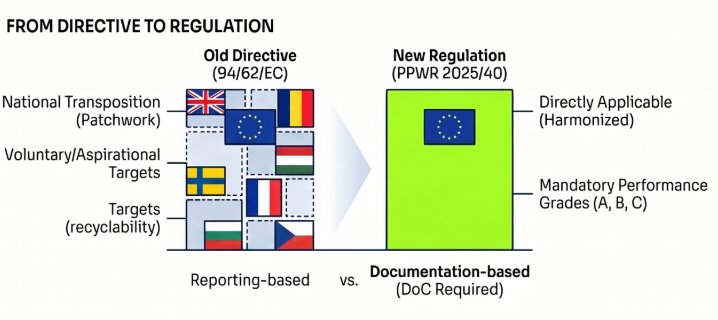
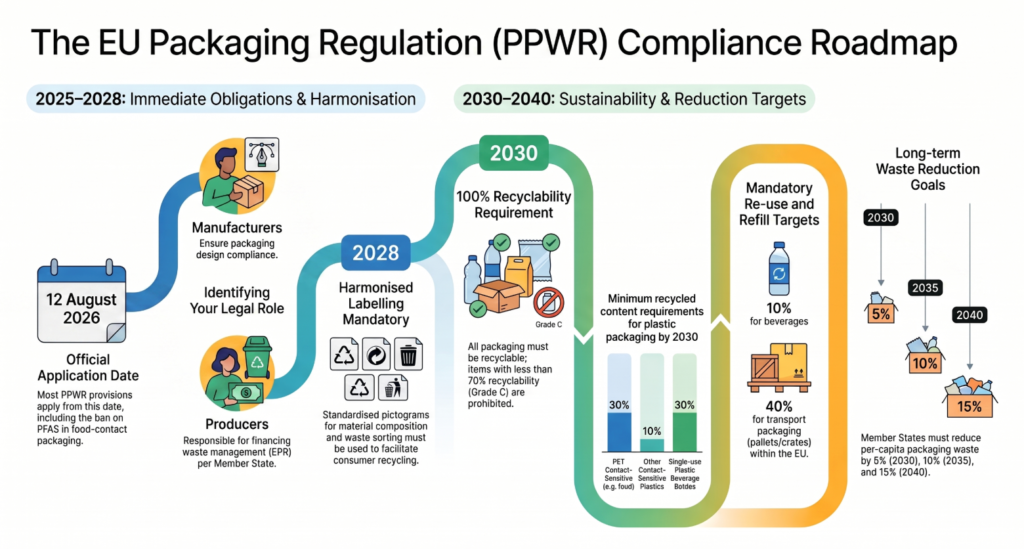
Until recently, EU packaging law relied on national implementation, which led to inconsistent requirements across Member States. The new packaging Regulation (EU) 2025/40 is directly applicable and is designed to harmonise packaging sustainability rules across the EU. It entered into force in 2025 and generally applies from 12 August 2026.
The key PPWR areas exporters should watch are:
- Recyclability by design, with all packaging expected to be recyclable by 2030
- Recyclability performance grades, with Grade C at 70 percent recyclable from 2030 and Grade B at 80 percent recyclable from 2038
- Recycled-at-scale expectations from 2035
- Packaging minimisation and reduction of unnecessary weight and volume
- A 50 percent empty-space limit for grouped, transport, and e-commerce packaging by 2030
- Recycled-content targets for certain plastic packaging from 2030
- Harmonised EU sorting labels expected from 2028
- Restrictions on unsupported environmental claims
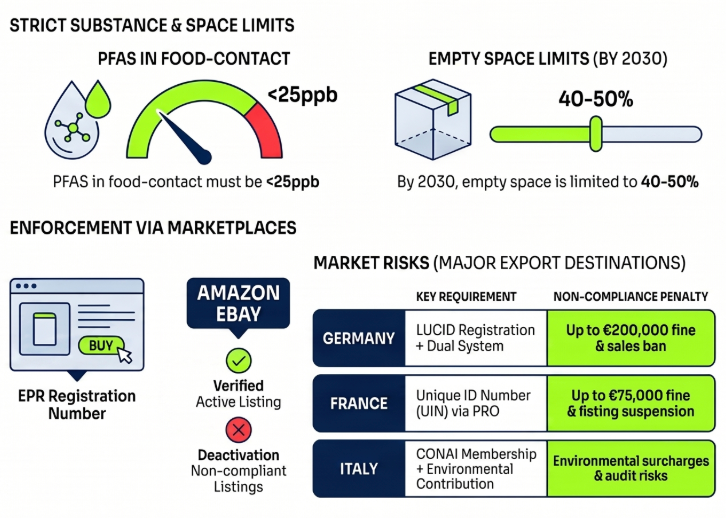
By 2030, packaging placed on the EU market must meet recyclability requirements. PPWR also introduces packaging minimisation duties, restrictions on avoidable empty space, recycled content targets for some plastic packaging, and future harmonised labelling requirements.
So an exporter cannot stop at registration. A valid EPR number may keep a listing active, but the physical pack still needs to be designed and documented correctly.
Country-by-country overview for common EU export markets
The EU is one market in customs terms, but EPR schemes in Europe are still national.
Germany
Germany is one of the strictest markets. If packaged goods are distributed in Germany, the producer must register with LUCID. For packaging subject to system participation, the producer must also contract with a dual system and report packaging volumes. Marketplaces and fulfilment service providers are expected to verify packaging compliance.
France
France requires producers to join an approved PRO such as Citeo and to obtain a Unique Identification Number issued by ADEME. Household packaging sold in France must carry the Triman logo and Info-Tri sorting instructions. These labelling requirements are currently in force, though EU-wide harmonisation under PPWR is expected to introduce standardised sorting labels from 2028 onwards
Spain
Spain has strengthened packaging EPR under Royal Decree 1055/2022. Producers placing packaging on the Spanish market need to assess registration, reporting, and participation in an EPR system.
Documents and data exporters should ask packaging suppliers for
The quality of your EPR reporting depends on the quality of your supplier data. Before approving a packaging format for EU export, ask for:
- Packaging specification sheet with dimensions, structure, and components
- Material composition and weight split by component
- Material data sheets
- Recyclability or compostability evidence where relevant
- Recycled-content declaration and chain-of-custody proof where relevant
- PFAS and heavy-metal test reports where applicable
- Print, label, adhesive, and ink details where they affect recyclability or compostability
- Declaration of Conformity inputs and Technical File support
For example, a paper mailer with a plastic coating cannot simply be reported as paper without checking the structure and local reporting rules.
A glass jar with a separable metal cap is typically reported as two separate components. Bonded composite packaging where materials cannot be separated is classified and reported differently depending on national PRO rules and the dominant material by weight.
“EU packaging EPR is not only a registration task. It is a packaging data task. Exporters need to know what every layer, label, filler, and shipping component is made of, because that is what decides reporting, fees, claims, and buyer confidence.”
— Vishal, Founder, UKHI
Get EPR-ready packaging documents for EU exports
If you are preparing packaging for Europe, start before the buyer asks.
Ukhi can help exporters review packaging formats, collect supplier data, prepare material and weight breakdowns, and align packaging choices with EU buyer expectations.
Share your product type, destination country, packaging format, and expected order volume. We can help you prepare a packaging data pack, sample kit, or recyclability grade assessment aligned to PPWR requirements for EU export discussions
FAQs
- Do small exporters need to follow EU packaging EPR?
Yes, low volume rarely means no obligation. Some countries have simplified declarations. It is best to check registration, reporting, and fee duties before shipping.
- Are product samples covered under EU packaging rules?
Yes. If samples are packaged and placed on an EU market, the packaging may still count, even when the product is free.
- What happens if packaging changes after EPR registration?
Update the packaging data before the next report. A new material or shipper weight can change declared volumes and fees.
- Can fulfilment centre data be used for EPR compliance?
Fulfilment data shows shipments, which is usually not enough. Packaging EPR needs material-level weights, formats, and country-wise sales records.
- Can exporters estimate EPR fees before final packaging approval?
Only roughly. Fees depend on destination country, material, weight, recyclability, and annual volume, so final costing needs confirmed packaging specifications.