
The word compostable looks simple on a package. But it can be a regulated claim. Packaging compostability claims are regulated in some U.S. states.
Once a brand prints compostable on a bag, pouch, liner, cup, tray, or coated paper pack, the claim has to survive two tests. It has to meet the federal standard for truthful environmental marketing. Then it has to meet the state rules in the places where the product is sold.
These state compostability packaging claim rules in the US also matter for exporters, importers, distributors, and packaging buyers.
The US does not have one national bioplastic compostable packaging law. The FTC Green Guides create the federal baseline for compostable claims, while states such as California, Washington, Colorado, Minnesota, and Maryland add specific compostable product labeling requirements.
What counts as a compostability claim?
A compostability claim is not only the word compostable. It can be direct, such as:
- Certified compostable
- Commercially compostable
- Home compostable
- Compostable where facilities exist
It can also be implied through design. A pack may create a compostability impression through leaf icons, soil language, green or brown graphics, food-scrap bin instructions, or phrases such as “made from plants” when they sit close to disposal messaging.
A pack that avoids the word “compostable” but suggests the same disposal outcome can still create a claim risk.
The safest approach is to treat every environmental disposal message as a claim that needs proof.
Federal baseline: FTC Green Guides and 16 CFR 260.7
The federal starting point is 16 CFR 260.7, which forms part of the FTC Green Guides. The rule says it is deceptive to misrepresent, directly or by implication, that a product or package is compostable.
It also says marketers should have competent and reliable scientific evidence that all materials in the item will break down into usable compost in a safe and timely manner.
This is the foundation of FTC Green Guides compostable claims.
For national sales, the facility qualifier is especially important.
BPI’s mark usage guidance recommends wording such as “Conditions Affect Product Breakdown. Access to Composting May Not Exist in Your Area.”
This helps buyers avoid giving consumers the impression that every community can process the item.
State-by-state rules buyers should check
The difficult part of US bioplastic compostable packaging rules is that state rules are not identical. A label that works for one state may need changes for another.
California
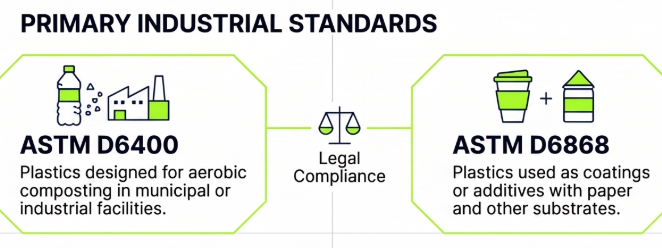
The California compostable labeling law requires compostable plastic products to meet ASTM D6400 and plastic-coated fiber products to meet ASTM D6868.
California also requires total organic fluorine below 100 ppm, no chasing-arrow recycling symbol on compostable plastic bags, and specific bag labeling formats.
From June 30, 2027, compostable consumer products must also meet the USDA National Organic Program linked material requirement, subject to the stated extension.
Washington
Washington compostable product labeling requires the word “compostable”, certification, and visual distinction using green, beige, or brown tinting, striping, or similar identification.
Washington also bans terms such as biodegradable, degradable, and decomposable, except for a narrow agricultural mulch film exception. Source:.
Colorado
The Colorado Compostables Labeling Act focuses on quick identification. Covered products must show a third-party certification logo, use the word compostable where possible, use green markings or design patterns, and avoid recycling symbols.
Minnesota
Minnesota compostable product labeling requires bags, packaging, and food-service products labeled compostable to be certified by a qualifying third party from January 1, 2026. Products must meet ASTM D6400 or ASTM D6868.
Maryland
The Maryland compostable labeling law prohibits selling plastic products labeled compostable unless they meet ASTM D6400 or ASTM D6868 and follow the FTC Green Guides.
Home compostable claims must meet the OK Compost Home certification standard adopted by Vincotte.
US State Compostable Packaging Rules At a Glance
Product types most affected
State rules usually focus on products that can confuse consumers or contaminate compost streams.
The highest-risk formats include:
- compostable film bags, produce bags, and pre-checkout bags
- food-service cups, trays, bowls, plates, lids, straws, and utensils
- compostable liners and food-scrap bags
- coated paper and fiber packaging with polymer coatings
- flexible packaging that resembles recyclable plastic
Coated paper deserves special attention.
A paper pack with a plastic or biopolymer coating may look like paper to the buyer, but many state rules treat the coating as the deciding factor. That is where ASTM D6868 becomes important.
Documents that prove a US compostability claim
A compostable claim should never sit only inside artwork. It should sit inside a documentation pack.
For US bioplastic compostable packaging compliance, one of the following documents must be collected:
- ASTM D6400 test or certificate
- ASTM D6868 test or certificate
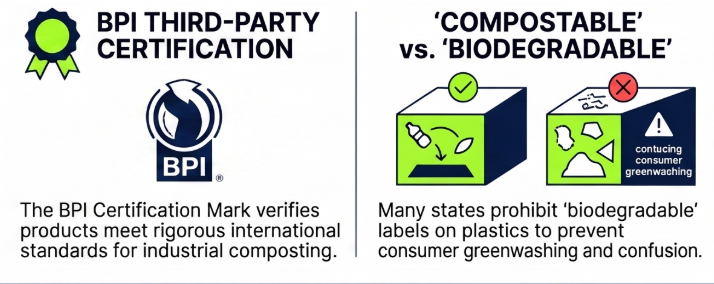
- BPI certification or equivalent third-party certification
- PFAS or total organic fluorine declaration
Common mistakes that create claim risk
Most claim problems begin before the product ships. The common mistakes are:
- Using biodegradable as a safer-sounding word
This is risky because several states restrict or ban vague terms such as biodegradable, degradable, decomposable, and oxo-degradable for covered products.
- Printing before certification is complete
A pending test is not the same as a compliant claim. Artwork should follow evidence, not hope.
- Using recycling symbols on bioplastic compostable packaging
Several state rules restrict chasing arrows or recycling-style symbols because they can push compostable products into recycling streams.
- Confusing industrial and home compostability
Most certified bioplastic compostable packaging is designed for commercial or industrial composting. Home compostable claims need separate proof and should not be used casually.
Practical workflow for exporters
A practical compliance process works best when packaging is not the first step.
Start with the target market. List the states where the product will be sold, distributed, or used by retailers.
Then confirm the product category. A coated paper bowl, a PBAT blend bag, a PLA cup, and a compostable liner may sit under different technical and labeling expectations.
Next, verify the claim. Get a BPI certification, CMA validation or an ASTM test before exporting bioplastic compostable packaging to the US.
Finally, create the compliance pack. This should include certificates, lab reports, PFAS declarations where relevant, artwork proofs, and a SKU-level state matrix.
“US compostable packaging compliance is not only a material question. It is a claim-control question. A buyer should know the resin, the test standard, the certifier, the disposal environment, and the target state before approving the word compostable on the pack.”
– Vishal, Founder, Ukhi
Get US bioplastic compostable packaging documentation support
Ukhi helps buyers move from intent to compliant packaging decisions.
Share your product format, target US states, material preference, expected order volume, and claim requirement.
We can help you choose and review suitable compostable material options and prepare a sample or grade recommendation before procurement decisions are finalised.
FAQs
- Do compostable bags need BPI certification in every US state?
There is no single federal rule that makes BPI certification compulsory for every compostable bag. But third-party like a BPI or another recognised certifier is expected by customers and retailers for compostable bioplastic products.
- Can compostable packaging be recycled in the USA?
Normally bioplastic compostable packaging is not meant to be out in recycling because they are designed for composting, not mechanical recycling. Several compostable product labeling requirements also restrict chasing-arrow or recycling-style symbols because they confuse consumers and waste handlers.
- How should brands dispose of compostable bags if no compost facility is nearby?
Brands should not suggest that compostable bags will break down properly everywhere. If suitable composting facilities are not available, the FTC Green Guides require the claim to be qualified. A safe label may need wording such as “access to composting may not exist in your area,” especially for national US sales.
- What is the difference between certified compostable and home compostable?
Certified compostable usually means the product has been tested for industrial or commercial composting conditions using standards such as ASTM D6400 or ASTM D6868. Home compostable is a separate claim because backyard compost piles work at lower, less controlled temperatures.