
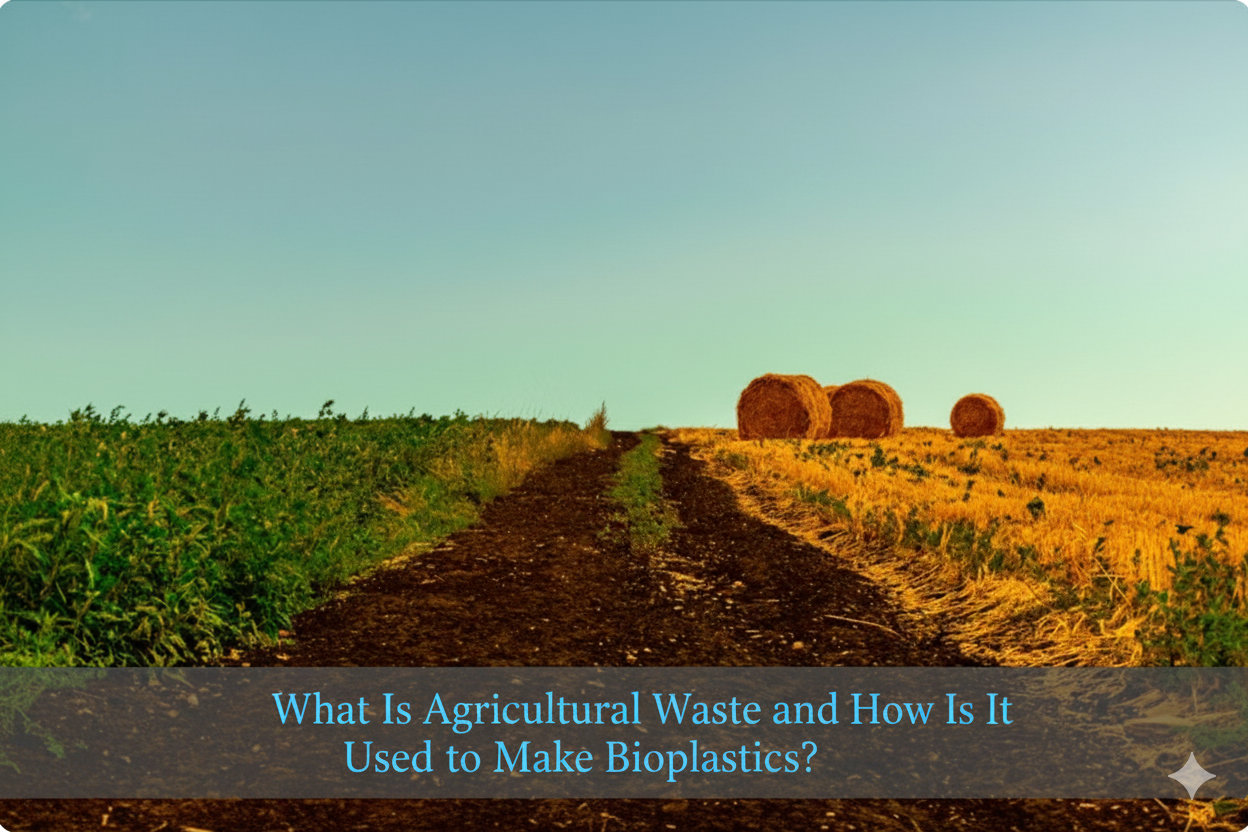
We produce billions of tons of agricultural waste each year. These stalks, husks, straw, peels, and fibrous residues remain after food is harvested. Most of it has little economic value today. Much of it is burned, dumped, or left to decay.
At the same time, we are struggling to replace conventional plastics that are polluting ecosystems and locking us into fossil based supply chains.
This overlap is an opportunity.
When we talk about bioplastics from agricultural waste, we are talking about converting what farmers consider residue into bio‑based plastics that perform like conventional materials but carry a far lower environmental cost.
We can make bio based plastic from organic waste and lignocellulosic materials like dry biomass, which is composed of cellulose, hemicellulose and lignin.

Agricultural waste is just one of the many biomass streams available for sustainable materials production. So, why make bioplastics from agricultural waste?
Why turn farm waste into bioplastics?
The strongest case for agricultural waste bioplastics begins with a problem most people underestimate.
Crop production generates over 5 billion tons of agricultural residues globally each year. A large share of this biomass has no organized downstream use. In countries like India, where collection systems are weak, the result is predictable:
- residues are burned in fields
- emissions rise
- rural air quality worsens
- embedded biomass value is lost
About 90 million tons of crop residue is burned annually in India. This contributes significantly to seasonal air pollution and avoidable carbon emissions.
Now compare that with plastics.
Conventional plastics are fossil derived, emissions intensive, and extremely persistent after use. Once produced, their environmental cost is mostly irreversible.
Using agricultural waste to make bioplastics interrupts both problems at once.
- Instead of releasing carbon through burning or decay, crop residues are converted into materials.
- Instead of extracting new fossil carbon, we reuse biological carbon already in circulation.
So, which crop residues work best?
As you might have guessed, all agricultural waste behave differently. Some residues are rich in cellulose. Some contain starch. Others have fibrous structures suited for composites.
What works at scale today tends to be:
- widely available
- of a predictable composition
- compatible with existing processing methods
Sugarcane bagasse is a good example. Produced after juice extraction, bagasse is rich in cellulose and is already collected at centralized sugar mills. This makes it one of the most commercially viable inputs for biodegradable packaging today.
Molded plates, food containers, and trays made from bagasse are replacing plastic and polystyrene in food service.
Rice straw and wheat straw are even larger in volume. These residues are abundant across Asia and are currently burned because farmers lack alternatives.
Chemically, they are well suited for conversion into sugars or fibers used in bio‑based plastics. But logistics and collection are ongoing constraints (crop residues are bulky, seasonal, and dispersed).
Corn stover and corn cobs, common in the Americas, are another mature feedstock.
They are already used in biofuels and are increasingly diverted into bioplastic pathways such as PLA and PHA.
Even smaller waste streams can be used.
Banana peels, cassava peels, and other starchy food residues have been successfully used to produce biodegradable films and molded products at pilot scale.
Once we understand what materials are available, the real question becomes, how do we turn this waste into usable polymers?
How is agricultural waste turned into biopolymers?
At a high level, bioplastics from agricultural waste follow a simple idea:
- Break complex plant matter into usable building blocks,
- then rebuild those blocks into polymer structures.
The diagram below shows how biopolymers can be extracted from biowaste with two methods, acidification and fermentation.

In practice, there are four main routes of conversion:
Starch‑based Plastics
Starchy residues such as cassava waste or banana peels are dried, ground, and heated with natural plasticizers like glycerol.
The result is a moldable material suitable for bags, films, and disposable items.
This is one of the simplest and most accessible ways to make biodegradable plastics.
Cellulosic Conversion to PLA
Bioplastic from agricultural waste fibrous residues like bagasse, rice straw, or corn stover are pre‑treated and enzymatically broken into sugars.
These sugars are fermented into lactic acid, which is then polymerized into PLA.
PLA is widely used in compostable cups, cutlery, and packaging films.
Microbial Synthesis of PHA
Microbial fermentation bioplastic is made when bacteria are fed carbon derived from agricultural waste. Under controlled conditions, the microbes convert this carbon into intracellular polymers.
PHAs biodegrade naturally in soil and marine environments and are among the most promising long‑term replacements for conventional plastics.
Mycelium Composites
In some cases, agricultural fibers are bound together using fungal mycelium, producing lightweight packaging materials that replace foam and protective plastics.
Each way has different performance and cost profiles. But can agricultural waste bioplastics compete economically with traditional plastic?
Are bioplastics from agricultural waste affordable yet?
Let’s be clear, conventional plastics still win on pure cost, for now.
For instance:
- PHA (a high-potential bioplastic) can cost $3-6 per kilo to produce
- Polyethylene (PE) and PET often land between $1.1 and $1.4 per kilo
That’s a big gap. But it is narrowing fast.
Because using agricultural residues as the starting point lowers feedstock costs. In some regions, crop waste is so undervalued that it can be sourced almost free or with subsidies for collection.
On top of that, bioplastic production can sometimes tap into carbon credits and sustainability linked finance.
Add to this, government incentives, such as the EU Innovation Fund and new Indian state policies offering capital subsidies and soft loans for bioplastic projects.
So, as production scales, unit costs drop.
The bioplastic market is growing at 9% CAGR or higher worldwide, pulling in investors and brands.
In short, bioplastics from agricultural waste are not yet cheaper. But they are on a cost trajectory that conventional plastics simply cannot match long-term.
Because fossil plastics will only get more expensive as externalities and regulations mount.
The most immediate challenge is processing cost, turning tough, mixed crop residues into high-quality polymers. Pre-treatment steps can be energy intensive.
Feedstock collection, too, is no small feat:
- Biomass is bulky and scattered, with supply peaking only after harvest
- Transportation can eat up potential profit
- Quality varies between batches, affecting process consistency
We have already proven the concept at Ukhi. Our EcoGran™ resin, made from hemp, flax, and rice stubble, debuted on World Environment Day 2025 and is scaling toward 100k tons yearly, turning farm smoke into market ready biopolymer and finished products like compostable plates and packaging.
FAQs
- What are bioplastics made from agricultural waste?
Bioplastics can be created from crop residues like bagasse, corn cobs, and fruit peels. Some popular bio-based plastics are PLA, PHA and PBS.
- How is agricultural waste converted into bioplastic?
Agricultural waste material is processed to extract cellulose or starch, fermented or blended, and then formed into biodegradable polymers like PLA and PHA for packaging and more.
- Can fruit waste really make bioplastic?
Yes, banana and cassava peels can be processed into biodegradable films at lab and pilot scale.
- What are the main uses of bioplastics from agricultural waste?
Agricultural waste bioplastics are commonly used to replace single-use plastic items like food packaging, bags, cutlery, films, hygiene products and coatings in multiple industries.
- Are these agricultural waste bioplastics biodegradable?
Bioplastics from agricultural waste can meet global compostability standards and break down in proper conditions.