
Quick Answer
In simple terms, agri-waste polymer vs. LDPE is a comparison between renewable residue-based carbon and fossil carbon. LDPE is made from oil or gas-derived ethylene. It typically has a cradle-to-gate carbon footprint of around 1.62–2.6 kg CO₂e per kg of resin, depending on the study and system boundaries.
Agri-waste polymers, by contrast, are made from agricultural or forestry residues such as straw, husks, or crop stalks. This means they rely on existing biomass rather than newly extracted fossil carbon.
So, which has the lower carbon impact? In many cases, agri-waste polymers can reduce fossil-carbon dependence and deliver a lower overall carbon footprint than LDPE, particularly when sourced from waste feedstocks and produced efficiently.
However, the outcome depends on the full life cycle, including processing energy, material performance, and end-of-life treatment. For packaging buyers, the most accurate answer comes from comparing the total carbon impact of the finished packaging format rather than the resin alone.
Main Findings: Agri-Waste Polymer Vs. LDPE Carbon Impact
A fair comparison should not stop at resin production. It should compare the material across its life cycle.
That includes feedstock, resin production, film conversion, transport, use-phase performance, and disposal.
Table: carbon impact by life-cycle stage
| Life-cycle stage | LDPE | Agri-waste polymer | Buyer takeaway |
| Feedstock | Fossil ethylene from oil or gas. | Agricultural or forestry residue. | Agri-waste reduces reliance on fossil carbon. |
| Resin production | Mature and energy-optimized. | Can require pretreatment, blending, or fermentation. | Processing energy can reduce carbon advantage. |
| Film conversion | Highly established on blown film lines. | Depends on grade, blend, and processing window. | Line trials matter before switching. |
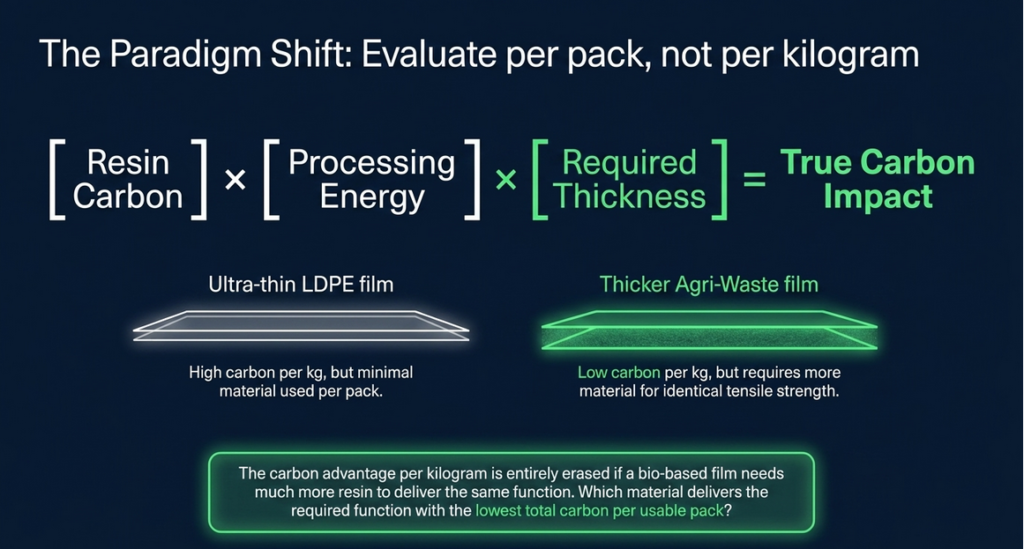
| Functional weight | Often strong at low gauge. | Some bio-based films may need higher thickness. | Compare per pack, not only per kg. |
| End-of-life | Recycling, landfill, or incineration. | Composting, biodegradation, landfill, or incineration depending on the grade. | Disposal routes can change the result. |
| Carbon risk | Fossil carbon enters the system. | Biogenic carbon may be partly circular. | Claims need LCA support. |
One finding is especially important for buyers.
Agri-waste polymers can lower fossil-carbon dependence, but the final carbon result depends on whether the material performs at the required thickness and reaches the correct end-of-life route.
For example, some second-generation bio-based polymers show 18 to 32 percent lower global warming potential than common fossil plastics such as PVC, PP, HDPE, and LDPE. Some bio-PBAT made from agricultural waste has been reported at around 3.72 kg CO₂e per kg, which is about 37 percent better than conventional fossil PBAT. (CE Delft, Sustainability of Biobased Plastics)
That is useful progress.
But if a bio-based film needs much more resin to do the same job, the benefit can shrink.
So the real question is not only “Which resin has lower carbon per kg?”
The better question is, “Which material delivers the required packaging function with the lowest total carbon per usable pack?”
Carbon Footprint Of LDPE
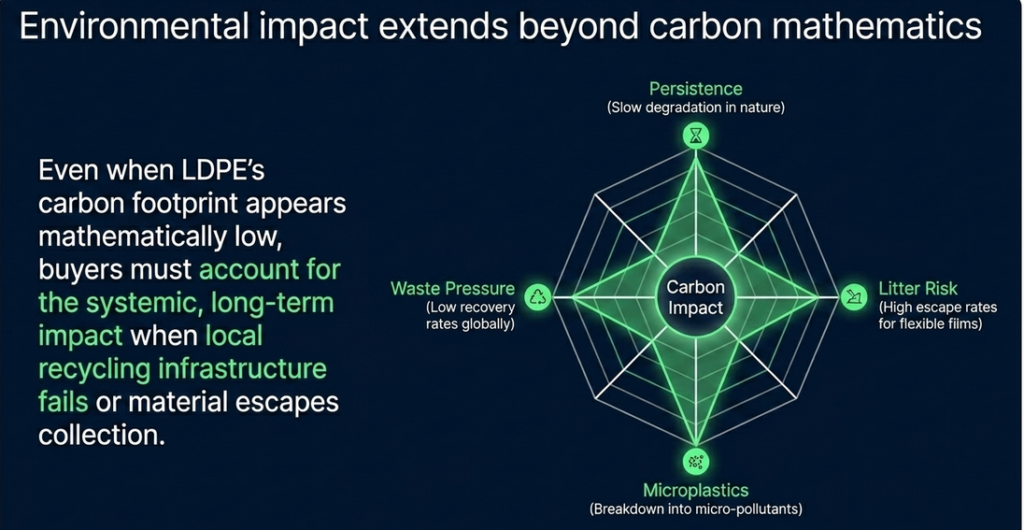
LDPE has two carbon realities.
The first is that it is fossil-based.
The second is that it is technically efficient.
The carbon footprint of LDPE begins with fossil feedstock extraction. Oil or natural gas is processed into ethylene, and ethylene is polymerized into LDPE resin. That resin is then converted into films, bags, liners, shrink films, wraps, and flexible packaging formats.
Recent industry data suggests that LDPE resin production in North America emits about 1.62 kg CO₂e per kg of resin. Other datasets place LDPE closer to 2.59 to 2.6 kg CO₂e per kg when broader production and forming assumptions are included. (American Chemistry Council, A Decreasing Footprint; UK BEIS/Defra Conversion Factors)
The number is not fixed because different studies use different boundaries, like:
- resin production,
- formation,
- transport,
- Or end-of-life.
For packaging buyers, this matters because CO2 emissions per kg of plastic can look low if the boundary is narrow and much higher if conversion and disposal are included.
End-of-life is also a major factor.
Mechanical recycling can reduce LDPE’s carbon footprint significantly. Some recycled LDPE assessments show around 64 percent lower carbon impact than virgin LDPE, along with major savings in fossil resource use. (NG Nordic, Circo Recycled Plastics LCA Study)
Incineration moves the result in the opposite direction because fossil carbon is released as CO₂. Landfill has lower immediate climate impact because LDPE degrades slowly, but it does not solve the material persistence problem.
So LDPE is not a simple villain in carbon terms.
It is efficient, lightweight, and recyclable in theory. But it remains tied to fossil carbon, and flexible LDPE recycling depends heavily on collection systems, segregation, and recycling infrastructure.
Carbon footprint of agri-waste polymers
Agri-waste polymers start from a different carbon source.
The feedstock is biomass residue. During plant growth, biomass absorbs CO₂ from the atmosphere. If that residue is converted into polymer instead of being burned, wasted, or left unmanaged, part of the carbon pathway can become more circular.
This is the core carbon logic behind second-generation materials.
They do not depend on food crops in the same way as first-generation bioplastics made from corn, sugarcane, or other edible feedstocks. They use materials such as:
- Wheat straw
- Corn stalks
- Rice husk
- Bagasse
- Forestry residue
- Empty fruit bunches
- Other lignocellulosic residues
These are useful agri-waste polymer examples because they avoid one common criticism of bio-based plastics, which is competition with food production.
Agri-waste feedstocks can also reduce non-renewable energy demand. Some assessments suggest that second-generation bio-based plastics may use about 25 percent less non-renewable energy than first-generation crop-based alternatives. (CE Delft, Sustainability of Biobased Plastics)
But there is a technical cost.
Agricultural residue is not automatically ready to become packaging resin. It may need drying, cleaning, size reduction, pretreatment, fermentation, chemical conversion, compounding, and blending.
For film applications, the polymer may also need performance partners to achieve:
- Tensile strength
- Sealability
- Flexibility
- Moisture resistance
- Shelf-life performance
- Machine compatibility
This means the carbon footprint of agri-waste polymers depends heavily on manufacturing efficiency.
A strong agri-waste polymer pathway uses local or low-transport residue, efficient processing, renewable energy where possible, optimized compounding, and correct end-of-life design.
A weak pathway can lose some of its carbon advantage through high energy use, long-distance transport, excess moisture handling, or poor material efficiency.
Agri-Waste Polymer Vs. LDPE: What It Means For Buyers
For buyers, agri-waste polymer vs. LDPE is not only a sustainability question. It is a packaging decision.
The better material depends on the job.
An agri-waste polymer can make strong sense when the buyer wants to reduce fossil-carbon dependence, support renewable feedstock use, meet compostability requirements, or build a packaging system around verified bio-based content.
It is especially relevant for brands reviewing:
- Compostable courier bags
- Secondary packaging films
- Food-service packaging
- Flexible packaging where compostability is required
- Applications where agricultural-residue sourcing strengthens the sustainability story
LDPE may still be suitable when the application needs very low gauge strength, high flexibility, mature processing, low cost, and access to an established recycling route.
This is why a comparison based on format is more important than the resin choice.
A 1 kg resin comparison is useful for early screening. A finished-pack comparison is better for real procurement.
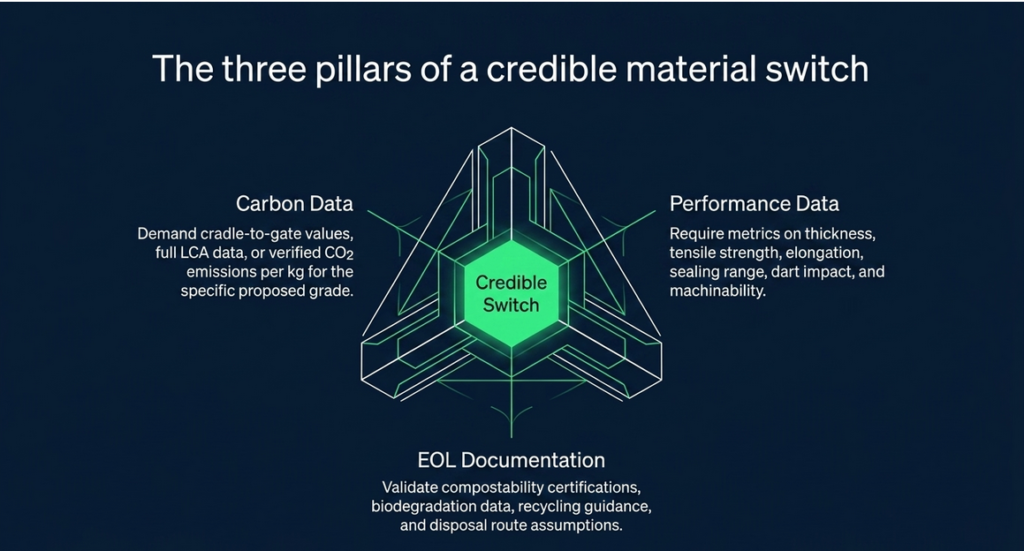
Before switching, buyers should ask suppliers for three types of data.
First, ask for carbon data.
This may include cradle-to-gate values, full life-cycle assessment data, or verified CO2 emissions per kg of plastic for the proposed grade.
Second, ask for performance data.
This should include thickness, tensile strength, elongation, sealing range, dart impact, tear resistance, and machinability.
Third, ask for end-of-life documentation.
This may include compostability certification, biodegradation data, recycling guidance, or disposal route assumptions.
The key is simple.
A material switch is credible only when carbon, performance, compliance, and disposal are reviewed together.
FAQs
- Is LDPE impact resistant compared with agri-waste polymer films?
LDPE is valued for flexibility, toughness, and impact resistance, especially in bags and flexible films. Agri-waste polymer films can be engineered for similar use cases, but impact resistance depends on the base polymer, blend design, thickness, filler level, and processing quality.
- Why do studies report different CO₂ emissions per kg of plastic?
Studies use different boundaries. Some measure resin production only. Others include forming, transport, disposal, recycling, or incineration. That is why CO₂ emissions per kg of plastic should always be read with the study scope, geography, and energy mix.
- What are useful agri-waste polymer examples beyond packaging film?
Common agri-waste polymer examples include polymers or blends using fruit peels, fruit seeds, crop stalks, straw, husks, bagasse, cellulose residue, and forestry by-products. These feedstocks can support films, coatings, molded items, thermoformed packaging, and compostable blends. (MDPI)
- Are the environmental impacts of LDPE only about carbon emissions?
No. The environmental impacts of LDPE also include persistence, litter risk, microplastic formation, low flexible-film recovery, and waste-management pressure. Carbon is important, but buyers should also consider what happens when LDPE escapes collection or cannot be recycled locally.
- What does CO₂-based LDPE mean in an agri-waste polymer vs. LDPE comparison?
CO₂-based LDPE is polyethylene made using captured carbon dioxide as part of the feedstock route. It is still chemically LDPE, so it behaves like regular polyethylene, but its climate impact depends on the energy source, conversion efficiency, and how much fossil feedstock it replaces.
Get an Agri waste polymer vs. LDPE benchmark
If you are making an agri-waste polymer vs. LDPE comparison, do not rely on a generic claim.
Bring the actual packaging format into the comparison.
UKHI can help evaluate the current LDPE structure, suggest an agri-waste polymer grade, review documentation, and support line trials before full conversion.
Explore Ukhi bioplastic products.
Start with a benchmark.
Compare your current film, bag, or flexible packaging format against an agri-waste polymer option using carbon data, technical performance, compliance requirements, and end-of-life fit.