
Quick Answer
For most D2C brands, recyclable packaging is the practical default. Compostable packaging becomes the better choice when the product, format, or disposal route makes recycling unrealistic.
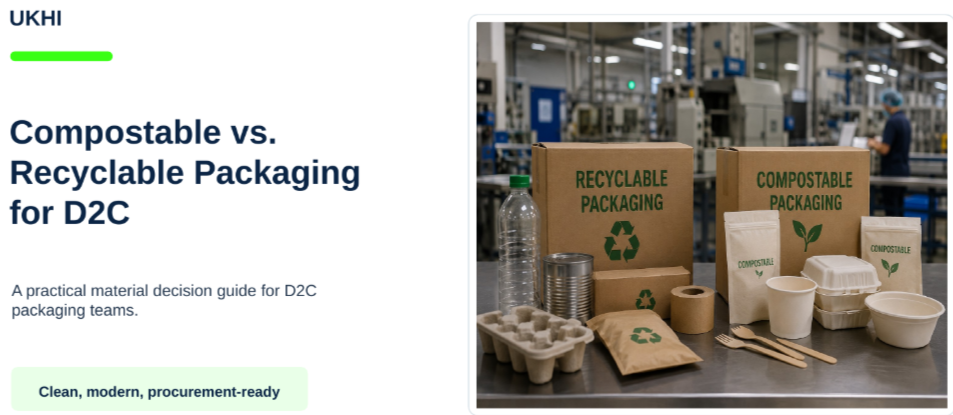
Recyclable packaging is chosen for clean and dry products. It is in widely collected formats such as corrugated boxes, kraft mailers, paperboard cartons, PET bottles, HDPE containers, and mono-material plastic packs. Compostable packaging is chosen when food residue, small size, or a controlled composting route makes recycling difficult.
Compostable Vs. Recyclable Packaging: Which One To Choose
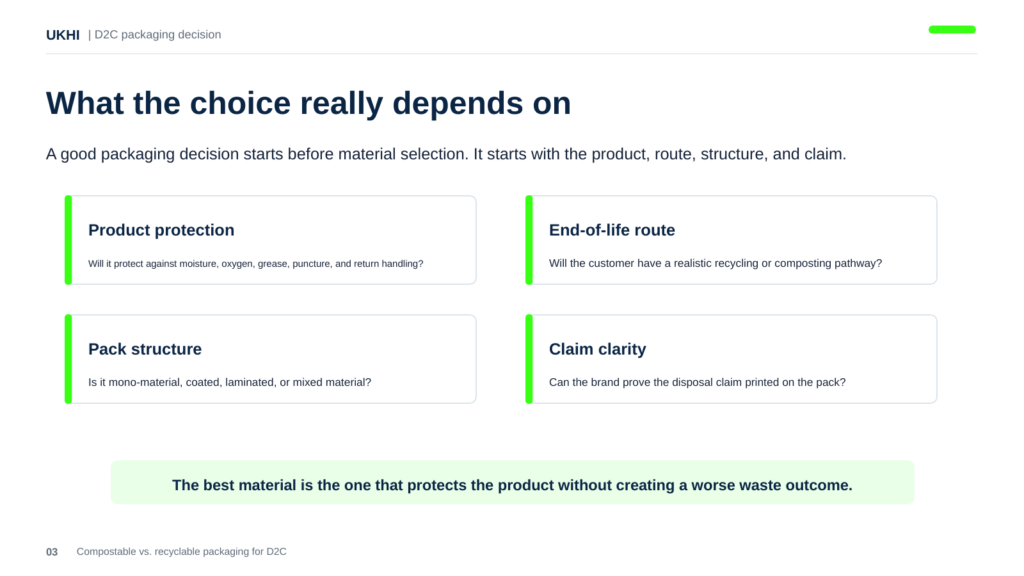
A good packaging decision starts before material selection. It starts with the product.
Product protection and shelf-life needs
Before making a choice between compostable vs. recyclable packaging, it is helpful to understand that the packaging must first protect what it carries.
A compostable film may be suitable for
- certain dry goods,
- fashion products,
- lightweight applications.
But sensitive products may need stronger moisture, oxygen, grease, or puncture resistance.
Recyclable rigid formats such as PET, HDPE, glass, aluminum, and mono-material PP can offer better shelf-life support for products such as
- beauty,
- wellness,
- personal care,
- And household liquids.
This is why the best material is not always the material with the strongest sustainability story. It is the material that protects the product without creating a worse waste outcome.
Collection, sorting, and end-of-life route
D2C brands ship into many homes, cities, and disposal systems. That makes end-of-life difficult.
Recyclable paper and corrugated packaging usually have stronger collection pathways. Compostable formats depend on industrial composting access, local acceptance, and clear separation from recycling streams.
If the customer cannot identify the right bin, the claim fails at the final step.
For D2C, that final step matters because the customer is the disposal operator.
Pack structure: mono-material vs. coated or laminated formats
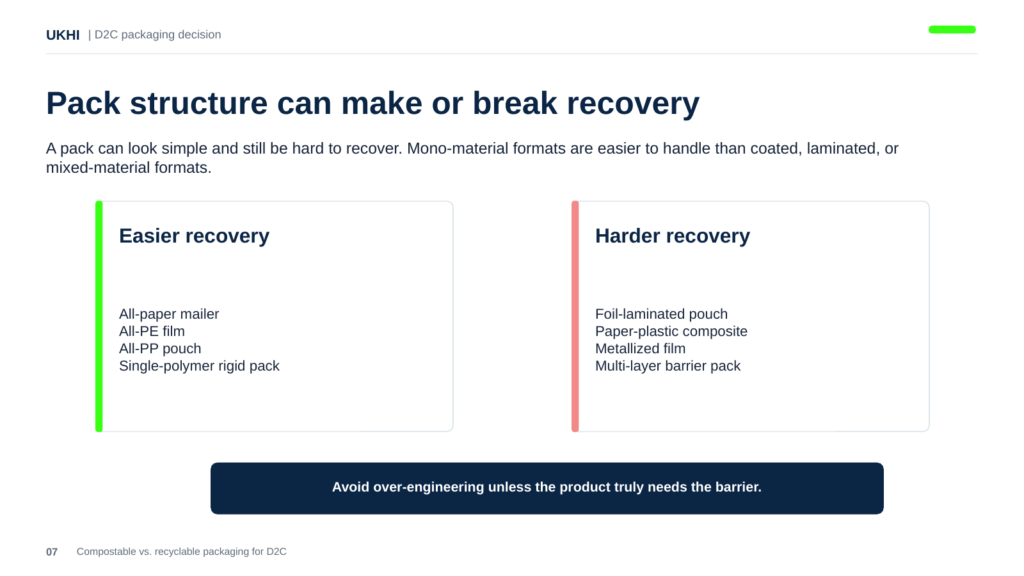
A pack can look simple and still be difficult to recover.
- Mono-material formats are easier to handle because they are made mainly from one material family. Examples include all-paper mailers, all-PE films, all-PP pouches, and single-polymer rigid packs.
- Coated and laminated packs are more complex. A paper pack with a plastic coating may not behave like normal paper. A multi-layer pouch may protect the product well but create recycling difficulty.
This scenario is where many brands make the wrong switch. They replace one problematic format with another format that only looks better.
Customer instructions and disposal clarity
Customers do not have time to decode packaging science.
A D2C pack should say clearly what the customer should do with it. If the pack is compostable, the instruction should explain whether it needs industrial composting or can go into home composting where certified.
If the pack is recyclable, the instruction should be specific to the material and format.
This is also where the difference between compostable and biodegradable plastic matters:
- “Biodegradable” is too broad for most packaging claims.
- “Compostable” must connect to a defined standard and composting condition.
Types of compostable and recyclable packaging materials
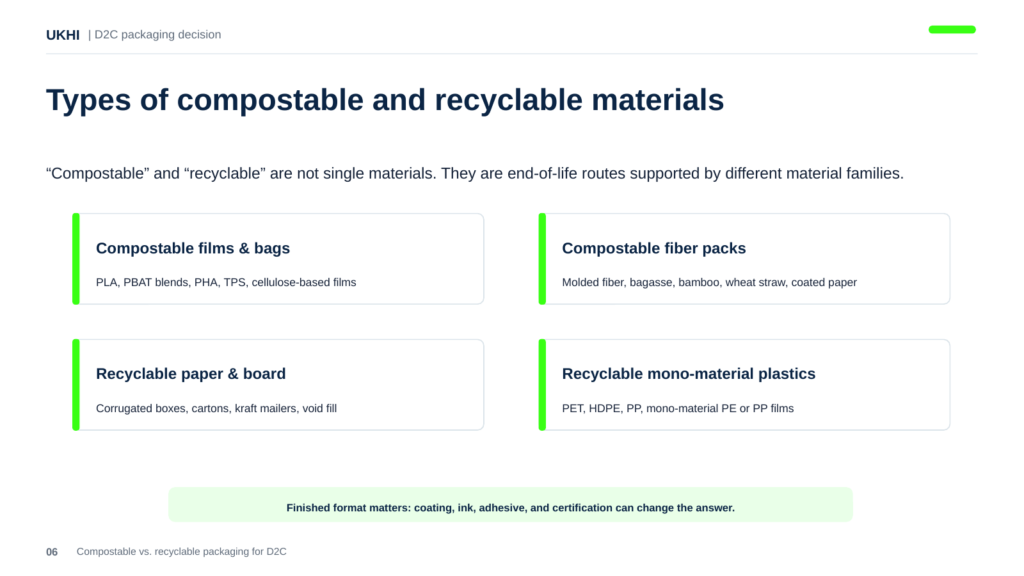
The material families matter because “compostable” and “recyclable” are not single materials.
They are end-of-life routes.
Compostable films and compostable bags
Compostable films and compostable bags are often made from materials such as PLA, PBAT blends, PHA, TPS, or cellulose-based films.
PLA can offer clarity and stiffness. PBAT can add flexibility. PHA is technically promising but often more expensive. Cellulose films can work for selected dry-food and barrier applications.
These materials are useful when the packaging application supports compostability and when certification is available for the finished format.
Compostable paper-based packaging with compatible coatings
Paper-based compostable packaging can include molded fiber, bagasse, bamboo fiber, wheat straw, and paper formats with compatible coatings.
These are often used for food-contact applications, trays, bowls, clamshells, and some protective formats.
Bagasse, for example, is used because it has heat and grease resistance for food-service applications. But the coating, ink, adhesive, and final structure still matter.
A fiber pack is not automatically compostable just because the base material is plant-based.
Recyclable paper, board, and corrugated packaging
Recyclable paper, paperboard, and corrugated packaging remain strong choices for D2C shipping.
They are widely understood, easy to print, and suitable for cartons, shippers, sleeves, inserts, void fill, and product boxes.
Paper-based packaging often gives the cleanest balance of cost, brand presentation, and disposal clarity for:
- apparel,
- skincare kits,
- small appliances,
- And gifting formats.
Recyclable mono-material plastic packaging
Recyclable plastics can include PET, HDPE, PP, and mono-material PE or PP films.
The advantage is structure. These materials can offer strength, moisture resistance, sealing performance, and shelf-life support.
The challenge is recovery. Flexible films may need store drop-off or dedicated collection systems in many markets. Rigid PET and HDPE usually have stronger recycling pathways than multi-layer flexible packs.
Where mixed-material packaging becomes difficult
Mixed-material packaging looks premium but behaves badly at the end of life.
Examples include foil-laminated pouches, paper-plastic composites, metallized films, and multi-layer barrier structures.
These formats may be necessary for high-barrier products. But if the product does not need that barrier, brands should avoid over-engineered packaging.
Over-engineering increases cost and makes disposal harder.
Decision matrix: how to compare both options before switching
Before switching, compare both options on practical buying criteria.
| Decision factor | Compostable packaging | Recyclable packaging |
| Best fit | Food-soiled, small, or controlled-route formats. | Clean, dry, widely collected formats. |
| MOQ | Often higher for certified or custom grades. | Often easier for common paper and mono-material formats. |
| Micron and strength | Needs testing by application. | Strong options available across paper, rigid, and film formats. |
| Sealing | Depends on resin and converter setup. | Usually easier on established formats. |
| Humidity | Needs storage and transit testing. | Generally more predictable in standard formats. |
| Export fit | Certification-sensitive. | Claim and recovery-rate sensitive. |
This table should not replace trials. It should help the brand know what to test first.
Compostable vs. recyclable packaging cost
Comparing compostable vs. recyclable packaging costs, it’s easy to understand why brands hesitate.
Compostable packaging often carries a 20 percent to 60 percent unit cost premium compared with conventional alternatives. Some home-compostable formats may sit around 25 percent to 35 percent higher.
That premium comes from resin cost, lower scale, certification, R&D, and more specialized conversion.
Recyclable packaging is often more economical when the format is common. Corrugated boxes, kraft paper, recycled paper mailers, PET bottles, HDPE containers, and mono-material packs can be easier to source at scale.
But the unit price is not the full cost.
D2C brands also need to count:
- certification costs,
- EPR fees,
- storage conditions,
- return logistics,
- customer complaints,
- incorrect disposal,
- and claim risk.
In the UK, according to the UK Business Guide 2026, compostable plastics such as PLA, CPLA, and TPLA may still be treated as plastic for tax purposes unless they meet recycled-content requirements. In some EPR systems, compostables may attract higher fees when they are not recognized as recyclable through existing systems.
The cheapest packaging is not always the lowest-risk packaging.
The wrong disposal route can cost more than the material premium.
Expert Quotes
“Flexible food packaging is an ideal application for compostable packaging going forward, given its often food-soiled, lightweight and multilayered nature… To date, though, compostable packaging has presented challenges given that it can contaminate recycling streams but also vexes composters.”
Rhodes Yepsen, Executive Director, Biodegradable Products Institute (BPI), USA
“There’s not really a big difference between recyclable and compostable flexibles today, in terms of both lacking robust end processing options… Build that composting infrastructure; subsidize it for packaging. Build the recycling infrastructure; subsidize it for hard-to-recycle packaging.”
Alison Keane, Executive Director, Flexible Packaging Association, USA
“The public are rightly concerned about plastic waste and in recent years we’ve seen an increase in alternatives such as compostable packaging. However, the huge variety of compostables and lack of consistency not only confuses people but can cause significant issues for our waste and recycling systems… we simply don’t currently have the infrastructure to support this in the UK.”
Alex Robinson, CEO, Hubbub (UK environmental behavior change expert)
“A recyclable pack that is actually collected is better than a compostable pack with no composting route. But where contamination or small format makes recycling unrealistic, certified compostable packaging can be the more responsible choice.”
Vishal, Founder, UKHI
FAQs
- Is compostable packaging recyclable?
No. Most compostable packaging should not go into recycling bins. It can contaminate recyclable paper or plastic streams because compostable materials are designed for breakdown, not reprocessing. Brands should print separate disposal instructions for composting and recycling.
- Are compostable bags the same as recyclable bags?
No. Compostable bags are made to break down under composting conditions. Recyclable bags are made to be collected, sorted, and reprocessed. They may look similar, but their correct disposal routes are different.
- Is compostable plastic good for D2C mailers?
Compostable plastic can work for selected D2C mailers, but only after strength, sealing, storage, and disposal testing. If most customers lack composting access, a recyclable mailer may perform better from a recovery perspective.
- Why is compostable vs. recyclable packaging cost different?
The compostable vs. recyclable packaging cost differs because compostable materials often involve higher resin costs, smaller production scale, testing, and certification. Recyclable paper and mono-material plastic formats are usually easier to source at scale.
- Which packaging claim is safer for D2C brands?
The safest claim is the one the brand can prove. Compostable vs recyclable packaging claims should match the material, certification, customer disposal route, and local rules. Vague terms like eco-friendly or green create avoidable risk.
How UKHI helps D2C brands choose the right packaging route
UKHI helps D2C brands choose packaging based on product type, dispatch conditions, disposal route, and the claim they want to make.
Our EcoGran material platform supports compostable films, coatings, injection moulding, cast film, blown film, and customized biopolymer solutions made from agricultural-residue-based innovation.
We support three practical steps:
- material and grade recommendation,
- sample kits for packaging trials,
- line, sealing, storage, and dispatch compatibility checks.
Explore Ukhi bioplastic products.
Share your product type, current packaging format, target market, and expected order volume. UKHI can help you decide whether compostable, recyclable, or hybrid packaging is the right route.