
Quick Answer
When you compare paper and biopolymer coating for barrier packaging, the answer is simple.
- Plain paper is the better choice for dry and non-greasy packaging.
- Biopolymer-coated paper is the better choice when the pack needs resistance to moisture, grease, oxygen, aroma loss, or liquid contact.
A polymer coating becomes necessary when paper has to hold or protect products that are oily, moist, frozen, aromatic, oxygen-sensitive, or likely to stain the pack. In those cases, the coating gives paper the “barrier” function it does not naturally have.
Plain paper works well for low risk packaging
Paper has a strong sustainability story. It is renewable, familiar, printable, and widely accepted by consumers. But the paper has one technical weakness. It breathes.
This can be useful for some products and risky for others. Paper and cardboard protect products from physical damage. But untreated paper does not naturally block moisture, oxygen, grease, aroma loss, or mineral-oil migration well because its fibre network is porous.
For food and sensitive goods, that porosity can affect texture, shelf life, hygiene, and package strength.
Uncoated paper has poor barrier performance against water vapour, oxygen, mineral oils, and grease. This is why coatings are added for packaging applications.
Plain paper can work extremely well when the product does not attack the paper.
This usually means the product is:
- dry;
- non-greasy;
- low-aroma;
- not oxygen-sensitive;
- not exposed to condensation;
- not expected to hold liquid or fat.
Examples include grains, powdered products, dry bakery liners, granulated sugar, secondary wraps, and dry sachet outer packs.
It can also offer a premium tactile feel, strong printability, and simpler fibre recovery at end of life. But this logic breaks when moisture, oil, oxygen, or aroma become part of the packaging problem.
A paper pouch for dry flour is one problem. But a paper wrap for a greasy burger is another. And a paper cup for hot liquid is a completely different problem.
When does biodegradable barrier coating become necessary?
A biodegradable barrier coating becomes necessary when the product can damage the paper or when the outside environment can damage the product.
This happens in products such as:
- frozen foods;
- confectionery;
- fried snacks;
- pet food;
- dairy-linked formats;
- takeaway food;
- paper cups;
- wraps and trays;
- products packed in recycled boards where mineral-oil migration is a concern.
Barrier coatings are used because paper-based food packaging can lose integrity when exposed to oil or water. Water-based biodegradable barrier coatings are a way to help paper packaging prevent oil leakage and moisture entry while retaining the move away from plastic heavy formats.
The sustainability reason is also practical. If packaging is contaminated with food residue, recycling becomes harder.
In some cases, a compostable or biodegradable coating may fit the product’s end-of-life reality better than a coating designed only for recycling. The material choice should therefore start with the product, not with the claim.
What are the barrier coating types relevant for the packaging industry?
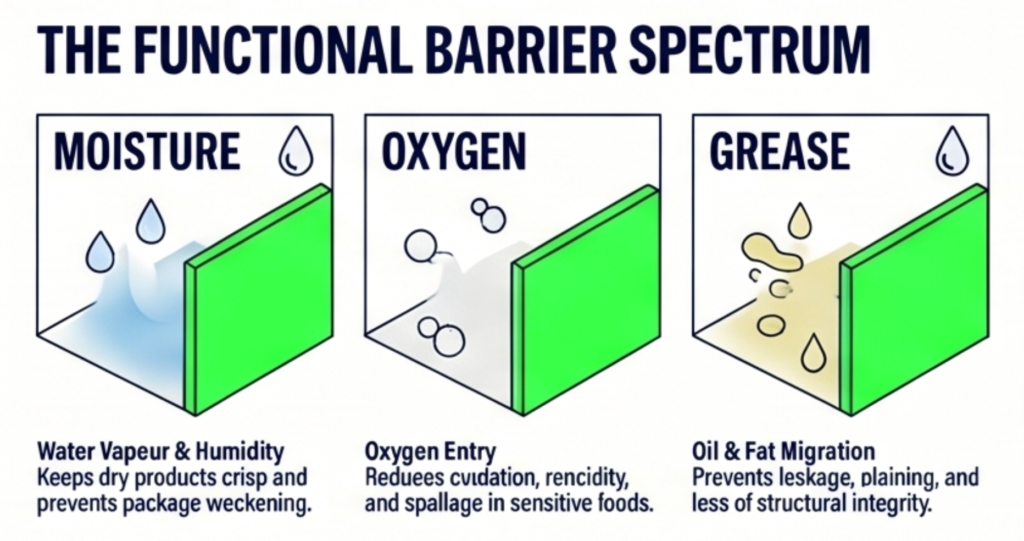
A biodegradable barrier coating in the paper industry is a functional layer applied to paper or board so that the surface resists transfer. The transfer can be from outside to inside, or from inside to outside.
It can include:
| Barrier type | What it protects against | Why it matters |
| Moisture barrier | Water vapour, humidity, condensation | Keeps dry products crisp and prevents clumping |
| Oxygen barrier | Oxygen entering the pack | Reduces oxidation, rancidity, colour change, and spoilage |
| Grease barrier | Oil and fat migration | Prevents staining, leakage, and package weakening |
| Aroma barrier | Aroma loss or outside odour entry | Protects coffee, tea, spices, and flavoured foods |
| Mineral-oil barrier | MOSH and MOAH migration | Important when recycled paper or board is used near food |
A pack can have good grease resistance but poor oxygen resistance. It can block liquid water but allow water vapour movement. It can be recyclable but not compostable.
So, good high barrier packaging starts by naming the exact barrier needed for your product.
WVTR, OTR, Cobb, and Grease Resistance in Simple Terms
As a buyer, you do not need to become laboratory scientists but should know the basic language of barrier performance. Cobb, oil resistance KIT testing, WVTR, heat sealability, blocking, and adhesive compatibility are some tests that let you screen paper barrier coatings.
Use this checklist before choosing a biodegradable barrier coating.
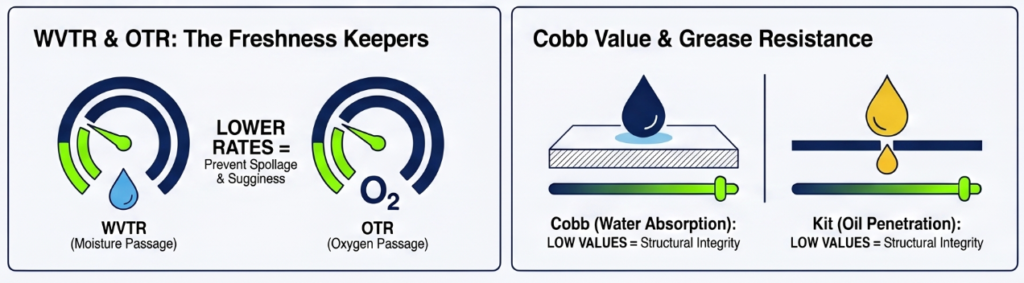
Water Vapour Transmission Rate (WVTR) – measures the amount of water vapour that passes through the packaging material. You want to look for a lower WVTR value for better moisture protection.
Similarly, Oxygen Transmission Rate (OTR) – measures how much oxygen passes through the pack. Lower OTR is important for oxygen-sensitive foods such as nuts, dairy-linked products, meat, pet food, and many dry foods.
Cobb value – measures how much water paper absorbs. A lower Cobb value means the paper absorbs less water. Grease resistance is usually tested through oil-resistance methods such as the KIT test.
These tests show how well the surface resists oil penetration.
Paper vs biopolymer coating for barrier packaging: Which is better?
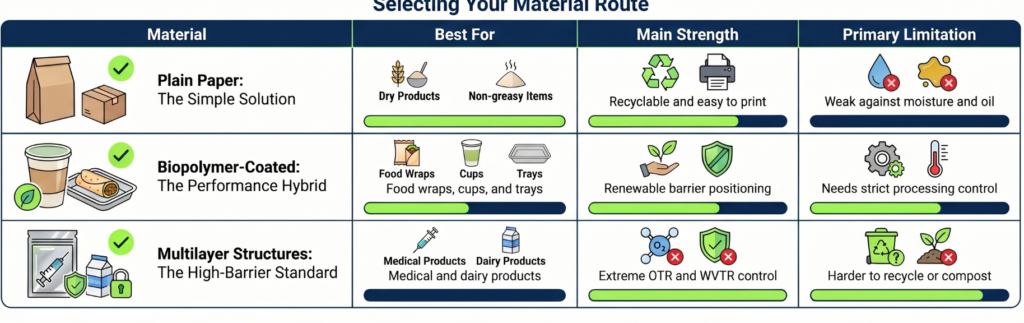
As we have mentioned above, plain paper is better when the packaging job is simple. Paper is also the lowest cost option because it does not need coating, drying, heat sealing trials, or extra documentation.
But a biopolymer coating is better when the product needs more than basic paper packaging.
In many paper applications, the coating layer may be only a few grams per square metre. But it can decide whether the pack works or fails.
Explore Ukhi compostable bioplastic products for different packaging needs.
Biopolymer coating for barrier packaging: How and why it works?
Bio-based coating materials include starch, cellulose derivatives, nanocellulose, chitosan, alginate, proteins, lignin, PLA, PHA, PBS, PBAT, waxes, and hybrid coating systems.
Let’s discuss how and why biopolymer packaging materials improve performance over paper.
- First, they fill or cover the pores in the paper surface. That reduces the path through which oxygen, moisture, and grease can travel.
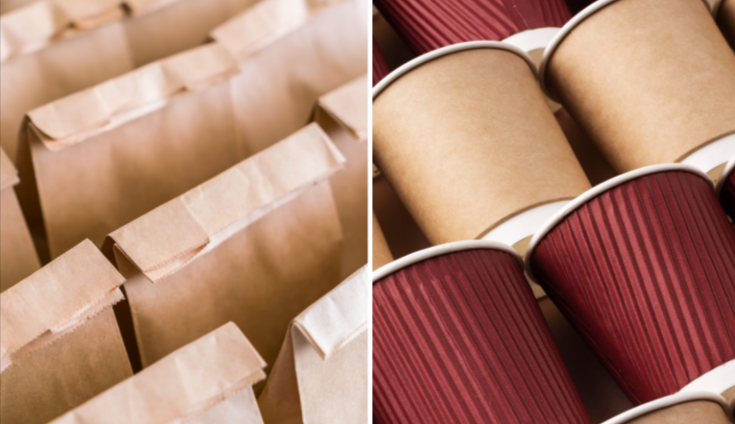
- Secondly, they allow paper to enter applications where untreated paper would fail. This includes greasy wraps, coated boards, cups, trays, and moisture-sensitive dry foods.
Overall, compared to fossil-based coatings, biopolymer coating can give paper a better sustainability profile while still adding the barrier performance.
A biodegradable barrier coating can also beat PE-coated paper when the buyer needs both performance and a better sustainability pathway.
The advantage is strongest when the buyer needs:
- grease and moisture protection;
- heat sealability;
- reduced plastic dependence;
- compostable or biodegradable positioning;
- improved compatibility with paper-based formats;
- lower concern around fossil-based plastic coatings.
Here is a use-case guide:
| Product or packaging use case | Best fit |
| Grains, flour, sugar, tea sachet outers, and powdered products | Plain paper |
| Crackers, cereals, dry snacks, and bakery packs | Biopolymer-coated paper |
| Croissants, doughnuts, muffins, and butter cookies | Biopolymer-coated paper |
| Burger wraps, roll wraps, sandwich wraps, and fried-food wraps | Biopolymer-coated paper |
| Food trays, clamshells, bowls, and takeaway packs | Biopolymer-coated paper |
| Paper cups, soup cups, and liquid-contact packs | Biopolymer-coated paper |
| Frozen food sleeves, liners, and cartons | Biopolymer-coated paper |
| Pet food, nuts, dairy-linked foods, and oxygen-sensitive products | High-barrier biopolymer coating |
| Garment wraps, tissue, tags, and inner paper sleeves | Plain paper |
| E-commerce inserts, void fill, invoice pouches, and secondary paper packaging | Plain paper |
Expert view: Paper should not be treated as one material
Ukhi’s CEO Vishal explains why buyers should choose the coating by barrier job not by sustainability claim.
“At UKHI, we do not see paper and biopolymers as competing ideas. Paper gives the package structure and consumer acceptance. The coating gives it performance. The right solution starts with the product risk, then moves to barrier value, processing route, certification, and end-of-life fit. That sequence prevents over engineering and under performance.”
If you are developing paper cups, trays, wraps, paperboard packs, or export ready barrier packaging, UKHI can help you evaluate the right coating route.
Contact us to get a sample kit, grade recommendation or a coating compatibility discussion with Ukhi’s team.
FAQs
- What affects paper vs biopolymer coating for barrier packaging cost?
Cost depends on paper grade, coating chemistry, coating weight, order volume, barrier target, and trial complexity. A simple grease barrier costs less than high barrier packaging that needs strong moisture and oxygen control.
- Is biodegradable barrier coating suitable for export packaging?
Yes, but only when the coating matches the buyer’s destination market requirement. Export buyers should check food contact documents, compostability or recyclability evidence, and test values for WVTR, OTR, Cobb, and grease resistance.
- Can barrier packaging use both waxes and biopolymers?
Some coatings combine biopolymers with waxes to improve water vapour resistance. The wax helps repel moisture, while the biopolymer supports film formation and surface coverage. This approach can be useful when paper needs better water resistance without a fully conventional plastic coating.
- Is high barrier packaging always necessary for food products?
Many foods need only one or two barriers. Dry products usually just moisture control, while fatty foods need grease resistance. High barrier packaging is necessary when oxygen, water vapour and aroma are all need to be controlled.