
The short answer
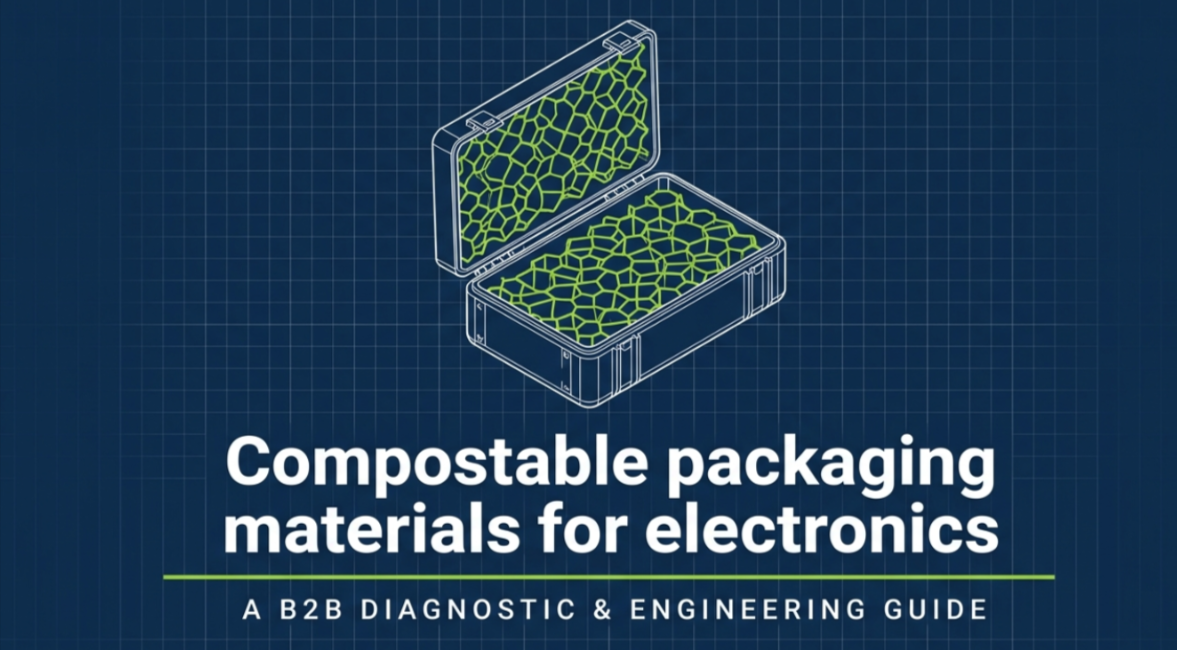
Molded pulp, mycelium foam, PLA-based film, and kraft corrugated are the four materials suitable as compostable electronics packaging. Each covers a different protection function. None of them cover all.
Molded pulp handles rigid inserts.
Mycelium foam protects high-value fragile devices.
Kraft corrugated covers outer shipping boxes.
PLA film directly replaces the single-use plastic wrap and poly sleeves that touch every electronic product. Plus, it doesn’t even require a structural redesign of existing packaging.
Why the choice of material matter in compostable electronics packaging?
Every year, millions of electronics ship inside expanded polystyrene foam and single-use plastic. These packaging materials outlast the product by centuries.
That is the problem that sellers are now being asked to fix. The pressure is coming from every direction at once. Packaging procurement teams now need defensible answers, not just good intentions.
The question is no longer “should we switch?” It is “what do we switch to, and will it actually hold up?”
The answer depends on what the sustainable electronics packaging is doing.
A rigid insert cradling a PCB has different requirements from a wrap protecting a charging cable. And both are different from the outer mailer that survives last-mile delivery.
Each job needs a different material. Below we map those jobs to the right compostable options and give you the decision data to make that call confidently.
What are the best compostable packaging materials for electronics?
There is no “best” material when it comes to eco-friendly electronics packaging. The correct answer is a function of your product’s risk profile:
- Shock sensitivity
- Moisture exposure
- Transit distance
- Export destination
Here is how the materials compare across the factors that matter in a real procurement decision.
| Parameter | Molded Pulp (Bagasse) | Mycelium Foam | PLA Film | Kraft Corrugated |
| Cost Tier | ₹8–₹20/piece | ₹30–₹80/piece | ₹120–₹180/kg | ₹6–₹14/piece |
| MOQ | 5,000–10,000 pcs | 2,000–5,000 pcs | 10,000–50,000 pcs | 1,000–5,000 pcs |
| Shock Absorption | Moderate–Good | Excellent | Low (wrap layer only) | Moderate |
| Moisture Resistance | Low–Moderate | Low | Moderate (with barrier coat) | Low–Moderate |
| Sealing / Line Fit | Formed, not sealed | Formed, not sealed | Heat-sealable on modified PE lines | Glued / tabbed |
| Key Certifications | EN 13432, BPI, IS 17088 | EN 13432, BPI | EN 13432, ASTM D6400 | FSC, EN 13432 |
| Export Compatibility | EU, US, UK — strong | EU, US — strong | EU — check PLA grade | EU, US, UK — strong |
The table above gives you the comparison at a glance. Now let us go through the most important decision factors in detail.
Moisture and humidity resistance
Moisture is the factor that catches most buyers by surprise when switching to compostable materials. Compostable materials are designed to break down in the presence of moisture, heat, and biological activity.
That makes them more vulnerable to humidity during storage and transit.
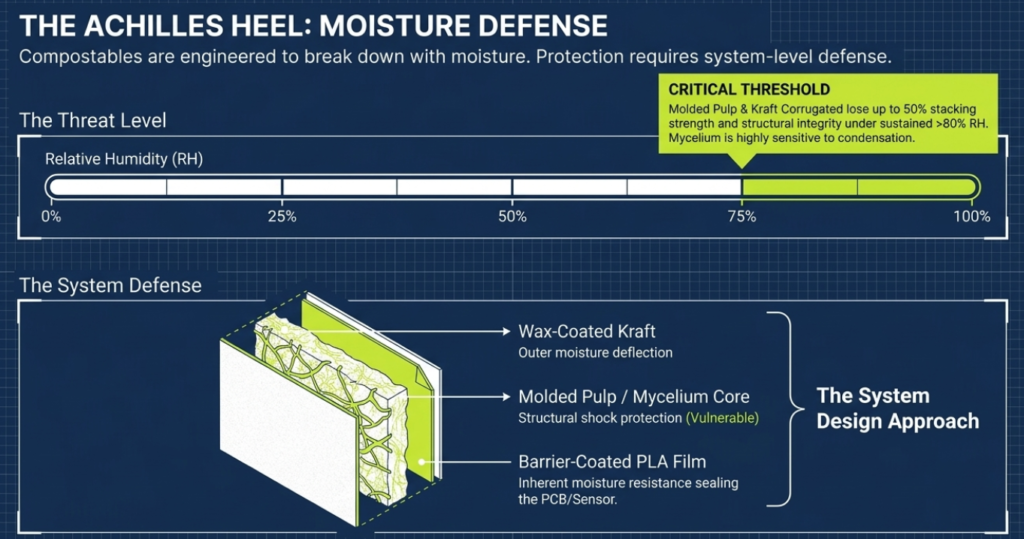
Here is how each material behaves:
- Molded pulp begins to soften and lose structural integrity at sustained relative humidity above 80 percent.
- Mycelium foam has similar moisture sensitivity to molded pulp. It should not be exposed to condensation or wet handling environments
- PLA film has better inherent moisture resistance than pulp or mycelium. For humidity-sensitive electronics like circuit boards and sensors, a barrier-coated PLA film is better.
- Kraft corrugated can lose 40 to 50 percent of its stacking strength within hours of condensation exposure. Compostable wax coatings are available and effective
The practical takeaway is that moisture protection is a system design question. The outer seal, inner structure, and whether the route requires desiccant or barrier layers all matter as much as the material itself.
Cost
The single biggest hesitation on compostable electronics packaging is cost. On a straight unit comparison, compostable materials run 1.5-3X more than conventional plastic. But that gap is narrowing faster than most buyers expect.
Industry data from early 2026 projects a 50-60% rise in conventional plastic prices. A PET unit costing ₹15 today could reach ₹22 to ₹24 by mid-2026. India’s EPR framework is also adding compliance fees on fossil-based packaging that did not exist two years ago. The more honest comparison is total cost of ownership over 12 to 18 months, not a spot price check.
Within compostable options:
- Kraft corrugated and molded pulp are the most cost-competitive, especially above 10,000 units
- PLA film sits in the middle, priced per kilogram rather than per piece
- Mycelium foam is the most expensive per unit. But its shock absorption can reduce damage-related return costs for high-value electronics
MOQ and lead time
MOQ is driven by tooling economics and material run minimums. Molded pulp tooling runs ₹20,000 to ₹80,000 as a one-time cost. After that, per-unit prices drop significantly at scale. PLA film below 10,000 pieces is better run with digital printing to avoid plate and cylinder setup costs. This brings viable quantities down to 500 to 1,000 units.
Mycelium has a 5 to 7 day growing cycle and limited India-based manufacturing. This results in a 20 to 35 day lead time for most Indian exporters. Kraft corrugated has the most flexible MOQ of the four, starting as low as 1,000 pieces with no custom tooling requirement.
Structural protection
Mycelium foam leads for shock absorption, performing comparably to EPS in independent drop tests. For context, EPS has been the standard for fragile electronics protection for decades. Mycelium reaching that benchmark while decomposing in 30 to 45 days is a meaningful engineering development.
Molded pulp handles moderately fragile electronics well and passes ISTA 2A and ASTM D4169 protocols.
PLA film provides no structural protection but does its job as a surface wrap and plastic sleeve replacement.
Kraft corrugated handles outer structural loads well but always needs an inner insert for product-level protection.
Important note on export compliance and certification
EN 13432 is the practical requirement for EU exports, ASTM D6400 for the US, and IS 17088 for domestic EPR compliance in India. A supplier who claims EN 13432 compliance without a third-party test report is making an unsubstantiated claim. Under the EU Green Claims Directive, that legal risk sits with the brand using the packaging, not just the supplier making the claim.
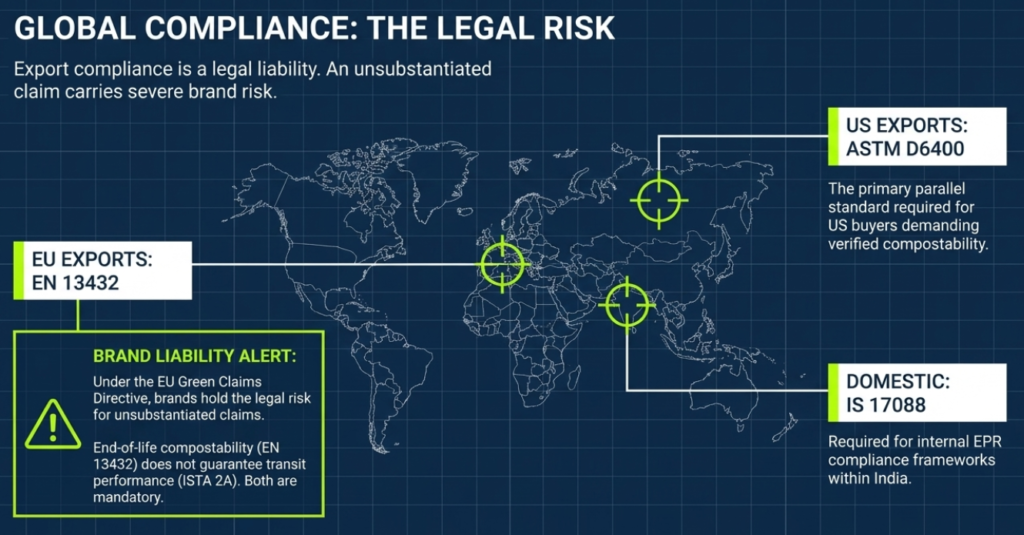
One important nuance: EN 13432 evaluates end-of-life compostability, not transit performance. You still need to qualify separately against ISTA 2A or ASTM D4169 to confirm the material actually protects your product through the shipping journey. Both are necessary. Neither substitutes for the other.
What should actually drive the material decision
Most buyers start with a sustainability claim they want to make. They then try to find the material that supports it. The better starting point is the failure mode.
Start by asking:
- What breaks in transit?
- What gets wet?
- What gets dropped and from what height?
- What compliance documentation does the buyer in Amsterdam or Dubai need to see?
Once those questions are answered, the material usually selects itself.
As Vishal Vivek, Co-Founder of UKHI explains,
“When electronics brands come to us, the first thing I ask is: what has already failed? A cracked corner. A scratched screen. A moisture claim. That failure defines the packaging job better than any spec sheet. Compostable materials have gotten good enough to do that job in most cases. But only if the material is matched to the risk, not to a marketing brief. The brands that switch successfully treat sustainable electronics packaging as an engineering decision first and a sustainability decision second. The outcome ends up being both.”
At UKHI, we work with electronics manufacturers and exporters to identify the right compostable grade for your product, volume, and export market.
Considering a switch? Connect with us to request a eco-friendly electronics packaging recommendation for your electronics SKU and get a compostable sample kit.
FAQ
Can compostable electronics packaging run on PE lines?
Yes, many compostable electronics packaging films (such as those made from PLA or PHA) can run on existing PE production lines. Though it isn’t plug-and-play and some modifications are needed, most converters have already adapted their lines.
Is EN 13432 certification mandatory for exporting compostable electronics packaging to the EU?
It is not legally mandatory in the strict sense as there is no EU regulation that requires all packaging to carry EN 13432 certification. But it is effectively required in practice. EU buyers and importers increasingly demand third-party certification before accepting a compostable claim.
What is the realistic MOQ for compostable electronics packaging at 50,000 units?
At 50,000 units, you are past the minimum thresholds for most materials, which puts you in a position to negotiate. Here is what to expect at that volume:
- Molded pulp inserts: ₹8 to ₹12 per piece depending on mold complexity
- PLA film formats: custom printing included without significant surcharge
- Kraft corrugated outer boxes: custom tooling costs well absorbed
The real negotiating lever at this volume is lead time flexibility. If you can offer 30 to 45 days rather than 15, most suppliers will pass on a 5 to 10% price improvement.
Does compostable packaging survive humidity during transit or warehouse storage?
It depends on the material and the exposure level. Here is how each material behaves:
- Molded pulp and kraft corrugated lose structural integrity under sustained humidity above 80% relative humidity for extended periods.
- Mycelium packaging has similar moisture sensitivity to pulp
- PLA film has overall the best inherent moisture resistance.
What is the difference between biodegradable and compostable electronics packaging, and does it matter for procurement?
Yes, it matters, and the distinction is frequently blurred by suppliers.
Biodegradable means a material will eventually break down through biological processes. But it gives no timeframe, no conditions, and no residue limits. A conventional plastic bag is technically biodegradable, in 400 to 500 years.
The best compostable packaging materials for electronics, however, is a defined standard. Under EN 13432 or ASTM D6400, compostable material must:
- Disintegrate to less than 2mm fragments within 12 weeks
- Biodegrade to at least 90% mineralisation within 6 months
- Do so under controlled composting conditions without leaving toxic residue
For procurement, this distinction matters because a compostable certification is verifiable and defensible. A biodegradable claim without a supporting standard is not. When evaluating suppliers, ask for the specific standard their material is certified against, not just the word “biodegradable” on a data sheet.