
A package can tell a brand story at a single glance. A leaf icon or a line that says “eco-friendly” might be mistaken for a formal claim about sustainability.
That is exactly why greenwashing in packaging is such a serious issue. The words on the pack, the colour palette, the leaf icon, and the recycling symbol all shape what a buyer believes before they ever read the fine print. If the claim is vague, exaggerated, or unsupported, the packaging stops being informative and starts becoming misleading.
And the risk is not just reputational. Sustainability claims are now read as evidence, not decoration. That means every statement has to earn its place.
What greenwashing in packaging means
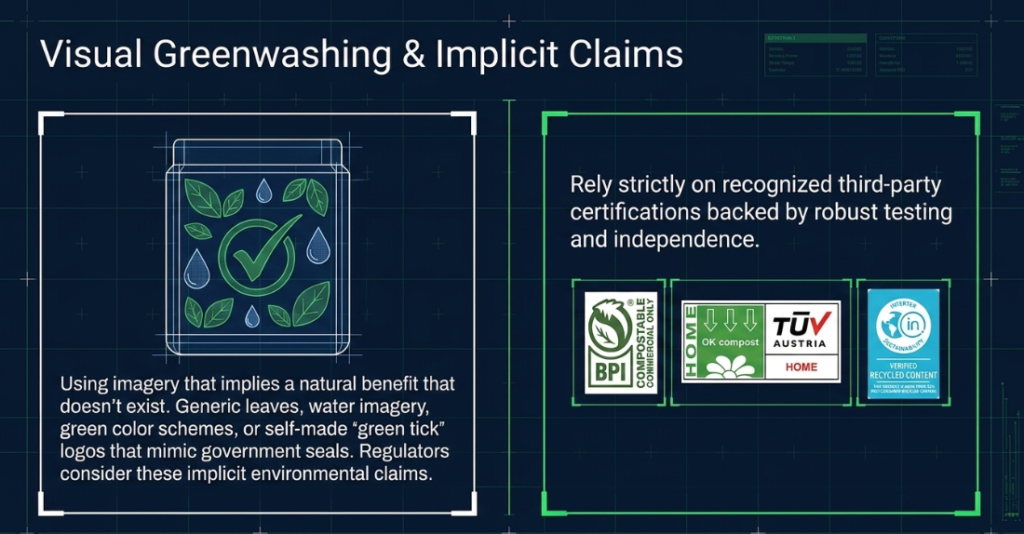
At its simplest, greenwashing means making a product or package seem more environmentally responsible than it really is. That can happen through direct claims, like calling something “eco-friendly,” or through softer signals, like using green colours, leaf imagery, or an official-looking badge that is not tied to a real certification.
The reason this matters is straightforward. Packaging is often the first proof point a customer sees. If the claim is too broad, most people will assume the full package is sustainable, when in reality it may be far more limited.
That is why spotting greenwashing in packaging starts with one basic question: Does the claim say something specific, or does it just sound good?
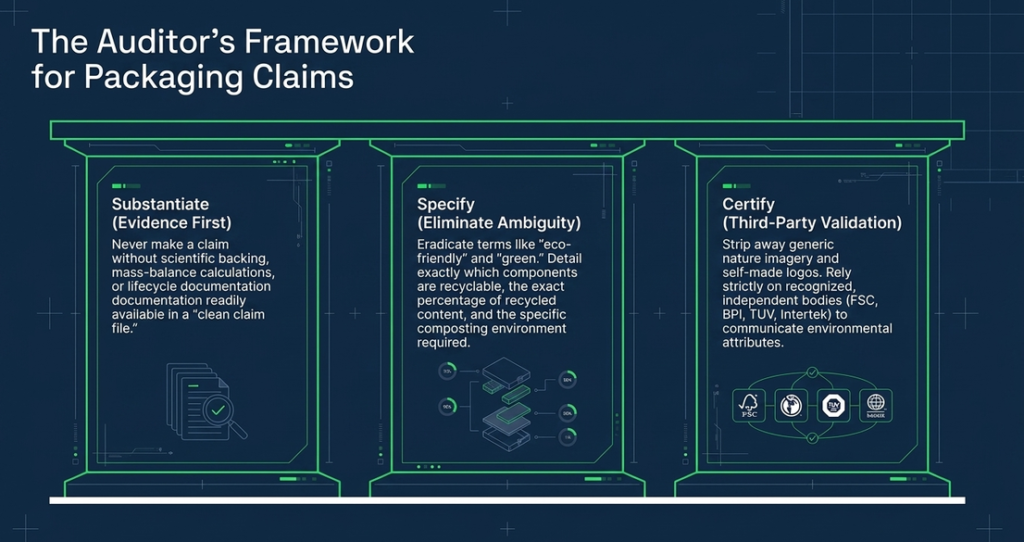
There is also an important boundary here. This does not mean brands should avoid sustainability claims altogether. It means they should only make claims that are specific, measurable, and proven. A statement like “made with 20% recycled content” is very different from “sustainable packaging.” One can be checked. The other is too broad to trust on its own.
The simple rule is still the best one: do not say more than your evidence supports.
Key requirements for packaging sustainability claims
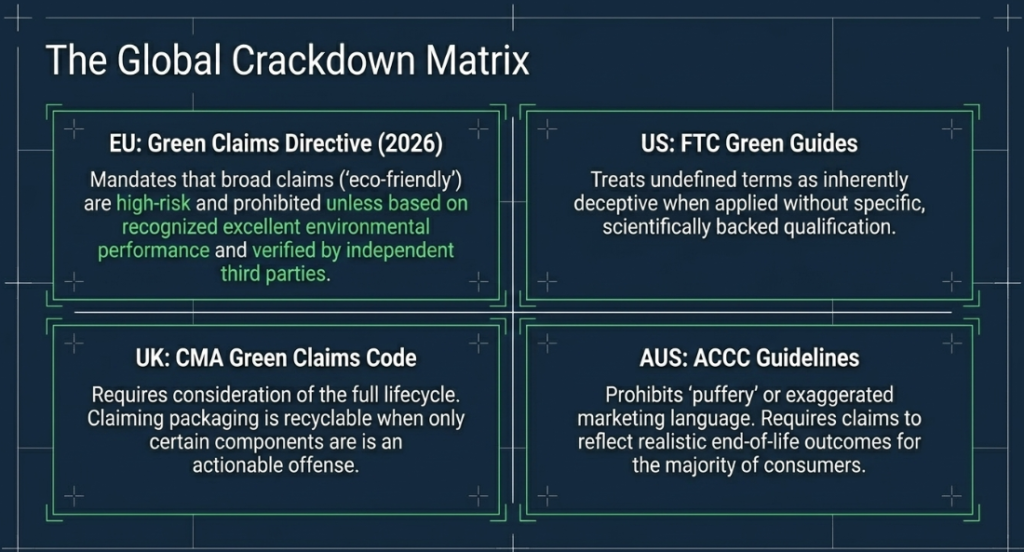
Most sustainable packaging regulations and green-claim guides follow the same basic logic: claims must be clear, accurate, substantiated, and not misleading in their full presentation.
That means packaging teams should check six things before approving a claim.
First, the claim should be truthful and current. A claim based on an old supplier certificate, a different resin grade, or a previous pack structure may not support the current artwork.
Second, it should be specific. Generic language like “eco-friendly,” “green,” “planet-safe,” “clean,” or “nature-friendly” is high-risk because it has no clear technical meaning. ISO 14021 warns against broad environmental assertions that are not specific or substantiated (ISO 14021 Environmental Labels and Declarations).
Third, it should avoid absolutes. Phrases like “100% sustainable,” “zero impact,” “zero emissions,” and “guilt-free” usually overstate the benefit. The ACCC guidance on environmental claims warns businesses against broad claims that create an impression of total environmental benefit without evidence across the product lifecycle (ACCC, Making Environmental Claims).
Fourth, disposal claims must explain the real end-of-life route.
- Use “recyclable” only when collection, sorting, and processing systems exist for that pack type. The FTC Green Guides state that recyclable claims should be qualified when recycling facilities are not available to a substantial majority of consumers, generally understood as at least 60% access (FTC Green Guides).
- Use “compostable” only under the correct conditions. Home compostable and industrially compostable are not the same. Industrial composting usually requires controlled heat, moisture, and microbial conditions.
- Use “biodegradable” with great care. The term is incomplete unless the claim says where, how long, and under which standard the pack biodegrades. European Bioplastics recommends that biodegradability claims specify the receiving environment, time frame, and test method (European Bioplastics, Claims on Biodegradability and Compostability).
Fifth, certification must match the exact packaging format. A resin certificate is not always enough for a finished pouch, coating, label, adhesive, ink, or laminate. Buyers should ask whether the full pack has been tested or whether only the input material has been certified.
Sixth, design cannot imply what the words avoid. A pack covered in leaves, green ticks, and “responsible choice” language can still mislead, even if no single sentence is technically false.
These requirements become easier to apply when we look at the actual eco-friendly packaging claims to avoid.
Eco-friendly packaging claims to avoid
Now we get to the claims that need the most caution. These are the phrases that often sound positive but create the biggest compliance and trust problems.
“Eco-friendly packaging” is one of the clearest examples. It is too broad to be meaningful. What exactly is eco-friendly? Less plastic? Lower emissions? Better recyclability? Without a measurable explanation, the phrase becomes a promise without proof.
“Biodegradable packaging” is also risky when used alone. Biodegradable in what environment? In soil, in water, in industrial compost, or in a landfill? A package can behave very differently depending on where it ends up.
“Compostable packaging” needs similar care. Many consumers think compostable means it will break down anywhere, but industrial composting and home composting are not the same thing. If the package needs a high-heat facility, that should be stated clearly.
“Recyclable packaging” can also mislead if the local collection system does not exist or is not widely available. A package is not truly recyclable in a practical sense if most consumers cannot access a route that actually recovers it.
“Plastic-free packaging” is another phrase that sounds absolute but often is not. A bottle may be mostly paper, yet still contain plastic in a lining, cap, pump, or adhesive layer.
“Made from natural materials” sounds reassuring, but “natural” is not a performance metric. It does not automatically mean low impact, safe, renewable, or responsibly sourced.
“Carbon-neutral packaging” is especially sensitive because it often depends on offsets. If the claim is based only on offsetting and not on real emission reduction, it can overstate the environmental outcome.
“Non-toxic packaging” is difficult, too. It can suggest broad safety for humans and the environment, which is a very high bar. Unless there is strong scientific support, it should not be used casually.
The pattern is consistent. The more absolute the claim sounds, the more evidence it needs.
Overview table: Risky claim, why it is risky, and safer wording
This table is a practical way to spot greenwashing in packaging before artwork, sampling, or export documentation is approved.
| Risky claim | Why it may be greenwashing | Proof needed | Safer wording |
| Eco-friendly | Too vague and undefined | Clear lifecycle evidence | Made with 100% recycled cardboard |
| Biodegradable | Depends on the disposal environment | Test data, timeframe, conditions | Biodegradable in soil within 12 months |
| Compostable | Can hide the difference between home and industrial composting | Recognized compostability standard | Certified industrially compostable |
| Recyclable | May not be available to most consumers | Real collection and processing access | Recyclable where local facilities exist |
| Plastic-free | May still contain hidden plastic parts | Full material breakdown | Plastic-free bottle body, excluding cap |
| Bio-based | Renewable sources do not equal better end-of-life | Percentage and source disclosure | Made with 50% plant-based content |
| Recycled content | May refer only to manufacturing scrap | Clear PCR percentage | Made with 30% post-consumer recycled plastic |
| Carbon neutral | Often depends on offsets | Verified emissions reduction and offset quality | Reduced logistics emissions by 20% |
| Sustainable | Too broad to verify | Specific quantified evidence | Uses 25% less plastic than the previous version |
| Non-toxic | No standard universal definition | Scientific safety evidence | BPA-free, where substantiated |
For buyers, this table also works as a procurement filter. When a supplier proposes a claim, ask for the evidence before the wording is approved.
Sources and references
Sources used for this guidance include:
- European Commission, environmental claims screening and Directive 2024/825
- ACCC, Making Environmental Claims: A Guide for Business
- FTC, Guides for the Use of Environmental Marketing Claims
- ISO 14021, Environmental Labels and Declarations: Self-Declared Environmental Claims
- European Bioplastics, Claims on Biodegradability and Compostability
- Competition and Markets Authority, Green Claims Code
- EN 13432, Requirements for Packaging Recoverable Through Composting and Biodegradation
- ASTM D6400, Standard Specification for Compostable Plastics
Expert quote block
“Good sustainable packaging communication starts with restraint. The strongest claim is not the biggest claim. It is the claim that matches the material, the certification, the disposal route, and the buyer’s market. If a brand cannot prove it on paper, it should not print it on packaging.”
Vishal, Founder, Ukhi
Get packaging claims reviewed before approval
Ukhi helps brands, exporters, and procurement teams review packaging claims before they move into sampling, printing, or buyer submission.
We can support with:
- Claim wording review
- Material and format checks
- Compostability and recyclability documentation
- Certification scope review
- Export-market compliance support
- Buyer-ready compliance packs
If your team is switching to compostable, bio-based, recyclable, or lower-impact packaging, do not leave the claim for the final artwork stage.
Share your packaging format, material structure, destination market, and proposed claim. Ukhi can help you check whether the wording is safe, specific, and supported by the right documents.
Frequently Asked Questions
What documents help prove packaging sustainability claims?
A buyer should ask for the documents that connect the sustainability claim to the exact finished pack and not the raw materials alone.
Buyers should ask for the following documents:
- Material composition sheet
- Test reports
- Certification scope documents
- Recycled content proof
- Disposal instructions
- Supplier declarations
Can supplier claims be used directly on packaging artwork?
Only after a thorough scrutiny. The claims may describe a material or coating in isolation and not the entire finished package. Sustainable packaging regulations usually demand that the brand independently verify all claims.
How can exporters reduce greenwashing risk in packaging?
Always check the definition market before finalizing artwork. A claim that is acceptable and legal in one country might need a different format or proof in another.
This is especially important for compostability, recyclability, recycled content, and other eco-friendly packaging claims to avoid.
Does green packaging design count as a claim?
Yes, it can. A package does not need words like “eco” or “green” to make an environmental promise. Colours, leaves, wood textures, nature icons, and self-made badges create a similar impression.
This is why learning to spot greenwashing in packaging is not just a copy check. It is also a design check.
Who is responsible if a packaging claim is misleading?
Usually, the brand is held responsible. However, the packaging manufacturers, importers, and retailers may also be held responsible for their role in the supply chain.
Greenwashing in packaging is a serious issue that goes far beyond false marketing.