
Quick Answer
Compostable shopping bags are carry bags made from plant-based resins like PLA and PBAT that break down into CO2, water, and biomass under industrial composting conditions. Retail chains in India are legally required to source these bags from a CPCB certified compostable bags manufacturer under Rule 4(h) of the Plastic Waste Management Rules. Wholesale prices of compostable shopping bags are between ₹150 and ₹310 per kg depending on grade and thickness. Ukhi is one of the few biodegradable and compostable shopping bags manufacturers in India that produces both the resin (EcoGran™) and the finished bag under one roof.
What to Look for in a Compostable Shopping Bag Supplier
Retail procurement teams looking for biodegradable and compostable shopping bags manufacturers in India can use the following checklist.
CPCB certification
Under Rule 4(h) of the Plastic Waste Management Rules, any manufacturer selling compostable plastic products in India must hold a valid registration certificate from the Central Pollution Control Board. If a supplier cannot share their CPCB certificate number for the specific product being quoted, the sale itself is not legal.
Lab report
The report must be issued by a CPCB-approved testing lab (in most cases CIPET), and it must be for the exact grade and micron thickness of the bag being bought. Retail buyers should ask for the report before placing an order.
In-house resin manufacture
Check whether the seller is the actual manufacturer or a trader reselling somebody else’s stock. Compostable bags have a shelf life of six to twelve months, so material sitting in a reseller’s warehouse for months can arrive to the buyer already degraded. Buying directly from the manufacturer gives the retail chain visibility into production date, batch, and lead time.
Production capacity and lead time
A retail chain running multiple stores cannot afford stockouts. A biodegradable and compostable shopping bags manufacturer in India should be able to state daily capacity in tonnes and commit to lead times in writing.
Specifications That Matter When Buying Compostable Shopping Bags
Compostable bags do not behave like conventional polyethylene. The material is engineered differently, and small changes in thickness make a large difference in what the bag can carry. A buyer should confirm the micron thickness against the intended load before finalising any order.
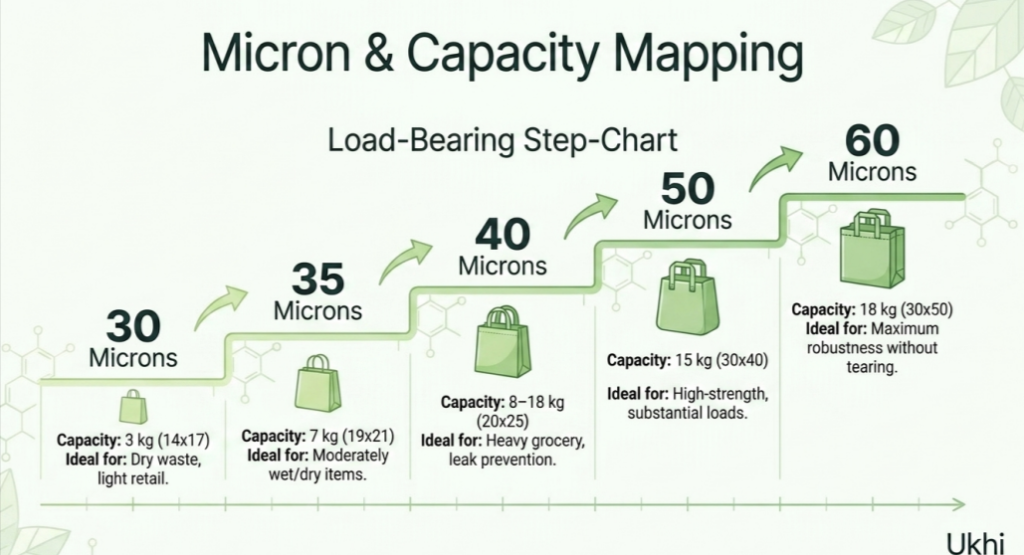
The table below shows how micron thickness maps to load-bearing capacity for standard bio compostable shopping bags used in Indian retail.
| Thickness | Typical Bag Size | Safe Load | Best Use |
| 30 microns | 14″ x 17″ | Up to 3 kg | Small retail items, dry goods |
| 35 microns | 19″ x 21″ | Up to 7 kg | Apparel, moderate grocery loads |
| 40 microns | 20″ x 25″ | 8 to 10 kg | Standard grocery and supermarket use |
| 50 microns | 30″ x 40″ | Up to 15 kg | Heavy grocery, bulk retail |
| 60 microns | 30″ x 50″ | Up to 18 kg | Warehouse and heavy-duty carry |
Beyond thickness, three specifications need to be locked down before a purchase order.
- Material composition should be stated clearly, usually a PLA and PBAT blend, with PLA giving strength and PBAT giving flexibility.
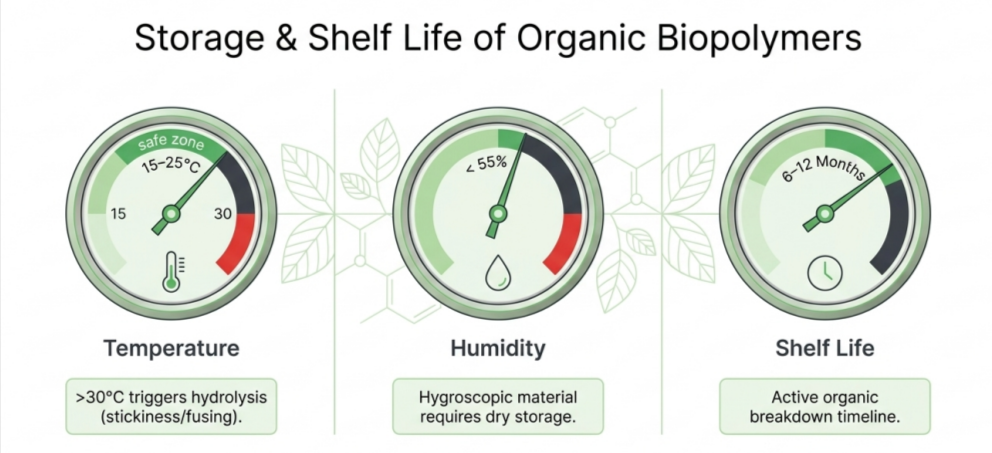
- Shelf life is typically six to twelve months from manufacture, and storage conditions should be kept between 15 and 25 degrees Celsius with relative humidity below 55 percent.
- Printing inks must comply with IS 15495:2020, which restricts heavy metals and bans toluene and phthalate esters in inks used on food-contact packaging.
One more habit that can save retail buyers money is to evaluate quotes on a per-bag basis rather than only on a per-kg basis. A cheaper price per kg can hide a heavier, thicker bag, which reduces the number of pieces the buyer actually receives per kilogram. The formula is straightforward:
Real Cost per Bag = Cost per Kg ÷ Bags per Kg
Materials and Manufacturing Processes Used for Compostable Shopping Bags
Materials
Biodegradable and compostable shopping bags manufacturers in India work with three raw materials.
- PLA (Polylactic Acid) is made by fermenting plant starches from corn, sugarcane, or cassava and gives the bag its strength.
- PBAT (Polybutylene Adipate Terephthalate) is added to give flexibility and tear resistance.
- Starch-based fillers from corn or potato are sometimes blended in to speed up decomposition.
At Ukhi, we manufacture our own PLA and PBAT compound in-house under the brand name EcoGran™. Producing the resin ourselves means we control the formulation from the granule stage. This ability lets us hold consistent seal strength, film clarity, and load performance from batch to batch.
Process
The manufacturing process itself is called blown film extrusion. The resin granules are dried, melted at temperatures between 140 and 180 degrees Celsius, forced through a circular die, and inflated into a continuous bubble of thin film.
The film is then cooled, flattened, wound onto rolls, and sent to conversion machines where it is cut, bottom-sealed, and punched into the final bag shape (D-cut, T-shirt, or flat handle). EcoGran is designed to run on the same blown film machinery that Indian converters already use for conventional polyethylene, which keeps the switch simple for existing production lines.
Certifications and Compliance to Look for in a Compostable Bag Manufacturer in India
Compliance is not optional in this category. A retail chain buying uncertified stock exposes itself to product seizure and fines under the Plastic Waste Management Rules. The certifications that matter most are listed below.
- CPCB certification under Rule 4(h) is the legal minimum. Every CPCB certified compostable bags supplier must be listed on the CPCB portal, and buyers can verify the certificate number directly. Ukhi holds this certification for its bag products.
- IS/ISO 17088:2021 is the Indian standard for compostable plastics. It requires that at least 90 percent of the organic carbon in the bag converts to CO2 within 180 days under industrial composting conditions, that the bag disintegrates into pieces smaller than 2 mm within twelve weeks, and that the residue is non-toxic to soil and plants.
- CIPET testing is required for the specific bag grade and micron. The Central Institute of Petrochemicals Engineering and Technology is the primary CPCB-approved testing body in India, with labs in Chennai, Ahmedabad, Lucknow, Bhubaneswar, and Kochi.
- Category IV EPR compliance applies to the buyer as well. Compostable carry bags fall under Category IV plastic packaging, and brand owners are responsible for meeting escalating recycling targets that rise to 80 percent by FY2028. The manufacturer’s CPCB number and the brand’s EPR registration must be printed on the bag.
For food-contact use in grocery and supermarket settings, Ukhi also holds FSSAI, GMP, ISO 9001, and ISO 14001 certifications.
How Much Do Compostable Shopping Bags Cost in India
The wholesale price of certified compostable bags for retail in India ranges between ₹150 and ₹310 per kg depending on grade, thickness, and order volume. Grocery-grade bags at 40 microns and above sit at the higher end, while lighter carry bags at 25 to 30 microns sit lower.
The per-kg number, however, does not tell the full cost story. A comparison of a standard 12″ x 15″ bag makes this clearer.
| Specification | Conventional Plastic Bag | Ukhi EcoGran™ Bag |
| Thickness | 120 microns | 20 microns |
| Weight per bag | 32 g | 7 g |
| Cost per kg | ₹150 | ₹300 |
| Bags per kg | 30 | 150 |
| Cost per bag | ₹5.70 | ₹2.28 |
The compostable bag costs twice as much per kg, but because it is engineered thinner and lighter without losing strength, the retail chain pays about 60 percent less per bag. The biodegradable bags price in India conversation should always be held at the per-bag level, not the per-kg level.
Why Buy Compostable Shopping Bags from Ukhi
Ukhi is a material science company based in IMT Faridabad.
- We manufacture our own compostable resin, EcoGran™, and convert it into finished bags under one roof.
- Our vertical setup is the reason we can hold quality consistent from granule to finished bag, and it is also the reason our unit economics come out lower than most biodegradable and compostable shopping bags manufacturers in India.
- Our current retail and brand clients include Reliance Retail, Amazon, V-Mart, Good Earth, Aditya Birla Group, and Dohful.
- We are backed by IIT Mandi Catalyst, IIM Bangalore’s NSRCEL, and IIT Guwahati.
- We also run a service called the EcoGran Circular Care Programme, which helps retail chains segregate used bags, coordinate collection, and route them to authorised industrial composting facilities, with written records for EPR reporting.
We are happy to ship free samples of our finished bags within seven days, at no cost, so procurement teams can run their own load and seal tests before committing to an order.
FAQs
1. Which company in India manufactures compostable shopping bags for retail chains?
Ukhi manufactures compostable shopping bags for retail chains from its facility in IMT Faridabad, Haryana. We produce our own PLA and PBAT resin under the EcoGran™ brand and convert it into finished bags, holding CPCB certification and IS/ISO 17088 compliance.
2. Are compostable and biodegradable shopping bags the same thing?
No. All compostable bags are biodegradable, but not all biodegradable bags are compostable. Compostable bags must meet the IS/ISO 17088 standard, which requires full breakdown into non-toxic residue within 180 days. Biodegradable is a broader, less regulated term.
3. What is the minimum order quantity for compostable carry bags from a manufacturer in India?
MOQ for compostable carry bags manufacturers in India typically starts at 500 to 1,000 kg per size and print variant.
4. Where are compostable bag manufacturers located in India?
Certified biodegradable and compostable shopping bags manufacturers in India are spread across industrial hubs in Haryana, Gujarat, Tamil Nadu, West Bengal, and Uttar Pradesh. Ukhi’s manufacturing unit is located in IMT Faridabad, Haryana, which allows us to serve retail chains across North, West, and Central India with shorter lead times.
5. Can compostable shopping bags be used for wet grocery items?
Yes, at the right thickness. Bags of 40 microns and above are engineered to hold wet grocery loads up to 10 kg without leaking. Bags below 30 microns are meant for dry retail items only. The micron specification should match the intended use.