
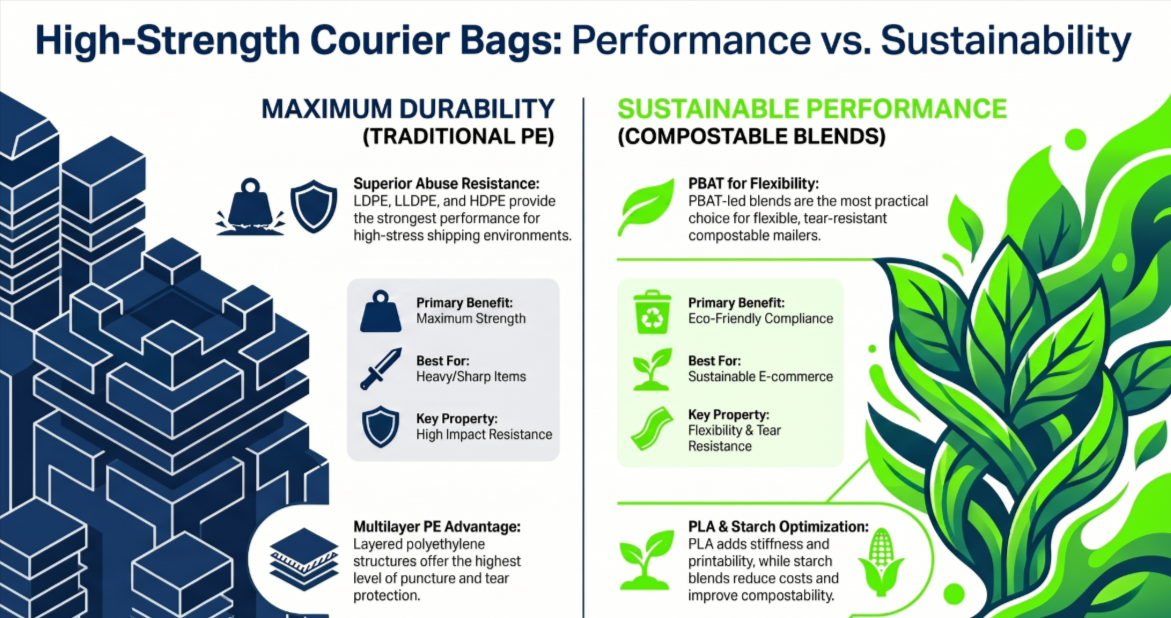
For a long time, brands have relied on traditional plastics like LDPE, LLDPE, HDPE, or multilayer PE for the strongest courier bag performance.
But compostable courier packaging with bioplastics like PBAT are also a practical choice for flexible courier bags. PBAT offers the most flexibility and tear resistance but can also be blended with materials such as PLA, starch, PBS, or other compostable polymers to balance softness, stiffness, processability, and cost.
What high strength means in courier bag material
A courier bag has a difficult job. It has to protect the product through sorting belts, warehouse stacking, rain exposure, delivery handling, and customer returns.
At the same time, brands now want the bag to carry a cleaner environmental claim. But can compostable courier packaging protect the shipment, run on the packing line, carry the right certificate, and still be compostable?
Strength comes from how the film behaves under stress. In courier packaging, the main tests are practical:
- Tensile strength: how much pulling force the film can take.
- Tear resistance: to test if a small cut easily rips the whole packaging.
- Puncture resistance: how the bag resists sharp corners, zipper pulls, tags, buckles, and box edges.
- Seal strength: tests how the adhesive strip or heat seal holds under load.
- Drop performance: how the filled package behaves when it falls or gets thrown during sorting.
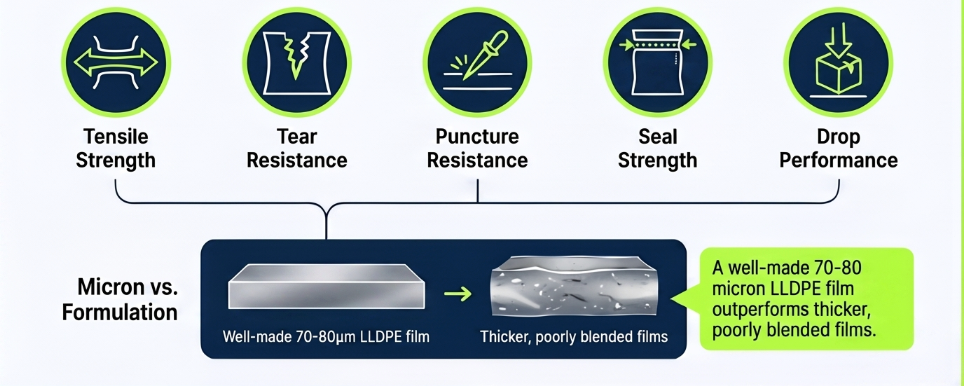
Micron also matters. But the thickness of a bag alone does not decide quality.
A well-made 70 to 80 micron LLDPE-rich film may perform better than a thicker but poorly blended film. In the same way, a compostable film may need a higher micron to match the handling comfort of a PE courier bag.
For garments, soft accessories, catalogues, and lightweight goods, 60 to 80 micron may be enough. For shoes, boxed products and return shipments, 90 to 120 micron may be safer.
The next step is to compare the material families, because each one behaves differently under the same courier conditions.
Courier bag material comparison: PBAT vs PLA vs other compostable bioplastics
LDPE is common in courier bags because it is soft, flexible, and forgiving. It stretches around irregular shapes without cracking, which is useful for apparel and other non-sharp e-commerce products.
Compostable courier packaging, on the other hand, can also be made flexible with PBAT blends. These bioplastic compostable courier bags also offer elongation, and tear resistance.
PLA supports stiffness and print finish but the polymer alone can be brittle.
Meanwhile, starch materials can be compostable and are also cheaper. But starch can increase moisture sensitivity if the formulation is not handled well.
So, here is a quick breakdown of which compostable courier bag materials are best used for different needs.
| Compostable material | Best use in courier bags | Main caution |
| PBAT-led blend | Flexible courier bags, garment mailers, e-commerce mailers | Certification and storage must be checked |
| PBAT plus PLA blend | Courier bags needing flexibility plus stiffness | PLA content can increase brittleness if not balanced |
| Starch-based blend | Cost-sensitive compostable bags | Humidity and tear strength need testing |
| Compostable coated paper | Flat, dry, low-risk shipments | Moisture and tearing can become problems |
| PLA-heavy film | Clear or stiff formats, not abuse-heavy courier use | Can be brittle for rough handling |
The strongest material is not always the best material. A fashion brand shipping T-shirts may not need a heavy multilayer courier bag. A footwear brand shipping boxed shoes should not choose a thin compostable mailer only for sustainability messaging.
A good compostable courier bag has to balance several things at once:
- flexibility to avoid cracking;
- stiffness to feel secure;
- seal strength to prevent opening;
- moisture resistance for the route;
- certification clarity for the claim.
This is why the buyer should compare finished bags, not just compostable courier packaging materials.
Two suppliers may both say “PBAT plus PLA.” One bag may perform well. Another may tear early because of poor formulation, poor extrusion, weak sealing, or the wrong micron.
The correct decision should start with load, edge risk, storage, sealing, weather exposure, and the disposal claim.
Decision matrix for choosing compostable courier packaging
| Buyer requirement | Best compostable material direction | What to check before approval |
| Garments and soft goods | PBAT-led compostable film | Tear resistance, seal strength, opacity, print rub |
| Fashion export shipments | Certified PBAT plus PLA blend | EN 13432 or buyer-required documentation |
| Lightweight e-commerce | PBAT or starch-blend compostable mailer | Micron, adhesive strip, rain exposure |
| Premium paper-led packaging | Compostable coated paper mailer | Moisture resistance, edge tearing, coating claim |
| Return shipments | Higher-micron PBAT-led mailer | Dual seal, second-use strength, storage life |
| Sharp or boxed goods | Reinforced compostable film or alternative format | Puncture resistance and drop test performance |
Compliance and claim control for compostable and biodegradable courier packaging
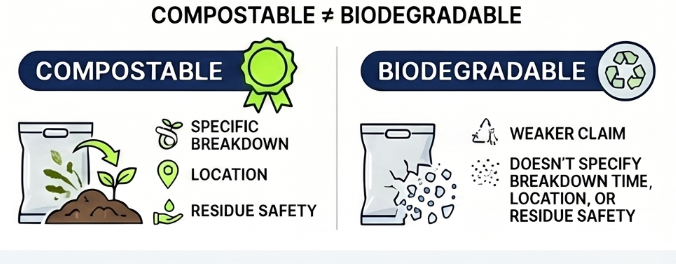
“Compostable” and “biodegradable” are not the same claim.
Compostable courier packaging should be backed by a recognized standard and a valid certificate. In India, compostable plastic packaging connects to CPCB certification and IS/ISO 17088. For EU-facing packaging, EN 13432 is the common industrial compostability reference. For North America, BPI certification is linked to ASTM D6400 or ASTM D6868.
These standards matter because they define the conditions under which the material should break down.
Biodegradable courier packaging is a weaker phrase if used alone. It does not automatically tell the buyer:
- where the material breaks down;
- how long it takes;
- whether it leaves residue;
- whether it needs industrial composting;
- whether the finished bag is certified.
The safer approach is to print specific disposal language, use valid certification numbers where applicable, and avoid broad “eco-friendly” or “biodegradable” claims without proof.
How to test courier bag material before bulk procurement
A sample should not be approved only by touch and appearance.
Before bulk ordering compostable courier packaging, the buyer should ask for:
- Technical Data Sheet for the film grade.
- Finished bag specification.
- Compostability certificate with product scope.
- Maximum certified thickness.
- Printing ink compatibility details.
- Seal or adhesive performance details.
- Storage instructions and shelf-life guidance.
Then the bag should be tested with actual products.
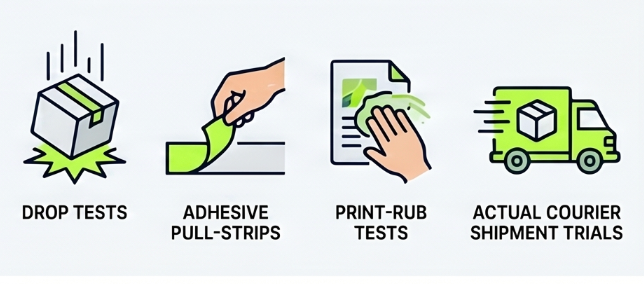
Pack the real garment, box, accessory, catalogue, or return item. Drop it from normal handling height. Pull the adhesive strip. Rub the printed area. Keep samples in warehouse-like humidity. Send a few test shipments through the intended courier route.
For compostable films, also check whether the bag blocks enough moisture for the use case. Compostable materials can be more sensitive to humidity and storage conditions than PE. A bag that looks strong on day one may not behave the same after poor storage.
Ukhi recommendation: Choose courier bag material by load and claim risk
Vishal Vivek, CEO & Co-Founder of Ukhi, explains why brands should evaluate compostable courier bags first as performance packaging, not sustainability packaging.
“For courier bags, compostability must be matched with performance. The packaging should first survive the shipment. A good compostable courier bag is best selected by load, puncture risk, seal strength, storage conditions, and certification scope.”
We recommend choosing courier bag material in three steps.
- First, define the shipment.
Is it soft or sharp? Is it flat or bulky? Is it under 1 kg or closer to 5 kg? Will it travel across cities, states, or export routes? Will it face rain, return handling, or long warehouse storage?
- Second, define the claim.
If you want compostable courier packaging, the bag needs to be certified and labelled clearly, according to the rules of the country you plan to sell the product. If the supplier only offers vague biodegradable courier packaging language, ask for the certificate before moving forward.
- Third, test the grade.
Compare micron, seal strength, print finish, tear resistance, and storage behaviour before confirming MOQ. A sample kit is often the fastest way to avoid over-ordering the wrong material.
For many brands, the right answer is not one universal courier bag. It may be a mix:
- compostable courier bags for soft, lightweight fashion shipments;
- stronger PE or multilayer formats for sharp, heavy, or return-heavy shipments;
- paper mailers for dry, flat, low-risk dispatches;
- clear documentation for every sustainability claim.
A good courier bag should protect the product first. A better courier bag protects the product and keeps the packaging claim honest.
Ukhi can help buyers compare grades, run sample checks, and choose a courier bag format that fits the product, dispatch route, and compliance expectation. Get in touch with us today.
FAQs
- What size compostable courier bag should an apparel brand choose?
Choose the smallest bag that fits the folded garment without stress. Oversized e-commerce mailers increase movement inside the parcel, while tight bags strain seals and corners.
- Is biodegradable courier packaging accepted by marketplaces?
Marketplaces accept biodegradable courier packaging when it is supported by proof. Brands should prefer certified compostable courier packaging with CPCB, EN 13432, ASTM D6400, or ASTM D6868 documentation
- How should brands compare compostable courier packaging suppliers?
Compare finished-bag samples, not only resin claims. Ask for certification scope, micron, MOQ, lead time, print quality, seal strength, storage guidance, and dispatch-line trial support.