
A fashion brand once told us they are switching to compostable mailers because of a viral TikTok. A customer filmed unboxing her dress, and the polybag didn’t tear even after 60 seconds of trying. That video got 280K views.
That story isn’t unusual anymore. Packaging decisions that used to live inside procurement spreadsheets now land on brand Instagram pages, in EPR compliance filings, and on retailer sustainability scorecards.
The cost of staying with conventional plastic is no longer just a materials line item. It’s showing up in customer retention data, marketplace audit reports, and tax obligations.
What this analysis covers
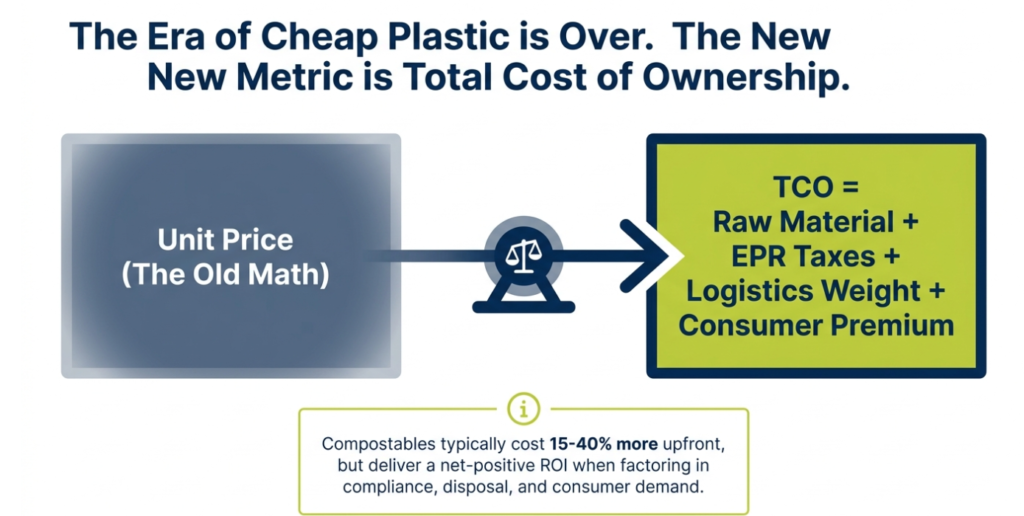
Most packaging discussions stop at unit cost per mailer. But we examine the full economics: material costs, logistics implications, compliance costs, and commercial upside.
Key areas covered:
- Why the historical price gap between plastic and compostable materials is narrowing.
- How compliance costs are reshaping the packaging equation across the UK, EU, and India.
- Where brands are actually generating ROI from sustainable fashion packaging. (It’s rarely where they expected!)
How UKHI evaluated packaging ROI for fashion brands
This analysis draws from ongoing procurement conversations with sourcing teams and packaging buyers across the UK, USA and India.
We compared plastic and bioplastic packaging formats on variables that often get stripped out during procurement reviews:
- Shipping weight and dimensional weight implications
- Regional tax obligations
- Extended Producer Responsibility (EPR) fee structures by market
- Consumer purchase behaviour data in sustainability-forward segments
- Retailer and marketplace compliance requirements, including Zalando’s Sustainability Framework and M&S Plan A commitments
Why fashion packaging decisions are no longer just about unit cost
Until around 2021, packaging was mostly functional. A price-per-unit comparison made sense. Then three things happened at roughly the same time. That’s when the “cheaper on paper” calculation started to break down. Here’s what happened:
1. Consumer expectations changed faster than most sourcing teams realised
In a 2025 survey of 1000 shoppers across the US, 70% said sustainable packaging was important for purchase decisions. More practically: Over 40% of consumers say they’ll pay more for products delivered in what they consider responsible packaging. At average order values of £65–£90 for mid-market fashion DTC, even a 3–4% lift in conversion among this segment covers a lot of material premium.
2. Regulatory pressure increased
This is where the numbers stop being theoretical. Three frameworks are already changing packaging economics:
- UK Plastic Packaging Tax: £217.85 per tonne (2024/25 rate) on packaging with less than 30% recycled plastic content. For a brand shipping 50,000 orders per month in standard 15g LDPE polybags, that’s approximately £1,960/year just in tax, before any EPR fees.
- Extended Producer Responsibility (EPR): UK EPR for packaging came into full effect for large producers in 2024, with fee modulation tied to recyclability. Certified compostable materials are being assessed more favourably than hard-to-recycle multilayer films.
- India’s single-use plastics rules under the Environment Protection Act have restricted certain plastic formats below 75 microns, affecting a growing share of standard garment polybags.
3. DTC growth made packaging impossible to hide
In traditional retail, the polybag went straight into a bin in the stockroom. In DTC, it’s the first physical thing the customer touches. For brands shipping direct, packaging has become part of the product experience. Eco-friendly clothing packaging is no longer just a compliance decision, it’s a channel strategy.
The real cost difference between compostable and conventional packaging
The gap exists. It’s just smaller than procurement teams typically expect, and it narrows further when you account for taxes and logistics.
| Material | India Price per kg | UK/US Price per kg | Typical Garment Bag Weight |
| LDPE / BOPP Plastic | ₹100–125 | $1.20–1.50 | 10–15 g |
| PLA / PBAT Bioplastic | ₹110–150 | $2.00–2.50 | 10–15 g |
| Kraft Paper | ₹30–36 | $0.40–0.50 | 35–40 g |
Source: UKHI 2026 Compostable Packaging Cost Benchmark
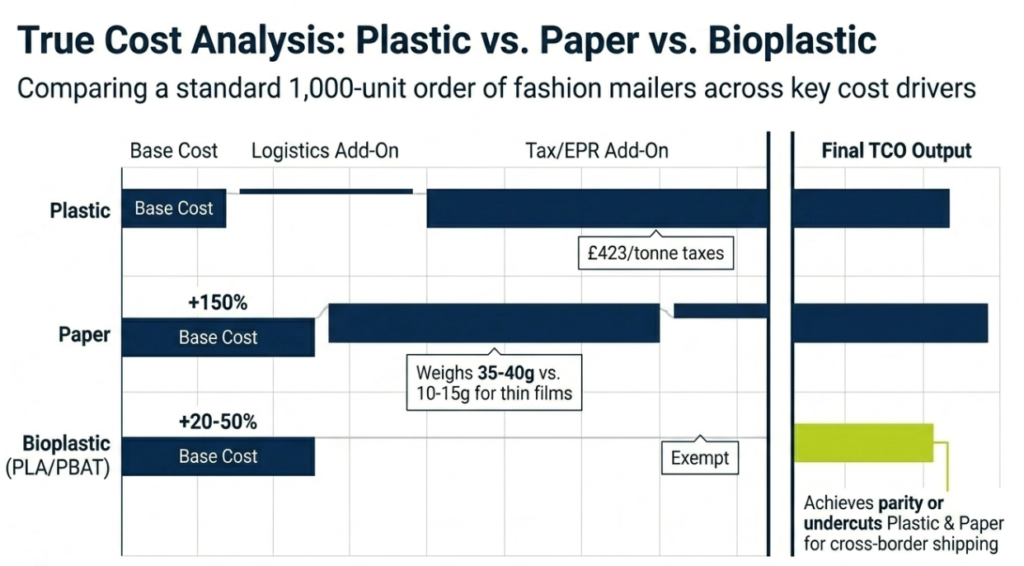
That headline difference (roughly 30–65% more per kg for PLA/PBAT) sounds significant until you run it through a real shipment.
How MOQ affects pricing economics
One area buyers frequently underestimate is how MOQ works at realistic volumes. For compostable mailers for clothing brands, setup and tooling costs are spread across the order quantity, which means the gap narrows considerably as volume rises.
Consider a mid-sized brand shipping 3,000 orders per month:
- Reorder stock requirement: 6,000 units
- Buffer stock requirement: 6,000 units
- Total working quantity: 12,000 units
At 12,000 units, that brand comfortably exceeds a typical manufacturer MOQ of 5,000–10,000 units, giving them real pricing leverage. Digital printing has pushed some MOQs down to 500–1,000 units, which has opened the door for smaller brands too.
Where the ROI of custom sustainable ecommerce packaging actually comes from
The material cost is the smallest part of the ROI story. The real returns show up in five areas:
1. Premium brand positioning and customer perception
Packaging is increasingly functioning as a product quality signal, particularly in DTC fashion. Customers who receive a thoughtfully designed, compostable mailer routinely describe the experience as ‘premium’ in post-purchase surveys. Eco-friendly clothing packaging, when executed well, signals care and long-term thinking in a way that plastic simply cannot.
2. Higher repeat purchase potential in sustainability-focused segments
Among sustainability-conscious fashion buyers, packaging is part of the brand story. Brands using eco-friendly clothing packaging have reported customer retention rates 8–14 percentage points higher in this segment compared to those still using conventional polybags.
3. Reduced regulatory and EPR exposure
This is becoming the most quantifiable ROI driver for brands selling into the UK and EU. The UK Plastic Packaging Tax at £217.85/tonne creates a direct cost offset against certified compostable materials.
EPR fee modulation is moving in the same direction.
For a brand running 100,000 shipments/month in 12g LDPE bags, the taxable plastic weight is approximately 1,200kg/month. That’s £261/month in Plastic Packaging Tax alone.
4. Better alignment with retailer and marketplace requirements
Zalando’s 2025 Sustainability Framework, the M&S Plan A requirements, and ASOS’s supplier code all now include packaging compliance as a criterion. Brands selling wholesale into these channels that can’t demonstrate certified compostable or recycled packaging compliance risk listing de-prioritisation or eventual exclusion.
5. Lower dimensional-weight and shipping inefficiencies
Compostable PLA/PBAT films remain in the same weight range as LDPE (10–15g for a standard garment mailer) so there’s no shipping weight penalty. Well-designed packaging can reduce freight expenses and improve container utilisation, particularly for brands shipping 40HC containers from India to European DCs, where cube efficiency directly impacts cost-per-unit-shipped.
Building for the packaging future
The most successful packaging transitions we’ve worked on have one thing in common:
The decision wasn’t made by comparing unit costs. It was made by comparing futures. As Vishal Vivek, Founder, UKHI explains,
“Every packaging decision is a prediction about the future. When a brand chooses a material today, it is making a bet on future regulations, future customer expectations, and future market access. The brands we’re seeing do this well aren’t doing it to check a sustainability box, they’re doing it because they’ve run the numbers and the forward-looking case is clear.”
The goal isn’t simply to replace plastic. It’s to build packaging systems that remain competitive, compliant, and commercially viable.
Evaluating a transition to compostable packaging? We, at UKHI, offer packaging economics reviews and line-trial assessments tailored to your products and markets.
Schedule a no-cost strategy session with our team to base your packaging decisions on numbers, not the assumptions.
FAQs
Are custom compostable mailers suitable for international fashion shipments?
Yes. Modern compostable mailers made from PLA/PBAT blends are lightweight and strong enough for standard shipping conditions. The one thing worth checking before you commit: moisture resistance on high-humidity routes. Run a sample shipment first if your transit goes through Southeast Asia or similar climates.
Do wholesale suppliers of eco-friendly clothing packaging require higher MOQs than plastic packaging suppliers?
Not necessarily. Some do, but digital printing has changed the math considerably. Many suppliers now offer runs from as low as 500–1,000 units. If MOQ is your main hesitation, it’s worth getting a few quotes before assuming the barrier is there.
What certifications should brands ask for when sourcing sustainable fashion packaging?
Ask for EN 13432, TÜV Austria OK Compost, or BPI certification depending on where you’re selling. These verify that the material actually biodegrades and breaks down safely. This matters both for compliance and for keeping your sustainability claims defensible.